
Household Water Softener System Market Size, Share, Growth, Opportunities 2034

Household Water Softener System Market By Product Type (Salt Based Water Softeners, Salt Free Water Softeners, Dual Tank Water Softeners, and Single Tank Water Softeners), By Technology (Ion Exchange, Reverse Osmosis, and Electromagnetic), By Distribution Channel (Online Retailers, Offline Retailers, and Direct Sales), and By Region - Global and Regional Industry Overview, Market Intelligence, Comprehensive Analysis, Historical Data, and Forecasts 2025 - 2034
| Market Size in 2024 | Market Forecast in 2034 | CAGR (in %) | Base Year |
|---|---|---|---|
| USD 2.24 Billion | USD 3.70 Billion | 6.50% | 2024 |
Household Water Softener System Industry Perspective:
What will be the size of the global household water softener system market during the forecast period?
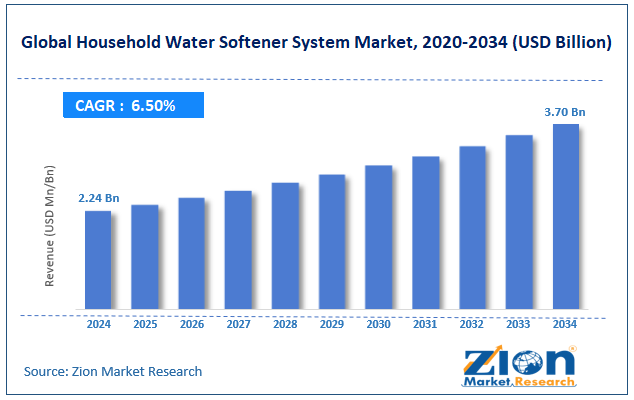
The global household water softener system market size was around USD 2.24 billion in 2024 and is projected to reach USD 3.70 billion by 2034, with a compound annual growth rate (CAGR) of roughly 6.50% between 2025 and 2034.
This report provides an in-depth analysis of the drivers, market restraints, and demand-side factors governing the global household water softener system industry, uncovering critical emerging opportunities for stakeholders during the forecast period.
Key Insights:
- As per the analysis shared by our research analyst, the global household water softener system market is estimated to grow annually at a CAGR of around 6.50% over the forecast period (2025-2034)
- In terms of revenue, the global household water softener system market size was valued at around USD 2.24 billion in 2024 and is projected to reach USD 3.70 billion by 2034.
- The household water softener system market is projected to grow significantly owing to increasing urbanization in China and India, demand for longer-lasting appliances such as heaters and washing machines, and technological advancements in water softener systems.
- Based on product type, the salt-based water softeners segment is expected to lead the market, while the salt-free water softeners segment is expected to grow considerably.
- Based on application, the ion exchange segment is the largest, while the reverse osmosis segment is projected to record sizeable revenue over the forecast period.
- Based on distribution channel, the offline retailers segment is expected to lead the market, followed by the direct sales segment.
- By region, North America is projected to dominate the global market during the forecast period, followed by Europe.
Household Water Softener System Market: Overview
A household water softener system removes hardness-causing minerals like magnesium and calcium, usually through ion exchange, preventing scale buildup in pipes and appliances, enhancing soap efficiency, improving water quality, and extending plumbing lifespan, with common types including salt-free, salt-based, and magnetic systems that differ in maintenance, effectiveness, and cost. The global household water softener system market is poised to expand rapidly, driven by rising cases of hard water worldwide, rising awareness of appliance protection, and increasing hygiene and health consciousness. The growing reliance on mineral-rich and groundwater sources has made hard water a common issue worldwide. This results in scaling pipes and reduced efficacy of household appliances. Hence, the demand for water softening systems is growing increasingly.
Moreover, consumers are becoming more aware of the damage caused by limescale buildup in appliances like washing machines and heaters. Water softeners help extend appliance lifespan and enhance performance. This awareness is a major driver of market adoption. Furthermore, hard water can cause skin dryness, irritation, and hair damage, increasing concerns among households. Softened water significantly enhances cleaning and bathing experiences. Rising health awareness is fueling demand for products.
Nevertheless, the global market faces limitations due to ongoing maintenance and operational costs, as well as environmental concerns about salt discharge. Regular maintenance, including salt refills and servicing, increases long-term expenses. These recurring costs may prevent users from continuing to use the service. Budget-conscious households may avoid these investments. Similarly, salt-based softeners discharge brine into wastewater, which can harm the environment. This has increased concerns among environmental groups and regulators. These issues limit adoption in some regions.
Still, the global household water softener system industry benefits from several favorable factors, including the development of eco-friendly solutions, integration with smart home ecosystems, and the growing demand for water-efficient solutions. Innovations in low-waste and salt-free systems are gaining popularity. These technologies address environmental concerns associated with traditional softeners. Sustainability trends are offering new avenues for growth. Smart water softeners with app-based controls are gaining traction. They offer real-time monitoring and efficient systems management. This trend backs growth in premium product segments. Additionally, water scarcity is driving demand to reduce water use. Efficient regeneration solutions are becoming a major selling point. This creates opportunities for differentiation and innovation.
Household Water Softener System Market: Dynamics
Growth Drivers
How are rising hard-water prevalence and water-quality concerns driving the household water-softener market?
Growing hardness levels in groundwater and municipal supplies are the key fueling factor for household water softeners. Hard water, containing magnesium and calcium, leads to scaling, skin irritation, and appliance damage, triggering adoption. Studies show that consumer awareness of the impacts of hard water has increased significantly, driving installations worldwide and fueling growth in the household water softener system market. The overall water softener industry is anticipated to grow from $3.58 billion in 2025 to over $6.23 billion by 2033. This rising awareness is especially strong in peri-urban and urban households relying on borewell water sources.
How are technological improvements and smart water softeners fueling the household water softener market?
Advancements in connected, smart, and salt-free softening solutions are accelerating industry adoption. Smart water softeners with IoT integration allow real-time monitoring, enhance efficiency, and enable predictive maintenance. The smart segment alone is anticipated to grow at a 13% CAGR through 2033, outpacing traditional systems. Improvements such as low-salt discharge solutions and dual tank systems also address environmental concerns. These advancements improve user convenience and reduce operating costs, appealing to modern houses.
Restraints
Competition from alternative water treatment solutions unfavorably affects the market progress
Consumers usually choose cost-effective treatment alternatives like RO systems, basic carbon filters, or salt-free conditioners. These substitutes address general water-safety concerns without the cost of a dedicated softener. Some point-of-use and whole-house filters claim to reduce hardness, reducing water softener demand. These overlaps dilute industry share for dedicated softening units. Hence, growth is hampered where alternatives are viewed as sufficient.
Opportunities
How do after‑sales services and subscription models create promising avenues for the growth of the household water softener industry?
Service contracts, maintenance packages, and resin replacement subscriptions can create recurring streams. Consumers are actively paying for ongoing service and convenience. Subscription models reduce the barrier to entry by reducing upfront costs. Brands can leverage this trend to build customer loyalty and long-term engagement. This household water softener system industry opportunity improves customer value in the ecosystem.
Challenges
Water hardness variability and complexity of solutions restrict market growth
Water chemistry varies significantly between regions, needing different softening approaches. Designing universally effective systems is technologically complex. Wrong sizing or system design leads to underperformance and customer dissatisfaction. This technical challenge needs service networks and localized expertise. Promising consistent performance across different conditions remains challenging.
Household Water Softener System Market: Segmentation
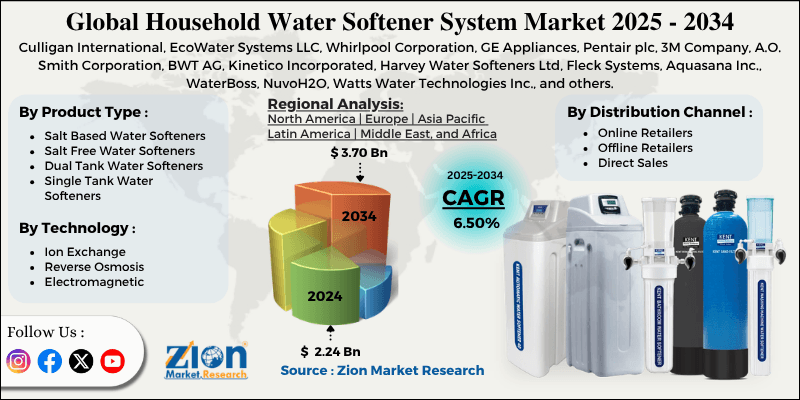
The global household water softener system market is segmented based on product type, technology, distribution channel, and region.
Why is the Salt-Based Water Softeners segment projected to dominate the household water softener system market?
Based on product type, the global household water softener system industry is divided into salt-based water softeners, salt-free water softeners, dual tank water softeners, and single tank water softeners. The salt-based water softeners segment captured nearly 75% of the total market. This is backed by their proven ion-exchange effectiveness in removing hardness minerals like magnesium and calcium, as well as by long-established consumer trust.
Nonetheless, the salt-free water softeners segment holds second place with 32% market share, gaining attention due to growing environmental and health awareness and regulatory pressures on salt discharge, making them a preferred alternative in eco-conscious regions.
What factors help the Ion Exchange segment lead the household water softener system market?
Based on technology, the global household water softener system market is segmented into ion exchange, reverse osmosis, and electromagnetic. The ion exchange segment accounted for a dominant 85% of the total market share due to its long-standing effectiveness in removing hardness from water and strong consumer trust in traditional softening performance.
Conversely, reverse osmosis technology ranked second, as it is increasingly adopted for combined softening and high-grade purification, particularly in regions facing growing health and water-quality issues.
What are the key reasons for the leadership of the Offline Retailers segment in the household water softener system market?
Based on distribution channel, the global market is segmented into online retailers, offline retailers, and direct sales. The offline retailers segment leads the market with 60% market share. This is supported by consumers' growing preference to visit physical stores, see units in person, and access expert consultation, installation, and after-sales support before buying.
However, the direct sales segment holds the second-largest market share at 35%, as specialized dealers and manufacturers offer personalized water testing, custom recommendations, and bundled maintenance services. These services attract high-end residential customers.
Household Water Softener System Market: Report Scope
| Report Attributes | Report Details |
|---|---|
| Report Name | Household Water Softener System Market |
| Market Size in 2024 | USD 2.24 Billion |
| Market Forecast in 2034 | USD 3.70 Billion |
| Growth Rate | CAGR of 6.50% |
| Number of Pages | 228 |
| Key Companies Covered | Culligan International, EcoWater Systems LLC, Whirlpool Corporation, GE Appliances, Pentair plc, 3M Company, A.O. Smith Corporation, BWT AG, Kinetico Incorporated, Harvey Water Softeners Ltd, Fleck Systems, Aquasana Inc., WaterBoss, NuvoH2O, Watts Water Technologies Inc., and others. |
| Segments Covered | By Product Type, By Technology, By Distribution Channel, and By Region |
| Regions Covered | North America, Europe, Asia Pacific (APAC), Latin America, Middle East, and Africa (MEA) |
| Base Year | 2024 |
| Historical Year | 2019 to 2023 |
| Forecast Year | 2025 - 2034 |
| Customization Scope | Avail customized purchase options to meet your exact research needs. Request For Customization |
Household Water Softener System Market: Regional Analysis
What gives North America a competitive edge in the global Household Water Softener System Market?
North America is projected to maintain its dominant position in the global household water softener system market, with a 7% CAGR, owing to high consumer awareness and purchasing power, developed infrastructure, and regulatory support, as well as extensive retail and service networks. North American homeowners are well-aware of the benefits of softened water for cleaning, health, and appliance longevity. High disposable income allows investment in premium and advanced water softeners. This awareness fuels broader adoption in residential households.
A majority of homes already have water treatment systems, and regulations promote high-quality, safe water. This sophistication backs consistent demand for upgrades and replacements. A mature infrastructure makes industry penetration easier. Furthermore, broader online and offline retail channels, along with professional installation and maintenance services, streamline setup and maintenance. Consumers can easily access guidance and support, thereby strengthening adoption rates.
Why does Europe rank second in the global Household Water Softener System Market?
Europe maintains its position as the second-largest region, with a 6.5% CAGR in the global household water softener system industry, driven by high hard-water incidence rates, stringent water quality regulations and standards, and rising health and environmental awareness. Several parts of Europe, particularly Southern and Western Europe, naturally have high water hardness. This creates consumer demand for softening systems to protect plumbing and enhance water quality. Broader hardness issues make softeners a common household investment.
Moreover, European norms focus on environmental protection and clean water, encouraging the adoption of treatment solutions. These standards push consumers and builders to install effective softening systems. Compliance with water quality norms backs steady industry growth. Additionally, European consumers are largely concerned about sustainability and personal health. This fuels a preference for low-salt alternatives, softeners, or eco-friendly solutions. Awareness of the impact of water quality on health encourages adoption.
Household Water Softener System Market: Competitive Analysis
The leading players in the global household water softener system market are:
- Culligan International
- EcoWater Systems LLC
- Whirlpool Corporation
- GE Appliances
- Pentair plc
- 3M Company
- A.O. Smith Corporation
- BWT AG
- Kinetico Incorporated
- Harvey Water Softeners Ltd
- Fleck Systems
- Aquasana Inc.
- WaterBoss
- NuvoH2O
- Watts Water Technologies Inc.
What are the key trends in the global Household Water Softener System Market?
Shift toward eco‑friendly and salt‑free solutions:
Environmental awareness is driving demand for low-waste, salt-free softener technologies that reduce brine discharge. Consumers increasingly prefer systems with the least ecological impact and sustainable adoption. This trend is transforming product development toward greener alternatives.
Customization and compact product innovation:
Manufacturers are launching space-efficient and compact units suitable for urban apartments and houses with limited space. Customizable systems tailored to specific water hardness levels are becoming common. Product innovation now focuses on easy installation, flexible design, and usability.
The global household water softener system market is segmented as follows:
By Product Type
- Salt Based Water Softeners
- Salt Free Water Softeners
- Dual Tank Water Softeners
- Single Tank Water Softeners
By Technology
- Ion Exchange
- Reverse Osmosis
- Electromagnetic
By Distribution Channel
- Online Retailers
- Offline Retailers
- Direct Sales
By Region
- North America
- The U.S.
- Canada
- Mexico
- Europe
- France
- The UK
- Spain
- Germany
- Italy
- Rest of Europe
- Asia Pacific
- China
- Japan
- India
- Australia
- South Korea
- Rest of Asia Pacific
- The Middle East & Africa
- Saudi Arabia
- UAE
- Egypt
- Kuwait
- South Africa
- Rest of the Middle East & Africa
- Latin America
- Brazil
- Argentina
- Rest of Latin America
Table Of Content
Methodology
FrequentlyAsked Questions
A household water softener system removes hardness-causing minerals like magnesium and calcium, usually through ion exchange, preventing scale buildup in pipes and appliances, enhancing soap efficiency, improving water quality, and extending plumbing lifespan, with common types including salt-free, salt-based, and magnetic systems that differ in maintenance, effectiveness, and cost.
The global household water softener system market is projected to grow due to rising awareness of the effects of hard water, growth in the residential construction sector, and the expansion of the global middle-class population.
According to a study, the global household water softener system market size was around USD 2.24 billion in 2024 and is expected to grow to around USD 3.70 billion by 2034.
The CAGR value of the household water softener system market is expected to be around 6.50% during 2025-2034.
Market trends and consumer preferences are evolving toward smart, eco-friendly, compact, and customizable water softener systems with convenient digital purchasing options.
North America is expected to lead the global household water softener system market during the forecast period.
The United States is a significant contributor due to strong consumer awareness, high prevalence of hard water, and broader adoption of advanced water-softening systems.
The key players profiled in the global household water softener system market include Culligan International, EcoWater Systems LLC, Whirlpool Corporation, GE Appliances, Pentair plc, 3M Company, A.O. Smith Corporation, BWT AG, Kinetico Incorporated, Harvey Water Softeners Ltd, Fleck Systems, Aquasana Inc., WaterBoss, NuvoH2O, and Watts Water Technologies, Inc.
Stakeholders should focus on smart and connected systems, eco-friendly innovations, strong distribution networks, product customization, and digital marketing to stay competitive.
The report examines key aspects of the household water softener system market, including a detailed analysis of current growth factors and restraints, as well as future growth opportunities and challenges that will affect the market.

HappyClients

