
Gas Spring Market Size, Share, Growth, Opportunities 2034

Gas Spring Market By Type (Lift Gas Spring, Lockable Gas Spring, Swivel Chair Gas Spring, Gas Traction Spring, Gas Spring Damper, and Others), By Mounting Orientation (Horizontal Gas Springs, Vertical Gas Springs), By Application (Automotive, Aerospace, Marine, and Rail, Home & Office Equipment, Industrial Machinery & Automation, Healthcare, and Others), By Sales Channel (OEM, Aftermarket), and By Region - Global and Regional Industry Overview, Market Intelligence, Comprehensive Analysis, Historical Data, and Forecasts 2025 - 2034
| Market Size in 2024 | Market Forecast in 2034 | CAGR (in %) | Base Year |
|---|---|---|---|
| USD 3.96 Billion | USD 6.36 Billion | 6.10% | 2024 |
Gas Spring Industry Perspective:
What will be the size of the global gas spring market during the forecast period?
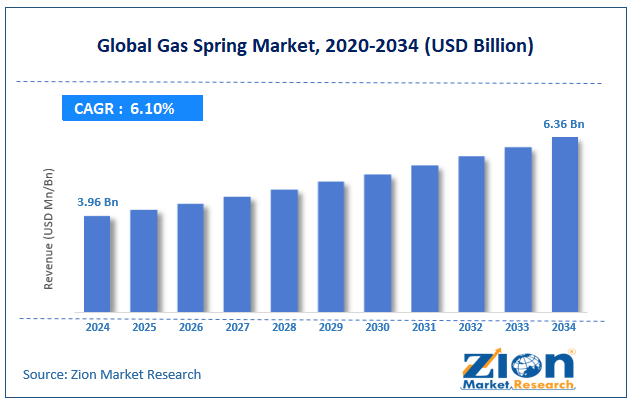
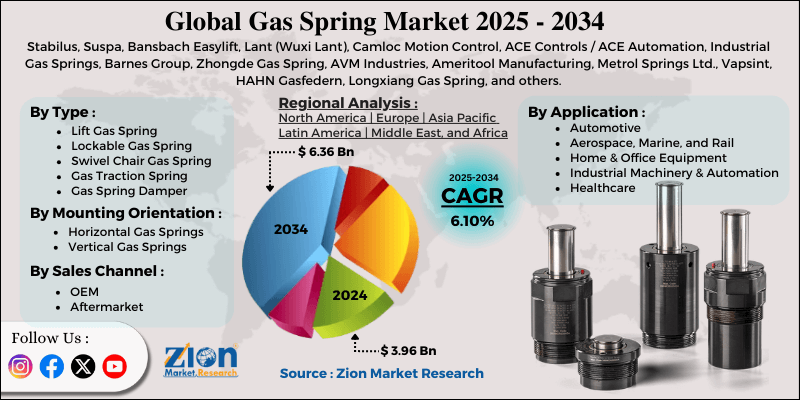
The global gas spring market size was around USD 3.96 billion in 2024 and is projected to reach USD 6.36 billion by 2034, with a compound annual growth rate (CAGR) of roughly 6.10% between 2025 and 2034.
Key Insights:
- As per the analysis shared by our research analyst, the global gas spring market is estimated to grow annually at a CAGR of around 6.10% over the forecast period (2025-2034)
- In terms of revenue, the global gas spring market size was valued at around USD 3.96 billion in 2024 and is projected to reach USD 6.36 billion by 2034.
- The gas spring market is projected to grow significantly owing to growth in the furniture industry, increased adoption of medical equipment, and adoption of construction machinery.
- Based on type, the lift gas spring segment is expected to lead the market, while the lockable gas spring segment is expected to grow considerably.
- Based on mounting orientation, the horizontal gas springs segment is the dominating segment, while the vertical gas springs segment is projected to witness sizeable revenue over the forecast period.
- Based on application, the automotive segment leads the market, while the industrial machinery & automation segment is anticipated to make significant gains in the near future.
- Based on sales channel, the OEM segment is expected to lead the market, followed by the aftermarket segment.
- Based on region, the Asia Pacific is projected to dominate the global market during the estimated period, followed by Europe.
Gas Spring Market: Overview
A gas spring is a mechanical device that uses compressed inert gas, often nitrogen, sealed inside a cylinder to exert a controlled force through a sliding piston. It provides counterbalancing, smooth lifting, or damping motion in applications such as office chairs, automotive hoods, and industrial machinery. The global gas spring market is projected to witness substantial growth, driven by the automotive industry, ergonomics and workplace safety trends, and the expansion of industrial automation. Rising vehicle production and demand for comfort features like hatch supports and trunk lifts drive the adoption of gas springs. Improved passenger car sales in the developing countries further expand the requirement—this fuels volume and advancement in the aftermarket and OEM segments.
Moreover, the growing focus on ergonomic designs in office furniture and industrial equipment is driving increased use of gas springs. Adjustable chairs, lift tables, and sit-stand desks leverage gas springs for smooth motion control. Enhanced workplace safety standards further promote their integration. Furthermore, smart manufacturing and automation need reliable motion control parts. Gas springs are used in machinery guards, conveyor systems, and access panels—their consistent durability and force support high-cycle industrial applications.
Although drivers exist, the global market is challenged by factors like complex design requirements and temperature sensitivity. Custom force requirements and dimensional constraints increase engineering complexity. Tailored gas spring solutions demand longer design cycles and higher development costs. Small manufacturers may find it challenging to meet niche specifications. Likewise, extreme temperatures affect gas spring performance and pressure. High heat may degrade seals; cold chain may reduce responsiveness. This lowers the use in extreme environments without specialized designs.
Even so, the global gas spring industry is well-positioned due to the expansion of electric and hybrid vehicles and the adoption of smart, connected components. Hybrid vehicles and EVs feature increased use of gas springs for hood-assist systems and liftgates. Efficient and lightweight components support EV design goals. This offers large growth potential within green mobility segments. Additionally, integrating sensors for predictive maintenance enhances the value of gas springs. Smart gas springs may communicate cycle life and force trends. This supports Industry 4.0 and IoT adoption in manufacturing.
Gas Spring Market: Dynamics
Growth Drivers
How is the gas spring market driven by the growth of ergonomic furniture and office equipment?
Comfort and ergonomics are transforming consumer preferences, with more than 51% of the worldwide adjustable furniture and chairs now using gas springs. Post-pandemic shifts towards remote work have augmented demand for adjustable desks, multifunctional home furniture, and ergonomic seating. Gas springs provide smooth height adjustment, safer motion, and durable support, making them crucial for modern office setups. The furniture segment’s rising share reflects broader lifestyle trends that prioritize comfort and health in both commercial and residential spaces. This propeller in the gas spring market continues to expand as ergonomic design becomes standard.
How are technological advancements and smart integration driving the growth of the gas spring market?
Innovation is transforming gas springs by developing sensor-integrated, smart models that communicate pressure or position data for predictive maintenance and automated control. Over 2 million sensor-enabled gas springs have been integrated into high-end industrial and automotive applications in recent years. New materials technologies, such as corrosion-resistant coatings, composite structures, and lightweight alloys, enhance lifecycle and performance, attracting high-precision domains like robotics and aerospace. This propeller supports not only functional growth but also technological differentiation among manufacturers.
Restraints
Performance limitations in extreme conditions adversely impact the market progress
Standard gas springs can lose performance under extreme pressure or temperatures, with reliability dropping by nearly 20% in harsh environments. This limits their use in aerospace, heavy-duty industrial, or outdoor applications where extreme conditions are common. While specialty models exist, they welcome higher costs, thus discouraging adoption. Performance concerns act as a constraint in expanding to all industrial domains.
Opportunities
How do smart and IoT‑enabled gas springs offer advantageous for the growth of the gas spring market?
The integration of IoT connectivity, sensors, and predictive maintenance capabilities with gas springs is creating entirely new product categories. Sensor-enabled variants are gaining attention in medical equipment and industrial automation, helping customers monitor use cycles and performance in real-time. This allows predictive servicing and lowers downtime, creating a value-added service revenue stream. Smart springs strengthen industry differentiation and create new B2B opportunities in the gas spring industry.
Challenges
Supply chain disruptions and logistics restrict the market growth
Global supply chain disruptions, including delays in sourcing piston rods, nitrogen cylinders, and seals, are impacting gas spring production schedules. Fluctuating shipping costs and bottlenecks raise expenses and delivery uncertainty. Small manufacturers with limited supplier networks are particularly vulnerable, affecting customer trust and responsiveness.
Gas Spring Market: Report Scope
| Report Attributes | Report Details |
|---|---|
| Report Name | Gas Spring Market |
| Market Size in 2024 | USD 3.96 Billion |
| Market Forecast in 2034 | USD 6.36 Bllion |
| Growth Rate | CAGR of 6.10% |
| Number of Pages | 222 |
| Key Companies Covered | Stabilus, Suspa, Bansbach Easylift, Lant (Wuxi Lant), Camloc Motion Control, ACE Controls / ACE Automation, Industrial Gas Springs, Barnes Group, Zhongde Gas Spring, AVM Industries, Ameritool Manufacturing, Metrol Springs Ltd., Vapsint, HAHN Gasfedern, Longxiang Gas Spring, and others. |
| Segments Covered | By Type, By Mounting Orientation, By Application, By Sales Channel, and By Region |
| Regions Covered | North America, Europe, Asia Pacific (APAC), Latin America, Middle East, and Africa (MEA) |
| Base Year | 2024 |
| Historical Year | 2019 to 2023 |
| Forecast Year | 2025 - 2034 |
| Customization Scope | Avail customized purchase options to meet your exact research needs. Request For Customization |
Gas Spring Market: Segmentation
The global gas spring market is segmented based on type, mounting orientation, application, sales channel, and region.
Why is the Lift Gas Spring segment projected to dominate the gas spring market?
Based on type, the global gas spring industry is divided into lift gas springs, lockable gas springs, swivel chair gas springs, gas traction springs, gas spring dampers, and others. The lift gas spring segment enjoys a leading position with 45% of the total market. This dominance is backed by broad use in automotive closures such as tailgates and hoods, industrial access panels, and furniture, due to their efficient, controlled lift and balance capacities.
Conversely, the lockable gas spring segment ranks second with 28% of the total market. This is backed by surging demand in precision applications such as medical beds, adjustable furniture, and equipment that require secure multi-position locking, where precise safety and positioning are essential.
Which key reasons that help the Horizontal Gas Springs segment dominate in the gas spring market?
Based on mounting orientation, the global market is segmented into horizontal gas springs and vertical gas springs. The horizontal gas springs segment captures 65% of the overall market. They are largely used in trunks, automotive hoods, and industrial equipment for stable lateral motion control.
Nonetheless, the vertical gas springs segment holds the second-largest market share at 40%. They are commonly used in cabinets, adjustable furniture, and medical equipment for smooth upward and downward movement.
What factors help the Automotive segment lead the gas spring market?
Based on application, the global gas spring market is segmented into automotive, aerospace, marine, and rail, home & office equipment, industrial machinery & automation, healthcare, and others. The automotive segment dominates the market with 44% market share. In the automotive industry, gas springs are primarily used for seat adjustments, trunk lids, and hood lids.
Nevertheless, the industrial machinery & automation segment ranks second with 30% market share, driven by its use in automated systems and factory equipment that require controlled motion.
What are the key reasons for the leadership of the OEM segment in the gas spring market?
Based on sales channel, the global market is segmented into OEM and aftermarket. The OEM segment accounts for 70% of the market share. OEM demand is backed by the integration of gas springs into industrial systems, new vehicles, and furniture products, where custom engineering, quality, and long-term contracts are crucial.
However, the aftermarket segment ranks second with 40% market share, driven by demand for maintenance, replacement, and upgrades in industrial automotive and furniture applications. The growth of the aftermarket is aided by the growing installed base of equipment and vehicles, expanded e-commerce access, and consumer focus on cost-effective parts.
Gas Spring Market: Regional Analysis
What enables Asia Pacific's strong foothold in the global Gas Spring Market?
Asia Pacific is likely to sustain its leadership in the Gas Spring market, with a 7.5% CAGR, driven by speedy automotive production, growing manufacturing and industrial base, and affordable manufacturing and labor costs. APAC houses leading automotive manufacturing centers that produce a massive volume of passenger cars, commercial vehicles, and EVs. Gas springs are broadly used in seats, hoods, and tailgates, fueling strong regional demand. High vehicle production volume makes the region a leading market contributor.
Moreover, the growth of industrial automation, robotics, and machinery in economies such as India, China, and Japan is driving the use of gas springs in equipment covers, safety enclosures, and hatches. Growing investments in modern assembly lines and smart factories increase component demand. Furthermore, low production costs in APAC allow local manufacturers to produce gas springs competitively for export and domestic markets. This cost-benefit motivates large-scale production and appeals to OWM partnerships.
Why does Europe rank second in the global Gas Spring Market?
Europe continues to hold the second-highest share, with a 7.3% CAGR in the gas spring industry, driven by advanced automotive technology, strong industrial automation adoption, and a focus on reliability and quality. Europe is home to leading automotive manufacturers producing electric, luxury, and premium vehicles. Gas springs are extensively used in tailgates, seating systems, and hoods, driving regional demand. High-end vehicle production backs innovation-based growth. European industries are steadily implementing robotics and automation in manufacturing, requiring gas springs for machinery covers, precision equipment, and hatches. Demand is backed by smart factory integration, efficiency, and safety.
Additionally, European OEMs prioritize durable, high-performance components, including gas springs. Quality and strict standards drive manufacturers to adopt lifelong and advanced solutions.
Gas Spring Market: Competitive Analysis
The leading players in the global gas spring market are:
- Stabilus
- Suspa
- Bansbach Easylift
- Lant (Wuxi Lant)
- Camloc Motion Control
- ACE Controls / ACE Automation
- Industrial Gas Springs
- Barnes Group
- Zhongde Gas Spring
- AVM Industries
- Ameritool Manufacturing
- Metrol Springs Ltd.
- Vapsint
- HAHN Gasfedern
- Longxiang Gas Spring
What are the key trends in the global Gas Spring Market?
Smart and sensor-enabled gas springs:
Sensor and IoT integration allow real-time monitoring of force, wear, and position for predictive maintenance. Industries like robotics, automotive, and medical equipment are adopting these smart solutions. This trend enhances operational efficiency and reliability.
Lightweight and eco-friendly materials:
Manufacturers are increasingly adopting composites, corrosion-resistant alloys, and aluminum to reduce environmental impact and weight. Lighter gas springs enhance fuel efficiency in vehicles and energy efficiency in industrial applications—sustainability fuels production advancement.
The global gas spring market is segmented as follows:
By Type
- Lift Gas Spring
- Lockable Gas Spring
- Swivel Chair Gas Spring
- Gas Traction Spring
- Gas Spring Damper
- Others
By Mounting Orientation
- Horizontal Gas Springs
- Vertical Gas Springs
By Application
- Automotive
- Aerospace, Marine, and Rail
- Home & Office Equipment
- Industrial Machinery & Automation
- Healthcare
- Others
By Sales Channel
- OEM
- Aftermarket
By Region
- North America
- The U.S.
- Canada
- Europe
- France
- The UK
- Spain
- Germany
- Italy
- Rest of Europe
- Asia Pacific
- China
- Japan
- India
- South Korea
- Southeast Asia
- Rest of Asia Pacific
- Latin America
- Brazil
- Mexico
- Rest of Latin America
- Middle East & Africa
- GCC
- South Africa
- Rest of Middle East & Africa
Table Of Content
Methodology
FrequentlyAsked Questions

HappyClients

