
Gas Insulated Switchgear Market Size, Growth, Global Trends, Forecast 2034

Gas Insulated Switchgear Market By Technology (Hybrid Switchgear, Integrated Three Phase, Compact Gas Insulated Switchgear), By Voltage (High, Medium, Low), By Application (Transmission & Distribution, Manufacturing & Processing, Infrastructure & Transportation, Power Generation, and Others), and By Region - Global and Regional Industry Overview, Market Intelligence, Comprehensive Analysis, Historical Data, and Forecasts 2025 - 2034
| Market Size in 2024 | Market Forecast in 2034 | CAGR (in %) | Base Year |
|---|---|---|---|
| USD 25.02 Billion | USD 35.04 Billion | 4.30% | 2024 |
Gas Insulated Switchgear Industry Perspective:
What will be the size of the global gas insulated switchgear market during the forecast period?
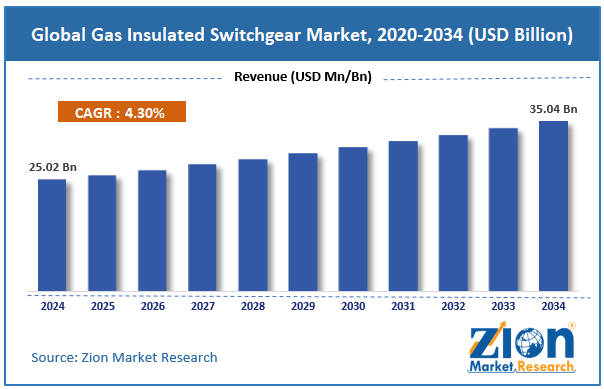
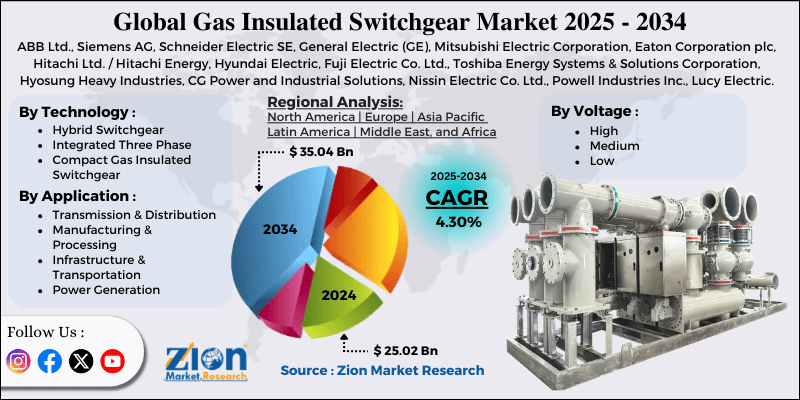
The global gas insulated switchgear market size was around USD 25.02 billion in 2024 and is projected to reach USD 35.04 billion by 2034, with a compound annual growth rate (CAGR) of roughly 4.30% between 2025 and 2034.
Gas Insulated Switchgear Market: Overview
Gas-insulated switchgear is a high-voltage, compact electrical substation technology that uses sulfur hexafluoride (SF₆) gas to insulate and quench arcs within switchgear equipment, enabling safe operation in confined spaces. It offers minimal maintenance, high reliability, and a lower environmental footprint than conventional air-insulated switchgear, making it suitable for industrial and urban applications. The global gas insulated switchgear market is likely to expand rapidly, driven by growing urbanization and power demand, space-saving design, and grid modernization initiatives. Speedy urbanization increases electricity consumption in commercial and residential sectors. GIS offers reliable and compact solutions ideal for high-density urban areas. Its ability to handle high voltages safely meets the surging energy needs. Subsequently, urban growth directly drives GIS adoption worldwide.
Moreover, GIS occupies remarkably less space than conventional air-insulated switchgear. This compact footprint enables installation in underground, constrained substations, or rooftop. Urban utilities and planners prefer GIS where land is scarce. Space efficiency is a major propeller in densely populated regions. Furthermore, utilities are upgrading aging infrastructure to enhance efficiency and reliability. GIS offers superior performance, digital integration, and reduced maintenance. Modernization projects usually prioritize advanced and compact technologies. This policy-based push elevates GID deployment globally.
Nevertheless, the global market faces limitations due to factors such as high initial cost and complex installation. GIS systems need higher upfront investment than traditional air-insulated switchgear. Initial procurement and installation expenses may strain utility budgets. Developing regions and smaller utilities may delay adoption. Hence, high capital cost sustains intricacies, hampering market growth. Similarly, GIS needs expert engineers and specialized equipment for installation. The complexity raises project schedules and costs. Emerging or remote markets may lack skilled professionals. Installation challenges may hamper time-sensitive or smaller projects.
Still, the global gas insulated switchgear industry benefits from several favorable factors, such as digital grid installations and microgrid applications. Integration of remote monitoring, IoT, and predictive analytics improves grid efficiency. Smart GIS systems offer real-time insights and predictive maintenance capabilities. Utilities adopting digital grids benefit from reduced downtime and operational costs. Digitalization offers recurring service and software revenue streams. Microgrids and distributed energy systems demand high-performance and compact switchgear. GIS is suitable for resilient, small-scale, and space-constrained networks. The growth of decentralized energy systems is driving GIS adoption. Microgrid projects offer a promising new market domain.
Key Insights:
- As per the analysis shared by our research analyst, the global gas insulated switchgear market is estimated to grow annually at a CAGR of around 4.30% over the forecast period (2025-2034)
- In terms of revenue, the global gas insulated switchgear market was valued at around USD 25.02 billion in 2024 and is projected to reach USD 35.04 billion by 2034.
- The gas insulated switchgear market is projected to grow significantly, driven by the integration of renewable energy sources into power grids, rising global electricity demand, and government initiatives and regulatory support for efficient power systems.
- Based on technology, the freestanding racks segment is expected to lead the market, while the double-sided racks segment is expected to grow considerably.
- Based on voltage, the metal segment is the dominating segment, while the plastic segment is projected to witness sizeable revenue over the forecast period.
- Based on application, the retail segment is expected to lead the market, followed by the food & beverages segment.
- By region, Asia Pacific is projected to dominate the global market during the forecast period, followed by North America.
Gas Insulated Switchgear Market: Dynamics
Growth Drivers
How are rising electricity demand and industrial expansion driving growth in the gas insulated switchgear market?
Worldwide electricity consumption is surging due to industrial electrification, population growth, and emerging digital economies. As demand increases, the need for reliable, efficient transmission and distribution systems grows, with GIS preferred in heavy industries, utility networks, and transportation electrification projects. The GIS market size in 2024 was estimated at USD 25-26 billion, with estimates that it will reach USD 40-60 billion by early-to-mid 2030s. These investments signify prioritization of electrical infrastructure to support industry, data centers, rail systems, and EV charging. Sustained demand growth highlights long-term GIS adoption.
How do technological advancements and digitalization drive the gas insulated switchgear market?
Advancements such as predictive maintenance tools, IoT-enabled condition monitoring, and modular designs are improving GIs' capabilities. Nearly half of novel GIS installations globally are incorporating digital monitoring technologies to enhance reliability and lower operational costs. Manufacturers are also launching eco-friendly designs with alternative insulation gases to address environmental concerns. These improvements attract utilities seeking safer and smarter grid assets and support integration with advanced distribution management systems. Technological progress strengthens the competitiveness and appeal of the gas insulated switchgear market.
Restraints
Standardization and compatibility issues negatively impact the market progress
Different economies have varied grid codes, safety standards, and voltage ratings, making GIS design less universal. Cross-border projects often require customization to meet local specifications, which increases engineering costs. Lack of standardization may delay procurement and commissioning and challenge maintenance operations. Utilities may deter investing in GIS if compatibility with current equipment or future upgrades is not certain. These technical and regulatory mismatches restrain worldwide scalability.
Opportunities
How are alternative insulation technologies creating promising avenues for the growth of the gas insulated switchgear industry?
Environmentally friendly substitutes for SF6, such as hybrid gas-solid insulation or low-global-warming-potential gases, are being developed. Adoption of these positions by manufacturers to capture environmentally conscious customers and meet tightening regulatory limits. Early adopters of low-GWP GIS can benefit from government incentives and green financing. Improvements in insulation also enhance reliability and reduce operational risk. This technological evolution presents a strategic opportunity for differentiation in the gas insulated switchgear industry.
Challenges
Long project cycle times limit the market growth
GIS projects comprise detailed planning, customization, regulatory approvals, and installations, resulting in long lead times. Delays in procurement or permitting can push back project timelines by years or months. This affects cash flow for manufacturers and utilities alike. Large-scale interconnection projects for renewable energy experience compounded schedules due to multiple stakeholders. Extended cycles complicate efficacy and need careful project management.
Gas Insulated Switchgear Market: Report Scope
| Report Attributes | Report Details |
|---|---|
| Report Name | Gas Insulated Switchgear Market |
| Market Size in 2024 | USD 25.02 Billion |
| Market Forecast in 2034 | USD 35.04 Bllion |
| Growth Rate | CAGR of 4.30% |
| Number of Pages | 215 |
| Key Companies Covered | ABB Ltd., Siemens AG, Schneider Electric SE, General Electric (GE), Mitsubishi Electric Corporation, Eaton Corporation plc, Hitachi Ltd. / Hitachi Energy, Hyundai Electric, Fuji Electric Co. Ltd., Toshiba Energy Systems & Solutions Corporation, Hyosung Heavy Industries, CG Power and Industrial Solutions, Nissin Electric Co. Ltd., Powell Industries Inc., Lucy Electric, and others. |
| Segments Covered | By Technology, By Voltage, By Application, and By Region |
| Regions Covered | North America, Europe, Asia Pacific (APAC), Latin America, Middle East, and Africa (MEA) |
| Base Year | 2024 |
| Historical Year | 2019 to 2023 |
| Forecast Year | 2025 - 2034 |
| Customization Scope | Avail customized purchase options to meet your exact research needs. Request For Customization |
Gas Insulated Switchgear Market: Segmentation
The global gas insulated switchgear market is segmented by technology, voltage, application, and region.
Why is the Hybrid Switchgear segment projected to dominate the gas insulated switchgear market?
Based on technology, the global gas insulated switchgear industry is divided into hybrid switchgear, integrated three phase, and compact gas insulated switchgear. The hybrid switchgear segment dominates the market, accounting for 47% of the market share. It combines gas-insulated and traditional components for reliable performance and flexibility. It accounts for nearly 47% of the technology market, favored for its adaptability and compact design in utility and urban networks. Hybrid GIS is broadly used where space constraints and varied grid conditions exist.
Conversely, the integrated three phase segment holds a second-leading position with 49% of the total market. It offers complete systems for low- and medium-voltage applications. It captures nearly 49% of low-voltage GIS installations, which are widely used in industrial and urban infrastructure setups. This segment is largely preferred for simplified installation and balanced operational performance.
What factors help the High segment lead the gas insulated switchgear market?
Based on voltage, the global gas insulated switchgear market is segmented into high, medium, and low. The high-voltage segment leads the market with approximately 60% share. It is broadly used in substations, bulk power transmissions, and grid interconnections. It usually registers the fastest-growing share, signifying major utility and transmission investments globally. High-voltage GIS is crucial for efficient long-distance power transfer and renewable energy integration.
However, the medium-voltage segment leaders are after high-voltage with roughly 37% of the market share. It serves industrial complexes, space-constrained substations, and urban distribution networks. Their market share is supported by a balance of compact design and reliable distribution performance. Medium-voltage GIS stands tall amid growing grid modernization needs and surging urbanization.
What are the key reasons for the leadership of the Transmission & Distribution segment in the gas insulated switchgear market?
Based on application, the global market is segmented into transmission & distribution, manufacturing & processing, infrastructure & transportation, power generation, and others. The transmission & distribution segment captures a leading 48% of the total market. This share reflects broad adoption in high-voltage utility networks. GIS is preferred for its reliable performance and compact design in modern transmission and distribution systems.
Nevertheless, the manufacturing and processing segment ranks second with 25% of the total market share. It serves refineries, factories, and industrial plants needing stable power. Its market share is fueled by industrial automation and electrification. GIS is chosen for reliability and space-efficient distribution in demanding industrial environments.
Gas Insulated Switchgear Market: Regional Analysis
What gives Asia Pacific a competitive edge in the global Gas Insulated Switchgear Market?
Asia Pacific is projected to maintain its dominant position in the global gas insulated switchgear market, with an over 8% CAGR, owing to rapid industrialization and urbanization, government initiatives, infrastructure investment, and the expansion of power transmission and distribution networks. Asia Pacific is witnessing fast urban growth and the expansion of industrial hubs. This increases demand for compact, reliable electrical distribution solutions. GIS adoption increases to meet high electricity consumption in industrial and urban areas.
Moreover, regional governments are heavily investing in smart cities, grid modernization, and the integration of renewable energy. Supportive policies and subsidies augment GIS deployment. Public infrastructure projects fuel large-scale adoption in more economies. Furthermore, expanding populations and industrialization create a high demand for distribution and transmission networks. GIS provides space-efficient solutions for high-voltage substations. This increases its preference for utilities handling surging energy loads.
What factors make North America rank second in the global Gas Insulated Switchgear Market?
North America maintains its position as the second-largest region, with a 6-7% CAGR in the global gas insulated switchgear industry, driven by advanced power transmission infrastructure, grid modernization and smart grid initiatives, and industrial electrification and infrastructure growth. North America has a well-developed, high-capacity power grid that requires reliable operation. GIS supports efficient transmission in remote and urban areas. Upgrading existing infrastructure fuels steady industry demand.
Utilities are actively investing in digital substations, smart grids, and automated monitoring. GIS integrates smoothly with predictive maintenance and IoT technologies. Modernization policies promote the adoption of high-performance, compact switchgear. Additionally, data centers, manufacturing, and critical infrastructure expansions raise high- and medium-voltage requirements. GIS offers compact, safe, and efficient solutions. Industrial growth supports consistent GIS demand in sectors.
Gas Insulated Switchgear Market: Competitive Analysis
The leading players in the global gas insulated switchgear market are:
- ABB Ltd.
- Siemens AG
- Schneider Electric SE
- General Electric (GE)
- Mitsubishi Electric Corporation
- Eaton Corporation plc
- Hitachi Ltd. / Hitachi Energy
- Hyundai Electric
- Fuji Electric Co. Ltd.
- Toshiba Energy Systems & Solutions Corporation
- Hyosung Heavy Industries
- CG Power and Industrial Solutions
- Nissin Electric Co. Ltd.
- Powell Industries Inc.
- Lucy Electric
What are the key trends in the global Gas Insulated Switchgear Market?
Smart grid and digital integration:
GIS is increasingly integrated with remote monitoring, predictive maintenance tools, and IoT sensors. Digital GIS improves operational efficiency and lowers downtime. Utilities use these systems to enhance grid automation and fault diagnostics.
Growth of hybrid and modular designs:
Modular and hybrid solutions offer easier installations, flexibility, and a phased deployment option. Utilities prefer these designs for future scalability and cost-effectiveness. Modularization backs diverse voltage classes and changing grid requirements.
The global gas insulated switchgear market is segmented as follows:
By Technology
- Hybrid Switchgear
- Integrated Three Phase
- Compact Gas Insulated Switchgear
By Voltage
- High
- Medium
- Low
By Application
- Transmission & Distribution
- Manufacturing & Processing
- Infrastructure & Transportation
- Power Generation
- Others
By Region
- North America
- The U.S.
- Canada
- Europe
- France
- The UK
- Spain
- Germany
- Italy
- Rest of Europe
- Asia Pacific
- China
- Japan
- India
- South Korea
- Southeast Asia
- Rest of Asia Pacific
- Latin America
- Brazil
- Mexico
- Rest of Latin America
- Middle East & Africa
- GCC
- South Africa
- Rest of Middle East & Africa
Table Of Content
Methodology
FrequentlyAsked Questions

HappyClients

