
Global Fortified Salts Market Size, Share, Price, Growth Trends, Forecast, 2032

Fortified Salts Market - By Product (Iodine [By Application {Hospitality & Service, Food Processing, Household & Animal Feed}, By Distribution Channel {Hypermarket & Supermarket, Grocery Stores, Online Stores}], Iron[By Application {Hospitality & Service, Food Processing, Household & Animal Feed}, By Distribution Channel {Hypermarket & Supermarket, Grocery Stores, Online Stores}], Double Fortified Salts[By Application {Hospitality & Service, Food Processing, Household & Animal Feed}, By Distribution Channel {Hypermarket & Supermarket, Grocery Stores, Online Stores}]) - Global Industry Perspective, Comprehensive Analysis, and Forecast, 2024 - 2032
| Market Size in 2023 | Market Forecast in 2032 | CAGR (in %) | Base Year |
|---|---|---|---|
| USD 6.28 Billion | USD 13.26 Billion | 7.8% | 2023 |
What is Fortified Salts Market Size?
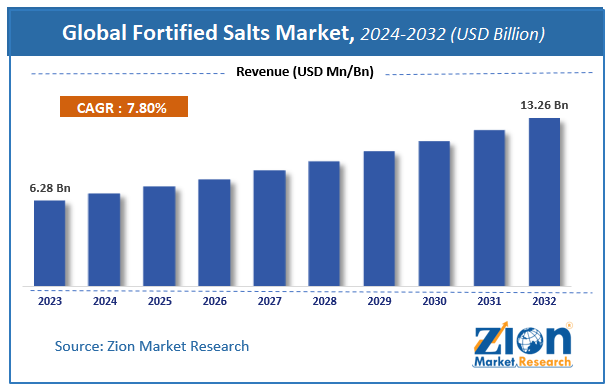
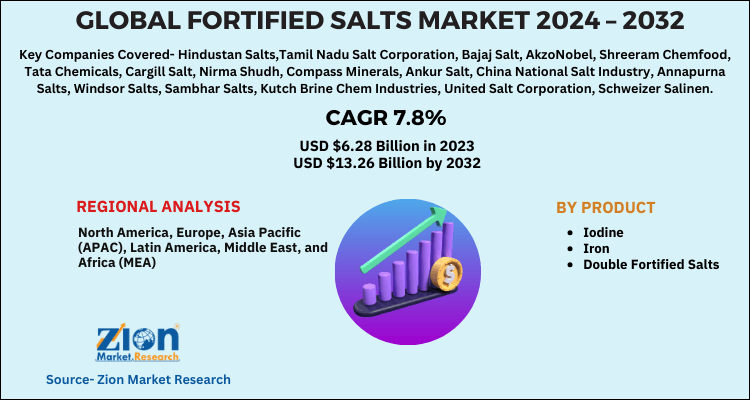
According to Zion Market Research, the global Fortified Salts Market was worth USD 6.28 Billion in 2023. The market is forecast to reach USD 13.26 Billion by 2032, growing at a compound annual growth rate (CAGR) of 7.8% during the forecast period 2024-2032. The report offers a comprehensive analysis of the market, highlighting the factors that will determine growth, potential challenges, and opportunities that could emerge in the Fortified Salts Market industry over the next decade.
Fortified Salts Market: Overview
Based on the clinical trials carried out by NIH researchers, fortified salts with iodine and iron has proved to be a cost-effective solution for low and middle income group population across the emerging economies. Reportedly, Positive effects of these fortified salts were found in women and school children. Moreover, the salts fortified with iron and iodine helped in reducing anemia risk and increased hemoglobin concentration in school children and pregnant women in the emerging economies.
Key Insights
- As per the analysis shared by our research analyst, the global fortified salts market is expected to grow at a CAGR of approximately 7.8% during the forecast period from 2024 to 2032.
- In terms of revenue, the global fortified salts market was valued at approximately USD 6.28 billion in 2023 and is projected to reach approximately USD 13.26 billion by 2032.
- The fortified salts market is primarily driven by increasing cases of micronutrient deficiencies, anemia, malnutrition, and iodine deficiency disorders, together with expanding government nutrition programs and growing consumer preference for nutritionally enhanced foods.
- Based on the product segment, iodine-fortified salt represents a highly established category owing to the widespread acceptance of salt iodization, extensive household consumption, regulatory support, and its role in preventing iodine deficiency disorders. The exact percentage share is not disclosed on the source report’s publicly accessible page.
- Double fortified salts represent an increasingly important product category because they combine iodine and iron fortification and can simultaneously address multiple micronutrient deficiencies, particularly in populations vulnerable to anemia and iodine deficiency.
- Based on the application segment, household and food-related consumption remains central to market demand because salt is consumed regularly and provides an effective vehicle for delivering micronutrients through routine diets. The source report does not publish an exact application-level percentage share.
- Based on the distribution channel segment, hypermarkets & supermarkets benefit from organized retail penetration, extensive shelf availability, packaged-food purchasing, and the ability of consumers to compare branded fortified products. The source report does not disclose the precise percentage contribution of this channel.
- Asia Pacific is expected to make notable contributions to global fortified salts market revenue throughout the forecast period due to the region’s large population base, growing demand for nutritious foods, substantial prevalence of anemia, and increasing need for iron-rich and high-quality foods. The source report identifies Asia Pacific as a major growth region but does not publish an exact regional percentage share on its public page.
Fortified Salts Market: Growth Dynamics
Massive consumer inclination towards nutritive food along with rising cases of malnutrition witnessed among the adults as well as children across the emerging economies will create lucrative growth avenues for fortified salts industry over the assessment timeline. Apart from this, surge in the cases of anemia as a result of iron deficiency is likely to drive the market growth trends. With large-scale sale of fortified salts owing to humungous need for preserving food is anticipated to favorably impact the intake of packaged & processed food, thereby steering the expansion of fortified salts industry over the assessment period.
Furthermore, rise in the occurrence of goiter in the under-developed nations of Africa and South Asia will create lucrative demand for fortified salts in the foreseeable future. In addition to this, exceptional nutrient features of the product assisting in combating gestational high blood pressure and neurological ailments will steer the expansion of fortified salts industry over the assessment period. Rise in the number of miscarriages as well as low mental growth witnessed in the children as a result of less intake of iron has resulted in induction of programs by the government in the emerging nations for promoting the consumption of fortified salts. Such positive moves will lucratively influence the expansion of fortified salts industry over the years ahead.
Fortified Salts Market: Report Scope
| Report Attributes | Report Details |
|---|---|
| Report Name | Fortified Salts Market |
| Market Size in 2023 | USD 6.28 Billion |
| Market Forecast in 2032 | USD 13.26 Billion |
| Growth Rate | CAGR of 7.8% |
| Number of Pages | 110 |
| Key Companies Covered | Hindustan Salts,Tamil Nadu Salt Corporation, Bajaj Salt, AkzoNobel, Shreeram Chemfood, Tata Chemicals, Cargill Salt, Nirma Shudh, Compass Minerals, Ankur Salt, China National Salt Industry, Annapurna Salts, Windsor Salts, Sambhar Salts, Kutch Brine Chem Industries, United Salt Corporation, Schweizer Salinen, Ahir Salt Industries, Saboo Sodium Chloro, Super Salts |
| Segments Covered | By Product, By Application and By Region |
| Regions Covered | North America, Europe, Asia Pacific (APAC), Latin America, Middle East, and Africa (MEA) |
| Base Year | 2023 |
| Historical Year | 2018 - 2023 |
| Forecast Year | 2024 - 2032 |
| Customization Scope | Avail customized purchase options to meet your exact research needs. Request For Customization |
Fortified Salts Market Segmentation
The fortified salts market is segmented by product, application, distribution channel, and region.
Based on Product Segment, the fortified salts market is divided into iodine, iron, and double fortified salts. Iodine-fortified salt is among the most established products because iodization has been adopted extensively as a practical measure for improving dietary iodine intake and preventing iodine deficiency disorders. Its availability across retail and institutional channels, broad consumer familiarity, relatively simple integration into routine diets, and government-backed iodization programs support sustained demand. Double fortified salts are strategically important because they combine iodine and iron, enabling a single product to address both iodine deficiency and iron-deficiency anemia. Their relevance is especially high in emerging economies where both deficiencies may coexist and where governments seek scalable nutrition interventions. Iron-fortified salt also plays an important role in addressing anemia, particularly among nutritionally vulnerable groups. Exact product-level market shares are not disclosed in the source report.
Based on Application Segment, the fortified salts market is divided into hospitality & service, food processing, and household & animal feed. Household consumption is structurally important because salt is a routinely purchased staple used in everyday cooking, allowing micronutrients to reach broad population groups consistently. Its repeat-purchase characteristics provide manufacturers with a stable consumer market while enabling public-health agencies to incorporate fortified products into nutrition programs. Food processing represents another major application opportunity as manufacturers of packaged foods, snacks, bakery items, prepared meals, and other products increasingly evaluate nutrient-enriched ingredients in response to consumer health awareness and nutritional labeling considerations. Hospitality & service establishments support market growth through restaurants, catering businesses, hotels, institutions, schools, and other high-volume food-preparation environments. Animal-feed applications additionally extend fortified salt use into livestock nutrition and agricultural supply chains.
Based on Distribution Channel Segment, the fortified salts market is divided into hypermarkets & supermarkets, grocery stores, and online stores. Hypermarkets & supermarkets provide substantial visibility for branded fortified salt because they offer organized shelves, multiple pack sizes, competing brands, product information, promotional activity, and convenient access for urban consumers. Grocery stores remain highly important, especially in emerging markets where neighborhood retail outlets represent the primary purchasing channel for frequently consumed staples. Their deep penetration across semi-urban and residential areas enables manufacturers to access consumers beyond large-format modern retail. Online stores represent an increasingly important channel as digital grocery adoption expands, consumers become more comfortable purchasing staples online, and brands use e-commerce platforms to introduce premium or specialty nutrition products directly to health-conscious customers.
Regional Analysis
Why will Asia Pacific continue to dominate the global market during the projection period?
Asia Pacific is expected to remain a central growth market for fortified salts because of its enormous population base, widespread nutritional requirements, increasing consumer health awareness, and expanding availability of packaged foods. The source report specifically attributes regional expansion to growing demand for nutritious diets, an aging population, increasing cases of anemia, greater iron requirements, and rising consumption of higher-quality food. India is particularly important because of its large consumer population, extensive salt industry, established iodization initiatives, public nutrition programs, and increasing attention to iron deficiency. China also represents a major market because of its large food-processing industry, sizeable consumer base, and established salt supply structure. Together, regional demographic scale and nutritional requirements create a strong foundation for continued product innovation and distribution expansion.
North America represents an established market characterized by comparatively mature packaged-food systems, advanced nutritional labeling, organized retail infrastructure, and strong consumer interest in health-oriented food products. The U.S. plays a dominant role within the region due to its large food manufacturing industry, extensive supermarket and e-commerce networks, and growing consumer demand for functional and nutrient-enhanced foods. Product differentiation through specialty minerals, reduced-sodium formulations, clean-label positioning, and value-added nutrition can support further development. Increasing awareness of preventive health and personalized nutrition may also encourage manufacturers to explore innovative fortified salt formulations for household and industrial applications.
Europe benefits from a sophisticated food-processing sector, stringent food-quality standards, strong packaged-food consumption, and growing interest in preventive nutrition. Germany, the UK, France, Italy, and Spain are important national markets supported by established retail systems and consumers who increasingly evaluate nutritional composition when purchasing food products. Growth opportunities are closely linked to premiumization, responsible sodium consumption, functional ingredients, and scientifically supported fortification. Manufacturers operating in Europe must balance nutrient enrichment with regulatory requirements, consumer preference for transparent labels, and initiatives intended to moderate overall salt intake.
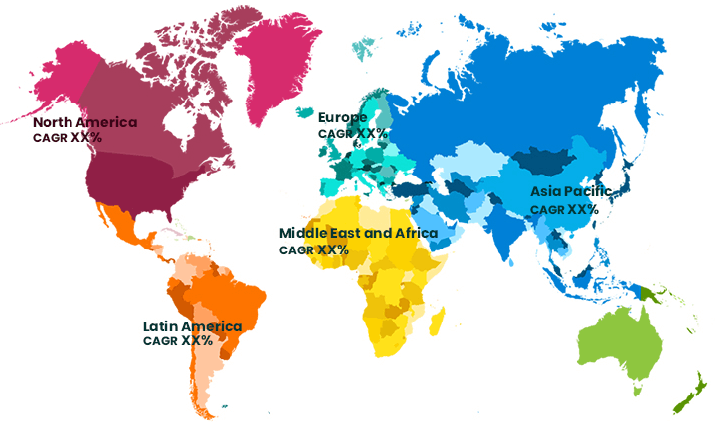
Latin America offers growth potential as awareness of micronutrient deficiencies increases and packaged-food distribution expands. Brazil represents a key national market because of its substantial population, large food-processing sector, urban retail infrastructure, and broad consumption of packaged staple foods. Mexico also contributes to regional demand through its major consumer market and established processed-food industry. Opportunities are particularly attractive for affordable fortified products that can be distributed through supermarkets, neighborhood grocery stores, food-service operators, and public nutrition initiatives.
The Middle East & Africa market is supported by increasing awareness of nutrition-related disorders, expanding urban populations, food-security initiatives, and the continuing need to address iodine and iron deficiencies in vulnerable communities. South Africa provides an important commercial base within the region due to its comparatively developed retail and food-processing ecosystem, while GCC countries support demand through high levels of packaged-food consumption and modern retail penetration. Across parts of Africa, fortification programs can serve as valuable public-health interventions where dietary diversity is limited. Strengthening local manufacturing capabilities, affordable distribution, product quality control, and nutrition education will be critical for long-term market development.
Recent Developments
- In April 2025, Tata Consumer Products reported the relaunch of Tata Salt Iron Health, a double-fortified product containing iron and iodine, at a more accessible price point. The initiative was positioned to improve affordability while helping address widespread iron deficiency, demonstrating the growing strategic importance of value-added and micronutrient-enriched salt products.
- In August 2022, Tata Consumer Products reported that Tata Salt Immuno, an iodine-fortified salt with added zinc, was being expanded nationally following encouraging pilot results. The initiative illustrated an industry shift toward functional salts that move beyond traditional iodine-only fortification and provide differentiated micronutrient propositions.
- During FY2022-23, Tata Consumer Products broadened its value-added salt portfolio with products including Tata Salt Iron Health, Tata Salt Immuno, and Tata Salt + Vitamin Shakti, highlighting increased investment in salt products designed around health, wellness, and micronutrient enrichment.
Key participants profiled in the report include:
- Hindustan Salts
- Tamil Nadu Salt Corporation
- Bajaj Salt
- AkzoNobel
- Shreeram Chemfood
- Tata Chemicals
- Cargill Salt
- Nirma Shudh
- Compass Minerals
- Ankur Salt
- China National Salt Industry
- Annapurna Salts
- Windsor Salts
- Sambhar Salts
- Kutch Brine Chem Industries
- United Salt Corporation
- Schweizer Salinen
- Ahir Salt Industries
- Saboo Sodium Chloro
- Super Salts.
What are the key trends in the Fortified Salts Market?
Increasing shift toward double- and multi-micronutrient fortification
The industry is gradually evolving beyond conventional iodized salt toward formulations capable of delivering multiple micronutrients through a single product. Double-fortified salt containing iodine and iron is particularly relevant because it can address two major micronutrient deficiencies without requiring consumers to adopt an entirely new food product. Advances in granulation, coating, encapsulation, stabilization, and controlled fortification technologies are enabling manufacturers to improve nutrient compatibility and product quality. This trend is expected to encourage product differentiation, strengthen public-health applications, and create opportunities for premium functional-salt portfolios.
Growing emphasis on health-focused and value-added salt portfolios
Consumer interest in preventive health, nutrition, and functional foods is encouraging companies to expand beyond basic commodity salt. Manufacturers are introducing products positioned around micronutrient supplementation, immunity, reduced sodium, mineral content, and broader wellness benefits. Established companies are increasingly using R&D, brand credibility, modern retail, digital platforms, and differentiated packaging to convert the traditional salt category into a value-added nutrition platform. Tata Consumer Products’ expansion of micronutrient-focused salt products provides a clear example of this wider industry trend.
The global fortified salts market is segmented as follows:
By Product
- Iodine
- By Application
- Hospitality & Service
- Food Processing
- Household & Animal Feed
- By Distribution Channel
- Hypermarket & Supermarket
- Grocery Stores
- Online Stores
- By Application
- Iron
- By Application
- Hospitality & Service
- Food Processing
- Household & Animal Feed
- By Distribution Channel
- Hypermarket & Supermarket
- Grocery Stores
- Online Stores
- By Application
- Double Fortified Salts
- By Application
- Hospitality & Service
- Food Processing
- Household & Animal Feed
- By Distribution Channel
- Hypermarket & Supermarket
- Grocery Stores
- Online Stores
- By Application
By Region
- North America
- The U.S.
- Canada
- Mexico
- Europe
- France
- The UK
- Spain
- Germany
- Italy
- Rest of Europe
- Asia Pacific
- China
- Japan
- India
- Australia
- South Korea
- Rest of Asia Pacific
- The Middle East & Africa
- Saudi Arabia
- UAE
- Egypt
- Kuwait
- South Africa
- Rest of the Middle East & Africa
- Latin America
- Brazil
- Argentina
- Rest of Latin America
Table Of Content
Methodology
FrequentlyAsked Questions
The market is witnessing growing adoption of double-fortified salts, multi-micronutrient formulations, improved encapsulation and granulation technologies, value-added health and wellness salts, reduced-sodium alternatives, innovative packaging, and increased use of digital retail channels. Companies are also expanding products containing combinations of iodine, iron, zinc, calcium, vitamins, and other nutritional components to address changing consumer health priorities.
The fortified salts industry value chain begins with sourcing and purification of raw salt, followed by procurement of fortificants such as iodine and iron compounds. Manufacturers then perform formulation, nutrient stabilization, blending or granulation, quality testing, packaging, and labeling. Finished products are distributed through wholesalers, supermarkets, grocery stores, online platforms, institutional procurement channels, food processors, and public nutrition programs before reaching household and commercial end users.
Asia Pacific is expected to make notable contributions to global fortified salts market revenue during the forecast period. Demand is supported by a large population base, rising nutritional awareness, growing cases of anemia, increased consumption of nutritious foods, and substantial requirements for iron and other micronutrients. India, China, and other developing Asian markets remain particularly important to regional expansion.
Major players include Hindustan Salts, Tamil Nadu Salt Corporation, Bajaj Salt, AkzoNobel, Shreeram Chemfood, Tata Chemicals, Cargill Salt, Nirma Shudh, Compass Minerals, Ankur Salt, China National Salt Industry, Annapurna Salts, Windsor Salts, Sambhar Salts, Kutch Brine Chem Industries, United Salt Corporation, Schweizer Salinen, Ahir Salt Industries, Saboo Sodium Chloro, and Super Salts.

HappyClients

