
Global Flexible Electronics Market Size, Share, Growth Analysis Report - Forecast 2034

Flexible Electronics Market By Component (Display, Battery, Sensors, and Memory), By Application (Automotive, Consumer Electronics, Healthcare, and Industrial), and By Region - Global and Regional Industry Overview, Market Intelligence, Comprehensive Analysis, Historical Data, and Forecasts 2025 - 2034
| Market Size in 2024 | Market Forecast in 2034 | CAGR (in %) | Base Year |
|---|---|---|---|
| USD 31.13 Billion | USD 82.23 Billion | 10.2% | 2024 |
Flexible Electronics Market: Industry Perspective
What will be the global flexible electronics market size during the forecast period?
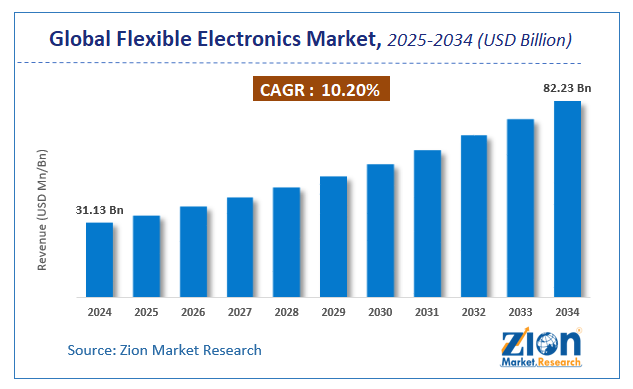
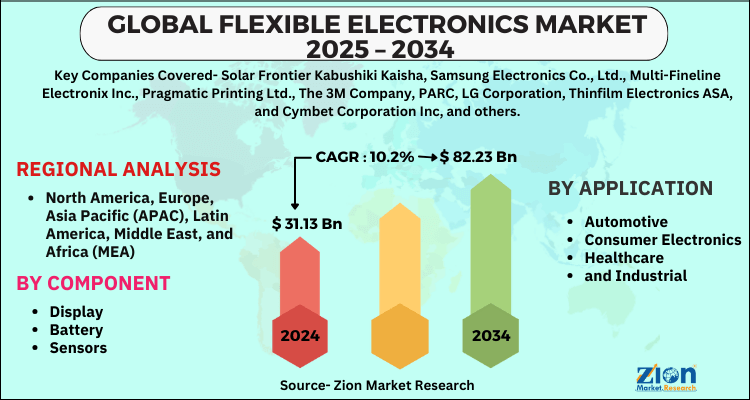
The global flexible electronics market size was worth around USD 31.13 billion in 2024 and is predicted to reach around USD 82.23 billion by 2034, with a compound annual growth rate (CAGR) of roughly 10.2% between 2025 and 2034.
This report provides a comprehensive analysis of the growth drivers, restraints, and challenges shaping demand across the global flexible electronics market throughout the forecast period, while highlighting high-potential emerging opportunities within the industry.
Key Insights
- As per the analysis shared by our research analyst, the global flexible electronics market is estimated to grow annually at a CAGR of around 10.2% over the forecast period (2025-2034).
- Regarding revenue, the global flexible electronics market size was valued at around USD 31.13 Billion in 2024 and is projected to reach USD 82.23 Billion by 2034.
- The flexible electronics market is projected to grow at a significant rate due to growing applications in the automotive and IoT industries, increasing demand for lightweight and wearable devices, rising adoption in consumer electronics and healthcare, and advancements in flexible display and sensor technologies.
- By component, the Display segment is expected to lead the global market.
- By application, the Automotive segment is growing at a high rate and will continue to dominate the global market.
- Based on region, Asia-Pacific is predicted to dominate the global market during the forecast period.
Flexible Electronics Market: Overview
Flexible electronics is a technique used for assembling electronic circuits through mounting electronic equipment on a flexible plastic substrate, including transparent conductive polyester, polyimide, and PEEK. These flex circuits can be screen-printed silver circuits on polyester. Furthermore, the huge demand for flexible electronics is driven by their low manufacturing costs, ruggedness, portability, and lightweight design. Moreover, flexible electronics assemblies can be produced using the same components used for rigid printed circuit boards, allowing the board to adapt to the required shape. Furthermore, flexible electronics has a plethora of applications in the gaming & entertainment sectors because it can roll, curve, fold, flex, and conform.
Flexible Electronics Market: Growth Drivers
What factors are primarily accelerating demand in the flexible electronics market?
Growth of the flexible electronics market over the forecast period is driven by a surge in connected-device sales and favorable government policies supporting the use of flexible electronics. In addition, the rise in portable products and smart electronics will drive industry expansion. A rapid surge in printed electronics will boost growth in the flexible electronics industry. Breakthroughs in grid connection, displays, health monitoring systems, power integration, and lightning technologies will expand the market's scope. Escalating demand for compact electronic equipment across various sectors such as defense, automotive, consumer electronics, and healthcare will create new growth avenues for the industry.
Moreover, the emergence of new technologies such as AI and IoT will open new growth avenues for the flexible electronics industry over the forecast period. High penetration of smart wearable devices, coupled with breakthroughs in in-mold electronics, will increase market size. A surge in acceptance of electronic parts in the automotive sector is set to boost flexible electronics industry progression in years to come.
Flexible Electronics Market: Restraints
What factors are limiting the expansion of the flexible electronics market?
Increasing competition from newer technologies such as printed electronics LCD and LED may limit market growth in certain applications.
Technical and cost challenges associated with large-scale manufacturing of highly flexible, durable, high-performance components can also moderate adoption in some end-use sectors.
Flexible Electronics Market: Opportunities
Where do significant growth opportunities lie for the flexible electronics market?
High penetration in multiple applications such as military, digital signage, and energy harvesting is expected to open new growth avenues. Continuous technological development and strong demand in the consumer electronics market further support expansion.
Consumer electronic devices, including smartwatches, smart glasses, smartphones, e-books, and e-papers, continue to drive demand for flexible electronic devices, while automotive and healthcare applications offer additional long-term potential.
Flexible Electronics Market: Challenges
What key challenges confront participants in the flexible electronics market?
Maintaining performance reliability under repeated flexing, folding, and environmental stress remains a technical challenge. Achieving cost-effective mass production while meeting durability and yield requirements requires ongoing process improvement.
Competition from alternative display and circuit technologies necessitates continuous innovation to sustain differentiation and market share.
Flexible Electronics Market: Report Scope
| Report Attributes | Report Details |
|---|---|
| Report Name | Flexible Electronics Market |
| Market Size in 2024 | USD 31.13 Billion |
| Market Forecast in 2034 | USD 82.23 Billion |
| Growth Rate | CAGR of 10.2% |
| Number of Pages | 245 |
| Key Companies Covered | Solar Frontier Kabushiki Kaisha, Samsung Electronics Co., Ltd., Multi-Fineline Electronix Inc., Pragmatic Printing Ltd., The 3M Company, PARC, LG Corporation, Thinfilm Electronics ASA, Cymbet Corporation Inc., and others. |
| Segments Covered | By Component, By Application, and By Region |
| Regions Covered | North America, Europe, Asia Pacific (APAC), Latin America, The Middle East and Africa (MEA) |
| Base Year | 2024 |
| Historical Year | 2020 to 2023 |
| Forecast Year | 2025 - 2034 |
| Customization Scope | Avail customized purchase options to meet your exact research needs. Request For Customization |
Flexible Electronics Market: Segmentation
The flexible electronics market is segmented by component, application, and region. All the segments of the flexible electronics market have been analyzed based on present and future trends, and the market is estimated from 2025 to 2034.
By component segment, the flexible electronics market is divided into display, battery, sensors, and memory. The display segment is expected to lead the market because of its critical role in foldable, rollable, curved, and flexible screen applications across consumer and automotive devices. This leadership drives overall market growth by supporting high-volume production of next-generation visual interfaces and encouraging continuous advances in materials and coating technologies that improve performance and durability.
By application segment, the flexible electronics market is divided into automotive, consumer electronics, healthcare, and industrial. The automotive segment is growing rapidly and will continue to dominate the market because of the rising adoption of electronic parts in vehicle systems and the need for lightweight, space-efficient components. This dominance supports market expansion by linking flexible electronics to vehicle design trends, safety features, and interior innovations, while consumer electronics, healthcare, and industrial applications contribute additional volume through wearables, monitoring devices, and specialized equipment.
Flexible Electronics Market: Regional Analysis
Why will Asia-Pacific continue to dominate the global market during the projection period?
Asia-Pacific is predicted to dominate the flexible electronics market during the forecast period. The region benefits from extensive electronics manufacturing capabilities, strong supply chains for components and materials, and rapid adoption of advanced consumer and automotive technologies. Countries such as China, Japan, South Korea, and others continue to invest in production capacity and research related to flexible displays, sensors, and related devices. Rising demand for smartphones, wearables, and automotive electronics further strengthens regional leadership. This dominance drives overall market growth by enabling large-scale production, accelerating innovation in materials and processes, and setting competitive cost and performance benchmarks that shape global trends and expansion strategies.
North America makes substantial contributions supported by high use of digital and electronic parts in consumer equipment, strong healthcare and automotive applications, and demand for technologically advanced devices. Europe is expected to grow at a moderate rate, while Latin America and the Middle East and Africa are progressing as adoption of advanced electronics expands.
Flexible Electronics Market: Competitive Landscape
The global flexible electronics market is dominated by players like:
- Solar Frontier Kabushiki Kaisha
- Samsung Electronics Co. Ltd.
- Multi-Fineline Electronix Inc.
- Pragmatic Printing Ltd.
- The 3M Company
- PARC
- LG Corporation
- Thinfilm Electronics ASA
- Cymbet Corporation Inc
Flexible Electronics Market: Key Trends
What are the key trends in the flexible electronics market?
Rising demand for flexible displays and wearable devices
Foldable, rollable, and curved displays, together with lightweight wearable electronics, continue to drive innovation and volume growth across consumer and automotive applications.
Integration with AI, IoT, and in-mold electronics
Advances in AI, IoT connectivity, and in-mold electronics expand the functional scope of flexible circuits, supporting new use cases in smart devices, health monitoring, and vehicle systems.
Segments Covered
The global flexible electronics market is segmented as follows:
By Component
- Display
- Battery
- Sensors
- Memory
By Application
- Automotive
- Consumer Electronics
- Healthcare
- Industrial
By Region
- North America
- The U.S.
- Canada
- Mexico
- Europe
- France
- The UK
- Spain
- Germany
- Italy
- Rest of Europe
- Asia Pacific
- China
- Japan
- India
- Australia
- South Korea
- Rest of Asia Pacific
- The Middle East & Africa
- Saudi Arabia
- UAE
- Egypt
- Kuwait
- South Africa
- Rest of the Middle East & Africa
- Latin America
- Brazil
- Argentina
- Rest of Latin America
Table Of Content
Methodology
FrequentlyAsked Questions
The flexible electronics market encompasses technologies for assembling electronic circuits on flexible plastic substrates such as polyimide, polyester, and PEEK, enabling lightweight, portable, rugged, and conformable devices used across displays, sensors, batteries, and related applications.
Key growth drivers include growing applications in automotive and IoT industries, increasing demand for lightweight and wearable devices, rising adoption in consumer electronics and healthcare, and advancements in flexible display and sensor technologies.
The global flexible electronics market was valued at approximately USD 31.13 billion in 2024 and is projected to reach around USD 82.23 billion by 2034.
The global flexible electronics market is expected to expand at a compound annual growth rate of approximately 10.2% between 2025 and 2034.
Asia-Pacific is expected to dominate the market during the forecast period, supported by strong manufacturing capabilities and expanding electronics production.
Major players include Solar Frontier Kabushiki Kaisha, Samsung Electronics Co., Ltd., Multi-Fineline Electronix Inc., Pragmatic Printing Ltd., The 3M Company, PARC, LG Corporation, Thinfilm Electronics ASA, and Cymbet Corporation Inc.

HappyClients

