
Fixed Zirconia Oxygen Analyzer Market Size, Share, Report 2034

Fixed Zirconia Oxygen Analyzer Market By Product Type (In-Situ Zirconia Oxygen Analyzers, Extractive Zirconia Oxygen Analyzers), By Application (Power Generation, Oil & Gas, Metals & Mining, Chemical & Petrochemical, Pulp & Paper, and Others), By End-User (Industrial, Environmental Monitoring, Research Laboratories, and Others), and By Region - Global and Regional Industry Overview, Market Intelligence, Comprehensive Analysis, Historical Data, and Forecasts 2025 - 2034
| Market Size in 2024 | Market Forecast in 2034 | CAGR (in %) | Base Year |
|---|---|---|---|
| USD 474.35 Million | USD 728.59 Million | 5.5% | 2024 |
Fixed Zirconia Oxygen Analyzer Industry Perspective:
What will be the size of the global fixed zirconia oxygen analyzer market during the forecast period?
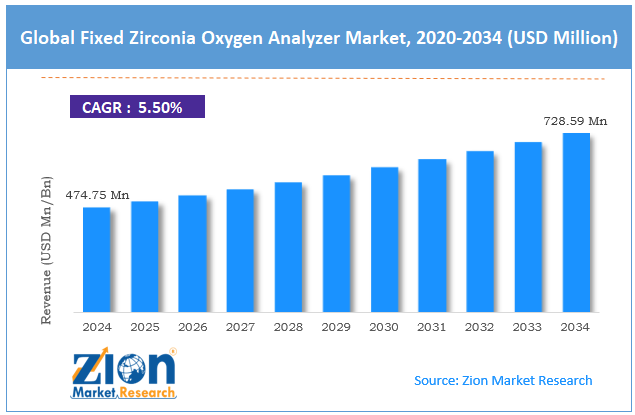
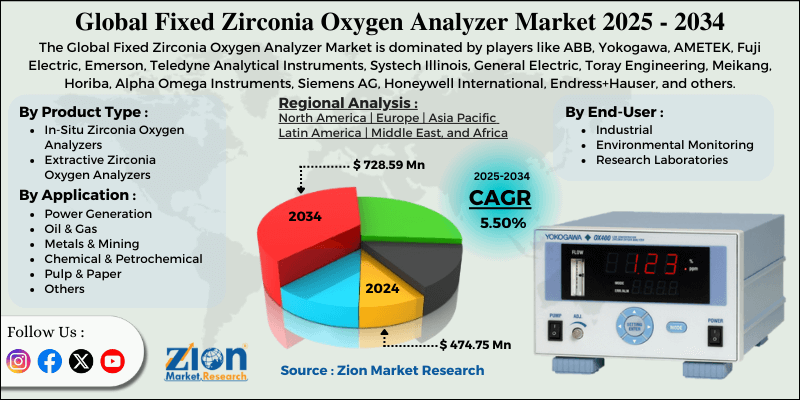
The global fixed zirconia oxygen analyzer market size was approximately USD 474.75 million in 2024 and is projected to reach USD 728.59 million by 2034, with a compound annual growth rate (CAGR) of approximately 5.50% between 2025 and 2034.
Key Insights:
- As per the analysis shared by our research analyst, the global fixed zirconia oxygen analyzer market is estimated to grow annually at a CAGR of around 5.50% over the forecast period (2025-2034)
- In terms of revenue, the global fixed zirconia oxygen analyzer market size was valued at around USD 474.75 million in 2024 and is projected to reach USD 728.59 million by 2034.
- The fixed zirconia oxygen analyzer market is projected to grow significantly, driven by stringent environmental regulations, growth in the petrochemical and chemical industries, and technological advancements in sensor accuracy.
- Based on product type, the in-situ zirconia oxygen analyzers segment is expected to lead the market, while the extractive zirconia oxygen analyzers segment is expected to grow considerably.
- Based on application, the power generation segment is the dominating segment, while the chemical & petrochemical segment is projected to witness sizeable revenue over the forecast period.
- Based on end-user, the industrial segment is expected to lead the market, followed by the environmental monitoring segment.
- By region, Asia Pacific is projected to dominate the global market during the forecast period, followed by North America.
Fixed Zirconia Oxygen Analyzer Market: Overview
A fixed zirconia oxygen analyzer is an industrial tool that continuously measures oxygen concentration in gases, particularly in combustion processes, environmental monitoring, and flue gases. It operates using a zirconia ceramic sensor that produces a voltage proportional to the difference in oxygen partial pressure between the measured gas and a reference gas, typically air. The global fixed zirconia oxygen analyzer market is poised to expand rapidly, driven by stringent environmental regulations, heightened focus on combustion efficiency, and the expansion of industrial automation. Industries are subject to strict emission standards, requiring precise oxygen monitoring. Fixed zirconia analyzers help improve combustion and reduce pollutant emissions. Compliance fuels broader adoption worldwide.
Moreover, optimizing the air-fuel ratio reduces fuel consumption and operating costs. Oxygen analyzers offer real-time feedback to support effective combustion. Efficiency concerns drive demand in industrial and power plants. Furthermore, automation trends integrate analyzers into process control systems. real-time oxygen monitoring backs predictive adjustments. Smart factories rely on these sensors to improve operations.
Despite the growth, the global market is impeded by factors such as sensor sensitivity to contaminants and the availability of alternative technologies. Zirconia sensors degrade when exposed to moisture or particulates. Gas conditioning is needed to maintain accuracy. Contamination raises maintenance and operational costs. Likewise, paramagnetic and electrochemical sensors offer competitive options. Industries may prefer simpler or cheaper substitutes. Hence, competition restricts the growth of industry share for zirconia analyzers.
Nonetheless, the global fixed zirconia oxygen analyzer industry stands to gain from several key opportunities, including IIoT and smart factory integration and aftermarket and service growth. Connecting analyzers to IIoT platforms allows remote monitoring. Predictive maintenance and data analytics become possible. Integration improves the value proposition and process efficiency. Additionally, calibration, maintenance, and training services create recurring revenue. OEMs can offer long-term support contracts. Aftermarket services boost customer relationships.
Fixed Zirconia Oxygen Analyzer Market: Dynamics
Growth Drivers
How is the integration of digital technologies and smart monitoring capabilities driving the fixed zirconia oxygen analyzer market?
Technological advancements, including smart diagnostics, IoT integration, and remote monitoring, are transforming fixed zirconia oxygen analyzers into more efficient systems. Modern fixed analyzers now include digital communication protocols and predictive maintenance features, enabling connectivity with plant automation systems and Industry 4.0 frameworks. These improvements reduce downtime, simplify calibration tasks, and advance data analytics to improve performance. As industries accelerate digital transformation, the appeal of connected, smart analyzers continues to drive the adoption of fixed zirconia oxygen analyzers.
How does the fixed zirconia oxygen analyzer market benefit from continuous innovation and product development?
Ongoing advancement in durability, sensor design, and performance is expanding the capabilities and appeal of fixed zirconia oxygen analyzers. Manufacturers are launching enhanced sensor materials with fast response times and improved thermal stability, making analyzers ideal for harsh industrial environments and high temperatures. The development of digitally enhanced, compact units with advanced diagnostics supports broader integration into applications. These innovations not only enhance overall measurement reliability but also reduce the total cost of ownership, thereby promoting broader adoption across industrial segments. This ultimately impacts the growth of the fixed zirconia oxygen analyzer market.
Restraints
Competition from alternative technologies adversely hinders the market progress
Fixed zirconia oxygen analyzers are constrained by alternative oxygen-sensing solutions, such as paramagnetic, optical, and electrochemical sensors, which often offer lower operational costs and simpler installation in some applications. These alternatives are appealing for less demanding applications in which full zirconia accuracy is not important. The presence of these substitutes creates adoption and pricing pressure on fixed zirconia analyzer vendors. Industries may prefer alternatives to enhance cost-benefit trade-offs.
Opportunities
How are sustainability and emission control presenting favorable prospects for the expansion of the fixed zirconia oxygen analyzer market?
Elevated global focus on stringent emissions and sustainability standards is creating demand for high-accuracy oxygen monitoring solutions to reduce greenhouse gas emissions and improve combustion. Industries seeking to meet environmental goals and carbon-reduction targets view fixed zirconia analyzers as vital tools. This creates growth opportunities in the fixed zirconia oxygen analyzer industry across the petrochemical, power generation, and waste-to-energy sectors, particularly in applications requiring stringent emission reporting. This push towards cleaner operations drives long-term demand.
Challenges
Supply chain vulnerabilities and raw material volatility limit the market growth
The global market is sensitive to supply chain disruptions and price fluctuations in critical raw materials, which may affect cost structures and production schedules. Worldwide logistical barriers, geopolitical stresses, and component scarcities further complicate delivery commitments and manufacturing planning. These volatility factors create uncertainty for both buyers and vendors, impacting pricing resilience and inventory strategies. Stable supply management is currently a vital challenge.
Fixed Zirconia Oxygen Analyzer Market: Report Scope
| Report Attributes | Report Details |
|---|---|
| Report Name | Fixed Zirconia Oxygen Analyzer Market |
| Market Size in 2024 | USD 474.75 Million |
| Market Forecast in 2034 | USD 728.59 Million |
| Growth Rate | CAGR of 5.50% |
| Number of Pages | 213 |
| Key Companies Covered | ABB, Yokogawa, AMETEK, Fuji Electric, Emerson, Teledyne Analytical Instruments, Systech Illinois, General Electric, Toray Engineering, Meikang, Horiba, Alpha Omega Instruments, Siemens AG, Honeywell International, Endress+Hauser, and others. |
| Segments Covered | By Product Type, By Application, By End-User, and By Region |
| Regions Covered | North America, Europe, Asia Pacific (APAC), Latin America, Middle East, and Africa (MEA) |
| Base Year | 2024 |
| Historical Year | 2019 to 2023 |
| Forecast Year | 2025 - 2034 |
| Customization Scope | Avail customized purchase options to meet your exact research needs. Request For Customization |
Fixed Zirconia Oxygen Analyzer Market: Segmentation
The global fixed zirconia oxygen analyzer market is segmented based on product type, application, end-user, and region.
Why is the In-Situ Zirconia Oxygen Analyzers segment projected to dominate the fixed zirconia oxygen analyzer market?
Based on product type, the global fixed zirconia oxygen analyzer industry is divided into in-situ zirconia oxygen analyzers and extractive zirconia oxygen analyzers. The in-situ zirconia oxygen analyzers segment accounts for 61% of the total market due to their ability to measure oxygen directly in the process stream. This is performed with real-time response and low maintenance needs in continuous industrial operations, such as combustion systems and power plants.
However, the extractive zirconia oxygen analyzers segment ranks second with 39% market share. They are widely used in applications where conditioning and gas sampling are needed before analysis to improve accuracy, or where direct insertion is not feasible.
What factors help the Power Generation segment lead the fixed zirconia oxygen analyzer market?
Based on application, the global fixed zirconia oxygen analyzer market is segmented into power generation, oil & gas, metals & mining, chemical & petrochemical, pulp & paper, and others. The power generation segment leads with 40% market share. The segmental dominance is supported by the importance of continuous oxygen measurement for optimizing combustion efficiency, reducing fuel consumption, and complying with stringent emission regulations in gas and thermal power plants.
Conversely, the chemical & petrochemical segment holds 27% of the total market. These analyzers are important for precise oxygen control in complex reactions, continuous process optimization, and safety assurance in chemical plants and refineries.
What are the key reasons for the leadership of the Industrial segment in the fixed zirconia oxygen analyzer market?
Based on end-user, the global market is segmented into industrial, environmental monitoring, research laboratories, and others. The industrial segment captures 65% of the overall market. It comprises chemical, metals, oil & gas, power plants, and manufacturing. It fuels demand for fixed zirconia oxygen analyzers for process control, emissions monitoring, and combustion optimization. Regulatory compliance enhances industry dominance.
Nonetheless, the environmental monitoring segment ranks second with 25% market share. This growth is backed by air quality regulations, continuous emissions monitoring systems (CEMS), and emissions control programs. Industrial facilities and governments are largely dependent on analyzers to reduce and track pollutants.
Fixed Zirconia Oxygen Analyzer Market: Regional Analysis
What gives Asia Pacific a competitive edge in the global Fixed Zirconia Oxygen Analyzer Market?
Asia Pacific is anticipated to retain its leading role with a 7% CAGR in the global fixed zirconia oxygen analyzer market, driven by rapid industrialization and manufacturing growth, expansion of energy and power generation infrastructure, and stringent environmental regulations and emission controls. APAC holds a leading share due to rapid industrial expansion in the chemicals, manufacturing, steel, and power sectors. Growing factories and plants need constant oxygen monitoring for safety and efficiency. This rise in industrial activity fuels strong demand for fixed zirconia oxygen analyzers.
Moreover, surging electricity demand has triggered the construction of new power plants and upgrades to current facilities. Combustion efficiency and continuous emissions monitoring are crucial in these plants. This ultimately drives the adoption of fixed zirconia oxygen analyzers in Asia. Furthermore, governments in the region are enforcing tighter industrial emissions and pollution control norms. Industries install oxygen analyzers to comply with regulations and reduce greenhouse gas emissions. Regulatory requirements strongly boost the industry growth.
Why does North America rank second in the global Fire Protection System Pipes Market?
North America ranks as the second-largest region in the global fixed zirconia oxygen analyzer industry, with a 5.8% CAGR, driven by a mature industrial infrastructure, high adoption of IIoT and automation, and a significant power generation sector. The region is home to well-developed power plants, manufacturing facilities, and refineries. These developed assets depend on advanced oxygen analyzers for process optimization and combustion control. Stable industrial activity sustains steady industry uptake.
North American companies prefer digital transformation in process control systems. Integrating oxygen analyzers with analytics platforms and automation enhances predictive maintenance and efficiency. This technological focus drives analyzer deployment. Additionally, gas, coal, and combined-cycle plants need precise oxygen monitoring to optimize combustion and reduce fuel prices. Continuous analyzers help power producers enhance performance and reduce emissions, thus fueling a remarkable share of regional installations.
Fixed Zirconia Oxygen Analyzer Market: Competitive Analysis
The leading players in the global fixed zirconia oxygen analyzer market are:
- ABB
- Yokogawa
- AMETEK
- Fuji Electric
- Emerson
- Teledyne Analytical Instruments
- Systech Illinois
- General Electric
- Toray Engineering
- Meikang
- Horiba
- Alpha Omega Instruments
- Siemens AG
- Honeywell International
- Endress+Hauser
What are the key trends in the global Fixed Zirconia Oxygen Analyzer Market?
Miniaturization and smart analyzer features:
Manufacturers are developing portable, compact, and smart models that can be easily installed. Novel units incorporate automatic calibration, self-diagnosis, and advanced data-processing features to improve accuracy. These advancements expand applications beyond traditional heavy-industrial settings.
Demand for high‑temperature, durable sensors:
Industries are moving towards zirconia analyzers designed for extreme environments with enhanced thermal stability and corrosion resistance. New sector designs deliver longer operational life and reliable performance at higher temperatures. This trend supports wider adoption across industries such as petrochemicals, cement, and steel.
The global fixed zirconia oxygen analyzer market is segmented as follows:
By Product Type
- In-Situ Zirconia Oxygen Analyzers
- Extractive Zirconia Oxygen Analyzers
By Application
- Power Generation
- Oil & Gas
- Metals & Mining
- Chemical & Petrochemical
- Pulp & Paper
- Others
By End-User
- Industrial
- Environmental Monitoring
- Research Laboratories
- Others
By Region
- North America
- The U.S.
- Canada
- Europe
- France
- The UK
- Spain
- Germany
- Italy
- Rest of Europe
- Asia Pacific
- China
- Japan
- India
- South Korea
- Southeast Asia
- Rest of Asia Pacific
- Latin America
- Brazil
- Mexico
- Rest of Latin America
- Middle East & Africa
- GCC
- South Africa
- Rest of Middle East & Africa
Table Of Content
Methodology
FrequentlyAsked Questions

HappyClients

