
Field Hockey Balls Market Size, Industry Share & Forecast 2034

Field Hockey Balls Market By Type (Traditional Yarn-Wound, Thermoplastic, and Pressed Paper Core), By Application (Professional, Recreational, and Training), and By Region - Global and Regional Industry Overview, Market Intelligence, Comprehensive Analysis, Historical Data, and Forecasts 2025 - 2034
| Market Size in 2024 | Market Forecast in 2034 | CAGR (in %) | Base Year |
|---|---|---|---|
| USD 389.01 Million | USD 595.77 Million | 4.85% | 2024 |
Field Hockey Balls Industry Perspective:
What will be the expected value of the field hockey balls market in the coming years?
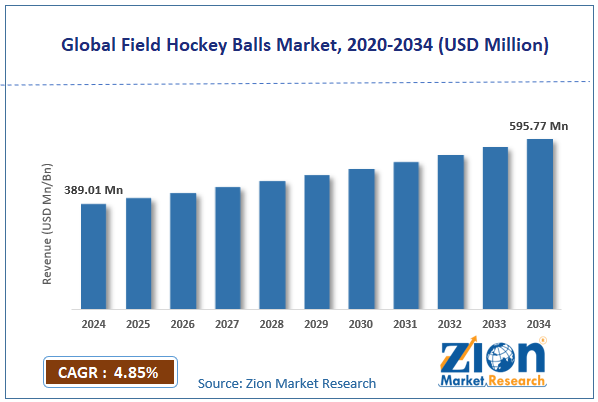
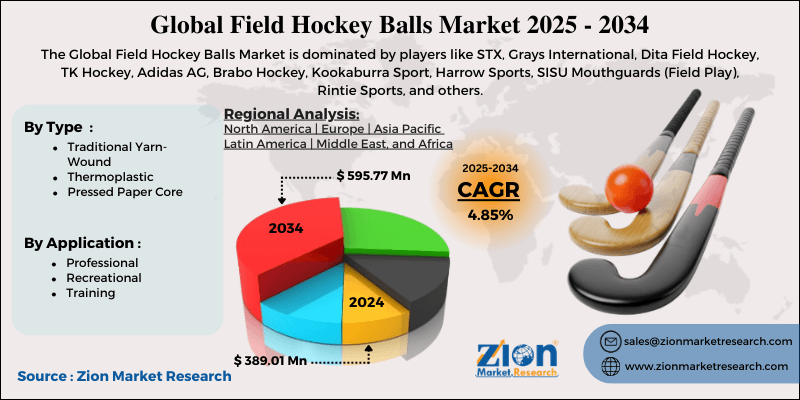
The global field hockey balls market size was worth around USD 389.01 million in 2024 and is predicted to grow to around USD 595.77 million by 2034, with a compound annual growth rate (CAGR) of roughly 4.85% between 2025 and 2034.
Key Insights:
- As per the analysis shared by our research analyst, the global field hockey balls market is estimated to grow annually at a CAGR of around 4.85% over the forecast period (2025–2034)
- In terms of revenue, the global field hockey balls market size was valued at around USD 389.01 million in 2024 and is projected to reach USD 595.77 million by 2034.
- The field hockey balls market is projected to grow at a significant rate due to increasing participation in organized sports and physical education programs globally.
- Based on type, the thermoplastic segment is growing at a high rate and will continue to dominate the global market, as per industry projections
- Based on application, the professional segment is anticipated to command the largest market share
- Based on region, Europe is projected to dominate the global market during the forecast period
Field Hockey Balls Market: Overview
Field hockey balls are specially engineered spherical sports equipment designed for the game of field hockey, featuring optimized weight, balance, and surface characteristics to ensure consistent roll, enhanced control, and predictable bounce on various playing surfaces. Traditionally crafted from materials such as cork, rubber, or pressed paper cores covered with nylon or thermoplastic coatings, these balls have evolved to meet the performance expectations of players, coaches, and governing sports bodies globally. The demand for field hockey balls is driven by rising participation in the sport at the amateur, school, collegiate, and professional levels.
According to industry analysis, increased investment by sports associations, the inclusion of hockey in multi-sport events, and youth development programs have heightened demand for standardized match and practice balls. Additionally, technological improvements in materials science have resulted in durable, weather-resistant balls suited to different climatic conditions, thereby further widening market demand. However, the market faces challenges related to seasonal demand fluctuations and the affordability of high-performance equipment in emerging regions.
Field Hockey Balls Market: Dynamics
Growth Drivers
How will growing grassroots and professional hockey participation influence field hockey market growth?
The global field hockey balls market is expected to be driven by rising grassroots sports initiatives and growing participation in professional field hockey tournaments. Industry analysis suggests that national federations are investing heavily in youth development programs, school-level competitions, and community sports infrastructure to promote athletic engagement from early ages. These efforts are increasing the demand for standardized equipment, including match-grade and practice field hockey balls.
The expansion of field hockey leagues, televised tournaments, and international events has further elevated spectator interest, creating a conducive environment for increased sports equipment sales. The growing preference for active lifestyles and fitness-oriented activities has also increased demand for field hockey balls in recreational settings.
Technological enhancements in ball materials to support sustained growth during the projection period
Advancements in materials science have led manufacturers to innovate field hockey balls with enhanced durability, resistance to water absorption, and optimized balance. The shift toward thermoplastic and blended material balls offers improved performance in varied weather conditions compared with traditional yarn-wound constructions. These technical improvements help reduce maintenance costs and extend product lifespans, thus driving enhanced adoption among clubs, schools, and professional teams.
Restraints
How will price sensitivity and equipment substitution limit field hockey market growth trends?
The global field hockey balls market is expected to be limited by price sensitivity among amateur and casual players. High-performance thermoplastic balls and premium-grade match balls often come at a higher price point compared to basic practice balls or substitutes used in informal play. In emerging economies, where sports budgets are limited, this cost disparity may restrain overall market growth.
Additionally, the availability of alternative recreational equipment and indoor hockey variants may divert potential demand away from traditional field hockey balls.
Opportunities
Rising demand for customized and branded hockey gear offers growth opportunities in the coming years
The global field hockey ball industry is expected to experience growth as demand for personalized and branded sports equipment increases. Teams and clubs are increasingly seeking custom-designed balls featuring logos, unique graphics, or specialized performance attributes. Partnerships between ball manufacturers and professional teams to produce licensed products can strengthen brand loyalty and support premium pricing strategies.
Additionally, collaborations with international hockey federations and sports goods distributors can help companies expand their global reach, particularly in emerging markets where hockey is gaining traction.
Challenges
Why will competition from low-cost substitutes challenge the growth of the field hockey market?
The global field hockey balls market is projected to be challenged by the presence of low-cost substitutes and unbranded options in local markets. These alternatives often compromise on quality and performance but are attractive to budget-conscious buyers. The growing popularity of informal hockey formats, such as street hockey or floor hockey using lightweight plastic balls, further divides consumer preferences and may hinder the adoption of standardized field hockey balls in certain regions.
Field Hockey Balls Market: Report Scope
| Report Attributes | Report Details |
|---|---|
| Report Name | Field Hockey Balls Market |
| Market Size in 2024 | USD 389.01 Million |
| Market Forecast in 2034 | USD 595.77 Mllion |
| Growth Rate | CAGR of 4.85% |
| Number of Pages | 223 |
| Key Companies Covered | STX, Grays International, Dita Field Hockey, TK Hockey, Adidas AG, Brabo Hockey, Kookaburra Sport, Harrow Sports, SISU Mouthguards (Field Play), Rintie Sports, and others. |
| Segments Covered | By Type, By Application, and By Region |
| Regions Covered | North America, Europe, Asia Pacific (APAC), Latin America, Middle East, and Africa (MEA) |
| Base Year | 2024 |
| Historical Year | 2019 to 2023 |
| Forecast Year | 2025 - 2034 |
| Customization Scope | Avail customized purchase options to meet your exact research needs. Request For Customization |
Field Hockey Balls Market: Segmentation
The global field hockey balls market is segmented based on type, application, and region.
Why will the thermoplastic segment lead the industry growth trends during the projection period?
Based on type, the global market segments are traditional yarn-wound, thermoplastic, and pressed paper core balls. In 2024, the global market was dominated by the thermoplastic segment, accounting for nearly 37% of total revenue. The segment is projected to generate a CAGR of over 4.89% in the coming years. Thermoplastic balls are widely preferred in professional and competitive play due to their enhanced durability, consistent performance characteristics, and water-resistant properties.
Which application segment will lead the industry in the coming years?
Based on application, the global industry is divided into professional, recreational, and training uses. The professional segment was the dominant revenue generator in 2024, with control over 50.01% of total revenue. The expected CAGR for the professional segment is 5.12% in the coming years, driven by demand from leagues, clubs, and international federation-sanctioned events. Professional-grade balls typically meet strict performance standards and deliver predictable behavior under varied play conditions.
Field Hockey Balls Market: Regional Analysis
Why will Europe continue to dominate the field hockey balls market during the projection period?
The global field hockey balls market is expected to be led by Europe over the projection period, with a CAGR exceeding 4.67%. The region accounted for 38.05% of the global revenue in 2024. Growth in Europe will be heavily influenced by the popularity of field hockey across Western Europe, extensive club networks, and well-established youth sports infrastructure. Countries such as the Netherlands, Germany, England, and Spain have strong field hockey legacies and host competitive domestic leagues, which continue to support equipment demand.
Why will Asia-Pacific emerge as the fastest-growing region in the coming years?
Asia-Pacific is expected to emerge as the fastest-growing regional market, registering a CAGR of over 5.21% in the coming years. Countries such as India, China, Japan, and South Korea will help fuel regional growth through expanding participation in school and collegiate sports programs.
Additionally, increased investment in sports infrastructure and broader awareness of field hockey among youth populations will further promote regional market expansion. The rising number of regional players offering a wide range of field hockey balls may further help the region thrive.
Field Hockey Balls Market: Competitive Analysis
The global field hockey balls market is led by players like:
- STX
- Grays International
- Dita Field Hockey
- TK Hockey
- Adidas AG
- Brabo Hockey
- Kookaburra Sport
- Harrow Sports
- SISU Mouthguards (Field Play)
- Rintie Sports
Which are the latest trends in the field hockey balls market?
Growth of eco-friendly and sustainable ball options
A notable trend observed in the industry is the development of environmentally friendly field hockey balls made using recyclable and bio-based materials to reduce plastic waste.
ncreasing adoption of performance-enhanced designs
There is growing demand for performance-enhanced hockey balls that deliver consistent speed, predictable bounce, and weather tolerance across all levels of play.
The global field hockey balls market is segmented as follows:
By Type
- Traditional Yarn-Wound
- Thermoplastic
- Pressed Paper Core
By Application
- Professional
- Recreational
- Training
By Region
- North America
- The U.S.
- Canada
- Europe
- France
- The UK
- Spain
- Germany
- Italy
- Rest of Europe
- Asia Pacific
- China
- Japan
- India
- South Korea
- Southeast Asia
- Rest of Asia Pacific
- Latin America
- Brazil
- Mexico
- Rest of Latin America
- Middle East & Africa
- GCC
- South Africa
- Rest of Middle East & Africa
Table Of Content
Methodology
FrequentlyAsked Questions

HappyClients

