
ERP Software Market Size, Share, Trends, Growth and Forecast 2034

ERP Software Market By Deployment (On-premise and Cloud), By Function (Finance, Supply Chain, HR, and Others), By Enterprise Size (Large Enterprises, Small Enterprises, and Medium Enterprises), By Industry Vertical (Manufacturing & Services, Healthcare, Retail, Telecom, Aerospace & Defense, BFSI, Government, and Others), and By Region - Global and Regional Industry Overview, Market Intelligence, Comprehensive Analysis, Historical Data, and Forecasts 2026 - 2034
| Market Size in 2025 | Market Forecast in 2034 | CAGR (in %) | Base Year |
|---|---|---|---|
| USD 76.8 Billion | USD 175.2 Billion | 9.6% | 2025 |
ERP Software Industry Perspective:
What will be the size of the global ERP software market during the forecast period?
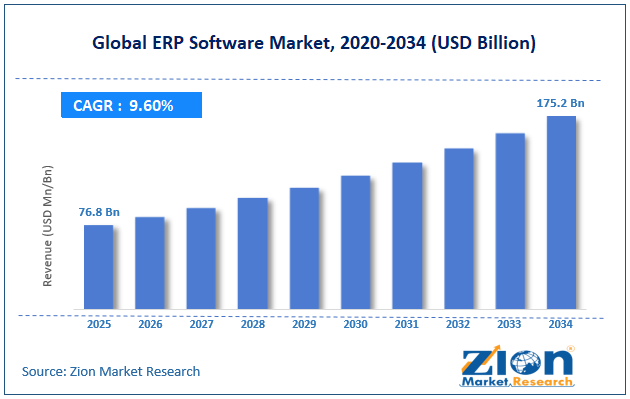
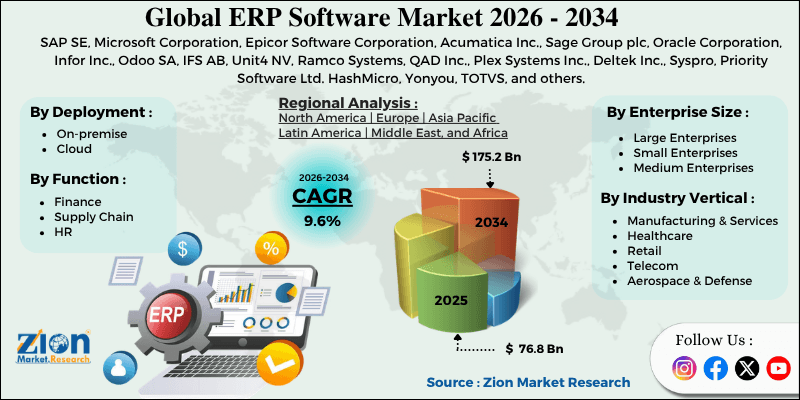
The global ERP software market size was worth around USD 76.8 billion in 2025 and is predicted to grow to around USD 175.2 billion by 2034, with a compound annual growth rate (CAGR) of roughly 9.6% between 2026 and 2034.
ERP Software Market: Overview
ERP software is a comprehensive business management solution that helps companies manage and streamline their operations on a single platform. In the current times, ERP software helps businesses integrate various functions, including finance and accounting, procurement, inventory, production, supply chain, HR, CRM, sales, and project management functions, among others, into a cohesive unit where all operations are supported by real-time data exchange. ERP software today includes features for cloud computing, AI, machine learning, predictive analytics, RPA, and IoT. The rise in demand for digitalization, efficiency, regulatory compliance, and data-driven decision-making across various businesses is driving the popularity of ERP software among SMEs and larger firms worldwide.
Key Insights
- As per the analysis shared by our research analyst, the global ERP software market is estimated to grow annually at a CAGR of around 9.6% over the forecast period (2026-2034).
- In terms of revenue, the global ERP software market size was valued at around USD 76.8 billion in 2025 and is projected to reach USD 175.2 billion by 2034.
- Rising adoption of cloud-based ERP solutions is expected to propel the ERP software market over the projected period.
- Based on the deployment, the cloud segment holds a significant market share in 2025 of 56%.
- Based on the function, the finance segment held the largest revenue share in 2025.
- Based on the enterprise size, the medium enterprises segment held the prominent market share of 38% in 2025.
- Based on the industry vertical, the manufacturing & services segment captures a significant revenue share in 2025 of 21%.
- Based on region, North America dominates the market with a major revenue share of 38% in 2025.
Impact of the USA-Israel War on Iran on the ERP Software Market
The USA-Israel disagreement over Iran has not had a significant impact on the ERP software market, as ERP software needs are driven by enterprises' digital transformation rather than by the geopolitical situation in any one region. But growing tensions in the geopolitical landscape have increased security, logistics, and compliance challenges, thereby necessitating the adoption of ERP software by enterprises, as it helps them address such circumstances. Enterprises are resorting to cloud-based ERP software to gain visibility into their supply chain, mitigate risks, streamline procurement and financial planning, and achieve business continuity. Even if there are existing disputes, they do not delay IT spending in the affected regions.
ERP Software Market: Dynamics
Growth Drivers
Why does the accelerating digital transformation across industries drive the ERP software market?
The accelerating pace of digital transformation is considered a critical factor driving growth in the ERP software market. A growing trend among businesses is to use digital technologies instead of traditional ones because of the benefits that result from integrating different processes into digital technology. With ERP software, the company can digitize its processes across accounting, procurement, manufacturing, logistics, HR management, and CRM, enabling real-time data analytics.
Moreover, the development of cloud computing, AI, machine learning, RPA, IoT, etc., makes ERP even more effective through intelligent data analysis, workflow automation, and cross-functional collaboration, irrespective of geographic location. As businesses adopt digital transformation to optimize their processes, reduce costs, enhance the customer experience, and grow, demand for ERP software continues to rise.
Restraints
High implementation and customization costs hamper the growth of the ERP software industry
Higher implementation and customization costs have remained major barriers to the ERP software market, especially among SMEs with constrained IT budgets. Implementation of an ERP software platform entails considerable costs for software licenses or subscriptions, consultants, integration, infrastructure investments, data migration, staff training, and maintenance. Moreover, companies tend to customize their ERP software platform to meet their process needs and regulatory requirements, which leads to added costs, implementation complexities, and longer implementation periods. This may dissuade companies from implementing an ERP solution due to high costs and the associated risks of delays or overbudget projects. Although cloud ERP solutions have reduced capital outlays, cost implications remain challenging for many organizations, especially those operating in more complex environments.
Opportunities
How does the increasing product launch offer a lucrative opportunity for the ERP software market?
The increasing number of product launches is expected to present an opportunity for the ERP software market. For instance, in July 2026, Azentio Software, one of the leading companies providing specialized solutions in BFSI and ERP software for emerging economies, has launched the UAE E-Invoicing Solution. This has been made possible after Azentio received the pre-approved Accredited Service Provider (ASP) designation from the Ministry of Finance of the UAE. The software is available on the Azentio ERP platform and enables UAE firms to comply with the mandatory use of E-Invoicing issued by the Federal Tax Authority, which comes into effect from January 2027.
Challenges
How does the integration challenges with legacy systems pose a significant challenge for the ERP software market?
Legacy system integration remains a major barrier for the ERP software industry, with numerous firms using legacy applications and databases and aging IT infrastructure that cannot integrate with ERP systems in the cloud. The integration of legacy systems with ERP solutions frequently requires customization, middleware, data cleansing, and complex migration procedures, which prolong the implementation process and make it costlier. There are also barriers, such as a lack of a consistent data format and the likelihood of disruptions during data migration. This factor may delay business digitalization and reduce ROI, discouraging companies from adopting more advanced solutions, especially large enterprises with integrated legacy environments.
ERP Software Market: Report Scope
| Report Attributes | Report Details |
|---|---|
| Report Name | ERP Software Market |
| Market Size in 2025 | USD 76.8 Billion |
| Market Forecast in 2034 | USD 175.2 Billion |
| Growth Rate | CAGR of 9.6% |
| Number of Pages | 227 |
| Key Companies Covered | SAP SE, Microsoft Corporation, Epicor Software Corporation, Acumatica Inc., Sage Group plc, Oracle Corporation, Infor Inc., Odoo SA, IFS AB, Unit4 NV, Ramco Systems, QAD Inc., Plex Systems Inc., Deltek Inc., Syspro, Priority Software Ltd. HashMicro, Yonyou, TOTVS, and others. |
| Segments Covered | By Deployment, By Function, By Enterprise Size, By Industry Vertical, and By Region |
| Regions Covered | North America, Europe, Asia Pacific (APAC), Latin America, Middle East, and Africa (MEA) |
| Base Year | 2025 |
| Historical Year | 2020 - 2024 |
| Forecast Year | 2026 - 2034 |
| Customization Scope | Avail customized purchase options to meet your exact research needs. Request For Customization |
ERP Software Market: Segmentation
Deployment Insights
Why does the cloud segment hold a prominent position in the ERP software market?
The cloud segment holds a significant share of the ERP software market in 2025, of 56%. The segment will grow due to the rising need for digitalization. Corporations need to digitize their operations to remain competitive, and using cloud ERP is one way to achieve this efficiently. Using cloud ERP allows corporations to carry out key operations such as finance, human resources, procurement, and supply chain management remotely.
Function Insights
Why does the finance segment capture the largest share in the ERP software market?
The finance segment held the largest revenue share of the ERP software industry in 2025. The demand for ERP software has increased due to the growing need for better management of financial transaction data and cybersecurity. With the increasing threat of cyberattacks, the finance department requires software to facilitate the secure storage of financial data. This is exactly what ERP software companies aim to accomplish through their software, including security features such as multifactor authentication, encryption, and more. For instance, in October 2025, J.P. Morgan Payments and Oracle partnered to improve Oracle Fusion Cloud ERP and Simphony POS.
Enterprise Size Insights
Does the medium enterprises segment capture the largest share of the ERP software market?
The medium enterprises segment held the prominent ERP software market share of 38% in 2025. ERP solutions are becoming cheaper and more flexible because they can be used in the cloud, benefiting medium-sized enterprises that lack the same level of IT capabilities as larger corporations. It allows them to have low initial costs and fewer hardware requirements that suit their budget well. Also, the scalability of such solutions enables them to include additional features as their requirements evolve.
Industry Vertical Insights
Does the manufacturing & services segment capture the largest share in the ERP software market?
The manufacturing & services segment captures a significant revenue share of 21% in the ERP software industry in 2025. The advancement of Industry 4.0 has led to smart manufacturing, in which ERP helps integrate machinery and systems on the production floor seamlessly. The emergence of cloud-based ERP applications is also proving to be a major factor behind the success of the ERP software industry, due to their scalability, flexibility, and remote access.
Regional Insights
Why does North America lead the ERP software market?
North America dominates the ERP software market, with a major revenue share of 38% in 2025. The regional growth pattern is driven by factors such as rapid digitalization, cloud computing, rising investment in the AI sector, and major enterprise software vendors in the USA and Canada. Cloud ERP software is used by companies across different spheres of operation – manufacturing, healthcare, retail, BFSI, logistics, and professional services – to become more productive and efficient, improve process management, streamline supply chain management, and base decisions on data.
The development of IT infrastructure in the region, high cloud computing adoption rates among businesses, and increasing demand for AI-driven process automation are driving ERP software implementation rates. Also, companies develop custom AI solutions. Thus, in May 2026, Epicor released the Agentic AI Stack and launched new features for the AI-powered Ascend program, enabling verified customers to implement cloud ERP software within 90 days.
ERP Software Market: Competitive Analysis
The global ERP software market is dominated by players like:
- SAP SE
- Microsoft Corporation
- Epicor Software Corporation
- Acumatica Inc.
- Sage Group plc
- Oracle Corporation
- Infor Inc.
- Odoo SA
- IFS AB
- Unit4 NV
- Ramco Systems
- QAD Inc.
- Plex Systems Inc.
- Deltek Inc.
- Syspro
- Priority Software Ltd. HashMicro
- Yonyou
- TOTVS
The global ERP software market is segmented as follows:
By Deployment
- On-premise
- Cloud
By Function
- Finance
- Supply Chain
- HR
- Others
By Enterprise Size
- Large Enterprises
- Small Enterprises
- Medium Enterprises
By Industry Vertical
- Manufacturing & Services
- Healthcare
- Retail
- Telecom
- Aerospace & Defense
- BFSI
- Government
- Others
By Region
- North America
- The U.S.
- Canada
- Mexico
- Europe
- France
- The UK
- Spain
- Germany
- Italy
- Rest of Europe
- Asia Pacific
- China
- Japan
- India
- Australia
- South Korea
- Rest of Asia Pacific
- The Middle East & Africa
- Saudi Arabia
- UAE
- Egypt
- Kuwait
- South Africa
- Rest of the Middle East & Africa
- Latin America
- Brazil
- Argentina
- Rest of Latin America
Table Of Content
Methodology
FrequentlyAsked Questions
ERP software is a comprehensive business management solution that helps companies manage and streamline their operations on a single platform. In the current times, ERP software helps businesses integrate various functions, including finance and accounting, procurement, inventory, production, supply chain, HR, CRM, sales, and project management functions, among others, into a cohesive unit where all operations are supported by real-time data exchange.
The ERP software market is primarily driven by the accelerating digital transformation of businesses, increasing adoption of cloud-based enterprise applications, and the growing need for integrated business process management across industries. Organizations are implementing ERP solutions to streamline finance, procurement, supply chain, manufacturing, human resources, customer relationship management, and inventory operations through a centralized platform, improving operational efficiency and real-time decision-making. The widespread adoption of Software-as-a-Service (SaaS) deployment models, along with advancements in artificial intelligence (AI), machine learning (ML), robotic process automation (RPA), predictive analytics, and Internet of Things (IoT) integration, is further enhancing ERP capabilities by enabling intelligent automation and data-driven insights.
The major challenges restraining the growth of the ERP software market include high implementation and customization costs, complex deployment processes, and integration difficulties with legacy IT systems. Many organizations, particularly small and medium-sized enterprises (SMEs), face budget constraints due to the high costs of software licensing or subscriptions, consulting services, data migration, employee training, and ongoing maintenance.
Based on the industry vertical, the manufacturing & services segment is expected to dominate the ERP software market growth during the projected period.
The ERP software market is being shaped by several emerging trends and innovations, including the rapid adoption of cloud-native and Software-as-a-Service (SaaS) ERP platforms, the integration of artificial intelligence (AI) and generative AI, and the increasing use of machine learning (ML) for predictive analytics and intelligent decision-making. Modern ERP solutions are incorporating robotic process automation (RPA) to automate repetitive tasks, while Internet of Things (IoT) connectivity enables real-time monitoring of assets, inventory, and production processes. Low-code and no-code development tools are allowing organizations to customize ERP applications more quickly and cost-effectively. At the same time, embedded business intelligence (BI) and advanced analytics provide actionable insights through real-time dashboards.
According to the report, the global ERP software market size was worth around USD 76.8 billion in 2025 and is predicted to grow to around USD 175.2 billion by 2034.
The global ERP software market is expected to grow at a CAGR of 9.6% during the forecast period.
The global ERP software industry growth is expected to be led by North America over the forecast period.
The global ERP Software market is dominated by players like SAP SE, Microsoft Corporation, Epicor Software Corporation, Acumatica, Inc., Sage Group plc, Oracle Corporation, Infor Inc., Odoo SA, IFS AB, Unit4 NV, Ramco Systems, QAD Inc., Plex Systems, Inc., Deltek, Inc., Syspro, Priority Software Ltd., HashMicro, Yonyou, and TOTVS, among others.
The ERP software market report covers the geographical market along with a comprehensive competitive landscape analysis. It also includes cash flow analysis, profit ratio analysis, market basket analysis, market attractiveness analysis, sentiment analysis, PESTLE analysis, trend analysis, SWOT analysis, trade area analysis, demand & supply analysis, Porter’s five forces analysis, and value chain analysis.

HappyClients

