E-SIM Card Market Size, Share, Growth Report 2032

E-SIM Card Market: By Application (Utility, Connected Cars, Companion & Wearable Devices, Connected Cars, Tablets & Laptops, Smartphones, And Others), By Region: Global And Regional Industry Overview, market Intelligence, Comprehensive Analysis, Historical Data, And Forecasts 2024 - 2032
| Market Size in 2023 | Market Forecast in 2032 | CAGR (in %) | Base Year |
|---|---|---|---|
| USD 8.73 Billion | USD 17.75 Billion | 8.2% | 2023 |
Description
What is the projected value for the E-SIM Card Market during 2024 to 2032?
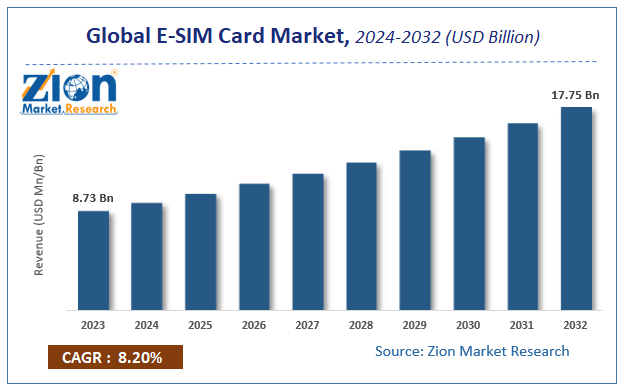
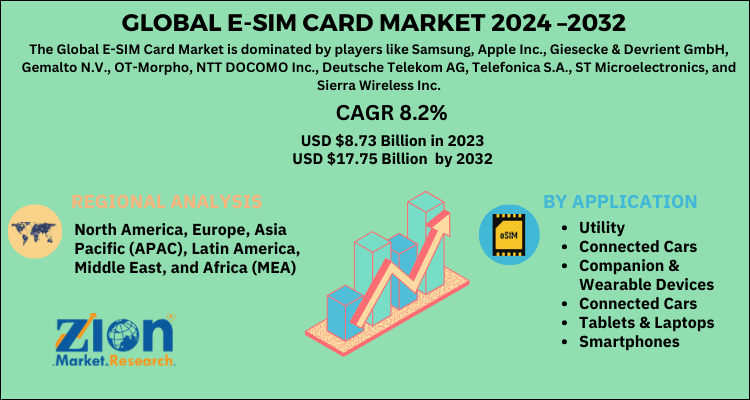
The global E-SIM Card market size was worth around USD 8.73 billion in 2023 and is predicted to grow to around USD 17.75 billion by 2032 with a compound annual growth rate (CAGR) of roughly 8.2% between 2024 and 2032. The study provides historical data from 2018 to 2022 along with a forecast from 2024 to 2032 based on revenue (USD Billion). The report covers a forecast and an analysis of the E-SIM Card market on a global and regional level.
Global E-SIM Card Market: Overview
The global E-SIM card market is increasing progressively owing to the different benefits of E-SIM card in excess of conformist SIM cards. E-SIM card permits altering mobile network service providers at a hardly any clicks, a function distinctive to them. For example, the capability of switching network service providers over the machine to machine air in systems such as connected cars and smart meters has considerable benefits in terms of lowering operational and logistics costs.
Global E-SIM Card Market: Growth Factors
There are various key reasons bringing about development in the global E-SIM card market. In the main, E-SIM card offers the capability of changing network service provider OTA (Over the Air) in synchronized time. Consumers of embedded SIM can alter MNO (mobile network operator) comfortably with hardly any clicks on the gadget in real time hence avoiding consumers to acquire global roaming charges. This is resulting in the increasing growth of the global E-SIM card market.
Among other benefits, consistency of technical specs for Embedded SIM tech provides improved safety in comparison to customary SIM card thereby boosting global E-SIM card market. Embedded SIM tech is consistent with Groupe Speciale Mobile Association. This body involves over 800 mobile service providers all over the world. In addition, the compressed design of E-SIM permits OEMs (original equipment manufacturers) to employ the saved room to either offer additional storage or elevate the battery size in gadgets such as tablets and smartphones powering the global E-SIM card market.
Global E-SIM Card Market: Segmentation
Based on the application, the global E-SIM card market is divided into utility, connected cars, companion & wearable devices, tablets & laptops, smartphones, and others.
On the basis of region, the global E-SIM card market is segmented into North America, Europe, Asia Pacific, and Rest of the World.
E-SIM Card Market: Report Scope
| Report Attributes | Report Details |
|---|---|
| Report Name | E-SIM Card Market |
| Market Size in 2023 | USD 8.73 Billion |
| Market Forecast in 2032 | USD 17.75 Billion |
| Growth Rate | CAGR of 8.2% |
| Number of Pages | 215 |
| Key Companies Covered | Samsung, Apple Inc., Giesecke & Devrient GmbH, Gemalto N.V., OT-Morpho, NTT DOCOMO Inc., Deutsche Telekom AG, Telefonica S.A., ST Microelectronics, and Sierra Wireless Inc |
| Segments Covered | By Application and By Region |
| Regions Covered | North America, Europe, Asia Pacific (APAC), Latin America, Middle East, and Africa (MEA) |
| Base Year | 2023 |
| Historical Year | 2018 - 2022 |
| Forecast Year | 2024 - 2032 |
| Customization Scope | Avail customized purchase options to meet your exact research needs. Request For Customization |
Global E-SIM Card Market: Regional Analysis
The main areas into which the global E-SIM card market is divided based on geography are North America, Europe, Asia Pacific, and Rest of the World. Europe was placed as the top income generation area and is anticipated to show considerable growth in the near future. The preeminence of the region is owing to the flattering government programs for the completion of “Industry 4.0” solutions and technology. France, the U.K., and Germany are the top income contributors to the global E-SIM card market in Europe.
North America held the next top income share in the global E-SIM card market with the U.S. adding the top income. The area is anticipated to show significant increment in the near future. The elevated acceptance of tech as well as home to main industry companies is boosting the growth of global E-SIM card market in this area.
Global E-SIM Card Market: Competitive Players
Some major companies working in the global E-SIM card market are:
- Samsung
- Apple Inc.
- Giesecke & Devrient GmbH
- Gemalto N.V.
- OT-Morpho
- NTT DOCOMO Inc.
- Deutsche Telekom AG
- Telefonica S.A.
- ST Microelectronics
- Sierra Wireless Inc.
The Global E-SIM Card Market is segmented as follows:
By Application
- Utility
- Connected Cars
- Companion & Wearable Devices
- Connected Cars
- Tablets & Laptops
- Smartphones
- Others
By Region
- North America
- The U.S.
- Canada
- Mexico
- Europe
- France
- The UK
- Spain
- Germany
- Italy
- Rest of Europe
- Asia Pacific
- China
- Japan
- India
- Australia
- South Korea
- Rest of Asia Pacific
- The Middle East & Africa
- Saudi Arabia
- UAE
- Egypt
- Kuwait
- South Africa
- Rest of the Middle East & Africa
- Latin America
- Brazil
- Argentina
- Rest of Latin America
What Reports Provides
- Full in-depth analysis of the parent market
- Important changes in market dynamics
- Segmentation details of the market
- Former, on-going, and projected market analysis in terms of volume and value
- Assessment of niche industry developments
- Market share analysis
- Key strategies of major players
- Emerging segments and regional markets
- Testimonials to companies in order to fortify their foothold in the market.
Table Of Content

FrequentlyAsked Questions
An e-SIM card is an embedded digital SIM that eliminates the need for physical SIM cards. It enables remote network activation and easy switching.
The global E-SIM Card market is expected to be driven by the Growth is supported by rising smartphone and IoT device adoption, need for remote provisioning, and multi-network flexibility for travelers. Expansion of connected cars and industrial IoT accelerates eSIM penetration.
According to study, the global E-SIM Card market size was worth around USD 8.73 Billion in 2023 and is predicted to grow to around USD 17.75 Billion By 2032.
The global E-SIM Card market is expected to grow at a Compound Annual Growth Rate (CAGR) of around CAGR 8.2% during the forecast period from 2024-2032.
The global E-SIM Card industry is projected to be challenged by Challenges include carrier interoperability and provisioning complexity, device compatibility constraints, and security concerns around remote SIM management.
The Opportunities include rapid growth of IoT connectivity, rising adoption in smartphones and wearables, demand for seamless global roaming, and enterprise interest in remote device fleet management will offer significant growth opportunities in the E-SIM Card market.
iSIM integration into chipsets; remote provisioning at scale for IoT; stronger security, lifecycle management, and roaming optimization are the emerging trends and innovations impacting the E-SIM Card market.
The global E-SIM Card market is expected to be led by APAC during the forecast period.
Some of the prominent players operating in the global E-SIM Card market are; Samsung, Apple Inc., Giesecke & Devrient GmbH, Gemalto N.V., OT-Morpho, NTT DOCOMO Inc., Deutsche Telekom AG, Telefonica S.A., ST Microelectronics, and Sierra Wireless Inc and others.
The report explores crucial aspects of the E-SIM Card market, including a detailed discussion of existing growth factors and restraints, while also browsing future growth opportunities and challenges that impact the market.
HappyClients