
Global E-Passports Market Growth, Size, Share, Trends, and Forecast 2032

E-Passports Market By Type (Short-Term, Long-Term), By Application (Individual Use, Commercial Use), and By Region - Global and Regional Industry Overview, Market Intelligence, Comprehensive Analysis, Historical Data, and Forecasts 2024 - 2032
| Market Size in 2023 | Market Forecast in 2032 | CAGR (in %) | Base Year |
|---|---|---|---|
| USD 26.32 Billion | USD 56.87 Billion | 8.94% | 2023 |
E-Passports Market: Industry Perspective
What will be the global e-passports market size during the forecast period?
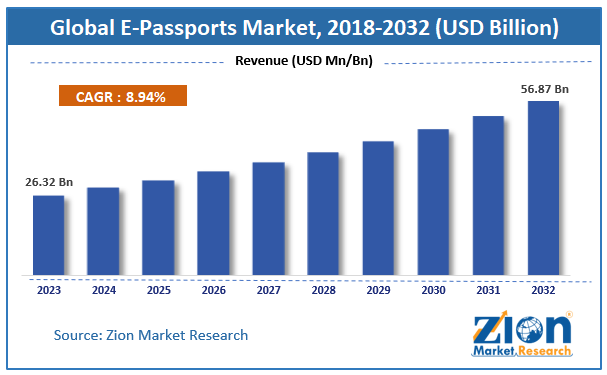
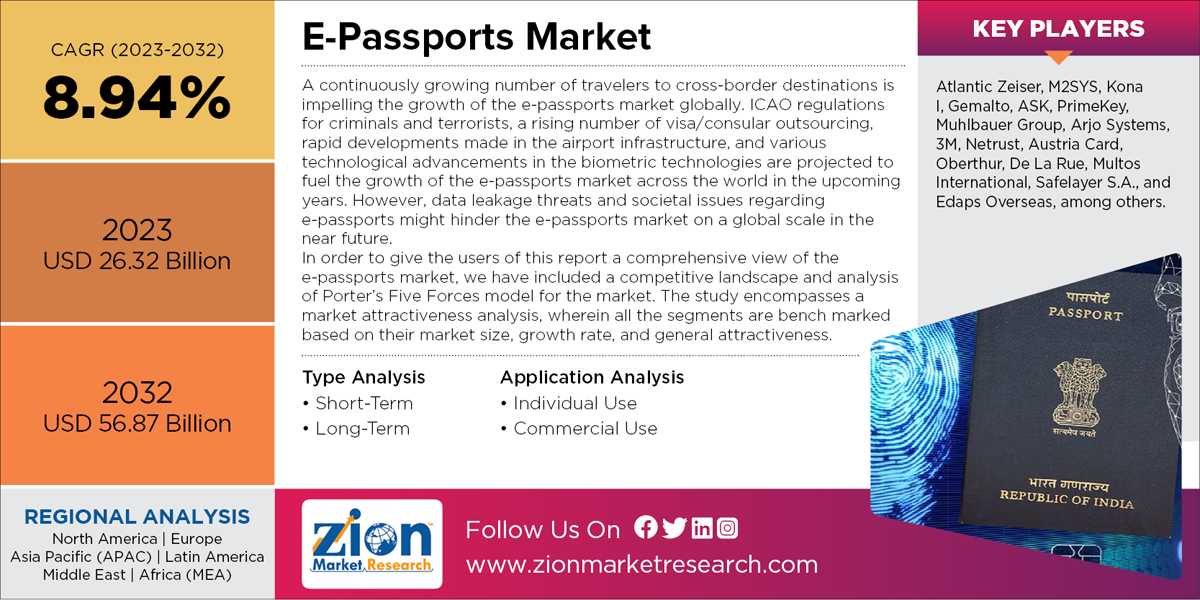
The global e-passports market size was worth around USD 26.32 billion in 2023 and is predicted to reach around USD 56.87 billion by 2032, with a compound annual growth rate (CAGR) of roughly 8.94% between 2024 and 2032.
This report provides a comprehensive analysis of the growth drivers, restraints, and challenges shaping demand across the global e-passports market throughout the forecast period, while highlighting high-potential emerging opportunities within the industry.
Key Insights
- As per the analysis shared by our research analyst, the global e-passports market is estimated to grow annually at a CAGR of around 8.94% over the forecast period (2024-2032).
- In terms of revenue, the global e-passports market size was valued at around USD 26.32 billion in 2023 and is projected to reach USD 56.87 billion by 2032.
- The e-passports market is driven by a continuously growing number of cross-border travelers, ICAO regulations targeting criminal and terrorist activity, rising visa and consular outsourcing, rapid airport infrastructure developments, and technological advancements in biometrics.
- By type, short-term passports are expected to dominate the market because they align with frequent or temporary travel needs.
- By application, commercial use is expected to dominate the market, driven by the growing number of companies sending employees to different countries for projects.
- North America is projected to lead the market during the forecast period, supported by a well-established IT industry in the United States, a large consumer base preferring advanced travel interfaces, and the presence of major companies, while Asia Pacific is expected to record the highest growth rate.
E-Passports Market: Overview
An e-passport, or biometric passport, consists of an electronic chip embedded within an advanced form of traditional travel document. It enhances security and helps restrict fraudulent cases. The use of an e-passport by travelers is recognized digitally across the world. These documents are primarily intended to reduce the risks associated with data duplication and alteration.
E-Passports Market: Growth Drivers
What factors are primarily accelerating demand in the e-passports market?
A growing number of travelers to cross-border destinations is driving global e-passport market growth. ICAO regulations on criminals and terrorists, rising visa/consular outsourcing, rapid developments in airport infrastructure, and advances in biometric technologies are projected to fuel e-passport market growth worldwide in the coming years. However, data leakage threats and societal issues around e-passports may hinder the e-passports market globally in the near future.
E-Passports Market: Restraints
What factors limit the expansion of the e-passport market?
Data leakage threats and societal issues related to the use of e-passports can hinder broader acceptance and slow market expansion in certain regions.
High implementation costs, challenges related to interoperability across borders, and the need for regulatory compliance also influence the pace of system rollout and public acceptance.
E-Passports Market: Opportunities
Where do significant growth opportunities lie for the e-passports market?
Opportunities exist in border security modernization, deeper biometric integration, and the continued recovery and expansion of global travel. Contactless verification, improved interoperability, and anti-counterfeiting features support system upgrades.
Rising awareness of e-passports in developing countries, combined with increasing government procedures for issuance, urbanization, and growing tourism, create additional avenues for volume growth, particularly in Asia Pacific.
E-Passports Market: Challenges
What key challenges confront participants in the e-passports market?
Ensuring robust protection of biometric and personal data against leakage remains a critical challenge. Achieving consistent interoperability across different national systems requires ongoing coordination.
Building public trust while managing the costs of infrastructure upgrades and training further affects the speed of widespread adoption.
E-Passports Market: Report Scope
| Report Attributes | Report Details |
|---|---|
| Report Name | E-Passports Market |
| Market Size in 2023 | USD 26.32 Billion |
| Market Forecast in 2032 | USD 56.87 Billion |
| Growth Rate | CAGR of 8.94% |
| Number of Pages | 240 |
| Key Companies Covered | Atlantic Zeiser, M2SYS, Kona I, Gemalto, ASK, PrimeKey, Muhlbauer Group, Arjo Systems, 3M, Netrust, Austria Card, Oberthur, De La Rue, Multos International, Safelayer S.A., and Edaps Overseas, among others. |
| Segments Covered | By Type, By Application, and By Region |
| Regions Covered | North America, Europe, Asia Pacific (APAC), Latin America, Middle East, and Africa (MEA) |
| Base Year | 2023 |
| Historical Year | 2018 - 2022 |
| Forecast Year | 2024 - 2032 |
| Customization Scope | Avail customized purchase options to meet your exact research needs. Request For Customization |
E-Passports Market: Segmentation
The e-passports market is segmented by type, application, and region. All the segments of the e-passports market have been analyzed based on present and future trends, and the market is estimated from 2024 to 2032.
By type segment, the e-passports market is divided into short-term and long-term. Short-term passports are anticipated to dominate the market because they align well with the needs of frequent or temporary international travel. This dominance supports overall market growth by addressing high-volume, shorter-duration travel patterns and encouraging efficient issuance and verification processes that meet the requirements of both individual and commercial travelers.
By application segment, the e-passport market is divided into individual and commercial use. Commercial use is anticipated to dominate the market due to the growing expansion of companies that send employees to different countries for projects. This trend creates consistent demand for secure, fast-processed travel documents, driving investment in reliable e-passport systems and supporting broader market expansion through corporate travel. Individual use continues to contribute meaningfully through personal leisure and other non-commercial travel needs.
E-Passports Market: Regional Analysis
Why will North America continue to dominate the global market during the projection period?
North America is projected to lead the e-passports market during the forecast period due to the well-established IT industry in the U.S., a large consumer base that prefers technically advanced customer-interface software for travel planning, and the presence of major companies. The combination of technological maturity, substantial travel volumes, and strong corporate activity drives overall market growth by establishing high performance and security standards, encouraging innovation in biometric and contactless solutions, and sustaining demand for advanced e-passport systems.
Asia Pacific is predicted to show the highest growth rate in demand for e-passports, mainly due to rising awareness of e-passports in developing countries and increasing government efforts to issue e-passports. The growing adoption of advanced systems, urbanization, and increased tourism are other major factors driving the huge growth of the Asia Pacific e-passports market.
E-Passports Market: Competitive Landscape
The key players in the global e-passports market are
- Atlantic Zeiser
- M2SYS
- Kona I
- Gemalto
- ASK
- PrimeKey
- Muhlbauer Group
- Arjo Systems
- 3M
- Netrust
- Austria Card
- Oberthur
- De La Rue
- Multos International
- Safelayer S.A.
- Edaps Overseas
E-Passports Market: Key Trends
What are the key trends in the e-passports market?
Expansion of biometric security features
Biometric-enabled secure passports and related identity verification technologies are increasingly integrated into border control systems to strengthen security and streamline processing.
Rising commercial and government adoption
Growing corporate international assignments and expanding government issuance programs continue to support higher volumes of e-passport deployment and related system upgrades.
Segments Covered
This report segments the global e-passports market into:
By Type
- Short-Term
- Long-Term
By Application
- Individual Use
- Commercial Use
By Region
- North America
- The U.S.
- Canada
- Mexico
- Europe
- France
- The UK
- Spain
- Germany
- Italy
- Rest of Europe
- Asia Pacific
- China
- Japan
- India
- Australia
- South Korea
- Rest of Asia Pacific
- The Middle East & Africa
- Saudi Arabia
- UAE
- Egypt
- Kuwait
- South Africa
- Rest of the Middle East & Africa
- Latin America
- Brazil
- Argentina
- Rest of Latin America
Table Of Content
Methodology
FrequentlyAsked Questions
E-passports are electronic passports embedded with digital chips. They store biometric data for secure identity verification.
The global E-passports market is expected to be driven by the border security needs, international travel growth, and government adoption of biometric identification systems.
According to study, the global E-passports market size was worth around USD 26.32 Billion in 2023 and is predicted to grow to around USD 56.87 Billion By 2032.
The global E-passports market is expected to grow at a Compound Annual Growth Rate (CAGR) of around CAGR 8.94% during the forecast period from 2024-2032.
The global E-passports industry is projected to be challenged by Challenges include high implementation costs, data security risks, and interoperability across borders. Regulatory compliance and public acceptance affect rollout speed.
The opportunities lie in border security modernization, biometric integration, and global travel recovery. Contactless verification, interoperability, and anti-counterfeiting features drive upgrades will offer significant growth opportunities in the E-passports market.
Biometric-enabled secure passports; contactless and encrypted chips; enhanced border control integration are the emerging trends and innovations impacting the E-passports market.
North America is expected to lead the global E-passports market during the forecast period.
Some of the prominent players operating in the global E-passports market are: Atlantic Zeiser, M2SYS, Kona I, Gemalto, ASK, PrimeKey, Muhlbauer Group, Arjo Systems, 3M, Netrust, Austria Card, Oberthur, De La Rue, Multos International, Safelayer S.A., and Edaps Overseas, and others.
The report explores crucial aspects of the E-passports market, including a detailed discussion of existing growth factors and restraints, while also browsing future growth opportunities and challenges that impact the market.

HappyClients

