
Global Aviation Infrastructure Market Size, Share, Trends, Growth 2032

Aviation Infrastructure Market By Airport Type (Brownfield and Greenfield Airport), By Application (Hangars, Maintenance, Repair and Overhaul (MRO) Facilities, Airport Terminal, Warehousing, Runways), and By Region - Global and Regional Industry Overview, Market Intelligence, Comprehensive Analysis, Historical Data, and Forecasts 2024 - 2032
| Market Size in 2023 | Market Forecast in 2032 | CAGR (in %) | Base Year |
|---|---|---|---|
| USD 866.49 Billion | USD 1254.79 Billion | 4.2% | 2023 |
How big is the Aviation Infrastructure Market?
The global aviation infrastructure market size was worth around USD 866.49 billion in 2023 and is predicted to grow to around USD 1254.79 billion by 2032 with a compound annual growth rate (CAGR) of roughly 4.2% between 2024 and 2032. The report analyzes the global aviation infrastructure market's drivers, restraints/challenges, and the effect they have on the demands during the projection period. In addition, the report explores emerging opportunities in the aviation infrastructure industry.
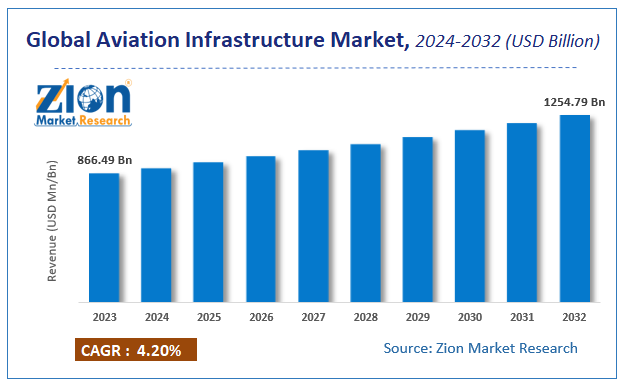
Aviation Infrastructure Market: Overview
The aviation infrastructure market has likely to have prominent opportunities in the upcoming future and is expected to grow at a single digit CAGR within the forecast period. This market is growing at the substantial phase owing to rise in the numbers of air travelers. Most of the airport operators are investing on infrastructure development which will drive the market. Moreover, aviation industry is emphasizing on technology for better functioning and strategic development which will create demand for aviation infrastructure market. The International Air Transport Association works with government and airport authorities for airline safety, infrastructure development with high efficiency to strengthen the market.
What are the Market Dynamics of Aviation Infrastructure Market?
Growth Drivers
Rising global air travel demand, fueled by economic growth in emerging markets and increasing middle-class populations, is a primary driver for aviation infrastructure expansion. Investments in new airports and upgrades to existing ones are accelerating to accommodate projected passenger growth, with governments and private entities prioritizing capacity enhancements. Technological advancements, such as AI-driven air traffic management and sustainable building materials, further propel the market by improving efficiency and reducing operational costs.
Restraints
High capital requirements for infrastructure projects pose significant barriers, often leading to delays or cancellations due to funding shortages or economic downturns. Regulatory hurdles, including stringent environmental compliance and safety standards, increase project timelines and costs. Additionally, geopolitical tensions and supply chain disruptions can hinder material availability and international collaborations essential for large-scale developments.
Opportunities
The shift toward sustainable aviation presents opportunities for green infrastructure, such as solar-powered terminals and low-emission facilities, aligning with global net-zero goals. Emerging markets in Asia-Pacific and the Middle East offer vast potential for new airport constructions and vertiport integrations for urban air mobility. Digital transformation, including IoT and big data analytics, opens avenues for smart airport solutions that enhance passenger experiences and operational resilience.
Challenges
Skilled labor shortages in construction and engineering sectors challenge timely project execution, exacerbated by aging workforces in developed regions. Environmental concerns, like noise pollution and land use conflicts, complicate site selections and approvals. Moreover, cybersecurity threats to interconnected systems and the need for resilient infrastructure against climate change impacts add layers of complexity to long-term planning.
Global Aviation Infrastructure Market Size: Segmentation
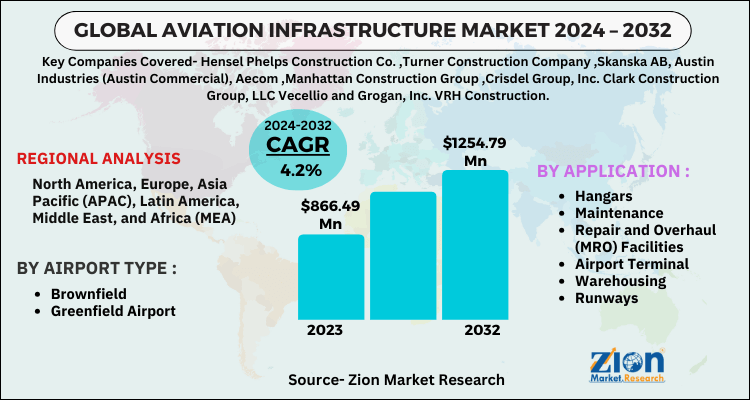
The aviation infrastructure market has been segmented on the basis of airport type, geography and application. All the segments have been analyzed based on present and future trends and the market is estimated from 2026 to 2035.
Based on airport type, aviation infrastructure market is categorized in two types named as Brownfield and Greenfield Airport. The infrastructure which has done on unused land refers to green field airports whereas demolishing and upgrading existing infrastructure refers to brownfield type.
Based on application, this market caters to MRO facilities, warehousing, airport terminals and runways. In 2017 North America dominated the market but due to rise in per capita income in Asia-Pacific region, the aviation infrastructure market is on faster phase and anticipated to reach highest CAGR and market share by 2026.
Aviation Infrastructure Market: Report Scope
| Report Attributes | Report Details |
|---|---|
| Report Name | Aviation Infrastructure Market |
| Market Size in 2023 | USD 866.49 Billion |
| Market Forecast in 2032 | USD 1254.79 Billion |
| Growth Rate | CAGR of 4.2% |
| Number of Pages | 110 |
| Key Companies Covered | Hensel Phelps Construction Co. ,Turner Construction Company ,Skanska AB, Austin Industries (Austin Commercial), Aecom ,Manhattan Construction Group ,Crisdel Group, Inc. Clark Construction Group, LLC Vecellio and Grogan, Inc. VRH Construction |
| Segments Covered | By Product, By Application and By Region |
| Regions Covered | North America, Europe, Asia Pacific (APAC), Latin America, Middle East, and Africa (MEA) |
| Base Year | 2023 |
| Historical Year | 2018 - 2022 |
| Forecast Year | 2024 - 2032 |
| Customization Scope | Avail customized purchase options to meet your exact research needs. Request For Customization |
What is the Regional Analysis of Aviation Infrastructure Market?
North America to dominate the global market.
North America leads the aviation infrastructure market with a 40% share, driven by robust investments in modernization projects across the US and Canada, where dominating countries like the US benefit from federal programs such as the Bipartisan Infrastructure Law funding airport upgrades; this region's mature ecosystem supports high traffic volumes at hubs like Atlanta and Chicago, fostering innovation in smart technologies and sustainable practices that enhance operational efficiency and economic impact.
Asia-Pacific is experiencing the fastest growth, propelled by rapid urbanization and air travel demand in countries like China and India, which dominate the region through massive airport expansions such as Beijing Daxing and new facilities in Mumbai; these developments address capacity constraints and integrate advanced systems for seamless operations, contributing significantly to global trade and tourism connectivity.
Europe maintains a strong position with emphasis on sustainability and regulatory compliance, where Germany and France lead through projects like Frankfurt's expansion and Paris Charles de Gaulle's renovations; these efforts focus on reducing emissions and improving passenger experiences, supported by EU funding that promotes integrated transport networks across the continent.
Latin America shows promising growth amid infrastructure investments, with Brazil and Mexico as key players through upgrades at Sao Paulo and Mexico City airports; these initiatives aim to boost regional connectivity and attract international carriers, overcoming challenges like funding limitations to capitalize on tourism and trade opportunities.
The Middle East and Africa region is expanding through ambitious projects in the UAE and Saudi Arabia, dominating with developments like Dubai International's enhancements and Riyadh's new terminals; these focus on luxury and efficiency to position the area as a global transit hub, while African nations like Ethiopia invest in Addis Ababa to improve intra-continental links despite infrastructural hurdles.
What are the Market Trends in Aviation Infrastructure Market?
- Adoption of sustainable practices, including green building materials and renewable energy integration in airport designs to meet net-zero emission targets.
- Rise of smart airports leveraging IoT, AI, and big data for predictive maintenance and enhanced passenger experiences.
- Increased focus on urban air mobility infrastructure, such as vertiports for eVTOL aircraft, to support future transportation modes.
- Growth in public-private partnerships to fund large-scale projects amid budget constraints.
- Emphasis on resilience against climate change, with investments in flood-resistant runways and adaptive designs.
- Digitalization of air traffic management systems to improve safety and reduce delays.
- Expansion of cargo facilities driven by e-commerce boom and global supply chain needs.
Global Aviation Infrastructure Market Size: Competitive Players
- Hensel Phelps Construction Co.
- Turner Construction Company
- Skanska AB
- Austin Industries (Austin Commercial)
- Aecom
- Manhattan Construction Group
- Crisdel Group
- Clark Construction Group
- LLC Vecellio and Grogan
- VRH Construction
The report segments the global aviation infrastructure market as follows:
By Airport Type
- Brownfield
- Greenfield Airport
By Application
- Hangars
- Maintenance
- Repair and Overhaul (MRO) Facilities
- Airport Terminal
- Warehousing
- Runways
By Region
- North America
- The U.S.
- Canada
- Mexico
- Europe
- France
- The UK
- Spain
- Germany
- Italy
- Rest of Europe
- Asia Pacific
- China
- Japan
- India
- Australia
- South Korea
- Rest of Asia Pacific
- The Middle East & Africa
- Saudi Arabia
- UAE
- Egypt
- Kuwait
- South Africa
- Rest of the Middle East & Africa
- Latin America
- Brazil
- Argentina
- Rest of Latin America
Table Of Content
Methodology
FrequentlyAsked Questions
The physical and organisational structures required for the operation of air transport are referred to as aviation infrastructure. It encompasses a diverse array of services and facilities that are indispensable for the operation of the aviation industry, air traffic management, and airports.
The demand for air travel worldwide is on the rise, primarily due to the expansion of the middle class, rising incomes, and economic development, particularly in Asia and other emerging markets. The demand for air cargo is increased by the growth of e-commerce and global trade, which necessitates the expansion of infrastructure.
The global aviation infrastructure market size was worth around USD 866.49 billion in 2023 and is predicted to grow to around USD 1254.79 billion by 2032.
The global aviation infrastructure market a compound annual growth rate (CAGR) of roughly 4.2% between 2024 and 2032.
North America dominated the market but due to rise in per capita income in Asia-Pacific region, the aviation infrastructure market is on faster phase and anticipated to reach highest CAGR and market share by 2026.
Hensel Phelps Construction Co. ,Turner Construction Company ,Skanska AB, Austin Industries (Austin Commercial), Aecom ,Manhattan Construction Group ,Crisdel Group, Inc. Clark Construction Group, LLC Vecellio and Grogan, Inc. VRH Construction
The report provides comprehensive analysis including market size, trends, segmentation, regional insights, key players, and forecasts.
Stages include planning and design, construction and engineering, operations and maintenance, financing and investment, and technology integration.
Trends are shifting toward sustainability and digitalization, with preferences for seamless, contactless experiences and eco-friendly facilities.
Factors include stringent emission regulations, safety standards, and climate resilience requirements that drive investments in green and adaptive infrastructure.

List of Contents
How big is the Market?OverviewWhat are the Market Dynamics of Market?Global Market Size: SegmentationReport ScopeWhat is the Regional Analysis of Market?What are the Market Trends in Market?Global Market Size: Competitive PlayersThe report segments the global aviation infrastructure market as follows:HappyClients

