
Global Drone Logistics Market Size, Share, Growth Analysis Report - Forecast 2034

Drone Logistics Market By Component (Software, Hardware, and Services), By Application (Transportation Management and Warehouse & Storage Management), By End-User (Military and Commercial), and By Region - Global and Regional Industry Overview, Market Intelligence, Comprehensive Analysis, Historical Data, and Forecasts 2025 - 2034
| Market Size in 2024 | Market Forecast in 2034 | CAGR (in %) | Base Year |
|---|---|---|---|
| USD 16.47 Billion | USD 165.08 Billion | 25.92% | 2024 |
What is the Market size of the Drone Logistics Market?
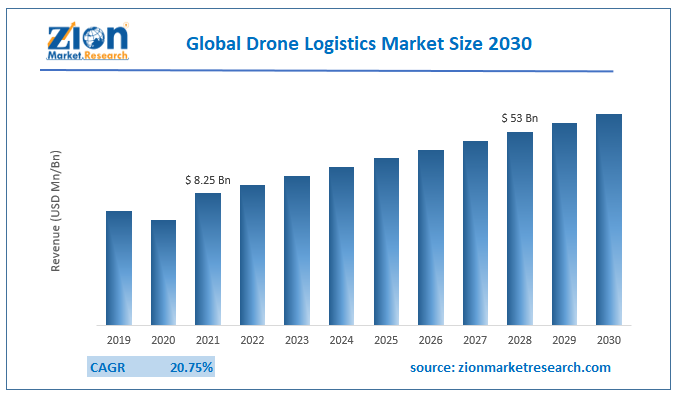
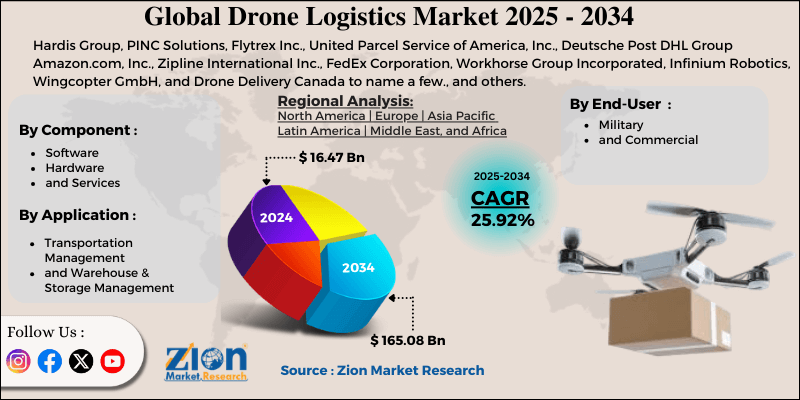
The global drone logistics market size was worth around USD 16.47 billion in 2024 and is predicted to reach around USD 165.08 billion by 2034, with a compound annual growth rate (CAGR) of roughly 25.92% between 2025 and 2034. This report provides a comprehensive analysis of the growth drivers, restraints, and challenges shaping demand across the global drone logistics market throughout the forecast period, while highlighting high-potential emerging opportunities within the industry.
Key Insights
- As per the analysis shared by our research analyst, the global drone logistics market is estimated to grow annually at a CAGR of around 25.92% over the forecast period (2025-2034).
- Regarding revenue, the global drone logistics market size was valued at around USD 16.47 Billion in 2024 and is projected to reach USD 165.08 Billion by 2034.
- The drone logistics market is projected to grow at a significant rate due to growing e-commerce, the need for last-mile delivery solutions, and advancements in autonomous drone technology.
- By component, the Software segment is expected to lead the global market.
- By Application, the Transportation Management segment is growing at a high rate and will continue to dominate the global market.
- Based on the End-User, the Military segment is projected to capture the largest market share.
- Based on region, North America is predicted to dominate the global market during the forecast period.
Drone Logistics Market: Overview
A drone, also called an unmanned aerial vehicle (UAV), is any aircraft that does not require a human pilot. Drones have no space for passengers. Drones fall under the category of unmanned aircraft systems (UAS). Operators control these devices from the ground using controllers and communication systems.
Drones emerged in the 20th century and were mainly developed by military personnel for national security; over time, however, many non-military-grade drones have emerged with uses ranging from recreation to logistics. This became possible as drone manufacturing costs decreased and awareness of the products increased. Logistics refers to transporting goods from one point to another for business purposes. Drone logistics requires the use of drones for the movement of products.
Drone Logistics Market: Growth Drivers
What factors are primarily accelerating demand in the drone logistics market?
The global drone logistics market is projected to grow due to increasing traffic worldwide. A growing population, increased use of private vehicles for transport, a growing automobile industry, and lifestyle changes driven by a higher standard of living are among the factors behind the steady rise in time spent in traffic over the last couple of years. In 2010, China witnessed the worst traffic jam, lasting more than 12 days.
The traffic jam stretched across 100 kilometers and drove up food and water prices. Such incidents have become common in the modern world, and businesses suffer from delays in package delivery. To adopt innovative ways many firms have started investing in drone technology to help them carry out their businesses. As per a 2019 report, traffic congestion cost the US economy more than USD 85 million in losses.
Drone Logistics Market: Restraints
What factors are limiting the expansion of the drone logistics market?
The global drone logistics market is projected to face growth restrictions due to the high cost of drones and increased operating expenses. Although systems have become more affordable, they remain out of reach for many businesses, since bulk buying can increase total associated capital. A high-technology drone can cost between USD 15000 to USD 16000 making buying in numbers a difficult choice for mid or small-sized firms. However, research and development into manufacturing affordable drones is underway and may soon become a widely accepted reality.
Drone Logistics Market: Opportunities
Where do significant growth opportunities lie for the drone logistics market?
Many experts view drones as the future of logistics because of the benefits associated with the technology. Drones not only expand transportation routes, but because they can cover more areas, the technology is also considered environmentally friendly. Drones run on batteries rather than fuel, which reduces carbon dioxide emissions, a by-product of fossil-fuel-powered transportation. Transportation is one of the top industries causing air pollution, accounting for over 26% of greenhouse gases in the United States.
Drone Logistics Market: Challenges
What key challenges confront participants in the drone logistics market?
Even the most advanced drones have relatively lower payload capacity compared to traditional product transport. This is a major challenge for the global drone logistics market, as it heavily restricts the types of products that can be transported from one point to another. For instance, beginner-level drones cannot lift anything more than 300 grams of added weight. Only military-grade drones have the capacity to lift around 500 kilograms of payload, but they are too expensive for commercial purposes.
Drone Logistics Market: Report Scope
| Report Attributes | Report Details |
|---|---|
| Report Name | Drone Logistics Market |
| Market Size in 2024 | USD 16.47 Billion |
| Market Forecast in 2034 | USD 165.08 Billion |
| Growth Rate | CAGR of 25.92% |
| Number of Pages | 226 |
| Key Companies Covered | Hardis Group, PINC Solutions, Flytrex Inc., United Parcel Service of America, Inc., Deutsche Post DHL Group, Amazon.com, Inc., Zipline International Inc., FedEx Corporation, Workhorse Group Incorporated, Infinium Robotics, Wingcopter GmbH, Drone Delivery Canada, and others. |
| Segments Covered | By Component, By Application, By End-User, and By Region |
| Regions Covered | North America, Europe, Asia Pacific (APAC), Latin America, The Middle East and Africa (MEA) |
| Base Year | 2024 |
| Historical Year | 2020 - 2024 |
| Forecast Year | 2025 - 2034 |
| Customization Scope | Avail customized purchase options to meet your exact research needs. Request For Customization |
Drone Logistics Market: Segmentation
The drone logistics market is segmented by component, application, end-user, and region. All the segments of the drone logistics market have been analyzed based on present and future trends and the market is estimated from 2025 to 2034.
By component, the global drone logistics market is divided into Software, Hardware, and Services. The software segment is expected to lead the global market because mission planning, fleet management, navigation, and logistics coordination software are essential for safe, efficient drone operations. This leadership drives overall market growth by enabling scalable control of routes, inventories, and deliveries, supporting both transportation management and warehouse applications and encouraging continued investment in digital platforms that complement hardware and services.
By application, the global market segments are transportation management and warehouse & storage management. In 2024, the warehouse & storage management segment dominated the global market, driven by the use of drones to manage inventory in large production facilities. Since a couple of drones can be effective in managing warehouses, more businesses are investing in small-scale drones. However, the transportation management segment may grow at a high CAGR of 25% during the forecast period, driven by growing awareness among organizations and product innovation by drone manufacturers to meet the needs of all consumer types.
By end-user, the drone logistics market is divided into military and commercial. The military segment is projected to hold the largest market share, supported by national security requirements and investment in logistical capabilities. This position helps drive demand for higher-capability systems, while the commercial segment continues to expand with e-commerce, last-mile delivery, and warehouse applications and is expected to grow at a strong rate as costs and regulations evolve.
Drone Logistics Market: Regional Analysis
Why will North America continue to dominate the global market during the projection period?
The global drone logistics market is projected to witness the highest CAGR in North America. The US is expected to lead with the highest regional market share, driven by its advanced economy and technology-driven business approach. The US has been at the forefront of adopting advanced systems to automate as many processes as possible.
This approach has helped the country become a superpower and is one of the main reasons it has been able to influence the rest of the world. Skydio, the largest drone producer, is based in the US, and in 2021 it crossed the USD 1 billion mark in value. High spending by the military division on drones for various logistical purposes is another factor driving regional market growth. In fiscal year 2017, the US government's military division allocated more than 4.61 billion for drone-related expenses.
Recent Developments:
-
In March 2024, United Parcel Service announced that its flight-forward drone logistics division received expanded regulatory clearance to operate automated delivery aircraft beyond visual line of sight without dedicated ground spotters, significantly broadening its commercial delivery footprint across healthcare and campus facilities.
-
In November 2023, Amazon unveiled its next-generation MK30 delivery drone, featuring a lightweight, weather-resistant airframe engineered to fly double the distance of previous models while operating at substantially reduced acoustic noise levels in suburban delivery zones.
- In October 2020, the Indian Army stepped up its efforts in a bid to procure 363 drones for national security reasons across the China border.
Drone Logistics Market: Competitive Analysis
The global drone logistics market is dominated by players like:
- Hardis Group
- PINC Solutions
- Flytrex Inc.
- United Parcel Service of America Inc.
- Deutsche Post DHL Group
- Amazon.com Inc.
- Zipline International Inc.
- FedEx Corporation
- Workhorse Group Incorporated
- Infinium Robotics
- Wingcopter GmbH
- Drone Delivery Canada.
Drone Logistics Market: Key Trends
What are the key trends in the drone logistics market?
Software-led operations and autonomous technology
Software for mission planning, fleet management, and logistics coordination is expected to lead component demand as organizations scale drone operations and advance autonomous delivery capabilities.
Focus on last-mile and transportation management
Transportation management continues to dominate application growth as e-commerce and last-mile needs drive adoption, supported by product innovation that expands the range of delivery use cases.
The global drone logistics market is segmented as follows;
By Component
- Software
- Hardware
- and Services
By Application
- Transportation Management
- Warehouse & Storage Management
By End-User
- Military
- Commercial
By Region
- North America
- The U.S.
- Canada
- Mexico
- Europe
- France
- The UK
- Spain
- Germany
- Italy
- Rest of Europe
- Asia Pacific
- China
- Japan
- India
- Australia
- South Korea
- Rest of Asia Pacific
- The Middle East & Africa
- Saudi Arabia
- UAE
- Egypt
- Kuwait
- South Africa
- Rest of the Middle East & Africa
- Latin America
- Brazil
- Argentina
- Rest of Latin America
Table Of Content
Methodology
FrequentlyAsked Questions
Drone logistics refers to the utilization of autonomous or remotely piloted unmanned aerial vehicles (UAVs) to transport freight, deliver commercial packages, distribute urgent medical items, and execute automated warehouse inventory auditing without relying on ground roadway infrastructure.
The primary growth drivers include severe ground roadway traffic congestion, surging consumer demand for fast, on-demand e-commerce package deliveries, expanding requirements for rapid medical transport, and the economic benefits of automated warehouse inventory management.
The global drone logistics market was valued at approximately USD 16.47 billion in 2024 and is projected to reach around USD 165.08 billion by 2034.
The global drone logistics market is projected to expand at a compound annual growth rate (CAGR) of roughly 25.92% over the forecast period from 2025 to 2034.
North America represents the most notable contributor to overall market value due to early regulatory integration for commercial BVLOS deliveries, massive defense logistics spending, and substantial commercial investments by leading retail and express courier corporations.
The major players leveraging market growth include Hardis Group, PINC Solutions, Flytrex Inc., United Parcel Service of America Inc., Deutsche Post DHL Group, Amazon.com Inc., Zipline International Inc., FedEx Corporation, Workhorse Group Incorporated, CANA Advisors, Infinium Robotics, Drone Delivery Canada, Matternet, Aerovironment, and DroneScan.
The report delivers a comprehensive evaluation of historical market valuations, quantitative and qualitative growth drivers, regulatory developments, competitive vendor market shares, segment forecasts, and regional investment opportunities through 2034.

HappyClients

