
Global Digital Mammography Market Size, Share, Growth Trends and Forecast 2034

Digital Mammography Market By Product (2D Full Field Digital Mammography, Tomosynthesis, and 3D Full Field Digital Mammography Tomosynthesis), By End-use (Hospitals, Diagnostic Centers, and Others), and Region - Global and Regional Industry Overview, Market Intelligence, Comprehensive Analysis, Historical Data, and Forecasts 2026 - 2034
| Market Size in 2025 | Market Forecast in 2034 | CAGR (in %) | Base Year |
|---|---|---|---|
| USD 1.98 Billion | USD 4.74 Billion | 10.2% | 2025 |
Digital Mammography Industry Perspective:
What will be the size of the global digital mammography market during the forecast period?
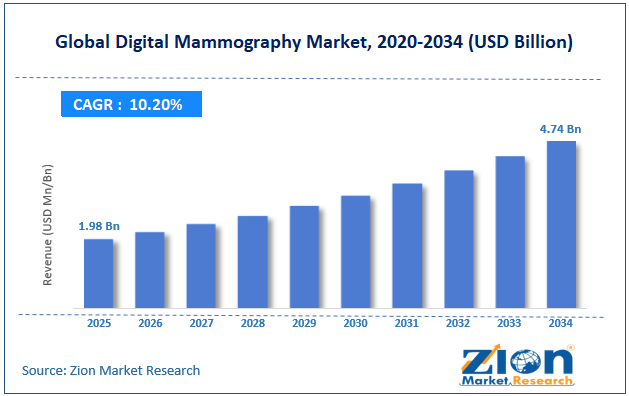
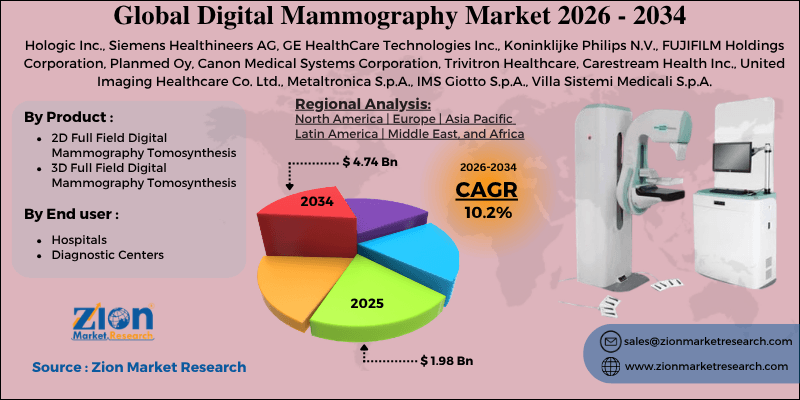
The global digital mammography market size was worth around USD 1.98 billion in 2025 and is predicted to grow to around USD 4.74 billion by 2034, with a compound annual growth rate (CAGR) of roughly 10.2% between 2026 and 2034.
This report provides a comprehensive analysis of the growth drivers, restraints, and challenges shaping demand across the global digital mammography market throughout the forecast period, while highlighting high-potential emerging opportunities within the industry.
Key Insights
- As per the analysis shared by our research analyst, the global digital mammography market is estimated to grow annually at a CAGR of around 10.2% over the forecast period (2026-2034).
- In terms of revenue, the global digital mammography market size was valued at around USD 1.98 billion in 2025 and is projected to reach USD 4.74 billion by 2034.
- Growing awareness among women is expected to drive the digital mammography market.
- Based on the product, the 2D full-field digital mammography segment dominates with a revenue share of 62% in 2025.
- Based on the end-use, the hospitals segment holds a majority of market share in 2025 of 46%.
- Based on region, North America dominates the Digital Mammography market with a revenue share of 36.5% in 2025.
Digital Mammography Market: Overview
The digital mammography market is the global market for mammography devices that use digital receptors and computer technology to acquire, process, store, and view breast X-ray images to diagnose anomalies. While film-based mammography uses X-ray film to detect abnormalities, digital mammography converts the X-ray signal into computer signals. Digital mammography enables easier image interpretation, storage, and transmission, giving radiologists ready access to breast images. The digital mammography market includes products such as FFDM and 3D mammography, hardware components, software systems, and services. Market trends driving growth in digital mammography include an increase in the prevalence of breast cancer and a rise in awareness toward early screening.
The growing popularity of breast cancer screening programs, the development of advanced imaging techniques to improve image resolution and efficiency, and the use of less invasive diagnostic tools to identify tumors are also key drivers. Artificial intelligence (AI) coupled with computer-aided detection systems (CAD) is improving mammography image interpretation and diagnostic efficiency, further fueling growth in digital mammography systems in hospitals, diagnostic imaging centers, and breast health clinics.
Impact of the USA-Israel War on Iran on the Digital Mammography Market
The US-Israel war on Iran, as expected, is likely to negatively affect Iran's digital mammography market in the short run through the disruption of health supply chains, elevated cost of transport and equipment, and inability to procure specialized imaging equipment (including spares and software) into the country. Due to the war, restrictions imposed along the Strait of Hormuz have created logistical problems and increased the cost of healthcare products in the region. Sanctions are a pre-existing barrier that complicates procurement, as well as after-sales services and maintenance of capital medical equipment in Iran.
The ongoing war and prioritization of emergency and trauma care are likely to defer spending on non-emergent diagnostic equipment, including digital mammography. The chronic need for breast cancer screening and replacement of outdated radiology equipment will likely serve to drive long-run market recovery.
Digital Mammography Market: Dynamics
Growth Drivers
How does the rising prevalence of breast cancer drive the digital mammography market?
The increasing incidence of breast cancer globally acts as a key catalyst to drive the growth of the digital mammography market due to growing patient numbers raising the demand for early detection, screening, and early diagnostic imaging for treatment. The U.S. National Cancer Institute (NCI) estimates the following incidence in the U.S. in 2025. It is anticipated that there will be about 316,950 new cases of invasive breast cancer in women. 59,080 cases were estimated for DCIS, and approximately 42,170 women are expected to lose their lives due to breast cancer in the U.S. in 2025, breast cancer being the most diagnosed cancer among U.S. women overall in the year 2025.
The same trend is visible in U.S. surveillance data. The incidence data from the NCI’s SEER program reports that the age-adjusted incidence of female breast cancer increased by 0.7% annually during 2014-2023, confirming the increased disease burden in the population. This growing disease burden has led governments and healthcare providers to increase mammography screening and invest in updated imaging equipment. Because mammography helps detect breast cancer in the early stages, the heightened focus on early detection further boosts demand for digital mammography and 3D breast tomosynthesis equipment in breast clinics, diagnostic centers, and hospitals.
Restraints
High implementation and deployment costs act as a major restraint on the growth of the digital mammography industry
High implementation and deployment costs restrain the growth in the digital mammography industry, especially for small hospitals, diagnostic centers, and healthcare facilities in emerging and low-resource markets. Setup costs include purchasing the imaging unit, installation, room modifications, image-processing workstations, software, quality-control programs, training, maintenance, and medical physics support. FDA states that digital mammography facilities need equipment calibration, quality assurance, maintenance procedures, and trained personnel. A significant financial burden arises when DBT technology is adopted to create a digital breast tomosynthesis. For instance, the Scottish Government estimated spending about £50,000 per X-ray unit to enable DBT and an additional £4,500 per year for a service contract.
Moreover, to perform biopsies, facilities may need to invest in biopsy equipment. Furthermore, meeting regulatory requirements also carries costs. For instance, in the U.S., mammography facilities must meet accreditation, annual medical-physicist surveys, inspections, quality assurance, and other requirements under the Mammography Quality Standards Act. Consequently, significant capital expenditures and ongoing costs discourage hospitals and other facilities from purchasing new equipment and investing in 3D technology, hindering growth in the digital mammography industry in a cost-sensitive healthcare environment.
Opportunities
How does the evolution of AI-powered digital mammography systems offer a lucrative opportunity for the digital mammography market?
The development of AI-powered digital mammography systems is a major opportunity for the digital mammography market, as these technologies can improve the speed, consistency, and accuracy of breast image interpretation. Algorithms based on AI can estimate breast density, analyze mammographic images in bulk, identify microcalcifications and worrisome lumps, and help radiologists prioritize tests. "AI can quickly analyze mammograms and NCI-supported research has shown the promise for better identification of breast cancer and long-term risk assessment,” according to the National Cancer Institute.
For instance, in June 2026, FUJIFILM India, a leader in advanced diagnostic imaging solutions, announced the installation of its latest AI-powered digital mammography system, AMULET SOPHINITY, at NM Medical, Khar. The announcement was made during an installation event at NM Medical, reinforcing FUJIFILM India’s continued commitment to strengthening preventive healthcare infrastructure and enabling early breast cancer detection through advanced imaging innovation.
Challenges
Why does the shortage of skilled professionals pose a significant challenge to the growth of the digital mammography industry?
The digital mammography sector's growth is constrained by a shortage of qualified personnel. Trained radiologists, radiologic technologists, and medical physicists are needed to operate and interpret mammography devices. The U.S. FDA mandates that mammography facilities meet specified personnel qualification and training standards, including those for physicians who interpret mammograms, technicians who perform examinations, and medical physicists who evaluate equipment. The challenge worsens with the advent of digital breast tomosynthesis (DBT), which requires additional modality-specific training for interpreting physicians, technologists, and medical physicists.
Therefore, a shortage of competent workers can negatively impact equipment use, increase the burden for current staff, lengthen reporting times, and make it difficult for hospitals and diagnostic centers, particularly in rural and underserved areas, to develop their digital mammography services. The Food and Drug Administration’s National Mammography Quality Assurance Advisory Committee identified shortages of mammography facilities and health-care professionals in rural and health-professional-shortage areas as a concern related to access to mammography services.
Digital Mammography Market: Report Scope
| Report Attributes | Report Details |
|---|---|
| Report Name | Digital Mammography Market |
| Market Size in 2025 | USD 1.98 Billion |
| Market Forecast in 2034 | USD 4.74 Billion |
| Growth Rate | CAGR of 10.2% |
| Number of Pages | 229 |
| Key Companies Covered | Hologic Inc., Siemens Healthineers AG, GE HealthCare Technologies Inc., Koninklijke Philips N.V., FUJIFILM Holdings Corporation, Planmed Oy, Canon Medical Systems Corporation, Trivitron Healthcare, Carestream Health Inc., United Imaging Healthcare Co. Ltd., Metaltronica S.p.A., IMS Giotto S.p.A., Villa Sistemi Medicali S.p.A., Allengers Medical Systems Limited, General Medical Merate S.p.A. (GMM), and others. |
| Segments Covered | By Product, By End-use, and By Region |
| Regions Covered | North America, Europe, Asia Pacific (APAC), Latin America, Middle East, and Africa (MEA) |
| Base Year | 2025 |
| Historical Year | 2020 - 2024 |
| Forecast Year | 2026 - 2034 |
| Customization Scope | Avail customized purchase options to meet your exact research needs. Request For Customization |
Digital Mammography Market: Segmentation
Product Insights
Why does the 2D full field digital mammography segment hold a prominent position in the digital mammography market?
The 2D full field digital mammography segment dominates with a revenue share of 62% in 2025. Growth will be supported by demand for conventional 2D breast screening, replacement of existing mammography equipment, and expansion of breast-cancer diagnostic imaging infrastructure. FFDM refers to producing standard X-ray images of the whole breast using a digital receiver, typically consisting of a digital image receptor, acquisition workstation, automatic exposure control, and image-processing software. Product launches and installations in 2025 indicate the ongoing interest in the technology.
For instance, FUJIFILM India installed an AMULET Innovality FFDM system at Vishwam Diagnostics Center in Nizamabad in September 2025. It has made advanced breast-cancer screening accessible to women in this Tier-II city for the first time. The system captures high-resolution images with a reduced radiation dose, while its innovative detector helps produce clear images, including of breasts with dense tissue. Moreover, India’s Advanced Center for Treatment, Research and Education in Cancer (ACTREC) issued a 2025 tender for a full-field digital mammography system, which will contribute to the growing number of FFDM equipment procurements.
End-use Insights
How does the hospitals segment capture the largest share in the digital mammography market?
The hospitals segment holds a majority share of the digital mammography industry at 46% in 2025. With increased breast cancer screening and the expansion of oncology services, hospitals are investing in advanced diagnostic imaging. Typically, hospitals have thousands of patients, diagnostic radiology departments, oncology treatment units, and the staff to operate digital mammography devices. According to FDA reports, as of March 2025, 8,963 mammography facilities were certified to perform screening mammography, with 13,759 accredited 2D digital mammography X-ray systems and over 43 million mammographic procedures reported.
Digital Mammography Market: Regional Insights
What factors drive the North America region in the digital mammography market?
North America dominates the digital mammography market with a revenue share of 36.5% in 2025. Factors such as increasing breast-cancer screening rates, advanced healthcare infrastructure, replacing obsolete mammography devices, and adopting innovative technologies, including 3D breast tomosynthesis and artificial intelligence (AI), are expected to drive the market. The US healthcare sector is highly developed and has far more diagnostic facilities than the rest of the world.
According to the Food and Drug Administration (FDA), as of March 2025, 8,962 facilities were certified, with 13,759 authorized 2D digital mammography systems. Additionally, the US accounts for over 43,000,000 mammography procedures performed annually and 15% of the world’s total healthcare expenditure. The FDA has approved mammography as the most efficient method of breast-cancer screening. Currently, the FDA has authorized the use of advanced 3D mammography technologies in the US.
Moreover, the large-scale launch of new products in 2025 boosted the region’s revenue. For instance, at the Society of Breast Imaging 2025 symposium in the US in April 2025, GE HealthCare introduced the Pristina Via™ mammography system. The system was designed to improve speed and workflow in diagnostic imaging through zero-click acquisition, rapid examination, prior-image comparison, and a faster DBT image-to-image cycle. GE HealthCare announced the commercialization of the SmartMammo™ AI technology from its partner, DeepHealth, in the US. In November 2025, GE HealthCare received FDA Premarket Authorization for Pristina Recon DL – an AI-driven 3D mammography reconstruction technology that delivers high-definition images with minimal artifacts.
Digital Mammography Market: Competitive Analysis
The global digital mammography market is dominated by players like:
- Hologic Inc.
- Siemens Healthineers AG
- GE HealthCare Technologies Inc.
- Koninklijke Philips N.V.
- FUJIFILM Holdings Corporation
- Planmed Oy
- Canon Medical Systems Corporation
- Trivitron Healthcare
- Carestream Health Inc.
- United Imaging Healthcare Co. Ltd.
- Metaltronica S.p.A.
- IMS Giotto S.p.A.
- Villa Sistemi Medicali S.p.A.
- Allengers Medical Systems Limited
- General Medical Merate S.p.A. (GMM)
The global digital mammography market is segmented as follows:
By Product
- 2D Full Field Digital Mammography Tomosynthesis
- 3D Full Field Digital Mammography Tomosynthesis
By End-use
- Hospitals
- Diagnostic Centers
- Others
By Region
- North America
- The U.S.
- Canada
- Mexico
- Europe
- France
- The UK
- Spain
- Germany
- Italy
- Rest of Europe
- Asia Pacific
- China
- Japan
- India
- Australia
- South Korea
- Rest of Asia Pacific
- The Middle East & Africa
- Saudi Arabia
- UAE
- Egypt
- Kuwait
- South Africa
- Rest of the Middle East & Africa
- Latin America
- Brazil
- Argentina
- Rest of Latin America
Table Of Content
Methodology
FrequentlyAsked Questions
The digital mammography market is the global market for mammography devices that use digital receptors and computer technology to acquire, process, store, and view breast X-ray images to diagnose anomalies.
The key growth drivers for the digital mammography market include the rising prevalence of breast cancer, increasing awareness of early detection and routine screening, expansion of government-led breast cancer screening programs, and growing healthcare expenditure.
The major challenges restraining the growth of the digital mammography market include high equipment, installation, and maintenance costs, particularly for advanced 3D mammography and AI-integrated systems. A shortage of skilled radiologists, technicians, and medical physicists can also limit effective system utilization, especially in rural and underserved areas.
Based on the product, the 2D full-field digital mammography segment is expected to dominate the digital mammography market growth during the projected period.
Key emerging trends and innovations impacting the digital mammography market include the rapid integration of artificial intelligence (AI) for lesion detection, screening prioritization, breast-density assessment, and cancer-risk prediction. AI-supported mammography is increasingly being evaluated in real-world screening programs, with a 2025 Nature Medicine study reporting higher cancer-detection rates without increasing recall rates.
According to the report, the global digital mammography market size was worth around USD 1.98 billion in 2025 and is predicted to grow to around USD 4.74 billion by 2034.
The global digital mammography market is expected to grow at a CAGR of 10.2% during the forecast period.
The global digital mammography industry growth is expected to be led by North America over the forecast period.
The global digital mammography market is dominated by players like Hologic, Inc., Siemens Healthineers AG, GE HealthCare Technologies Inc., Koninklijke Philips N.V., FUJIFILM Holdings Corporation, Planmed Oy, Canon Medical Systems Corporation, Trivitron Healthcare, Carestream Health, Inc., United Imaging Healthcare Co., Ltd., Metaltronica S.p.A., IMS Giotto S.p.A., Villa Sistemi Medicali S.p.A., Allengers Medical Systems Limited, and General Medical Merate S.p.A. (GMM), among others.
The digital mammography market report covers the geographical market along with a comprehensive competitive landscape analysis. It also includes cash flow analysis, profit ratio analysis, market basket analysis, market attractiveness analysis, sentiment analysis, PESTLE analysis, trend analysis, SWOT analysis, trade area analysis, demand & supply analysis, Porter’s five forces analysis, and value chain analysis.

HappyClients

