
DevOps Platform Market Size, Share, Growth, Opportunities 2034

DevOps Platform Market By Type (DevOps Ready, DevOps Capable, and DevOps Enabled), By Application (IT, Education, Telecom, Retail, BFSI, and Others), and By Region - Global and Regional Industry Overview, Market Intelligence, Comprehensive Analysis, Historical Data, and Forecasts 2026 - 2034
| Market Size in 2025 | Market Forecast in 2034 | CAGR (in %) | Base Year |
|---|---|---|---|
| USD 16.5 Billion | USD 102.5 Billion | 22.5% | 2025 |
DevOps Platform Industry Perspective:
What will be the size of the global DevOps Platform market during the forecast period?
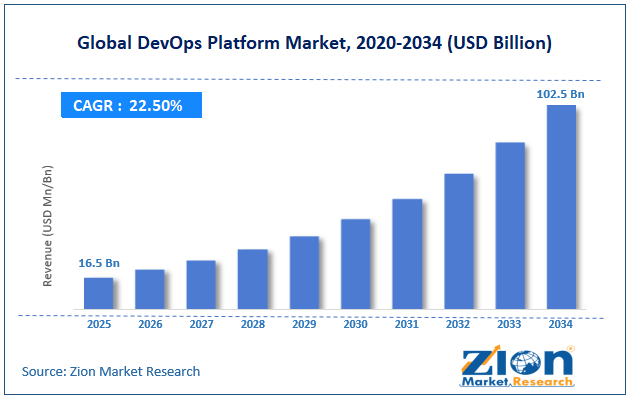
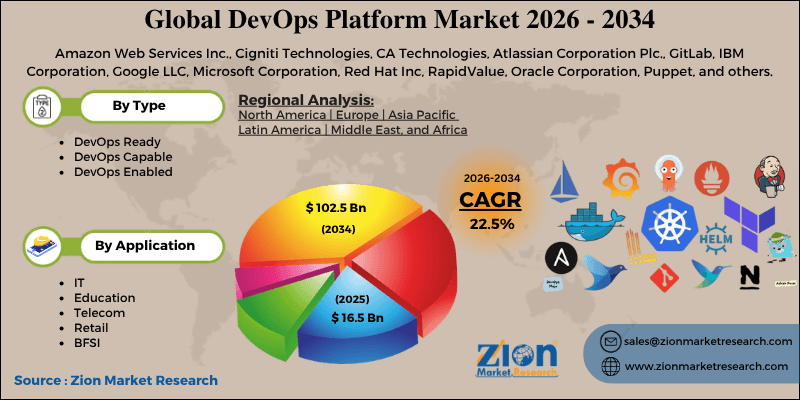
The global DevOps platform market size was worth around USD 16.5 billion in 2025 and is predicted to grow to around USD 102.5 billion by 2034, with a compound annual growth rate (CAGR) of roughly 22.5% between 2026 and 2034.
Key Insights
- As per the analysis shared by our research analyst, the global DevOps Platform market is estimated to grow annually at a CAGR of around 22.5% over the forecast period (2026-2034).
- In terms of revenue, the global DevOps Platform market size was valued at around USD 16.5 billion in 2025 and is projected to reach USD 102.5 billion by 2034.
- Increasing adoption of microservices and containerization is expected to propel the DevOps Platform market over the projected period.
- Based on the type, the DevOps ready segment held the largest revenue share of 38% in 2025.
- Based on the application, the IT segment held the largest revenue share in 2025 of 35%.
- Based on region, North America dominates the DevOps platform market with a revenue share of 75% in 2025.
DevOps Platform Market: Overview
A DevOps platform is a unified software application that enables a company to build, operate, govern, and maintain its own programs by introducing end-to-end development life-cycle management systems. It allows developers, operators, security analysts, and testers to work closely together to create high-quality products with minimal human intervention. The DevOps platform includes CI/CD tools, source code control, container orchestration, M&E (monitoring and logging components), and security technologies that enable effective and efficient app control and operation. It enables continuous feedback, faster delivery, and application management in hybrid and multi-cloud environments, allowing an organization to scale its software to meet changing market and consumer demands.
Impact of the USA-Israel War on Iran on the DevOps Platform Market
The dispute between the U.S. and Israel over Iran has a limited effect on the DevOps platform market. Rising tensions between countries increase cybersecurity threats, prompting companies to invest more in cybersecurity, DevSecOps, and automated code monitoring. In addition, some geopolitical events can cause instability in the world market, which can slow down IT spending in some areas. However, the demand for reliable cloud platforms, secure CI/CD pipelines, and automated operations was high during the pandemic and continues to grow.
DevOps Platform Market: Dynamics
Growth Drivers
How does rising adoption of cloud computing and hybrid cloud drive the DevOps platform market?
The growing need for cloud computing and hybrid cloud is one of the key factors driving the DevOps platform market. Organizations are looking to adopt DevOps platforms that offer software development and operations features to design, test, deliver, and monitor applications in hybrid IT infrastructures. These platforms also facilitate continuous testing, integration, and delivery of code, as well as managing, orchestrating, and hosting software containers to ensure scalable operations. With firms looking to migrate critical applications and data to hybrid and multi-cloud environments, the need for platforms like DevOps is only set to increase.
Government data also indicate the rising need for DevOps platforms. As per the OECD Digital Government Outlook 2026, 86% of OECD countries offer shared cloud computing and hosting services for government agencies, while 83% of these economies have initiated shared cloud storage. Additionally, 68% of the member states identified securing and ensuring the resilience of cloud-based platforms as a strategic priority. According to the report, the key objectives of government cloud strategies are driven by demands for enhancing efficiency and operational effectiveness.
On the other hand, Eurostat reports that 52.7% of companies across the EU accessed cloud computing services in 2025 compared to 17.8% recorded in 2014. These figures suggest that governments and firms are increasingly adopting cloud technologies to host their applications and data. As such, there is a growing need for DevOps platforms that support continuous development, delivery, and deployment of applications while also managing operations in hybrid IT settings.
Restraints
Shortage of skilled DevOps professionals hampers the growth of the DevOps platform industry
Shortage of skilled professionals in emerging fields like DevOps is a primary restraining factor for the DevOps platform market. Due to the complex nature of processes like cloud computing, Continuous Integration/Continuous Delivery (CI/CD), Infrastructure as Code (IaC), microservices orchestration, automation, monitoring, and robust cybersecurity, many firms struggle to develop competent in-house expertise and take longer to adopt DevOps. This lack of skilled professionals raises the cost of adoption and training. It decreases the rate of adoption, especially for Small and Medium-sized Enterprises (SMEs), who are unable to compete with large corporations in hiring skilled DevOps engineers.
Consequently, organizations may fail to fully leverage the potential of DevOps and associated technologies like AI and machine learning to optimize their business processes, delaying their digital transformation and return on investment (ROI), thus hampering the overall growth of the DevOps platform market.
Opportunities
How does increasing product launches offer a lucrative opportunity for the DevOps platform market?
Increasing product launch is expected to offer a potential opportunity to the DevOps platform market over the projected period. For instance, in November 2025, AlertD launched out of stealth, unveiling its agentic AI SRE (Site Reliability Engineering) and DevOps platform designed to tackle the mounting operational complexity of cloud operations. AlertD empowers teams to quickly gain contextualized visibility across their AWS environments through an easy-to-use user interface that delivers verifiable data and enables powerful collaboration. AlertD's AI SRE and DevOps platform has been shaped directly through ongoing collaboration with mid- to large-sized enterprises that operate mature SRE and DevOps functions. These design partnerships have enabled the team to focus on delivering measurable proactive and reactive outcomes—streamlining daily workflows for individual contributors while providing leadership with real-time visibility into system health and team performance.
Challenges
How does the complexity of integrating legacy systems pose a significant challenge to the growth of the DevOps platform industry?
The complexity of legacy systems integration is a major challenge for the growth rate of the DevOps platform market. Many companies have existing applications that are not compatible with DevOps platforms, because these applications were created before most DevOps tools. Additionally, companies must make their existing systems compatible with the new system, which adds costs and puts pressure on the growth of the DevOps platform market.
Furthermore, the complexity of the integration process increases the time required to fully integrate these new platforms within an organization. In some industries, companies are concerned about migrating away from legacy systems because of issues regarding stability, compliance, and continuity of business operations. Hence, the complexity of integrating systems within an organization is a major factor hindering the growth of the DevOps platform market.
DevOps Platform Market: Report Scope
| Report Attributes | Report Details |
|---|---|
| Report Name | DevOps Platform Market |
| Market Size in 2025 | USD 16.5 Billion |
| Market Forecast in 2034 | USD 102.5 Billion |
| Growth Rate | CAGR of 22.5% |
| Number of Pages | 227 |
| Key Companies Covered | Amazon Web Services Inc., Cigniti Technologies, CA Technologies, Atlassian Corporation Plc., GitLab, IBM Corporation, Google LLC, Microsoft Corporation, Red Hat Inc, RapidValue, Oracle Corporation, Puppet, and others. |
| Segments Covered | By Type, By Application, and By Region |
| Regions Covered | North America, Europe, Asia Pacific (APAC), Latin America, Middle East, and Africa (MEA) |
| Base Year | 2025 |
| Historical Year | 2020 - 2024 |
| Forecast Year | 2026 - 2034 |
| Customization Scope | Avail customized purchase options to meet your exact research needs. Request For Customization |
DevOps Platform Market: Segmentation
Type Insights
Why does the DevOps ready segment hold a prominent position in the DevOps platform market?
The DevOps ready segment held the largest revenue share of the DevOps platform industry of 38% in 2025. Market growth is driven by demand for ready-to-deploy environments that simplify and accelerate software development and operations. Enterprises are adopting DevOps-ready platforms to address the complexity and time associated with implementation and reduce the need for extensive in-house DevOps competencies. These platforms offer embedded capabilities such as CI/CD, IaC, orchestration, testing, monitoring, and security, enabling organizations to deploy cloud-native applications faster while improving overall efficiency. The need for public, private, and hybrid cloud environments, increasing adoption of DevSecOps, and demand for AI-driven automation and standardized development are some of the factors expected to drive the segment’s revenue growth over the projected period.
Application Insights
Does the IT segment capture the largest share in the DevOps platform market?
The IT segment held the largest revenue share of the DevOps platform market in 2025 of 35%. The growth is primarily driven by the need for faster software development, continued application delivery, and better IT infrastructure management. As companies continue to transform their legacy systems and adopt cloud technologies, IT teams are looking to leverage DevOps platforms to standardize and automate software development, testing, launching, and monitoring. The need for hybrid and multi-cloud environments, microservices, containers, and IaC is growing rapidly, thus creating more demand for DevOps platforms.
Regional Insights
What factors drive the North America region in the DevOps platform market?
North America dominates the DevOps platform market with a revenue share of 75% in 2025. The market's growth is attributed to the region’s sophisticated digital infrastructure, extensive adoption of cloud computing, and the presence of major IT companies. Various enterprises are adopting DevOps platforms to develop and deploy applications faster using CI/CD tools, enable cloud-native development, and adopt continuous testing procedures. The growing need for hybrid and multi-cloud platforms, microservices architecture, containers, DevSecOps, and others is also expected to propel the market demand for DevOps platforms.
Further, rising investments in artificial intelligence, automation, cybersecurity, and digital transformation initiatives by enterprises will compel organizations to transform and optimize their IT capabilities to improve software delivery efficiency, which will also boost market growth during the forecast period. The strong presence of cloud computing companies, a developed IT ecosystem, and rising R&D activities in developing integrated software development solutions in the region are major factors contributing to the growth of the North American DevOps platform market. Moreover, the adoption of these platforms in diverse end-use industries, including the banking, financial services, healthcare, retail, telecom, and government sectors, is also anticipated to support the revenue growth of the market in the region.
DevOps Platform Market: Competitive Analysis
The global DevOps platform market is dominated by players like:
- Amazon Web Services Inc.
- Cigniti Technologies
- CA Technologies
- Atlassian Corporation Plc.
- GitLab
- IBM Corporation
- Google LLC
- Microsoft Corporation
- Red Hat Inc
- RapidValue
- Oracle Corporation
- Puppet
The global DevOps platform market is segmented as follows:
By Type
- DevOps Ready
- DevOps Capable
- DevOps Enabled
By Application
- IT
- Education
- Telecom
- Retail
- BFSI
- Others
By Region
- North America
- The U.S.
- Canada
- Mexico
- Europe
- France
- The UK
- Spain
- Germany
- Italy
- Rest of Europe
- Asia Pacific
- China
- Japan
- India
- Australia
- South Korea
- Rest of Asia Pacific
- The Middle East & Africa
- Saudi Arabia
- UAE
- Egypt
- Kuwait
- South Africa
- Rest of the Middle East & Africa
- Latin America
- Brazil
- Argentina
- Rest of Latin America
Table Of Content
Methodology
FrequentlyAsked Questions
A DevOps platform is a unified software application that enables a company to build, operate, govern, and maintain its own programs by introducing end-to-end development life-cycle management systems.
The DevOps platform market is primarily driven by the rapid adoption of cloud computing and hybrid cloud environments, increasing demand for faster software development and Continuous Integration/Continuous Delivery (CI/CD), and the growing use of microservices and containerized applications. Rising enterprise digital transformation initiatives, expanding adoption of DevSecOps, AI-powered automation, and Infrastructure as Code (IaC) are further accelerating market growth.
The DevOps platform market faces several challenges, including the shortage of skilled DevOps professionals, the complexity of integrating modern DevOps tools with legacy IT systems, and high initial implementation and training costs. Organizations also encounter difficulties in managing multi-cloud environments, ensuring security and regulatory compliance, and integrating diverse toolchains across development and operations teams.
Based on the type, the DevOps ready segment is expected to dominate the DevOps Platform market growth during the projected period.
The DevOps platform market is being shaped by several emerging trends, including the integration of artificial intelligence (AI) and machine learning (ML) for intelligent automation, predictive analytics, and automated incident management. The growing adoption of DevSecOps is embedding security throughout the software development lifecycle, while the increasing use of Infrastructure as Code (IaC), GitOps, Kubernetes, and containerized microservices is improving application scalability and deployment efficiency.
According to the report, the global DevOps platform market size was worth around USD 16.5 billion in 2025 and is predicted to grow to around USD 102.5 billion by 2034.
The global DevOps platform market is expected to grow at a CAGR of 22.5% during the forecast period.
The global DevOps platform industry growth is expected to be led by North America over the forecast period.
The global DevOps platform market is dominated by players like Amazon Web Services Inc., Cigniti Technologies, CA Technologies, Atlassian Corporation Plc., GitLab, IBM Corporation, Google LLC, Microsoft Corporation, Red Hat Inc, RapidValue, Oracle Corporation, and Puppet, among others.
The DevOps platform market report covers the geographical market along with a comprehensive competitive landscape analysis. It also includes cash flow analysis, profit ratio analysis, market basket analysis, market attractiveness analysis, sentiment analysis, PESTLE analysis, trend analysis, SWOT analysis, trade area analysis, demand & supply analysis, Porter’s five forces analysis, and value chain analysis.

HappyClients

