Deep Eutectic Solvents Market Size, Share, Growth, Opportunities 2034

Deep Eutectic Solvents Market By Type (Hydrophilic Deep Eutectic Solvents, Hydrophobic Deep Eutectic Solvents, Natural Deep Eutectic Solvents, Ionic Liquid Analogue Solvents), By Application (Extraction and Purification, Electrochemistry and Metal Processing, Pharmaceutical Formulation, Biomass Processing), By End-Use Industry (Pharmaceutical and Biotechnology, Chemical Manufacturing, Food and Beverage Processing, Cosmetics and Personal Care), By Source (Plant Based Sources, Animal Based Sources, Synthetic Sources, Mixed Sources), and By Region - Global and Regional Industry Overview, Market Intelligence, Comprehensive Analysis, Historical Data, and Forecasts 2026 - 2034
| Market Size in 2025 | Market Forecast in 2034 | CAGR (in %) | Base Year |
|---|---|---|---|
| USD 204.38 Million | USD 734.96 Million | 15.26% | 2025 |
Deep Eutectic Solvents Industry Perspective:
What will be the size of the deep eutectic solvents market during the forecast period?
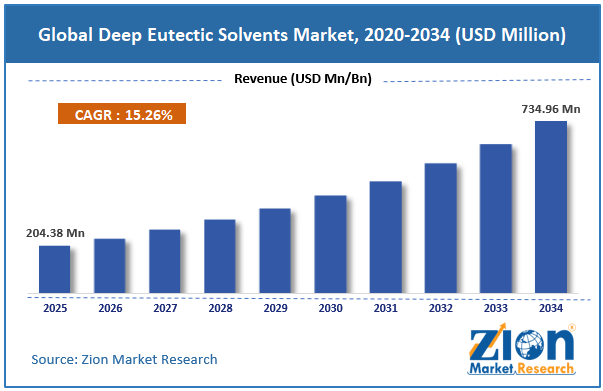
The global deep eutectic solvents market size was valued at approximately USD 204.38 million in 2025 and is projected to reach around USD 734.96 million by 2034, growing at a compound annual growth rate of approximately 15.26% between 2026 and 2034.
Key Insights
- As per the analysis shared by our research team, the global deep eutectic solvents market is estimated to grow at a compound annual growth rate of approximately 15.26% during the forecast period from 2026 to 2034.
- In terms of revenue, the global deep eutectic solvents market was valued at approximately USD 204.38 million in 2025 and is projected to reach USD 734.96 million by 2034.
- The deep eutectic solvents market is expected to grow strongly due to rising demand for green chemistry solutions, increasing pharmaceutical research activity, growing interest in natural extraction methods, and expanding industrial focus on reducing hazardous solvent use.
- Based on type, hydrophilic deep eutectic solvents lead the market because of their strong compatibility with water-based extraction processes, while natural deep eutectic solvents are gaining strong momentum as one of the fastest-growing types due to rising demand for plant-based and biodegradable options.
- Based on application, extraction and purification lead the market due to widespread use in natural compound recovery. At the same time, pharmaceutical formulation is the fastest-growing segment as drug developers seek safer solvent alternatives for sensitive compounds.
- Based on end-use industry, chemical manufacturing leads the market due to broad use across industrial processing, while pharmaceutical and biotechnology are steadily growing as companies look for solvents that support sensitive biological materials.
- Based on source, plant-based sources lead the market due to their natural availability and low cost, while synthetic sources are growing rapidly as manufacturers seek consistent quality for large-scale industrial applications.
- Based on region, Europe leads the global deep eutectic solvents market, while Asia Pacific is the fastest-growing region due to expanding pharmaceutical manufacturing and rising green chemistry research funding.
Deep Eutectic Solvents Market: Overview
Deep eutectic solvents are liquid mixtures made by combining two or more compounds that create a much lower melting point than their individual melting points. They are gaining popularity as safer, greener alternatives to traditional solvents because many can be made from low-cost, natural, biodegradable materials. The deep eutectic solvents market is growing as industries seek cleaner methods for extracting compounds from plants, processing metals, producing medicines, and supporting chemical manufacturing. These solvents can dissolve many different substances, making them useful for plant extraction, chemical reactions, material processing, and cosmetic production. Their low volatility also helps reduce harmful solvent emissions and workplace exposure to hazardous chemicals. Another advantage is their flexibility: manufacturers can change the types and amounts of starting materials to create solvents suited to specific applications. Growing efforts to reduce industrial waste and adopt sustainable production methods are encouraging companies to replace conventional solvent systems. Increasing research into bio-based chemicals is also leading to new deep eutectic solvent formulations, improving their potential for commercial use across pharmaceutical, food, agricultural, and chemical industries.
The deep eutectic solvents industry continues to expand as chemical innovators, academic researchers, and manufacturing companies work together to build safer, more sustainable, and more versatile solvent solutions worldwide.
Deep Eutectic Solvents Market: Strategic Perspective
Where is the deep eutectic solvents market heading?
The deep eutectic solvents market is expected to shift toward more specialized, application-specific formulations that can meet pharmaceutical, cosmetic, food, and industrial processing needs with greater precision. Greater focus on natural and biodegradable ingredient sourcing, improved solvent recycling methods, and expanding industrial-scale production could make these solvents a mainstream choice across many chemical processes.
Where should businesses invest in the deep eutectic solvents market?
The deep eutectic solvents market offers promising investment opportunities in natural extraction technology, pharmaceutical-grade solvent development, metal processing applications, and sustainable cosmetic ingredient research. Companies that can develop solutions for large-scale biomass processing, plant compound extraction, and green industrial chemistry may benefit as more sectors move toward environmentally responsible solvent systems.
What will reshape competition in the deep eutectic solvents market?
Competition in the deep eutectic solvents market is likely to be shaped by formulation expertise, production scalability, cost efficiency, and the ability to demonstrate clear environmental benefits over traditional solvents. Companies that offer reliable supply chains, meet varying regional safety standards, and provide strong technical support to research and industrial customers are likely to gain an advantage.
Deep Eutectic Solvents Market: Technology Roadmap 2026–2034
What is the projected development roadmap of the deep eutectic solvents market over the forecast period?
The deep eutectic solvents market is advancing through improved formulation techniques, more efficient large-scale production methods, expanded understanding of solvent properties, and growing use of natural raw materials, making these solvents more practical and affordable for widespread industrial use. The market is expected to grow at a compound annual growth rate of approximately 15.26% over the forecast period, driven by accelerating green chemistry adoption, developing regulatory support, and continuous refinement of solvent formulation science.
The following roadmap outlines key development phases expected through 2034.
2026–2028: Formulation Understanding and Research Expansion Phase
- Improved solvent characterization: Researchers are expected to develop better methods for understanding how different deep eutectic solvent combinations behave under various temperature and processing conditions.
- Academic and industrial collaboration: Universities and chemical companies are likely to work more closely together to move promising laboratory formulations toward practical industrial applications.
- Growing pharmaceutical interest: Deep eutectic solvents are expected to see increased testing in drug formulation and delivery research as pharmaceutical companies look for gentler solvent alternatives.
2029–2031: Industrial Scale-Up and Application Diversification Phase
- Large-scale production methods: Manufacturers are expected to develop more efficient processes to produce deep eutectic solvents in bulk without compromising quality or consistency.
- Cosmetic and personal care adoption: Beauty and skincare brands are expected to incorporate deep eutectic solvents into formulations as natural and gentle alternatives to synthetic ingredients.
- Expansion into metal processing: Deep eutectic solvents are expected to spread further into metal extraction and electroplating applications as their ability to dissolve metal compounds becomes more widely recognized.
2032–2034: Mainstream Adoption and Circular Chemistry Phase
- Recyclable solvent systems: Companies are likely to develop methods to recover and reuse deep eutectic solvents multiple times, reducing waste and lowering overall production costs.
- Advanced biomass applications: Deep eutectic solvents may increasingly be used to break down plant material for biofuel and biochemical production, supporting renewable energy goals.
- Broader regulatory acceptance: As safety and environmental data accumulate, regulatory agencies may formally recognize deep eutectic solvents as approved alternatives across pharmaceutical, food, and cosmetic industries.
Deep Eutectic Solvents Market: Dynamics
Growth Drivers
What is driving the expansion of the deep eutectic solvents market across green chemistry applications?
The deep eutectic solvents industry is expanding as industries seek safer alternatives to traditional solvents that may pose toxicity and flammability risks. Pharmaceutical companies are exploring these solvents for drug formulation because they can dissolve difficult compounds while protecting sensitive active ingredients. Extraction businesses use deep eutectic solvents to recover valuable substances, including antioxidants and essential oils, more efficiently from plants. Better understanding of solvent chemistry is helping researchers create formulations suited to specific extraction and processing needs. Growing use in metal processing is driving demand as industries seek cleaner methods to dissolve and recover metals from ores and electronic waste. Improved production methods are also helping manufacturers produce these solvents more cheaply and at larger volumes. Natural ingredient trends in cosmetics and food are encouraging brands to consider deep eutectic solvents as processing aids. Meanwhile, biomass conversion research is using these solvents to break down plant fibers into useful chemical building blocks. Together, these advances are helping deep eutectic solvents move from laboratory research toward commercial use in pharmaceuticals, cosmetics, food processing, metal recovery, and industrial chemistry.
Green chemistry research funding is creating fresh opportunities in the deep eutectic solvents market.
The deep eutectic solvents industry is creating opportunities as industries shift toward more sustainable, safer chemical processing. Pharmaceutical companies can use these solvents to develop drug formulations, while cosmetic manufacturers can create products using natural, biodegradable solvent ingredients. Food processors are exploring deep eutectic solvents to extract flavors, colors, antioxidants, and nutritional compounds with fewer concerns about harmful residues. Researchers are developing customized formulations by combining natural materials to achieve specific properties for targeted applications. Rising government support for green chemistry research is helping universities, startups, and technology developers discover new uses for these solvents. Growing interest in circular economy practices is creating opportunities to recover valuable materials from agricultural waste, food byproducts, and industrial residues. As research moves toward commercial applications, deep eutectic solvents are becoming useful tools for cleaner extraction, waste recovery, and sustainable manufacturing. This wider adoption can strengthen their role across pharmaceutical, food, cosmetic, agricultural, and chemical industries while creating new avenues for market expansion.
Restraints
How are scalability and standardization concerns affecting the deep eutectic solvents market?
The deep eutectic solvents market faces challenges such as limited production scalability, inconsistent testing standards, and insufficient long-term performance data. Many formulations are still developed in laboratories, making large-scale production difficult when manufacturers encounter higher costs or variations in product quality. The lack of common industry standards also makes it harder to compare different formulations and demonstrate their safety and effectiveness to regulators and customers. Some industries remain hesitant to replace established solvents because deep eutectic alternatives have a shorter commercial history. Storage and transportation can present additional difficulties, as moisture and changing conditions may affect formulation stability. Developing these solvents also requires specialized chemical knowledge, which can increase R&D expenses. Limited laboratory facilities in developing regions may further slow adoption. Addressing these barriers through standardized testing, stronger performance data, improved production methods, industry collaboration, and clearer regulatory guidelines can increase confidence in deep eutectic solvents and support wider commercial adoption across various industries worldwide.
Opportunities
Broader industry adoption is creating new opportunities in the deep eutectic solvents market.
The deep eutectic solvents market is gaining opportunities as green solvent technology grows across pharmaceuticals, cosmetics, food processing, and industrial chemistry. Drug developers use these solvents to formulate medicines while protecting sensitive compounds, and cosmetic manufacturers explore them for natural skincare and haircare products. Metal processing companies are applying deep eutectic solvents to recover valuable metals from electronic waste through cleaner extraction and recycling methods. Food and beverage producers are also exploring their use to obtain natural flavors, colors, and preservatives with fewer concerns about synthetic residues. New formulations from different natural starting materials provide greater flexibility for specific industrial requirements. Expanding biomass processing, circular economy initiatives, and sustainable extraction practices are creating further application areas. Companies developing solvent recycling systems, standardized testing methods, and scalable production processes can benefit from these emerging opportunities. Growing use in analytical chemistry and research laboratories is supporting higher-value specialized applications. At the same time, investment in green chemistry infrastructure is encouraging adoption. Rising demand for safer, more sustainable solvent systems is expected to strengthen opportunities across the pharmaceutical, cosmetic, food, and chemical manufacturing industries.
Challenges
Limited industrial history and regulatory uncertainty are creating challenges for the deep eutectic solvents market.
The deep eutectic solvents market faces challenges from limited industrial experience, changing regulations, and differences in solvent performance. Because these solvents are newer than traditional alternatives, industries have less long-term data on their behavior in large-scale manufacturing. Regulatory requirements vary across countries, while clear approval pathways for pharmaceutical, food, and cosmetic applications are still developing. This uncertainty can make companies cautious about investing in new products or facilities. Solvent performance may change when the ratio or purity of starting materials varies, raising concerns about consistent results across production batches. Maintaining formulation stability during storage and transportation can also be challenging. Companies also need intellectual property strategies to protect solvent combinations from competitors. A shortage of specialists with deep eutectic solvent expertise may raise research and development costs. Better industrial testing, clearer regulations, standardized quality controls, and stronger knowledge can reduce these barriers and support wider adoption of deep eutectic solvents across industries.
Deep Eutectic Solvents Market: Report Scope
| Report Attributes | Report Details |
|---|---|
| Report Name | Deep Eutectic Solvents Market |
| Market Size in 2025 | USD 204.38 Million |
| Market Forecast in 2034 | USD 734.96 Million |
| Growth Rate | CAGR of 15.26% |
| Number of Pages | 229 |
| Key Companies Covered | Merck KGaA, Sigma-Aldrich Corporation, Scionix Limited, Cambrex Corporation, TCI Chemicals, Alfa Aesar, Enamine Limited, GreenSol Chemicals, PhytoExtract Technologies, BioSolv Industries, and others. |
| Segments Covered | By Type, By Application, By End-Use Industry, By Source, and By Region |
| Regions Covered | North America, Europe, Asia Pacific (APAC), Latin America, Middle East, and Africa (MEA) |
| Base Year | 2025 |
| Historical Year | 2020 - 2024 |
| Forecast Year | 2026 - 2034 |
| Customization Scope | Avail customized purchase options to meet your exact research needs. Request For Customization |
Deep Eutectic Solvents Market: Segmentation
The global deep eutectic solvents market is segmented by type, application, end-use industry, source, and region.
What makes hydrophilic deep eutectic solvents the dominant type in the deep eutectic solvents market?
By type, the market is segmented into hydrophilic, hydrophobic, natural, and ionic liquid analog solvents. Hydrophilic deep eutectic solvents hold about 40% of the market share, leading due to their strong compatibility with water-based extraction and purification processes. Natural deep eutectic solvents hold around 25% market share. This segment is the fastest-growing because of rising demand for plant-based, biodegradable, and non-toxic solvent alternatives.
How does the extraction and purification application maintain its leading position in the deep eutectic solvents market?
Based on application, the deep eutectic solvents industry is divided into extraction and purification, electrochemistry and metal processing, pharmaceutical formulation, and biomass processing. Extraction and purification account for approximately 36% of the global market share, driven by widespread use in recovering natural compounds from plants and agricultural byproducts. Pharmaceutical formulation accounts for around 19% of the market share. It is the fastest-growing segment due to rising interest in gentler solvent systems for sensitive drug compounds.
What makes chemical manufacturing the dominant end use industry in the deep eutectic solvents market?
Based on end-use industry, the market is classified into pharmaceutical and biotechnology, chemical manufacturing, food and beverage processing, and cosmetics and personal care. Chemical manufacturing leads with about a 32% share because of its broad use across industrial extraction, synthesis, and processing. Pharmaceutical and biotechnology hold around a 24% market share. It is growing steadily as drug developers seek solvents that protect sensitive biological and chemical compounds.
How does the plant-based source category shape the demand landscape of the deep eutectic solvents market?
Based on source, the deep eutectic solvents market is categorized into plant-based, animal-based, synthetic, and mixed sources. Plant-based sources account for about 38% of the market, leading because of their natural availability, low cost, and strong alignment with sustainability goals. Synthetic sources hold around 22% market share. This segment is expanding quickly as manufacturers seek consistent quality and predictable performance for large-scale industrial applications.
Deep Eutectic Solvents Market: Regional Analysis
Why is Europe leading the global deep eutectic solvents market?
Europe holds a 37.64% share of the global deep eutectic solvents market and is expected to retain its leading position during the forecast period. The region has a strong foundation in green chemistry, supported by government funding, advanced research centers, and established pharmaceutical and cosmetic industries. Germany, the United Kingdom, and France are key contributors, with chemical companies and universities developing new applications for deep eutectic solvents. Strict environmental rules on conventional solvents are also encouraging manufacturers to adopt cleaner alternatives across industrial processes. Pharmaceutical companies are exploring these solvents for drug formulation as part of broader sustainability efforts, while cosmetic brands are considering them for natural and clean-label products. Europe’s mature research network provides access to skilled chemists, advanced testing facilities, and partnerships between businesses and universities. Food and beverage manufacturers are showing interest in deep eutectic solvents for extracting flavors, colors, and nutrients from natural sources. In addition, circular economy programs are encouraging the recovery of useful materials from waste streams. Growing commercial activity and rising demand for environmentally responsible processing solutions are creating new opportunities for technology providers and manufacturers across the region. Continued investment in green chemical technologies, sustainable manufacturing, and research infrastructure is likely to strengthen regional adoption and help Europe remain a major market contributor throughout the forecast period.
What makes Asia Pacific the fastest-growing region in the deep eutectic solvents market?
Asia Pacific accounts for 32.36% of the global deep eutectic solvents market and is expected to remain one of the fastest-growing regional markets during the forecast period. Expanding pharmaceutical manufacturing, rising chemical research, and increasing interest in sustainable production are supporting regional demand. China, India, and Japan are major contributors, backed by government funding for green chemistry and growing pharmaceutical production capacity. Universities and research institutes are also increasing studies on deep eutectic solvent applications, strengthening local technical expertise. Rising cosmetic and personal care manufacturing is creating demand for natural solvent alternatives, while food and beverage companies are exploring these solvents to recover flavors, colors, and other useful compounds from natural sources. Local chemical manufacturers are investing in production capacity, improving availability and reducing costs for industrial users. Growing electronic waste recycling is opening additional opportunities for deep eutectic solvents in metal recovery and cleaner processing. Increasing investment in green chemistry infrastructure and sustainable manufacturing is creating further opportunities for solvent developers. As pharmaceutical research, recycling activities, and environmentally responsible production continue to expand, Asia Pacific is expected to strengthen its market position.
Recent Market Developments
- In May 2026, Proionic GmbH announced new capabilities for drying viscous biomass, highlighting the company’s continued development of ionic-liquid-based technologies for biomass processing and resource-efficient applications.
- In March 2026, Proionic GmbH announced the launch of EMIM acrylate, a new polymerizable ionic liquid, expanding its ionic-liquid product portfolio and supporting applications related to advanced materials and sustainable chemical technologies.
Deep Eutectic Solvents Market: Competitive Analysis
The leading players in the global deep eutectic solvents market are:
- Merck KGaA
- Sigma-Aldrich Corporation
- Scionix Limited
- Cambrex Corporation
- TCI Chemicals
- Alfa Aesar
- Enamine Limited
- GreenSol Chemicals
- PhytoExtract Technologies
- BioSolv Industries
The global deep eutectic solvents market is segmented as follows:
By Type
- Hydrophilic Deep Eutectic Solvents
- Hydrophobic Deep Eutectic Solvents
- Natural Deep Eutectic Solvents
- Ionic Liquid Analog Solvents
By Application
- Extraction and Purification
- Electrochemistry and Metal Processing
- Pharmaceutical Formulation
- Biomass Processing
By End-Use Industry
- Pharmaceutical and Biotechnology
- Chemical Manufacturing
- Food and Beverage Processing
- Cosmetics and Personal Care
By Source
- Plant-Based Sources
- Animal-Based Sources
- Synthetic Sources
- Mixed Sources
By Region
- North America
- The U.S.
- Canada
- Mexico
- Europe
- France
- The UK
- Spain
- Germany
- Italy
- Rest of Europe
- Asia Pacific
- China
- Japan
- India
- Australia
- South Korea
- Rest of Asia Pacific
- The Middle East & Africa
- Saudi Arabia
- UAE
- Egypt
- Kuwait
- South Africa
- Rest of the Middle East & Africa
- Latin America
- Brazil
- Argentina
- Rest of Latin America
Table Of Content
Methodology
FrequentlyAsked Questions
Deep eutectic solvents are liquid mixtures made by combining two or more compounds that create a much lower melting point than their individual melting points.
The global deep eutectic solvents market is expected to grow due to rising demand for green chemistry solutions, increasing pharmaceutical research activity, growing interest in natural extraction methods, and expanding industrial focus on reducing hazardous solvent use worldwide.
According to research, the global deep eutectic solvents market was valued at approximately USD 204.38 million in 2026 and is projected to reach approximately USD 734.96 million by 2034.
What will be the compound annual growth rate of the deep eutectic solvents market from 2026 to 2034?
The compound annual growth rate of the deep eutectic solvents market is expected to be approximately 15.26% from 2026 to 2034.
Europe is expected to lead the global deep eutectic solvents market throughout the forecast period, driven by strong government support for green chemistry research and well-established pharmaceutical and cosmetic manufacturing industries.
The major players in the global deep eutectic solvents market include Merck KGaA, Sigma-Aldrich Corporation, Scionix Limited, Cambrex Corporation, TCI Chemicals, Alfa Aesar, Enamine Limited, GreenSol Chemicals, PhytoExtract Technologies, and BioSolv Industries.
The report examines key aspects of the deep eutectic solvents market, including research and development drivers, adoption barriers, application opportunities, competitive landscape dynamics, detailed regional market performance analysis, and a comprehensive forward-looking outlook across all major types, applications, end-use industries, sources, and geographic regions through 2034.
Evolving regulatory guidelines around solvent classification, growing restrictions on hazardous chemical use, and expanding green chemistry certification programs are shaping the deep eutectic solvents market. Governments are also encouraging safer and more biodegradable industrial processing methods.
Pharmaceutical formulation, natural compound extraction, metal recycling, cosmetic ingredient development, and biomass processing will offer strong opportunities in the deep eutectic solvents market. Growing demand for safer, sustainable processing solutions is driving adoption across these sectors.
Natural and biodegradable formulation development, solvent recycling technology, pharmaceutical-grade applications, and circular economy integration are key trends shaping the deep eutectic solvents market. Growing research collaboration between universities and industry is also expanding its everyday use.

HappyClients