
Construction Anchors Market Size, Share, Trends, Growth and Forecast 2034

Construction Anchors Market By Type (Mechanical Anchors, Screw Anchors, Expansion Anchors, Chemical Anchors, and Post-installed Anchors), By Material (Steel, Composite Materials, Plastic, Stainless Steel, and Fiberglass), By Application (Residential Construction, Infrastructure Development, Commercial Construction, and Industrial Applications), By Installation Method (Manual Installation, Pre-assembled Installation, and Power Tool Installation), and By Region - Global and Regional Industry Overview, Market Intelligence, Comprehensive Analysis, Historical Data, and Forecasts 2026 - 2034
| Market Size in 2025 | Market Forecast in 2034 | CAGR (in %) | Base Year |
|---|---|---|---|
| USD 6.1 Billion | USD 8.9 Billion | 4.3% | 2025 |
Construction Anchors Industry Perspective:
What will be the size of the global construction anchors market during the forecast period?
The global construction anchors market size was worth around USD 6.1 billion in 2025 and is predicted to grow to around USD 8.9 billion by 2034, with a compound annual growth rate (CAGR) of roughly 4.3% between 2026 and 2034.
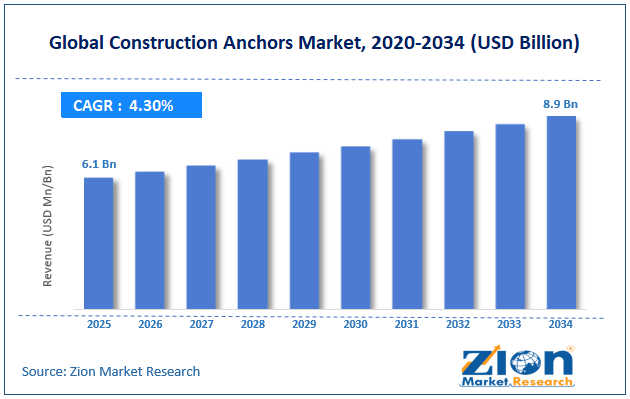
Construction Anchors Market: Overview
Construction anchors are fastening devices that can be mechanical or chemical in nature and are used to attach structural or non-structural elements to base materials such as concrete, brickwork, masonry, stone, and drywall. Construction anchors help secure load-bearing capacity by sharing tensile, shear, and dynamic loads, thereby providing safety and durability to installed fixtures and structural members. Construction anchors have been extensively used in residential, commercial, industrial, and infrastructure construction work, with applications ranging from structural steel connections, curtain walls, railings, heavy machinery anchoring, HVAC systems, electrical installations, pipeline installations, bridges, tunnels, and earthquake retrofitting projects. Depending on the type of application and the substrate materials used, there are different types of anchors, such as mechanical anchors (wedge anchors, sleeve anchors, drop-in anchors, expansion anchors, and screw anchors), and other types (epoxy, vinyl ester, and polyester resin-based anchors).
The construction anchors market involves the production, distribution, and application of these anchoring systems, owing to rising construction activities, infrastructure renovation work, tightening building safety requirements, and increased demand for high-performance fastening systems.
Key Insights
- As per the analysis shared by our research analyst, the global construction anchors market is estimated to grow annually at a CAGR of around 4.3% over the forecast period (2026-2034).
- In terms of revenue, the global construction anchors market size was valued at around USD 6.1 billion in 2025 and is projected to reach USD 8.9 billion by 2034.
- Rapid growth in infrastructure and commercial construction is expected to propel the construction anchors market over the projected period.
- Based on the type, the mechanical anchors are expected to capture the largest market share over the projected period.
- Based on the material, the stainless steel segment held a prominent market share of 55% in 2025.
- Based on the application, the commercial construction segment held the largest revenue share of 75% in 2025.
- Based on the installation method, the manual installation garner a highest revenue share in 2025.
- Based on region, the Asia Pacific led the market with a revenue share of 39% in 2025.
Impact of the USA-Israel War on Iran on the Construction Anchors Market
The effect of the conflict between the USA and Israel regarding Iran on the global construction anchors market is likely to be moderately adverse in the short term but positive in the medium- to long-term, driven by reconstruction work. This effect is mainly secondary in nature, arising from logistical issues, rising energy and freight costs, and uncertain construction conditions.
Construction Anchors Market: Dynamics
Growth Drivers
Why does the expansion of renovation and structural retrofitting activities drive the construction anchors market?
Rapid development of renovation and retrofitting projects is one of the key drivers of the construction anchor market, as there is a need to reinforce, repair, and renovate old structures, including buildings, bridges, tunnels, hospitals, schools, and industrial plants, instead of demolishing them. Construction anchors (mechanical and chemical) are necessary to fix reinforcing steel, structural steel elements, façades, seismic retrofitting, machinery, and utilities during the renovation of old buildings.
This tendency is further promoted by government-driven renovation projects. For instance, the EU Renovation Wave Strategy aims to renovate 35 million buildings by 2030 and aims to double the current annual renovation rate. This project includes modernizing infrastructure through energy efficiency and modernizing buildings.
Restraints
Volatility in raw material prices hampers the growth of the construction anchors industry
Fluctuations in the prices of raw materials, such as carbon steel, stainless steel, alloy steel, zinc, aluminum, and chemical resins used in manufacturing mechanical and chemical anchoring systems, constitute a major constraint on the market for construction anchors. The high level of dependence on price-fluctuating raw materials increases production costs for manufacturers, squeezes profit margins, and adds uncertainty to procurement and budgeting processes. In the case of construction anchor products sold at fixed prices, manufacturers cannot entirely pass on the rising cost of raw materials to customers in a competitive market.
The price instability in steel products is caused by fluctuations in iron ore and energy prices, logistical issues, trade barriers, and geopolitical factors. On the other hand, the increase in the prices of chemical anchors is attributed to price instability in epoxy, vinyl ester, and polyester resins, as well as petrochemical products, which are closely associated with crude oil prices. Such an increase in costs adds to the total cost of fastening solutions and forces buyers to postpone purchase decisions, order smaller quantities, or resort to cheaper alternatives.
The impact of rising raw-material prices will be felt mainly by small- and medium-sized companies that lack bargaining power when procuring raw materials and have limited inventory capacity to cope with price fluctuations.
Opportunities
Why does the growth of industrial and manufacturing facilities offer a lucrative opportunity for the construction anchors market?
Rapid construction of industrial and manufacturing facilities is a key driver of the construction anchors market, as high-quality anchoring systems are needed for factories, warehouses, logistics hubs, semiconductor fabs, data centers, automotive manufacturing plants, and other energy-related industrial structures. Such construction anchors are widely used to anchor various building structures, heavy machinery, conveyors, racking systems, production lines, piping, electrical systems, crane systems, and safety systems to concrete and masonry.
Industrialization is being driven by governments worldwide through large-scale manufacturing programs and investments in the necessary infrastructure. For instance, in the United States, the CHIPS and Science Act led to more than US$500 billion in private-sector investments in semiconductor manufacturing and supply chains. Thus, demand for heavy-duty mechanical and chemical anchoring systems installed in semiconductor fabs and advanced manufacturing facilities will increase.
Challenges
Does the availability of low-cost, non-certified products pose a significant challenge to the construction anchors market?
The availability of cheap, non-certified construction anchors is one of the main obstacles hindering the development of the construction anchors market. The sale of such anchors in many developing countries, where buyers choose products based on price rather than quality, drives fierce price competition among manufacturers. Certified products will not be preferred in such cases, as they tend to be more expensive than non-certified products.
The problem is that while non-certified construction anchors may save money initially, they do not provide the necessary guarantee of safe operation. In contrast to certified anchors, which meet all engineering standards for load-bearing, corrosion resistance, seismic, and fire resistance, there is no strict monitoring of the quality of non-certified anchors. Hence, the material used to manufacture them is less resistant, and their performance is poor, especially when dealing with heavy-duty construction and dynamic forces.
Moreover, it imposes price restrictions on certified products, as manufacturers of construction anchors are required to undergo additional product qualification, which is quite costly. It should be noted that companies producing certified construction anchors must comply with the applicable engineering standards and, as a result, incur higher production costs than non-compliant manufacturers.
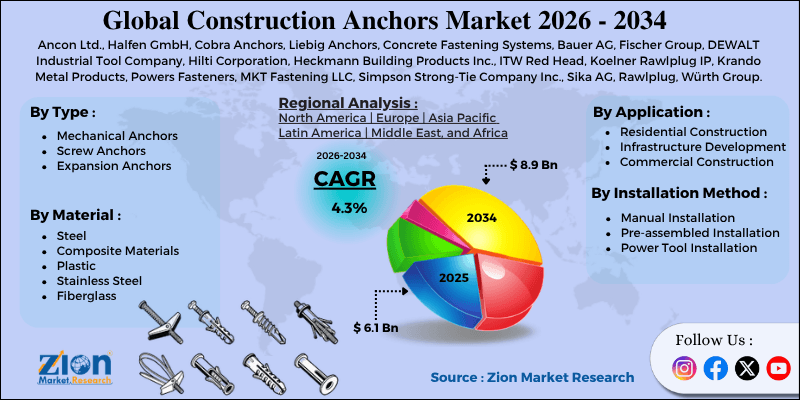
Construction Anchors Market: Report Scope
| Report Attributes | Report Details |
|---|---|
| Report Name | Construction Anchors Market |
| Market Size in 2025 | USD 6.1 Billion |
| Market Forecast in 2034 | USD 8.9 Billion |
| Growth Rate | CAGR of 4.3% |
| Number of Pages | 227 |
| Key Companies Covered | Ancon Ltd., Halfen GmbH, Cobra Anchors, Liebig Anchors, Concrete Fastening Systems, Bauer AG, Fischer Group, DEWALT Industrial Tool Company, Hilti Corporation, Heckmann Building Products Inc., ITW Red Head, Koelner Rawlplug IP, Krando Metal Products, Powers Fasteners, MKT Fastening LLC, Simpson Strong-Tie Company Inc., Sika AG, Rawlplug, Würth Group, and others. |
| Segments Covered | By Type, By Material, By Application, By Installation Method, and By Region |
| Regions Covered | North America, Europe, Asia Pacific (APAC), Latin America, Middle East, and Africa (MEA) |
| Base Year | 2025 |
| Historical Year | 2020 - 2024 |
| Forecast Year | 2026 - 2034 |
| Customization Scope | Avail customized purchase options to meet your exact research needs. Request For Customization |
Construction Anchors Market: Segmentation
Type Insights
Why does the mechanical anchors segment dominate the construction anchors market?
The mechanical anchors are expected to capture the largest share in the construction anchors industry over the projected period. The revenue growth is attributed to the extensive use of wedge anchors, sleeve anchors, drop-in anchors, expansion anchors, screw anchors, and undercut anchors in construction projects for residential buildings, commercial buildings, industrial facilities, and infrastructure development. This type of anchor offers load-bearing capacity, excellent tensile and shear strength, and easy installation with no curing time.
Material Insights
How does the stainless steel segment capture the largest share in the construction anchors market?
The stainless steel segment held a prominent share of 55% in the construction anchors industry in 2025. Stainless steel resists oxidation much better than other metals, such as iron and carbon steel. Also, due to its attractive, shiny appearance, corrosion resistance, low maintenance requirements, and strength, stainless steel is widely used in the production of mechanical anchors.
Application Insights
Does the commercial construction segment capture the largest market share in the construction anchors market?
The commercial construction segment held the largest revenue share in the construction anchors market of 75% in 2025. This process would be supported by growth in investment in offices, malls, hotels, hospitals, schools, airports, computer servers, storage facilities, and mixed-use developments. Anchors form an important part of commercial construction because they act as the base for attaching steelwork, curtain walls, suspended ceilings, HVAC systems, electrical conduits, fire protection systems, elevators, and heavy machinery.
Installation Method Insights
How does the manual installation segment capture the largest market share in the construction anchors market?
The manual installation garner a highest revenue share in 2025. The expansion is due to the extensive use of this technique in building construction, which requires flexibility, economy, and ease of installation. Manual tool installation is done with the help of manual tools like drills, hammers, torque wrenches, and setting tools to fix mechanical and chemical anchors.
Regional Insights
Why does the Asia Pacific lead the construction anchors market?
The Asia Pacific led the market with a revenue share of 39% in 2025. These factors are fueling growth, driven by urbanization, infrastructure development, industrial development, and investments in the construction of residences and commercial buildings. An increase in government expenditure on transportation, smart cities, industrial corridors, renewable energy projects, and other types of infrastructure is creating consistent demand for mechanical and chemical anchoring systems.
China holds the largest market share due to continuous investment in the construction of high-rise residential buildings, transport infrastructure such as high-speed railways, airports, bridges, metros, and other renewable energy infrastructure. China’s rising manufacturing sector, along with its redevelopment efforts, will create considerable demand for construction anchors for steel connections and facades.
Construction Anchors Market: Competitive Analysis
The global construction anchors market is dominated by players like:
- Ancon Ltd.
- Halfen GmbH
- Cobra Anchors
- Liebig Anchors
- Concrete Fastening Systems
- Bauer AG
- Fischer Group
- DEWALT Industrial Tool Company
- Hilti Corporation
- Heckmann Building Products Inc.
- ITW Red Head
- Koelner Rawlplug IP
- Krando Metal Products
- Powers Fasteners
- MKT Fastening LLC
- Simpson Strong-Tie Company Inc.
- Sika AG
- Rawlplug
- Würth Group
The global construction anchors market is segmented as follows:
By Type
- Mechanical Anchors
- Screw Anchors
- Expansion Anchors
- Chemical Anchors
- Post-installed Anchors
By Material
- Steel
- Composite Materials
- Plastic
- Stainless Steel
- Fiberglass
By Application
- Residential Construction
- Infrastructure Development
- Commercial Construction
- Industrial Applications
By Installation Method
- Manual Installation
- Pre-assembled Installation
- Power Tool Installation
By Region
- North America
- The U.S.
- Canada
- Mexico
- Europe
- France
- The UK
- Spain
- Germany
- Italy
- Rest of Europe
- Asia Pacific
- China
- Japan
- India
- Australia
- South Korea
- Rest of Asia Pacific
- The Middle East & Africa
- Saudi Arabia
- UAE
- Egypt
- Kuwait
- South Africa
- Rest of the Middle East & Africa
- Latin America
- Brazil
- Argentina
- Rest of Latin America
Table Of Content
Methodology
FrequentlyAsked Questions
Construction anchors are fastening devices that can be mechanical or chemical in nature and are used to attach structural or non-structural elements to base materials such as concrete, brickwork, masonry, stone, and drywall.
The growth of the construction anchors market is primarily driven by rising investments in residential, commercial, industrial, and infrastructure construction projects worldwide. Rapid urbanization, smart city development, and increasing government spending on transportation infrastructure—including highways, bridges, railways, airports, metro systems, and tunnels—are significantly boosting demand for reliable anchoring solutions.
The major challenges restraining the construction anchors market include volatile raw material prices, particularly for steel, stainless steel, aluminum, and chemical resins, which increase manufacturing costs and reduce profit margins. The market also faces intense price competition from low-cost, non-certified products that often fail to meet international safety and performance standards, creating pricing pressure for established manufacturers.
Based on the type, the mechanical anchors segment is expected to dominate the construction anchors market growth during the projected period.
The growing popularity of prefabricated and modular construction is driving demand for precision-engineered anchoring systems that enable faster installation and improved structural reliability. In addition, innovations such as torque-controlled anchors, self-tapping concrete screws, quick-curing resin-based chemical anchors, and injection anchoring systems are reducing installation time while improving safety and productivity. Increasing use of Building Information Modeling (BIM), digital construction technologies, and engineered fastening solutions is enabling more accurate anchor selection and structural design.
According to the report, the global construction anchors market size was worth around USD 6.1 billion in 2025 and is predicted to grow to around USD 8.9 billion by 2034.
The global construction anchors market is expected to grow at a CAGR of 4.3% during the forecast period.
The global construction anchors industry growth is expected to be led by the Asia Pacific over the forecast period.
The global construction anchors market is dominated by players like Ancon Ltd., Halfen GmbH, Cobra Anchors, Liebig Anchors, Concrete Fastening Systems, Bauer AG, Fischer Group, DEWALT Industrial Tool Company, Hilti Corporation, Heckmann Building Products Inc., ITW Red Head, Koelner Rawlplug IP, Krando Metal Products, Powers Fasteners, MKT Fastening LLC, Simpson Strong-Tie Company Inc., Sika AG, Rawlplug, and Würth Group, among others.
The construction anchors market report covers the geographical market along with a comprehensive competitive landscape analysis. It also includes cash flow analysis, profit ratio analysis, market basket analysis, market attractiveness analysis, sentiment analysis, PESTLE analysis, trend analysis, SWOT analysis, trade area analysis, demand & supply analysis, Porter’s five forces analysis, and value chain analysis.

HappyClients

