
Colorless Polyimide Films Market Size, Share, Trends, Growth and Forecast 2034

Colorless Polyimide Films Market By Type (Thermally Cured Colorless Polyimide Films, UV-Cured Colorless Polyimide Films, Fluorinated Colorless Polyimide Films, Hybrid Colorless Polyimide Films), By Application (Flexible Display Substrates, Touch Panel and Cover Window Films, Printed Circuit Board Applications, Optical and Photonic Components), By End-User (Consumer Electronics and Smartphone Manufacturers, Display Panel Producers, Automotive Electronics Manufacturers, Aerospace and Defense Applications), By Distribution Channel (Direct Sales to Panel Makers, Specialty Material Distributors, Online Chemical and Material Platforms, Third-Party Converters and Processors), and By Region - Global and Regional Industry Overview, Market Intelligence, Comprehensive Analysis, Historical Data, and Forecasts 2026 - 2034
| Market Size in 2025 | Market Forecast in 2034 | CAGR (in %) | Base Year |
|---|---|---|---|
| USD 471.63 Million | USD 1,293.81 Million | 11.67% | 2025 |
Colorless Polyimide Films Industry Perspective:
What will be the size of the colorless polyimide films market during the forecast period?
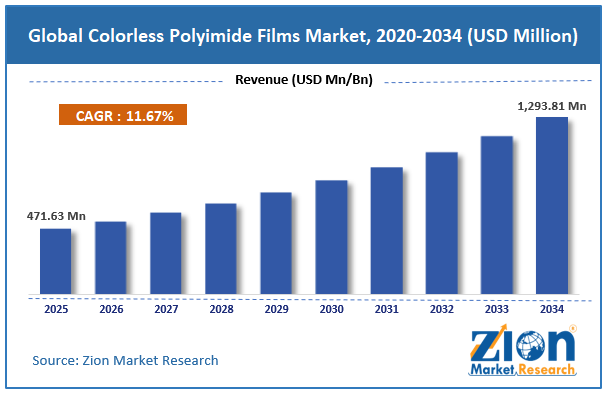
The global colorless polyimide films market size was worth approximately USD 471.63 million in 2025 and is projected to grow to around USD 1,293.81 million by 2034, with a compound annual growth rate of roughly 11.67% between 2026 and 2034.
Key Insights
- As per the analysis shared by our research analyst, the global colorless polyimide films market is estimated to grow annually at a compound annual growth rate of around 11.67% over the forecast period from 2026 to 2034.
- In terms of revenue, the global colorless polyimide films market size was valued at approximately USD 471.63 million in 2025 and is projected to reach USD 1,293.81 million by 2034.
- The colorless polyimide films market is expected to grow steadily, driven by rising production of foldable and flexible smartphones, expanding investment in flexible OLED display manufacturing, growing demand for lightweight automotive displays, increasing use in wearable electronics, and rising preference for durable, scratch-resistant cover materials.
- Based on type, thermally cured colorless polyimide films are expected to lead the overall market, while fluorinated colorless polyimide films are anticipated to grow steadily as manufacturers seek improved optical clarity and lower yellowing over time.
- Based on application, the flexible display substrates segment is expected to lead the colorless polyimide films market, while the touch panel and cover window films segment is anticipated to grow rapidly, driven by rising demand for foldable smartphone cover materials.
- Based on end-user, consumer electronics and smartphone manufacturers form the largest current end-user group, while automotive electronics manufacturers are anticipated to grow most rapidly during the forecast period as vehicles adopt more flexible digital display systems.
- Based on the distribution channel, direct sales to panel makers are expected to lead the market, while online chemical and material platforms are anticipated to grow steadily as digital procurement adoption increases among smaller device makers and research institutions.
- Based on region, Asia Pacific is projected to dominate the global colorless polyimide films market during the estimated period, followed by North America.
Colorless Polyimide Films Market: Overview
Colorless polyimide films are advanced transparent plastic films designed to replace glass in modern electronic devices by offering high flexibility, strength, and excellent optical clarity. They are lightweight, clear, and durable, making them ideal for electronic products that need to bend or fold without breaking. Unlike traditional polyimide films, which are usually yellow or amber, colorless polyimide films are specially made to remain transparent while maintaining excellent heat resistance, mechanical strength, and flexibility. These films are widely used in foldable smartphones, flexible displays, wearable devices, tablets, and other next-generation electronics where both clarity and durability are important. They can withstand repeated folding, high-temperature manufacturing, scratches, and moisture, making them a reliable alternative to thin glass.
Common applications include flexible display substrates, protective cover windows, touch panels, and printed circuit boards. The growing popularity of foldable smartphones, the expansion of flexible display production, and the rising demand for lightweight, durable electronic devices are driving market growth. Increasing investments in advanced display manufacturing, especially across Asia, along with continuous innovation in consumer electronics, are further encouraging the adoption of colorless polyimide films worldwide.
The colorless polyimide films industry is growing due to rising demand for foldable devices, expanding flexible display production, and increasing shift toward lightweight, durable electronic materials.
Impact of the USA-Israel War on Iran on the Colorless Polyimide Films Market
Geopolitical tensions involving the United States, Israel, and Iran may affect global petrochemical supply chains, increasing the costs of key raw materials used in the short-term production of colorless polyimide film. Some disruptions in Middle East trade could tighten the supply of specialty chemical intermediates, creating temporary pricing pressure for film manufacturers across the global electronics supply chain. However, strong demand from flexible display makers and consumer electronics brands is expected to support long-term stability, helping the colorless polyimide films market continue growing despite short-term challenges.
Colorless Polyimide Films Market: Technology Roadmap 2025–2034
What is the projected development roadmap of the colorless polyimide films market over the forecast period?
The colorless polyimide films market is advancing through improved fold durability, greater optical clarity, scratch-resistant hard coatings, and lower-cost production methods, thereby reducing reliance on glass-based display covers. The market is expected to grow at a compound annual growth rate of around 11.67% over the forecast period, driven by steady demand from manufacturers of flexible displays and foldable devices.
The following roadmap outlines key development phases expected through 2034.
2025–2027: Optical Clarity and Fold Durability Improvement Phase
- Film makers are expected to improve transparency and reduce yellowing over time, helping colorless polyimide films more closely match the visual clarity of thin glass.
- New hard-coating technologies are expected to offer improved scratch resistance while keeping the films thin enough for foldable device designs.
- Digital simulation tools for fold testing are expected to help companies develop more durable films faster and reduce testing time.
2028–2031: Automotive and Wearable Expansion Phase
- Producers are expected to develop colorless polyimide films suitable for automotive dashboard displays and curved interior screens that meet stricter heat- and vibration-resistance requirements.
- Regional production in countries such as South Korea, China, and Taiwan is expected to grow as demand rises and companies reduce their reliance on imports.
- Standard testing and certification systems are expected to help companies prove durability performance and build trust with display and automotive customers.
2032–2034: Ultra-Thin and Smart Film Functionality Phase
- Ultra-thin colorless polyimide films with embedded sensing capability are expected to enable new wearable and foldable device designs with added functionality.
- Fully recyclable and lower-emission production processes are expected to gain acceptance as sustainability becomes a bigger factor in material selection.
- Artificial intelligence tools are expected to help design better-performing films faster, making customized solutions easier and more affordable for device manufacturers.
Colorless Polyimide Films Market: Dynamics
Growth Drivers
What is driving growth in the colorless polyimide films market as foldable devices and flexible displays expand?
The colorless polyimide films market is growing steadily due to rising demand for foldable smartphones and flexible displays in the consumer electronics industry. Major smartphone brands are launching more foldable and rollable devices that require a strong, clear material that can bend thousands of times without breaking or losing its appearance. Colorless polyimide films are well suited for this purpose because they are flexible, transparent, lightweight, and more durable than many traditional materials.
At the same time, the production of flexible OLED displays is expanding rapidly across Asia, where these films are widely used as the base layer for bendable screens. Countries such as South Korea, China, and Japan are investing heavily in advanced display manufacturing, increasing the demand for high-quality colorless polyimide films. Consumers are also increasingly interested in lightweight, portable, and stylish electronic devices, prompting manufacturers to adopt these advanced materials. The growing popularity of foldable electronics and continued investment in flexible display production are driving steady demand for colorless polyimide films worldwide.
Automotive display expansion and evolving end-user preferences are further strengthening the growth of the colorless polyimide films market.
The colorless polyimide films industry is growing as automotive and electronics companies increasingly choose lightweight, durable materials that deliver high performance without adding extra weight. Vehicle manufacturers are using larger, curved digital displays, and colorless polyimide films provide the flexibility and heat resistance needed for modern dashboard and infotainment systems.
Many companies also prefer suppliers that can provide consistent transparency, high quality, and long-lasting performance, making material reliability an important factor in product selection. The rapidly growing wearable electronics market, especially in Asia, is creating more demand for colorless polyimide films used in smartwatches, fitness bands, and other flexible devices. These films offer the strength and flexibility needed for everyday products. Growing demand for durable, lightweight, and flexible electronic devices, along with increased focus on advanced automotive displays, is driving long-term growth in the colorless polyimide films market across the global electronics and automotive industries.
Restraints
Manufacturing complexity and raw material cost sensitivity are key challenges in the colorless polyimide films market.
The colorless polyimide films market faces several challenges, including complex manufacturing processes and fluctuating raw material prices, which hinder its wider adoption. Making colorless polyimide films requires careful control of the production process to prevent the yellow tint found in regular polyimide, which makes manufacturing more difficult and expensive than for standard films. It is also challenging to maintain the same level of transparency and quality across large production batches, and small defects can result in rejected products and higher production costs.
In addition, the prices of key raw materials, such as specialty chemical compounds, often fluctuate due to changes in the global petrochemical market and supply chain conditions. Higher raw material costs can increase the price of colorless polyimide films, making them less competitive than lower-cost alternatives in price-sensitive electronics markets. These challenges continue to slow market growth despite the excellent flexibility, transparency, durability, and performance offered by colorless polyimide films.
Opportunities
How are growth in foldable devices, automotive innovation, and emerging display markets driving opportunities in the colorless polyimide films market?
The colorless polyimide films market is experiencing significant growth due to the rising demand for foldable devices, automotive displays, and next-generation electronic products worldwide. The increasing popularity of foldable smartphones and tablets is encouraging manufacturers to use better cover and base materials, driving demand for colorless polyimide films that provide both flexibility and clear visibility. The automotive industry is also creating new opportunities as vehicle manufacturers introduce larger, curved, and more interactive digital displays that require lightweight and durable materials. The growing use of smartwatches, fitness bands, and other wearable devices across North America, Europe, and East Asia is further driving demand for flexible, long-lasting films.
Expanding production capacity, improving manufacturing efficiency, and greater awareness of these advanced materials among product designers are helping companies reach new markets. Increasing investments in flexible OLED display manufacturing and advanced semiconductor technologies are creating additional opportunities for film suppliers. Rising demand for lightweight, durable materials in healthcare devices and industrial electronics is also supporting future market growth. These trends are creating strong long-term growth opportunities for the global colorless polyimide films market.
Challenges
What challenges does the colorless polyimide films market face in production consistency and sustaining innovation amid competition?
The colorless polyimide films market faces challenges in maintaining consistent product quality and dealing with increasing competition among manufacturers worldwide. Producing films with the same level of transparency, thickness, and flexibility across every batch requires advanced equipment and strict quality control, which makes the manufacturing process more difficult. Even small defects can lead to rejected products and affect a company's reputation among electronics and display manufacturers that expect high-quality standards.
At the same time, both large global companies and smaller specialized manufacturers compete by offering better prices and improved performance. Smaller companies often find it difficult to invest in advanced research and new technologies, while larger companies face pressure to stay competitive and protect their profits. Continuous investment in innovation, quality improvement, and technical support is essential to succeed. These challenges can slow market growth and require strong technical expertise and financial resources to overcome.
Colorless Polyimide Films Market: Report Scope
| Report Attributes | Report Details |
|---|---|
| Report Name | Colorless Polyimide Films Market |
| Market Size in 2025 | USD 471.63 Million |
| Market Forecast in 2034 | USD 1,293.81 Million |
| Growth Rate | CAGR of 11.67% |
| Number of Pages | 230 |
| Key Companies Covered | SKC Incorporated, Kolon Industries, Sumitomo Chemical Company, DuPont de Nemours, Kaneka Corporation, Taimide Tech Incorporated, UBE Corporation, Toyobo Company, SK Innovation, Nexolve Corporation, and others. |
| Segments Covered | By Type, By Application, By End-User, By Distribution Channel, and By Region |
| Regions Covered | North America, Europe, Asia Pacific (APAC), Latin America, Middle East, and Africa (MEA) |
| Base Year | 2025 |
| Historical Year | 2020 to 2024 |
| Forecast Year | 2026 - 2034 |
| Customization Scope | Avail customized purchase options to meet your exact research needs. Request For Customization |
Colorless Polyimide Films Market: Segmentation
The global colorless polyimide films market is segmented by type, application, end-user, distribution channel, and region.
What makes thermally cured colorless polyimide films the expected leader in the colorless polyimide films market?
Based on type, the global colorless polyimide films market is divided into thermally cured, UV-cured, fluorinated, and hybrid colorless polyimide films. Thermally cured colorless polyimide films hold about 44% market share, leading due to their proven durability, established production processes, and widespread use among major display manufacturers. Fluorinated, colorless polyimide films hold around 21% of the market share. It is among the fastest-growing segments, driven by rising demand for improved optical clarity and better long-term resistance to yellowing.
How does the flexible display substrates application segment maintain its leading position in the colorless polyimide films market?
Based on application, the colorless polyimide films market is categorized into flexible display substrates, touch panel and cover window films, printed circuit board applications, and optical and photonic components. The flexible display substrates segment accounts for approximately 50% of the global colorless polyimide films market share, reflecting the widespread use of these films as the base layer in foldable and flexible display panels. The touch panel and cover window films segment holds around 24% of the market share. It is growing rapidly due to the rising demand for durable, scratch-resistant cover materials in foldable smartphones.
What makes consumer electronics and smartphone manufacturers the leading end-users of colorless polyimide films?
Based on end-user, the market is classified into consumer electronics and smartphone manufacturers, display panel producers, automotive electronics manufacturers, and aerospace and defense applications. Consumer electronics and smartphone manufacturers lead with about 47% share, driven by high demand for foldable and flexible devices in global markets. Automotive electronics manufacturers hold around 17% share. They are growing most rapidly as vehicles increasingly adopt curved and flexible in-cabin display technology.
How do direct sales to panel makers dominate the distribution landscape of the colorless polyimide films market?
Based on distribution channel, the colorless polyimide films industry is segregated into direct sales to panel makers, specialty material distributors, online chemical and material platforms, and third-party converters and processors. Direct sales to panel makers account for about 46% of the market and lead, as major display manufacturers prefer reliable supply, technical support, and long-term pricing agreements. Online chemical and material platforms hold around 8% share. They are growing as device makers and research institutions increasingly use digital channels to source specialty films and compare specifications.
Colorless Polyimide Films Market: Regional Analysis
How is Asia Pacific shaping global demand for colorless polyimide films?
The Asia Pacific region leads the global colorless polyimide films market and is expected to grow at a CAGR of around 8.3% during the forecast period. The rising production of foldable smartphones, flexible displays, and other advanced electronic devices mainly drives the region's growth. Many of the world's leading electronics and display manufacturers operate in the Asia Pacific, creating strong demand for high-quality colorless polyimide films. South Korea is a major market because it is home to leading flexible OLED display manufacturers and well-known smartphone brands that continue to develop foldable devices. China is also expanding rapidly, with large investments in display panel manufacturing and increasing production of foldable and flexible consumer electronics. Japan and Taiwan contribute through advanced materials research, innovation, and high-quality specialty film manufacturing. The growing popularity of smartwatches, fitness bands, tablets, and other wearable devices is further increasing the demand for lightweight, flexible, and durable film materials.
Governments across the region are supporting advanced manufacturing through research programs, technology investments, and production incentives, helping local companies expand their capabilities. Strong electronics manufacturing infrastructure, continuous technological innovation, and rising consumer demand for flexible devices continue to make the Asia Pacific the largest and fastest-growing market for colorless polyimide films worldwide.
How does North America maintain its strong position in the colorless polyimide films market?
The North American colorless polyimide films market is the second-largest globally and is expected to grow at a CAGR of around 6.5% during the forecast period. Growth is driven by increasing demand for advanced consumer electronics, growing innovation in automotive displays, and rising investment in advanced materials research. The United States leads the regional market because it is home to many leading technology companies that continue to develop foldable smartphones, tablets, and other flexible electronic devices. Canada also plays an important role through ongoing research in advanced materials and specialty film technologies. The growing popularity of smartwatches, fitness trackers, and other wearable devices is increasing the demand for lightweight, durable, and flexible film materials.
At the same time, automotive manufacturers are introducing larger digital dashboards and interactive display systems, creating additional demand for high-performance transparent films. Strong research and development capabilities, along with close partnerships between material suppliers and electronics manufacturers, are helping expand the use of colorless polyimide films across different industries. Increasing investments in next-generation display technologies and flexible electronic components for healthcare, aerospace, and industrial applications are further supporting long-term market growth across North America.
Recent Market Developments
- In February 2026, SKC Incorporated continued developing its advanced colorless polyimide film technology, focusing on improved optical clarity and fold durability to meet the evolving needs of foldable display manufacturers.
Colorless Polyimide Films Market: Competitive Analysis
The leading players in the global colorless polyimide films market are:
- SKC Incorporated
- Kolon Industries
- Sumitomo Chemical Company
- DuPont de Nemours
- Kaneka Corporation
- Taimide Tech Incorporated
- UBE Corporation
- Toyobo Company
- SK Innovation
- Nexolve Corporation
The global colorless polyimide films market is segmented as follows:
By Type
- Thermally Cured Colorless Polyimide Films
- UV-Cured Colorless Polyimide Films
- Fluorinated Colorless Polyimide Films
- Hybrid Colorless Polyimide Films
By Application
- Flexible Display Substrates
- Touch Panel and Cover Window Films
- Printed Circuit Board Applications
- Optical and Photonic Components
By End-User
- Consumer Electronics and Smartphone Manufacturers
- Display Panel Producers
- Automotive Electronics Manufacturers
- Aerospace and Defense Applications
By Distribution Channel
- Direct Sales to Panel Makers
- Specialty Material Distributors
- Online Chemical and Material Platforms
- Third-Party Converters and Processors
By Region
- North America
- The U.S.
- Canada
- Mexico
- Europe
- France
- The UK
- Spain
- Germany
- Italy
- Rest of Europe
- Asia Pacific
- China
- Japan
- India
- Australia
- South Korea
- Rest of Asia Pacific
- The Middle East & Africa
- Saudi Arabia
- UAE
- Egypt
- Kuwait
- South Africa
- Rest of the Middle East & Africa
- Latin America
- Brazil
- Argentina
- Rest of Latin America
Table Of Content
Methodology
FrequentlyAsked Questions
Colorless polyimide films are thin, flexible, and highly transparent materials used as lighter, more bendable substitutes for glass in electronic devices. They retain the strength, heat resistance, and flexibility of regular polyimide while remaining clear rather than yellowing.
The global colorless polyimide films market is expected to grow, driven by rising production of foldable and flexible smartphones, expanding flexible OLED display manufacturing, growing automotive display innovation, increasing use in wearable electronics, and rising preference for lightweight, durable cover materials.
According to research, the global colorless polyimide films market size was worth around USD 471.63 million in 2025 and is predicted to grow to around USD 1,293.81 million by 2034.
The compound annual growth rate value of the colorless polyimide films market is expected to be around 11.67% during 2026 to 2034.
Asia Pacific is expected to lead the global colorless polyimide films market during the forecast period, driven by large-scale flexible display production in South Korea and China, rapidly expanding foldable smartphone manufacturing, and strong government support for advanced materials industries.
The major players in the global colorless polyimide films market include SKC Incorporated, Kolon Industries, Sumitomo Chemical Company, DuPont de Nemours, Kaneka Corporation, Taimide Tech Incorporated, UBE Corporation, Toyobo Company, SK Innovation, and Nexolve Corporation.
The report examines key aspects of the colorless polyimide films market, including growth drivers, restraints, emerging opportunities, challenges, a competitive landscape analysis, regional breakdowns, and a detailed future outlook across all major types, applications, end users, and geographies.
The colorless polyimide films market faces challenges, including high production costs, complex manufacturing processes, and competition from ultra-thin glass solutions offered by companies such as Corning Incorporated. Maintaining high optical clarity, durability, and large-scale production efficiency also remains a significant challenge.
The colorless polyimide films market is moderately consolidated, with leading companies such as SKC Co., Ltd., Kolon Industries, Sumitomo Chemical Co., Ltd., Kaneka Corporation, and DuPont competing through material innovation, strategic partnerships, manufacturing expansion, and research focused on flexible display and advanced electronic applications.
Consumer demand for thinner, lighter, and foldable electronic devices is prompting companies, including SKC Co., Ltd., Kolon Industries, and Sumitomo Chemical Co., Ltd., to develop highly transparent, durable, and flexible films that enhance display performance, reliability, and the overall user experience.

HappyClients

