
Global Cast Acrylic Sheet Market Size, Share, Trends, Growth & Forecast 2034

Cast Acrylic Sheet Market By Type (Clear Cast Acrylic, Colored Cast Acrylic, Frosted Cast Acrylic, Mirrored Cast Acrylic, Textured Cast Acrylic), By Thickness (Below 3mm, 3mm to 6mm, 6mm to 12mm, Above 12mm), By Application (Signage and Displays, Automotive, Architecture and Construction, Furniture and Fixtures, Lighting, Aquariums, Medical Equipment), By End-User (Commercial, Residential, Industrial, Institutional), and By Region - Global and Regional Industry Overview, Market Intelligence, Comprehensive Analysis, Historical Data, and Forecasts 2025 - 2034
| Market Size in 2024 | Market Forecast in 2034 | CAGR (in %) | Base Year |
|---|---|---|---|
| USD 4.23 Billion | USD 7.12 Billion | 5.95% | 2024 |
Cast Acrylic Sheet Market: Industry Perspective
What will be the size of the cast acrylic sheet market during the forecast period?
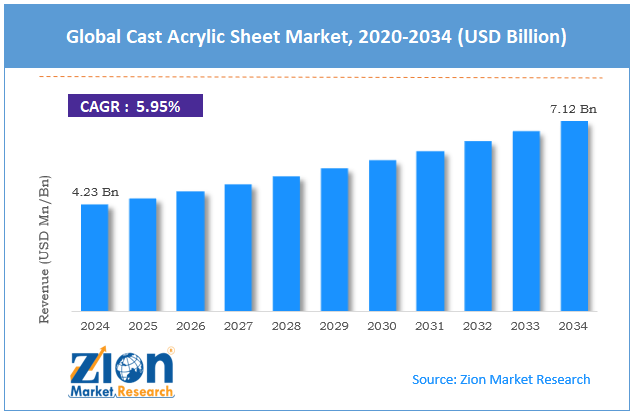
The global cast acrylic sheet market size was worth approximately USD 4.23 billion in 2024 and is projected to grow to around USD 7.12 billion by 2034, with a compound annual growth rate (CAGR) of roughly 5.95% between 2025 and 2034.
Key Insights
- As per the analysis shared by our research analyst, the global cast acrylic sheet market is estimated to grow annually at a CAGR of around 5.95% over the forecast period (2025-2034).
- In terms of revenue, the global cast acrylic sheet market size was valued at approximately USD 4.23 billion in 2024 and is projected to reach USD 7.12 billion by 2034.
- The cast acrylic sheet market is projected to grow significantly due to increasing construction activities, rising demand for energy-efficient building materials, growing automotive production, expanding signage industry, and technological advancements in acrylic manufacturing.
- Based on type, the clear cast acrylic segment is expected to lead the cast acrylic sheet market, while the colored cast acrylic segment is anticipated to grow significantly.
- Based on thickness, the 3mm to 6mm segment is expected to lead the cast acrylic sheet market, while the above 12mm segment is anticipated to grow rapidly.
- Based on application, the signage and displays segment is the dominating segment, while the architecture and construction segment is projected to witness sizeable revenue over the forecast period.
- Based on end-user, the commercial segment is expected to lead the market, followed by the residential segment.
- Based on region, Asia Pacific is projected to dominate the global cast acrylic sheet market during the estimated period, followed by North America.
Cast Acrylic Sheet Market: Overview
Cast acrylic sheets are transparent thermoplastic materials manufactured by casting liquid acrylic resin between two glass plates and curing it to form solid sheets with superior optical clarity. This controlled casting process results in a smooth surface finish and a consistent thickness compared with other acrylic manufacturing methods. Cast acrylic allows light to pass through efficiently, providing a glass-like appearance with minimal visual distortion. Because of this high transparency, it is widely used in applications where clear visibility and appearance are important. The material also shows strong resistance to common chemicals, including cleaning solutions, alcohols, and mild acids, making it suitable for regular use in commercial and industrial settings. Cast acrylic maintains its shape and size across a wide range of temperatures and resists bending or warping over long periods. It can be easily cut, drilled, polished, and shaped using standard fabrication tools without complex processing.
When heated, the sheets can be formed into curved and three-dimensional shapes for custom designs. The surface supports printing, painting, engraving, and coating for added functionality. Cast acrylic performs well outdoors and retains clarity under sunlight. It is lighter than glass, easier to install, and safer due to high impact resistance.
The increasing demand for lightweight, durable materials in the construction and automotive industries is expected to drive growth in the cast acrylic sheet market over the forecast period.
Cast Acrylic Sheet Market: Technology Roadmap 2025 to 2034
What is the projected development roadmap of the cast acrylic sheet market over the forecast period?
The cast acrylic sheet market is entering a phase of rapid growth, supported by construction expansion, sustainability initiatives, manufacturing innovation, and improvements in material performance. The market is expected to grow at a CAGR of around 5.95% over the forecast period, driven by rising demand across signage, architecture, and commercial applications. The following roadmap outlines key development phases expected through 2034.
2025-2027: Manufacturing Efficiency and Quality Enhancement Phase
- Improved casting methods speed up production while maintaining clarity and consistent thickness in large sheets, supporting high-volume demand where clear cast acrylic holds nearly 48% market share.
- Automated quality checks identify defects early in the process, reducing material waste and delivering more consistent products to customers.
- Improved surface finishing produces smoother sheets that require less processing, lowering production costs and improving final visual quality.
2028-2031: Sustainable Materials and Performance Optimization Phase
- New bio-based acrylic materials made from renewable sources help lower carbon emissions and reduce environmental impact during production and use.
- Improved additives increase resistance to sunlight, scratches, and weather, supporting outdoor and signage applications growing at over 6% CAGR.
- Recycling systems reuse scrap and old sheets to make new products, supporting sustainable and circular manufacturing.
2032-2034: Smart Materials and Application Expansion Phase
- Smart features, such as adjustable transparency, allow acrylic sheets to change appearance for modern buildings and privacy-control applications.
- Advanced coatings combine properties such as easy cleaning, reduced glare, and hygiene protection for specialized and high-value applications.
- Hybrid designs mix acrylic with other materials to create stronger, more efficient, and better-looking solutions for many uses.
Cast Acrylic Sheet Market: Dynamics
Growth Drivers
Growing construction and architectural applications drive market expansion.
The cast acrylic sheet market is growing rapidly as global construction expands and architects choose acrylic materials for interior and exterior building applications, with the architecture and construction sectors representing the largest demand segment. Modern architecture favors natural light through large, transparent surfaces, and cast acrylic sheets serve as reliable alternatives to traditional glass. Low material weight reduces structural load requirements, allowing wider transparent spans without heavy frameworks or complex reinforcement systems. High-impact resistance improves safety in buildings exposed to harsh weather conditions, seismic activity, or higher vandalism risk. Improved thermal insulation supports energy-efficient buildings by reducing heating and cooling loads relative to conventional glass installations.
Design flexibility allows curved forms, smooth surfaces, and large seamless panels, supporting creative architectural concepts across commercial and residential projects. Renovation projects use acrylic sheets to upgrade lighting, refresh the building's appearance, and enhance overall energy performance. Urban development growth increases demand for offices, retail spaces, transit hubs, and institutions, where cost efficiency, durability, clarity, and ease of installation provide strong advantages.
How is the expanding signage and advertising industry driving the growth of the cast acrylic sheet market?
The global cast acrylic sheet industry grows steadily as businesses invest in attractive signage and advertising displays, with signage remaining the most material-intensive application per installation. Cast acrylic sheets are well-suited for illuminated signage because their excellent light transmission creates bright, uniform illumination, while their durability supports long-term outdoor use. Face-lit acrylic channel letters deliver bold storefront signage for shopping centers, commercial buildings, and urban retail locations. Edge-lit acrylic signs offer thin, modern designs for retail interiors, offices, and corporate spaces that require clean, professional wayfinding solutions.
Digital printing enables full-color graphics on acrylic surfaces, creating strong visual effects for branding displays and promotional communication. Retail environments use acrylic for three-dimensional signs, product displays, and point-of-purchase units, combining clarity, strength, and style. Outdoor advertising, including billboards, shelters, transit displays, and monument signs, relies on acrylic protection for visibility, durability, and weather resistance. Restaurants, exhibitions, events, and corporate lobbies use acrylic panels for backlit menus, exhibits, branding, and clear directional signage.
Restraints
Competition from alternative materials limits market growth.
A major challenge for the cast acrylic sheet market is strong competition from other transparent materials used in construction, signage, and industrial applications. Extruded acrylic sheets are less expensive and provide acceptable performance for projects in which premium optical clarity or thickness control is unnecessary. Polycarbonate materials offer higher impact resistance, making them suitable for security barriers, protective glazing, and locations with a high risk of vandalism. Glass options, such as tempered or laminated products, provide scratch resistance and visual quality preferred for luxury architectural and interior design projects.
New plastic materials continue to enter the market, offering targeted benefits that spread demand across multiple substitutes competing with cast acrylic sheets. Many buyers focus on price sensitivity and select cheaper alternatives when advanced acrylic properties offer limited added value. A misunderstanding of acrylic performance, combined with aggressive marketing by rival suppliers, often shifts purchasing decisions toward competing materials. Regulatory preferences, environmental concerns, and established supplier relationships further slow the adoption of cast acrylic across traditional glazing and display applications.
Opportunities
How is customization and specialty product development creating new opportunities for the cast acrylic sheet market?
The cast acrylic sheet industry continues to grow as manufacturers introduce specialized products, with custom and specialty grades generating higher value realization than standard sheets. Custom color options help architects and designers match brand colors and design themes with greater accuracy across large projects. Textured acrylic surfaces enhance visual appeal and distribute light more evenly while maintaining durability and weather resistance. Anti-glare and anti-reflective finishes improve visibility in display cases, protective barriers, and equipment covers where reflections reduce clarity. Anti-static acrylic reduces dust buildup, making it suitable for use in cleanrooms, electronics manufacturing areas, and museum display environments.
Ultraviolet filtering sheets protect products, artwork, and interior spaces from ultraviolet radiation while preserving brightness and clear visibility over extended exposure periods. Flame-resistant acrylic grades comply with stringent fire safety regulations, thereby expanding their use in public buildings, transportation hubs, and regulated commercial spaces. Antibacterial acrylic surfaces improve hygiene standards in hospitals, food service areas, and public facilities where cleanliness remains critical. Impact-modified and optical-grade acrylic solutions support demanding technical, lighting, and scientific applications that require enhanced strength, precision, and long-term reliability.
Challenges
How are raw material price volatility and supply chain disruptions creating challenges for the cast acrylic sheet industry?
The cast acrylic sheet industry faces structural challenges due to its high sensitivity to petrochemical feedstock pricing, which directly affects production economics. Production relies on methyl methacrylate sourced from petroleum feedstocks, creating strong exposure to crude oil prices and natural gas market volatility. Rising energy prices increase manufacturing costs through higher processing power requirements and higher costs for essential raw materials. Geopolitical tensions, natural disasters, and pandemic-related restrictions interrupt material supply, finished product movement, and international trade flows worldwide.
Port congestion, container shortages, and limited transport capacity delay deliveries, raise logistics costs, and complicate inventory and demand management decisions. Strong demand periods strain manufacturing capacity, causing longer lead times, uneven supply allocation, and customer dissatisfaction across the construction and signage markets. Environmental regulations for chemical production add compliance costs, create sourcing risks, and pressure manufacturers to adjust procurement and long-term planning strategies.
Cast Acrylic Sheet Market: Report Scope
| Report Attributes | Report Details |
|---|---|
| Report Name | Cast Acrylic Sheet Market |
| Market Size in 2024 | USD 4.23 Billion |
| Market Forecast in 2034 | USD 7.12 Bllion |
| Growth Rate | CAGR of 5.95% |
| Number of Pages | 223 |
| Key Companies Covered | Evonik Industries, Mitsubishi Chemical Corporation, Altuglas International (Arkema), Plaskolite, Schweiter Technologies (3A Composites), Unigel Group, Asia Poly Industrial, Margacipta Wirasentosa, Gary Plastic Packaging Corporation, Astari Niagara, and others. |
| Segments Covered | By Type, By Thickness, By Application, By End User, and By Region |
| Regions Covered | North America, Europe, Asia Pacific (APAC), Latin America, Middle East, and Africa (MEA) |
| Base Year | 2024 |
| Historical Year | 2019 - 2023 |
| Forecast Year | 2025 - 2034 |
| Customization Scope | Avail customized purchase options to meet your exact research needs. Request For Customization |
Cast Acrylic Sheet Market: Segmentation
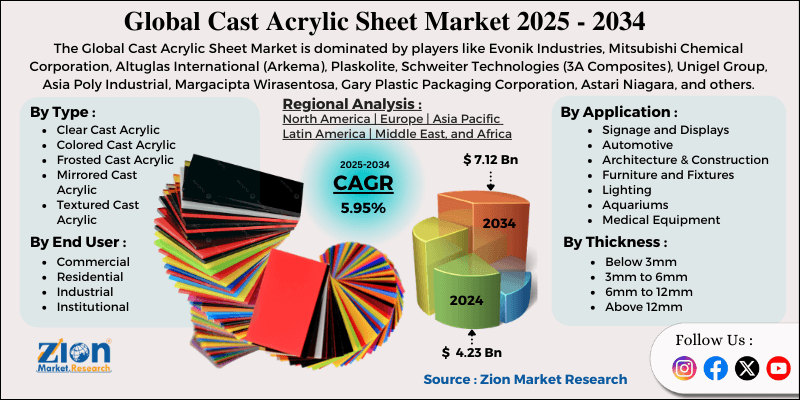
The global cast acrylic sheet market is segmented based on type, thickness, application, end-user, and region.
Why is the clear cast acrylic segment expected to lead the cast acrylic sheet market?
Based on type, the global cast acrylic sheet industry is categorized into clear cast acrylic, colored cast acrylic, frosted cast acrylic, mirrored cast acrylic, and textured cast acrylic. The clear cast acrylic segment accounted for approximately 48% of the global market share and is expected to remain dominant during the forecast period due to its superior optical clarity, high light transmission, and wide use across signage, architecture, lighting, and retail display applications.
The colored cast acrylic segment follows as the second-largest category, with nearly 22% market share, driven by rising demand for aesthetic design elements, branded interiors, decorative panels, and architectural features that require consistent color quality.
What supports the leadership of the 3mm to 6mm thickness segment in the cast acrylic sheet market during the forecast period?
Based on thickness, the market is divided into below 3mm, 3mm to 6mm, 6mm to 12mm, and above 12mm. The 3mm to 6mm segment holds around 43% of the total market share and is expected to lead throughout the forecast period, as it is the most commonly used thickness range across end-use applications, balancing cost, strength, and fabrication ease.
The 6mm to 12mm segment ranks second with approximately 27% market share, supported by growing use in architectural glazing, protective barriers, aquariums, and structural applications requiring higher rigidity.
Why does the signage and displays segment dominate the cast acrylic sheet market?
Based on application, the global cast acrylic sheet market is segregated into signage and displays, automotive, architecture and construction, furniture and fixtures, lighting, aquariums, and medical equipment. The signage and displays segment accounts for nearly 38% of the overall market share and continues to lead, driven by strong demand for illuminated signage, retail branding, and advertising structures.
The architecture and construction segment accounts for approximately 26% of the market, driven by the increasing use of acrylic in canopies, skylights, partitions, and decorative building elements across commercial and residential projects.
What enables the commercial end-user segment to lead the global cast acrylic sheet market?
Based on end user, the market is segmented into commercial, residential, industrial, and institutional categories. The commercial segment leads with approximately 52% market share and is expected to grow steadily, supported by higher material consumption per installation site in retail, hospitality, office, and shopping center projects.
The residential segment holds the second position with nearly 23% market share, driven by rising home renovation activity, outdoor living trends, and increased use of acrylic in interior décor, furniture, and lighting applications.
Cast Acrylic Sheet Market: Regional Analysis
What factors enable the Asia Pacific to dominate the global cast acrylic sheet market during the forecast period?
Asia-Pacific is expected to account for 39.2% of global production and exports and serve as the primary global production and export hub for the cast acrylic sheet market. The region leads due to fast industrial growth, large-scale construction activity, expanding manufacturing capacity, and high production volumes serving local and global markets. China is the largest producer and consumer of cast acrylic sheets, supported by a strong manufacturing infrastructure and cost-efficient production systems. Rising construction activity across the region is driving high demand for glazing, skylights, partitions, and decorative building elements made from acrylic materials. A growing middle class supports retail expansion, increasing demand for shop signage, indoor displays, and point-of-purchase fixtures made from acrylic sheets.
Manufacturing centers across the Asia Pacific supply furniture, lighting products, and consumer goods made from acrylic for domestic use and export. Increasing vehicle production in China, Japan, South Korea, and India supports demand for acrylic in lighting and interior components. Rapid urban growth drives the use of acrylic solutions for commercial buildings, transport projects, and public facilities. Low labor costs and supportive regulations help manufacturers maintain competitive pricing while scaling production efficiently across the region. Government investments in transport, healthcare, and education infrastructure continue to create steady institutional demand for acrylic sheets in multiple building applications. Tourism growth across the Asia Pacific drives new hotels, resorts, and entertainment spaces, increasing acrylic use in architectural features, interior design, and aquarium installations, while export-focused production strengthens global supply networks.
What factors are contributing to North America's significant growth?
North America is projected to account for 27.6% of the global cast acrylic sheet market and remain the second-largest region. The region shows steady growth as renovation activity rises and sustainable construction practices gain wider acceptance across commercial, institutional, and residential building projects. Strong construction fundamentals support regular demand for architectural acrylic used in glazing, partitions, skylights, and decorative building elements. High consumer spending sustains the retail sector, increasing demand for attractive signage, interior displays, and store fixtures fabricated from cast acrylic sheets.
A mature signage industry supports complex illuminated signs and architectural features requiring premium optical clarity and consistent acrylic quality. Advanced manufacturing sectors, including automotive, aerospace, and furniture, rely on precision acrylic components meeting strict quality and performance requirements. Building codes and safety standards favor impact-resistant materials, thereby increasing the adoption of acrylic in schools, hospitals, public facilities, and high-traffic environments.
Environmental awareness supports the use of acrylic due to its energy-efficiency benefits, reduced structural weight, lower transport impacts, and growing recycling potential. Replacement and maintenance activities create steady demand as existing acrylic installations require renewal after long-term exposure to outdoor conditions. A strong culture of innovation encourages architects and designers to specify acrylic for modern construction and challenging design requirements. Well-developed distribution networks ensure the reliable availability of acrylic sheets in a range of sizes, colors, and thicknesses. Strong research systems and intellectual property protection support the development of advanced acrylic formulations and improved manufacturing processes across North America.
Recent Market Developments
- In April 2025, Plaskolite LLC announced the launch of its new CELTEC White PVC sheet, aimed at expanding its material portfolio for signage and display applications and strengthening its position in the broader acrylic and sheet market.
Cast Acrylic Sheet Market: Competitive Analysis
The leading players in the global cast acrylic sheet market are:
- Evonik Industries
- Mitsubishi Chemical Corporation
- Altuglas International (Arkema)
- Plaskolite
- Schweiter Technologies (3A Composites)
- Unigel Group
- Asia Poly Industrial
- Margacipta Wirasentosa
- Gary Plastic Packaging Corporation
- Astari Niagara
The global cast acrylic sheet market is segmented as follows:
By Type
- Clear Cast Acrylic
- Colored Cast Acrylic
- Frosted Cast Acrylic
- Mirrored Cast Acrylic
- Textured Cast Acrylic
By Thickness
- Below 3mm
- 3mm to 6mm
- 6mm to 12mm
- Above 12mm
By Application
- Signage and Displays
- Automotive
- Architecture and Construction
- Furniture and Fixtures
- Lighting
- Aquariums
- Medical Equipment
By End User
- Commercial
- Residential
- Industrial
- Institutional
By Region
- North America
- The U.S.
- Canada
- Mexico
- Europe
- France
- The UK
- Spain
- Germany
- Italy
- Rest of Europe
- Asia Pacific
- China
- Japan
- India
- Australia
- South Korea
- Rest of Asia Pacific
- The Middle East & Africa
- Saudi Arabia
- UAE
- Egypt
- Kuwait
- South Africa
- Rest of the Middle East & Africa
- Latin America
- Brazil
- Argentina
- Rest of Latin America
Table Of Content
Methodology
FrequentlyAsked Questions
Cast acrylic sheets are transparent thermoplastic materials manufactured by casting liquid acrylic resin between two glass plates and curing it to form solid sheets with superior optical clarity.
The global cast acrylic sheet market is projected to grow due to increasing construction activities, rising demand for energy-efficient building materials, growing automotive production, expanding signage industry, and technological advancements in acrylic manufacturing.
According to a study, the global cast acrylic sheet market size was worth around USD 4.23 billion in 2024 and is predicted to grow to around USD 7.12 billion by 2034.
The CAGR value of the cast acrylic sheet market is expected to be around 5.95% during 2025-2034.
Asia Pacific is expected to lead the global cast acrylic sheet market during the forecast period.
The major players profiled in the global cast acrylic sheet market include Evonik Industries, Mitsubishi Chemical Corporation, Altuglas International (Arkema), Plaskolite, Schweiter Technologies (3A Composites), Unigel Group, Asia Poly Industrial, Margacipta Wirasentosa, Gary Plastic Packaging Corporation, and Astari Niagara.
The report examines key aspects of the cast acrylic sheet market, including a detailed analysis of current growth drivers and constraints, as well as future growth opportunities and challenges.
In the cast acrylic sheet market, customers increasingly demand sustainable materials, custom colors, and specialty formulations with enhanced properties. Manufacturers respond by developing bio-based resins, expanding color portfolios, and creating functional additives for specific applications, such as antibacterial or ultraviolet-resistant sheets.
In the cast acrylic sheet market, pricing varies significantly based on thickness, type, and order volume, ranging from moderate costs for standard clear sheets to premium pricing for specialty colors and formulations. Manufacturers offer volume discounts, while prices fluctuate with raw material and energy costs.
In the cast acrylic sheet market, competition involves both large multinational manufacturers and regional producers serving local markets. Differentiation is achieved through product quality, specialized offerings, technical support, and distribution networks, with leading companies investing in capacity expansion and sustainability initiatives.

HappyClients

