
Cancer Monoclonal Antibodies Market Size, Share, Value and Forecast 2034

Cancer Monoclonal Antibodies Market By Type (Murine, Chimeric, Human, and Humanized), By Application (Lung Cancer, Blood Cancer, Melanoma, Colorectal Cancer, Breast Cancer, Liver Cancer, and Others), By End-User (Research Institutions, Hospitals, and Others), and By Region - Global and Regional Industry Overview, Market Intelligence, Comprehensive Analysis, Historical Data, and Forecasts 2025 - 2034
| Market Size in 2024 | Market Forecast in 2034 | CAGR (in %) | Base Year |
|---|---|---|---|
| USD 125.1 Billion | USD 577.26 Billion | 18.21% | 2024 |
Cancer Monoclonal Antibodies Industry Perspective:
What is the anticipated size of the cancer monoclonal antibodies market during the projection period?
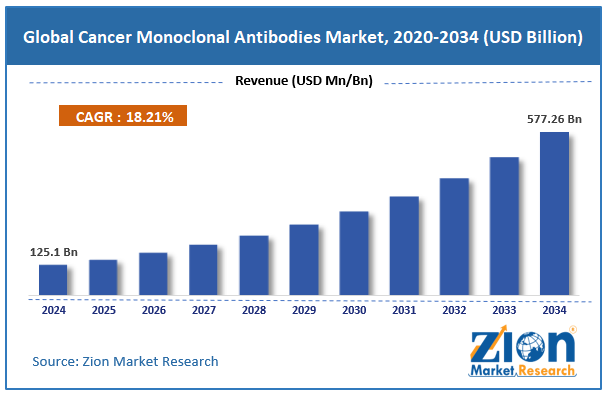
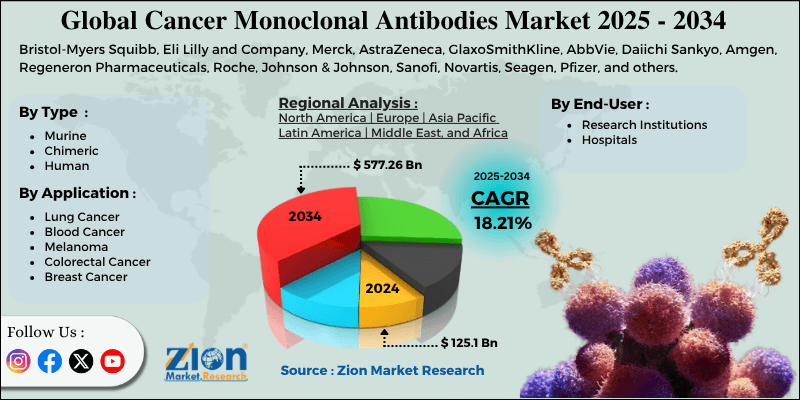
The global cancer monoclonal antibodies market size was worth around USD 125.1 billion in 2024 and is predicted to grow to around USD 577.26 billion by 2034 with a compound annual growth rate (CAGR) of roughly 18.21% between 2025 and 2034.
Cancer Monoclonal Antibodies Market: Overview
Cancer monoclonal antibodies (mAbs) are a prominent type of cancer treatment. They are a type of immunotherapy or targeted cancer drug since they can deliver results in both ways. Researchers develop mAbs in laboratories and leverage them to treat certain medical conditions and a wide range of cancers. Cancer treatments using monoclonal antibodies are effective since they block signals encouraging the growth of cancer cells. In addition, they are used for delivering drugs directly to the cancer cells, thus improving treatment efficacy. During the forecast period, demand for cancer monoclonal antibodies is projected to grow due to the rising prevalence of cancer, increasing healthcare expenditure, and a surge in cancer research investments.
Additionally, regulatory approvals and government support will play crucial roles in shaping the market growth trends. However, the high cost of initial investment, competition from other cancer treatments, and legal barriers may affect overall market revenue in the long run.
Key Insights:
- As per the analysis shared by our research analyst, the global cancer monoclonal antibodies market is estimated to grow annually at a CAGR of around 18.21% over the forecast period (2025-2034)
- In terms of revenue, the global cancer monoclonal antibodies market size was valued at around USD 125.1 billion in 2024 and is projected to reach USD 577.26 billion by 2034.
- The market is projected to grow at a significant rate due to the growing prevalence of the disease.
- Based on the type, the human segment is growing at a high rate and will continue to dominate the global market, as per industry projections
- Based on the application, the lung cancer segment is anticipated to command the largest market share.
- Based on the end-user, the hospitals segment is expected to lead the market growth trends.
- Based on region, North America is projected to dominate the global market during the forecast period.
Impact of the USA-Israel and Iran War on the Cancer Monoclonal Antibodies Market:
The ongoing war between the USA, Israel, and Iran has affected the global supply of mAbs, thus disrupting research & development (R&D) activities and biotechnology logistics. The global pharmaceutical industry is witnessing growing threats of a shortage of essential medicines. In the long run, the war is projected to influence the expansion of supply channels, risk diversification, and strategic global partnerships.
Cancer Monoclonal Antibodies Market: Dynamics
Growth Drivers
How will rising cancer prevalence influence demand in the cancer monoclonal antibodies market?
The global cancer monoclonal antibodies market is expected to be driven by the growing prevalence of the disease. Cancer is a leading cause of medical deaths across the globe. According to official reports, 1 in every female and male is expected to develop cancer once in their lifetime. Cancer burden on the global healthcare infrastructure has risen at unprecedented levels, driven by several lifestyles, environmental, and genetic factors. For instance, liver cancer is associated with excessive alcohol consumption, non-alcoholic fatty liver disease (NAFLD, cirrhosis, and hepatitis B or C virus infections.
Breast cancer is one of the world’s most prevalent forms of cancer. Other common types include colorectal, cervical, and oral cancers. Targeted therapies such as cancer monoclonal antibodies have shown excellent results with a success rate of over 65% to 80% in certain cases, as compared to other treatments.
Increased demand for immunotherapy in cancer treatment to promote market expansion
Rising demand for targeted treatments and immunotherapy will work in favor of the global cancer monoclonal antibodies market. Immunotherapy, for instance, is designed to strengthen a patient’s immune response to cancer. Since it is a form of biological therapy, it does not have side effects associated with traditional cancer treatments such as chemotherapy. In addition, the effects of immunotherapy last longer and are preferred by a wider range of medical professionals.
Restraints
Which cost barriers will limit the expansion of the cancer monoclonal antibodies market?
The global cancer monoclonal antibodies industry is expected to be restricted due to the high cost of initial investment. mAbs research & development can cost more than USD 1.1 billion, limiting the number of players. The use of advanced manufacturing facilities, skilled workforce, and cutting-edge R&D equipment forms a major part of the investments. In addition, treatments consisting of cancer mAbs are expensive and continue to remain unaffordable for the middle and low-income groups.
Opportunities
Ongoing advancements in the industry are generating growth opportunities in the long term
The global cancer monoclonal antibodies market is anticipated to generate growth opportunities due to rising advancements. In April 2026, the American Association for Cancer Research achieved a breakthrough in antibody-based cancer therapies. The agency used investigational antibody-drug conjugate (ADC), QLS5132, which showed positive results in trials concerning the treatment of patients with advanced platinum-resistant ovarian cancer. Phase I trial showed an objective response rate exceeding 50% and a disease control rate of up to 100% at higher doses.
In February 2026, ImmunityBio, Inc., a leading provider of commercial-stage immunotherapy, launched ResQ215B. This phase 2 clinical study is evaluating a novel chemotherapy-free and lymphodepletion-free combination immunotherapy for patients with indolent B-cell non-Hodgkin lymphoma (iNHL) and Waldenström’s Macroglobulinemia. Cancer research investments in the last few years have increased as the global burden continues to reach new levels, thus offering opportunities for higher use of monoclonal antibodies during treatments.
Challenges
How will regulatory constraints shape the cancer monoclonal antibodies market?
The global cancer monoclonal antibodies industry is expected to be challenged by regulatory pressures. Cancer research and development are subject to strict regulations and quality standards. In addition, federal laws concerning drug development vary between regions, creating additional complexities for the industry players.
Cancer Monoclonal Antibodies Market: Report Scope
| Report Attributes | Report Details |
|---|---|
| Report Name | Cancer Monoclonal Antibodies Market |
| Market Size in 2024 | USD 125.1 Billion |
| Market Forecast in 2034 | USD 577.26 Billion |
| Growth Rate | CAGR of 18.21% |
| Number of Pages | 227 |
| Key Companies Covered | Bristol-Myers Squibb, Eli Lilly and Company, Merck, AstraZeneca, GlaxoSmithKline, AbbVie, Daiichi Sankyo, Amgen, Regeneron Pharmaceuticals, Roche, Johnson & Johnson, Sanofi, Novartis, Seagen, Pfizer, and others. |
| Segments Covered | By Type, By Application, By End-User, and By Region |
| Regions Covered | North America, Europe, Asia Pacific (APAC), Latin America, Middle East, and Africa (MEA) |
| Base Year | 2024 |
| Historical Year | 2019 - 2023 |
| Forecast Year | 2025 - 2034 |
| Customization Scope | Avail customized purchase options to meet your exact research needs. Request For Customization |
Cancer Monoclonal Antibodies Market: Segmentation
The global cancer monoclonal antibodies market is segmented based on type, application, end-user, and region.
Why will the humanized segment lead the cancer monoclonal antibodies industry revenue during the forecast period?
Based on type, the global market segments are murine, chimeric, human, and humanized. In 2024, the highest growth was listed in the humanized segment, accounting for 41% of the global revenue. During the forecast period, human monoclonal antibodies will lead the market with a CAGR of 18.5% due to a surge in regulatory approvals and improved efficacy of the mAbs.
Which will be the fastest-growing application during the forecast period in the cancer monoclonal antibodies market?
Based on application, the global cancer monoclonal antibodies industry is divided into lung cancer, blood cancer, melanoma, colorectal cancer, breast cancer, liver cancer, and others. In 2024, lung cancer emerged as the major contributor to the regional growth trends. It accounted for 25% and is projected to grow at a CAGR of 21.5%. The rising prevalence of lung cancer and increased adoption of immunotherapy for treating the specific cancer type will help generate improved segmental revenue.
Why will the automotive segment lead the cancer monoclonal antibodies industry during the forecast period?
Based on end-user, the global market segments are research institutions, hospitals, and others. The highest growth rate in 2024 was listed in the hospitals segment. It accounted for 66% of the global revenue and will grow at a CAGR of 14.5% during the forecast period. Growth in the hospitals segment will be led by the expansion of the healthcare infrastructure, increased access to affordable cancer care, and favorable government policies.
Cancer Monoclonal Antibodies Market: Regional Analysis
Why will North America lead the cancer monoclonal antibodies market?
The global cancer monoclonal antibodies market is expected to be led by North America during the forecast period. In 2024, it accounted for 39% of the global revenue and will grow at a CAGR of 8.1% during the forecast period. Growth in North America is led by the presence of a robust pharmaceutical and health research & development industry, with the US dominating the regional markets. In addition, higher disposable income encouraged improved affordability of expensive medical treatments.
Which factors influence growth in Europe’s cancer monoclonal antibodies market?
Europe is the second-highest revenue generator in the global cancer monoclonal antibodies market. In 2024, it held a prominence of over 33% of the total market share and will grow at a CAGR of 16.9% during the projection period. European countries have robust and accessible healthcare infrastructure. In addition, a rising geriatric population, increasing prevalence of cancer, and higher demand for targeted therapies will aid regional growth trends in the coming years.
Cancer Monoclonal Antibodies Market: Competitive Analysis
The global cancer monoclonal antibodies market is led by players like:
- Bristol-Myers Squibb
- Eli Lilly and Company
- Merck
- AstraZeneca
- GlaxoSmithKline
- AbbVie
- Daiichi Sankyo
- Amgen
- Regeneron Pharmaceuticals
- Roche
- Johnson & Johnson
- Sanofi
- Novartis
- Seagen
- Pfizer
What are the latest key trends in the cancer monoclonal antibodies market?
Technology integration during R&D
The growing use of cutting-edge technologies such as Artificial Intelligence (AI) and Machine Learning (ML) during cancer mAbs R&D is a promising market trend. These technologies will improve research outcomes at an accelerated rate.
Increased focus on bispecific & multispecific antibodies
Bispecific and multispecific antibodies target two or more antigens. They have delivered improved immune activation and tumor targeting response. Growing demand for multi-target precision therapies will further encourage advancements in bispecific & multispecific antibodies.
The global cancer monoclonal antibodies market is segmented as follows:
By Type
- Murine
- Chimeric
- Human
- Humanized
By Application
- Lung Cancer
- Blood Cancer
- Melanoma
- Colorectal Cancer
- Breast Cancer
- Liver Cancer
- Others
By End-User
- Research Institutions
- Hospitals
- Others
By Region
- North America
- The U.S.
- Canada
- Mexico
- Europe
- France
- The UK
- Spain
- Germany
- Italy
- Rest of Europe
- Asia Pacific
- China
- Japan
- India
- Australia
- South Korea
- Rest of Asia Pacific
- The Middle East & Africa
- Saudi Arabia
- UAE
- Egypt
- Kuwait
- South Africa
- Rest of the Middle East & Africa
- Latin America
- Brazil
- Argentina
- Rest of Latin America
Table Of Content
Methodology
FrequentlyAsked Questions
Cancer monoclonal antibodies (mAbs) are a prominent type of cancer treatment. They are a type of immunotherapy or targeted cancer drug since they can deliver results in both ways.
The global cancer monoclonal antibodies market is expected to be driven by the growing prevalence of the disease.
According to study, the global cancer monoclonal antibodies market size was worth around USD 125.1 billion in 2024 and is predicted to grow to around USD 577.26 billion by 2034.
The CAGR value of cancer monoclonal antibodies market is expected to be around 18.21% during 2025-2034.
The global cancer monoclonal antibodies industry is expected to be challenged by regulatory pressures.
Technology integration during R&D and increased focus on bispecific & multispecific antibodies are the emerging trends and innovations impacting the cancer monoclonal antibodies market.
The global cancer monoclonal antibodies market has performed well so far and will offer similar trends in the coming years.
The global cancer monoclonal antibodies market is expected to be led by North America during the forecast period.
The global cancer monoclonal antibodies market is led by players like Bristol-Myers Squibb, Eli Lilly and Company, Merck, AstraZeneca, GlaxoSmithKline, AbbVie, Daiichi Sankyo, Amgen, Regeneron Pharmaceuticals, Roche, Johnson & Johnson, Sanofi, Novartis, Seagen, and Pfizer.
The report explores crucial aspects of the cancer monoclonal antibodies market including detailed discussion of existing growth factors and restraints while also browsing future growth opportunities and challenges that impact the market.

List of Contents
Cancer Monoclonal AntibodiesIndustry Perspective:OverviewKey Insights:DynamicsReport ScopeSegmentationRegional AnalysisCompetitive AnalysisWhat are the latest key trends in the cancer monoclonal antibodies market?The global cancer monoclonal antibodies market is segmented as follows:HappyClients

