
Global Cancer Biologics Market Size, Share, Growth, Trends, and Forecasts 2034

Cancer Biologics Market By Drug Class (Monoclinal Antibodies (Naked Monoclinal Antibodies, Conjugated Monoclinal Antibodies, and Bispecific Monoclinal Antibodies), Cancer Growth Inhibitors (Proteasome Inhibitors, Motor Inhibitors, Tyrosine Kinase Inhibitors, and Others), By Vaccine (Therapeutic Vaccines and Preventive Vaccines), Gene Therapy, Interferons (IFN), CAR-T Cells, Recombinant Proteins, Angiogenesis Inhibitors, and Others), By Application (Skin Cancer, Breast Cancer, Blood Cancer, Prostate Cancer, Colorectal Cancer, Liver Cancer, Gastric Cancer, Ovarian Cancer, and Others), By End-Use (Cancer Centers, Hospitals, and Academic & Research Institutes), and By Region - Global and Regional Industry Overview, Market Intelligence, Comprehensive Analysis, Historical Data, and Forecasts 2026 - 2034
| Market Size in 2025 | Market Forecast in 2034 | CAGR (in %) | Base Year |
|---|---|---|---|
| USD 119.40 Billion | USD 232.02 Billion | 3.14% | 2025 |
Cancer Biologics Industry Perspective:
What is the anticipated size of the cancer biologics market during the projection period?
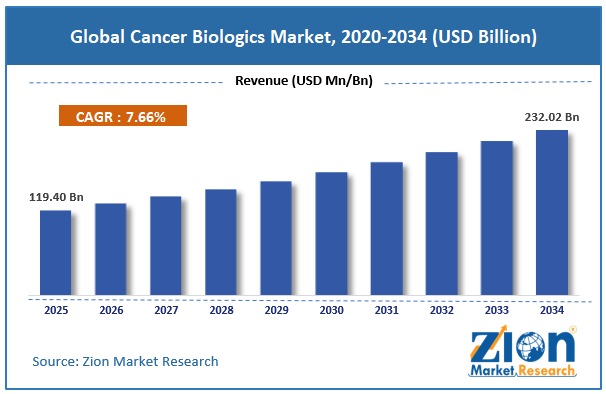
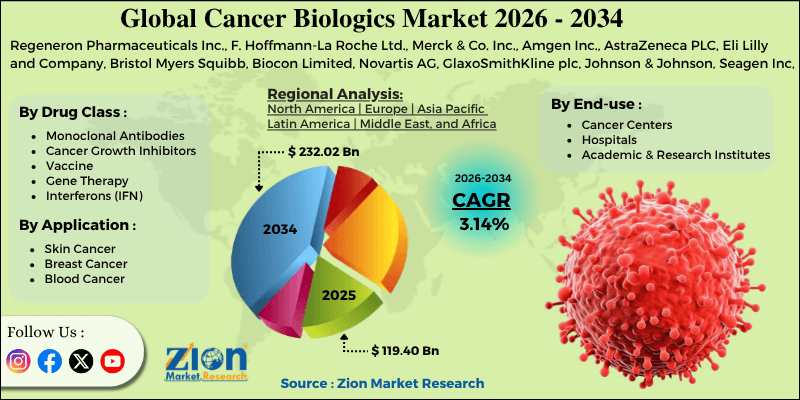
The global cancer biologics market size was worth around USD 119.40 billion in 2025 and is predicted to grow to around USD 232.02 billion by 2034, with a compound annual growth rate (CAGR) of roughly 3.14% between 2026 and 2034.
Key Insights:
- As per the analysis shared by our research analyst, the global cancer biologics market is estimated to grow annually at a CAGR of around 7.66% over the forecast period (2026-2034)
- In terms of revenue, the global cancer biologics market size was valued at around USD 119.40 billion in 2025 and is projected to reach USD 232.02 billion, by 2034.
- The cancer biologics market is projected to grow at a significant rate due to the growing demand for targeted therapies, rising cancer prevalence, and heightened research & development (R&D).
- Based on the drug class, monoclonal antibodies were the highest revenue generator in 2025. CAR-T cells will lead market growth trends.
- Based on the application, blood cancer is projected to emerge as the fastest-growing segment.
- Based on the end-use, cancer centers will lead growth trends with a CAGR of 12.9%.
- Based on region, North America is projected to dominate the global market during the forecast period.
Cancer Biologics Market: Overview
Cancer biologics are a prominent way of cancer treatment. Biological therapies use substances made by living organisms instead of relying on synthetic chemicals to treat cancer. The primary goal of cancer biologics is to encourage the immune system to fight cancer cells. According to market research, cancer biologics are highly effective in treating some forms of cancer. However, the method has certain limitations and may not prove efficient in treating all cancer types. At present, the global healthcare infrastructure has several biological treatments against cancer. Some of them are Adoptive T-cell therapy, cancer vaccines, monoclonal antibodies, immunoconjugates, cytokine therapy, targeted therapy, and tumor-infiltrating lymphocyte therapy.
During the forecast period, the global cancer biologics market will be driven by growing demand for targeted therapies, rising cancer prevalence, and heightened research & development (R&D). However, competition from other cancer treatments, high cost, and side effects of biological treatments may limit market growth in the coming years.
Impact of the USA-Israel and Iran war on the Cancer Biologics Market:
The USA-Israel and Iran war is expected to have a marginal effect on the supply chain of medicines, clinical equipment, and raw materials required for healthcare delivery. The war will also affect overall treatment costs and delayed shipments. As geopolitical instability subsides, market players are expected to focus on diversifying procurement and distribution routes. In addition, regional production of healthcare equipment and medicine will see increased investments.
Cancer Biologics Market: Dynamics
Growth Drivers
Why will targeted therapies prove beneficial for the cancer biologics market growth?
The global cancer biologics market will be driven by growing demand for targeted therapies. These treatments are designed to target specific cancer-causing proteins and genes. They do not destroy healthy cells, unlike conventional treatments such as chemotherapy. Although the success rate of targeted therapies depends on several factors such as cancer type and stage, it can reach up to 80% in the case of a successful match. Medical professionals prefer highly precise and targeted cancer treatments to enhance patient outcomes and reduce discomfort for the treatment seekers. Growing awareness around the advantages of targeted therapies will influence the cancer biologics adoption rate in the coming years.
Government support to play a pivotal role in shaping market growth trends during the forecast period
Governments and regulatory bodies worldwide have launched new initiatives to encourage and accelerate the launch of new biological treatments for cancer. In July 2026, the US Food and Drug Administration (FDA) approved pembrolizumab and berahyaluronidase alfa-pmph (Keytruda Qlex, Merck) or pembrolizumab (Keytruda, Merck) each in combination with enfortumab vedotin-ejfv (Padcev, Astellas Pharma). This combination is approved as a neoadjuvant treatment for adults with muscle-invasive bladder cancer (MIBC). Clear guidelines and accelerated approvals will allow new treatments to enter the commercial healthcare space quickly, thus benefiting the global cancer biologics market.
Restraints
What are the leading restrictions in the cancer biologics market?
The global cancer biologics industry is projected to be restricted as these treatments may not be considered for all types of cancer. Biological treatments can prove effective only on specific cancer types and stages. For instance, doctors may not recommend cancer biologics for patients with most early-stage localized cancers, certain prostate cancers, and some pancreatic cancers. In addition, cancer biologics are not free of side effects. Patients undergoing the treatment may suffer from nausea & vomiting, headache, fever, fatigue, and muscle pain.
Opportunities
Will advancements in cell and gene therapies create new growth opportunities for the cancer biologics industry?
The global cancer biologics market is projected to come across new growth opportunities due to significant advancements being reported in cell and gene therapies. These treatments are designed to treat cancer at the cellular level. Cell transplant deals with injecting the patient’s body with immune or stem cells to encourage normal function. Gene therapy, on the other hand, allows the addition of healthy genes to replace a missing or malfunctioning one. In September 2025, scientists at Northwestern University developed a new nanostructure that supercharges Clustered Regularly Interspaced Short Palindromic Repeats (CRISPR’s) to enter cells with efficiency and safety. This Deoxyribonucleic Acid (DNA)-coated lipid nanoparticle platform can improve gene editing efficiency by 3 times and can be used in treating solid tumors. Accelerated shift toward in vivo delivery platforms has exceptional growth potential in the coming years.
Challenges
How will cost barriers and competition from other treatments challenge the cancer biologics industry?
The global cancer biologics industry is projected to be challenged by the high cost of treatment and increasing advancements in alternative treatments. Cancer biologics treatments can cost over USD 200,000 per patient. Moreover, limited reimbursement and use of other treatment options such as chemotherapy and radiation may further affect industry revenue in the long run.
Cancer Biologics Market: Report Scope
| Report Attributes | Report Details |
|---|---|
| Report Name | Cancer Biologics Market |
| Market Size in 2025 | USD 119.40 Billion |
| Market Forecast in 2034 | USD 232.02 Billion |
| Growth Rate | CAGR of 3.14% |
| Number of Pages | 229 |
| Key Companies Covered | Regeneron Pharmaceuticals Inc., F. Hoffmann-La Roche Ltd., Merck & Co. Inc., Amgen Inc., AstraZeneca PLC, Eli Lilly and Company, Bristol Myers Squibb, Biocon Limited, Novartis AG, GlaxoSmithKline plc, Johnson & Johnson, Seagen Inc, Pfizer Inc., Gilead Sciences Inc., AbbVie Inc., and others. |
| Segments Covered | By Drug Class, By Application, By End-Use, and By Region |
| Regions Covered | North America, Europe, Asia Pacific (APAC), Latin America, Middle East, and Africa (MEA) |
| Base Year | 2025 |
| Historical Year | 2020 - 2024 |
| Forecast Year | 2026 - 2034 |
| Customization Scope | Avail customized purchase options to meet your exact research needs. Request For Customization |
Cancer Biologics Market: Segmentation
The global cancer biologics market is segmented based on drug class, application, end-use, and region.
Why will the CAR-T segment lead the cancer biologics industry revenue during the forecast period?
Based on drug class, the global market is divided into monoclonal antibodies, cancer growth inhibitors, vaccines, gene therapy, interferons (IFN), CAR-T cells, recombinant proteins, angiogenesis inhibitors, and others. Monoclonal antibodies are further divided into naked monoclonal antibodies, conjugated monoclonal antibodies, and bispecific monoclonal antibodies. The cancer growth inhibitors segment is fragmented into proteasome inhibitors, motor inhibitors, tyrosine kinase inhibitors, and others. The vaccine segment is segmented into therapeutic vaccines and preventing vaccines. In 2025, the highest growth was listed in the monoclonal antibodies segment. It accounted for 61% of the global revenue. During the forecast period, the CAR-T cells segment will lead market growth trends with a CAGR of 31% due to increasing demand for personalized cancer treatments and increasing research.
Which will be the fastest-growing application during the forecast period in the cancer biologics market?
Based on application, the global cancer biologics industry is segmented into skin cancer, breast cancer, blood cancer, prostate cancer, colorectal cancer, liver cancer, gastric cancer, ovarian cancer, and others. The market was dominated by breast cancer in 2025. It contributed around 25.2% of the global revenue. Blood cancer is projected to emerge as the fastest-growing segment in the coming years with a CAGR of 14.7% as cases of leukemia and multiple myeloma are on the rise.
Which factors drive demand in the cancer centers segment in the cancer biologics industry?
Based on end-use, the global market segments are cancer centers, hospitals, and academic & research institutes. In 2025, hospitals were the leading revenue generators in the market, controlling over 66% of total revenue. During the forecast period, cancer centers will lead growth trends with a CAGR of 12.9%. A growing number of specialized cancer treatment centers and a higher rate of clinical trials will aid segmental growth in the future.
Cancer Biologics Market: Regional Analysis
Why will North America lead the cancer biologics market in the coming years?
The global cancer biologics market is currently led by North America. In 2025, it accounted for 48% of the global revenue and will grow at a CAGR of 10.01% during the forecast period. The presence of a thriving healthcare infrastructure, pharmaceutical giants, and favorable reimbursement policies will drive regional growth trends. Moreover, increasing demand for personalized medicine and targeted therapies will propel regional demand for cancer biologics.
Why will Asia-Pacific generate the fastest CAGR in the cancer biologics market during the forecast period?
Asia-Pacific is expected to emerge as the fastest-growing region in the cancer biologics market with a CAGR of 13.64% during the forecast period. In 2025, it accounted for 25% of the global revenue. Rising prevalence of cancer, pressure on the existing medical care sector, increased government interest in promoting research & development, and expansion of specialized cancer care facilities are the leading regional growth drivers. Increased investments in biotechnology centers and improving healthcare access will further intensify regional market growth trends.
Cancer Biologics Market: Competitive Analysis
The global cancer biologics market is led by players like:
- Regeneron Pharmaceuticals Inc.
- F. Hoffmann-La Roche Ltd.
- Merck & Co. Inc.
- Amgen Inc.
- AstraZeneca PLC
- Eli Lilly and Company
- Bristol Myers Squibb
- Biocon Limited
- Novartis AG
- GlaxoSmithKline plc
- Johnson & Johnson
- Seagen Inc
- Pfizer Inc.
- Gilead Sciences Inc.
- AbbVie Inc.
What are the latest key trends in the cancer biologics market?
Cell therapies for solid tumors
Pharmaceutical and biotechnology companies are working on expanding the application of cell therapies for treating solid tumors. Currently, cell-based biological therapies are used to treat blood cancers. However, CAR-T and other therapies have shown promising results in treating solid tumors as well.
Combination therapies
The ongoing use of combination therapies such as cancer biologics along with traditional treatments is a prominent market trend. It aims to enhance treatment efficiency and deliver elevated patient outcomes.
The global cancer biologics market is segmented as follows:
By Drug Class
- Monoclonal Antibodies
- Naked Monoclonal Antibodies
- Conjugated Monoclonal Antibodies
- Bispecific Monoclonal Antibodies
- Cancer Growth Inhibitors
- Proteasome Inhibitors
- Motor Inhibitors
- Tyrosine Kinase Inhibitors
- Others
- Vaccine
- Therapeutic Vaccines
- Preventive Vaccines
- Gene Therapy
- Interferons (IFN)
- CAR-T Cells
- Recombinant Proteins
- Angiogenesis Inhibitors
- Others
By Application
- Skin Cancer
- Breast Cancer
- Blood Cancer
- Prostate Cancer
- Colorectal Cancer
- Liver Cancer
- Gastric Cancer
- Ovarian Cancer
- Others
By End-Use
- Cancer Centers
- Hospitals
- Academic & Research Institutes
By Region
- North America
- The U.S.
- Canada
- Mexico
- Europe
- France
- The UK
- Spain
- Germany
- Italy
- Rest of Europe
- Asia Pacific
- China
- Japan
- India
- Australia
- South Korea
- Rest of Asia Pacific
- The Middle East & Africa
- Saudi Arabia
- UAE
- Egypt
- Kuwait
- South Africa
- Rest of the Middle East & Africa
- Latin America
- Brazil
- Argentina
- Rest of Latin America
Table Of Content
Methodology
FrequentlyAsked Questions
Cancer biologics is a prominent cancer treatment. Biological therapies utilize substances made using living organisms instead of relying on synthetic chemicals for treating cancer.
The global cancer biologics market will be driven by growing demand for targeted therapies. These treatments are designed to target specific cancer-causing proteins and genes.
According to study, the global cancer biologics market size was worth around USD 119.40 billion in 2025 and is predicted to grow to around USD 232.02 billion by 2034.
The CAGR value of the cancer biologics market is expected to be around 7.66% during 2026-2034.
The global cancer biologics industry is projected to be challenged by the high cost of treatment and increasing advancements in alternative treatments.
Cell therapies for solid tumors and combination therapies are the emerging trends and innovations impacting the cancer biologics market.
The global cancer biologics market has performed well so far and will offer similar trends in the coming years.
North America will contribute notably towards the cancer biologics market value.
The global cancer biologics market is led by players like Regeneron Pharmaceuticals, Inc., F. Hoffmann-La Roche Ltd., Merck & Co., Inc., Amgen Inc., AstraZeneca PLC, Eli Lilly and Company, Bristol Myers Squibb, Biocon Limited, Novartis AG, GlaxoSmithKline plc, Johnson & Johnson, Seagen Inc, Pfizer Inc., Gilead Sciences, Inc., and AbbVie Inc.
The report explores crucial aspects of the cancer biologics market, including a detailed discussion of existing growth factors and restraints, while also browsing future growth opportunities and challenges that impact the market.

HappyClients

