
Global Bladder Cancer Market Size, Share, Trends, Growth and Forecast 2034

Bladder Cancer Market By Type (Muscle-Invasive Bladder Cancer (MIBC) and Non-Muscle-Invasive Bladder Cancer (NMIBC)), By Diagnosis (Urine Biomarker Tests, Cystoscopy, Biopsy & Histopathology, Urine Cytology, and Imaging Systems), By Treatment (Immunotherapy, Surgery, Chemotherapy, Targeted Therapy, Radiation Therapy, and Others), By End-User (Diagnostic Laboratories, Ambulatory Surgical Centers (ASCs), Specialty Cancer Centers, and Hospitals), and By Region - Global and Regional Industry Overview, Market Intelligence, Comprehensive Analysis, Historical Data, and Forecasts 2026 - 2034
| Market Size in 2025 | Market Forecast in 2034 | CAGR (in %) | Base Year |
|---|---|---|---|
| USD 5.68 Billion | USD 9.53 Billion | 5.92% | 2025 |
Bladder Cancer Industry Perspective:
What is the anticipated size of the bladder cancer market during the projection period?
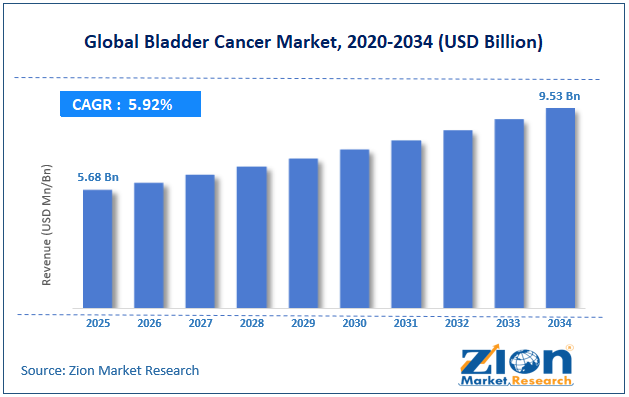
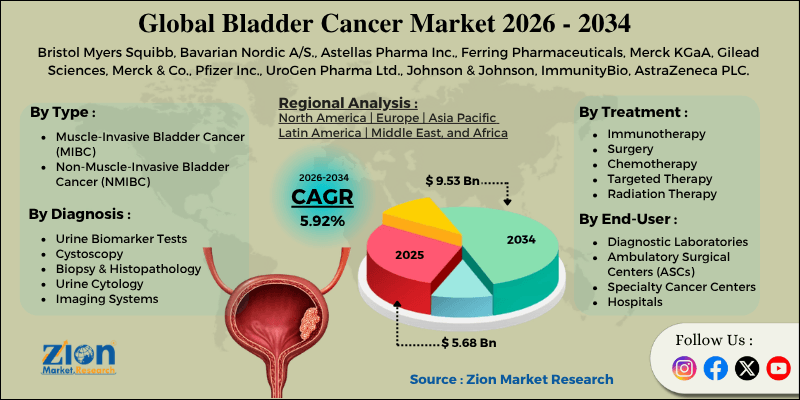
The global bladder cancer market size was worth around USD 5.68 billion in 2025 and is predicted to grow to around USD 9.53 billion by 2034, with a compound annual growth rate (CAGR) of roughly 5.92% between 2026 and 2034.
Key Insights:
- As per the analysis shared by our research analyst, the global bladder cancer market is estimated to grow annually at a CAGR of around 5.92% over the forecast period (2026-2034)
- In terms of revenue, the global bladder cancer market size was valued at around USD 5.68 billion in 2025 and is projected to reach USD 9.53 billion, by 2034.
- The bladder cancer market is projected to grow at a significant rate due to the rising prevalence of the cancer type, growing awareness, advancements in diagnostic techniques, and novel treatment methods.
- Based on the type, the muscle-invasive bladder cancer (MIBC) is expected to deliver the fastest CAGR during the forecast period.
- Based on the diagnosis, cystoscopy was the leading revenue generator in 2025, but the biomarker tests segment will emerge as the fastest-growing segment during the forecast period.
- Based on the treatment, the immunotherapy segment is expected to dominate the market growth trends in the coming years.
- Based on the end-user, the specialty cancer centers segment is projected to influence revenue in the market.
- Based on region, North America is projected to dominate the global market during the forecast period.
Bladder Cancer Market: Overview
Bladder cancer begins in bladder cells. It is a muscular, hollow organ located in the lower abdomen and stores urine. Bladder cancer generally begins in urothelial cells. They line the inside of the bladder. As urothelial cells are also present in kidneys and ureters, urothelial cancer may develop in the kidneys as well. According to the Mayo Clinic, most cases of bladder cancer are detected in the early stages and can be treated effectively. In addition, patients with bladder cancer require frequent follow-up for years even after the cancer is treated successfully. During the forecast period, the bladder cancer market is expected to grow due to rising prevalence of the cancer type, growing awareness, advancements in diagnostic techniques, and novel treatment methods. However, high cost of treatment and post-treatment care, lack of infrastructure in emerging parts of the world, and cases of relapse are expected to affect market revenue during the forecast period.
Impact of the USA-Israel and Iran war on the Bladder Cancer Market:
The USA-Israel and Iran war will affect the supply chain of medicines, diagnostic tools, and other medical accessories. In addition, this geopolitical conflict may also raise concerns over access to chips, semiconductors, and electronic solutions required to power surgical and diagnostic systems. As per industry analysis, the war may encourage new strategic partnerships and developments of more resilient supply chain networks.
Bladder Cancer Market: Dynamics
Growth Drivers
How will the rising prevalence of the disease influence the bladder cancer market?
The global bladder cancer market is expected to be driven by the rising prevalence of the cancer type. According to the World Bladder Cancer Patient Coalition, more than 600,000 new cases of bladder cancer are reported every year. Common symptoms of bladder cancer are frequent urination, painful urination, blood in urine, and back pain. Prominent risk factors associated with this cancer type are increasing age, smoking, exposure to certain chemicals, chronic bladder inflammation, and previous cancer treatment. In addition, bladder cancer is more common in males as compared to females. Evolving lifestyles of the common population and environmental pollution may also play a prominent role in inducing more cases of bladder cancer in the coming years.
Advancements in diagnostic technologies to promote market revenue during the forecast period
Rapid expansion of diagnostic infrastructure supported by industry advancements will encourage more demand for bladder cancer treatment. In May 2026, researchers at the Massachusetts Institute of Technology (MIT) developed a new technique to detect bladder cancer in early stages. The researchers have introduced a specialized nanosensor-coated catheter that can detect extremely low protein levels produced by bladder cancer cells. Furthermore, government and public institutes have amplified investments in expanding cancer diagnostic infrastructure to improve access to quality healthcare for the general population, thus encouraging revenue in the global bladder cancer market.
Restraints
Which are the leading growth barriers in the bladder cancer market?
Growth in the global bladder cancer industry is restricted to high cost of treatment and post-treatment care. According to the National Cancer Institute, national costs for cancer treatment reached over USD 208 billion in 2020. Chemotherapy, a common medical treatment for cancer, can cost anywhere between USD 1000 per month and USD 50000 per year for multiple sessions. Post-operative care is equally expensive and beyond financial reach for a large part of the population.
Opportunities
New drug discovery and treatment therapies to generate growth opportunities for the market players
The global bladder cancer market is projected to generate growth opportunities due to rising developments in new drugs and medical therapies. Gene & Immunotherapies, Antibody-Drug Conjugates (ADCs), and targeted therapies are witnessing higher investments as highly effective cancer treatments.
In July 2026, reports emerged suggesting that a New England Journal of Medicine study conducted by Mount Sinai investigators suggested that a combination of enfortumab vedotin and pembrolizumab increases lifespan for patients who have muscle-invasive bladder cancer. The combination also reduces the chances of cancer returning post-treatment. Another international phase-3 study led by Mayo Clinic suggests that a new immunotherapy treatment, called cretostimogene grenadenorepvec, helped patients with aggressive bladder cancer keep their organ instead of surgically removing it. The treatment is yet to receive clearance from the US Food & Drug Administration (FDA). However, results confirm that a large number of patients remained cancer-free for more than two years and caused mostly mild side effects.
Challenges
What will be the impact of limited infrastructure on the bladder cancer market?
The global bladder cancer industry is projected to be challenged by the lack of sufficient infrastructure supporting mass-scale deployment of cancer diagnosis and treatment. Moreover, limited awareness among the general population, delayed diagnosis of bladder cancer, and shortage of skilled workforce will add to the existing industry growth barriers.
Bladder Cancer Market: Report Scope
| Report Attributes | Report Details |
|---|---|
| Report Name | Bladder Cancer Market |
| Market Size in 2025 | USD 5.68 Billion |
| Market Forecast in 2034 | USD 9.53 Billion |
| Growth Rate | CAGR of 5.92% |
| Number of Pages | 230 |
| Key Companies Covered | Bristol Myers Squibb, Bavarian Nordic A/S., Astellas Pharma Inc., Ferring Pharmaceuticals, Merck KGaA, Gilead Sciences, Merck & Co., Pfizer Inc., UroGen Pharma Ltd., Johnson & Johnson, ImmunityBio, AstraZeneca PLC, Incyte Corporation, Roche Holding AG, Novartis AG, and others. |
| Segments Covered | By Type, By Diagnosis, By Treatment, By End-User, and By Region |
| Regions Covered | North America, Europe, Asia Pacific (APAC), Latin America, Middle East, and Africa (MEA) |
| Base Year | 2025 |
| Historical Year | 2020 - 2024 |
| Forecast Year | 2026 - 2034 |
| Customization Scope | Avail customized purchase options to meet your exact research needs. Request For Customization |
Bladder Cancer Market: Segmentation
The global bladder cancer market is segmented based on type, diagnosis, treatment, end-user, and region.
Why will the muscle-invasive bladder cancer (MIBC) segment lead the bladder cancer industry revenue during the forecast period?
Based on type, the global market segments are muscle-invasive bladder cancer (MIBC) and non-muscle-invasive bladder cancer (NMIBC). In 2025, the highest growth was listed in the non-muscle-invasive bladder cancer (NMIBC) segment. It accounted for 76% of the global revenue. During the forecast period, the muscle-invasive bladder cancer (MIBC) segment is anticipated to generate the highest CAGR of 9.57% as investment rates in MIBC treatments have increased in the last few years.
Which will be the fastest-growing diagnosis during the forecast period in the bladder cancer market?
Based on diagnosis, the global bladder cancer industry is fragmented into urine biomarker tests, cystoscopy, biopsy & histopathology, urine cytology, and imaging systems. In 2025, cystoscopy accounted for 41% of the global revenue. During the projection period, urine biomarker tests will emerge as the fastest-growing segment, with a CAGR of 10.25%, as demand for non-invasive diagnostic systems rises.
Which factors drive demand in the immunotherapy segment in the bladder cancer industry?
Based on treatment, the global market is fragmented into immunotherapy, surgery, chemotherapy, targeted therapy, radiation therapy, and others. Surgery was the leading revenue generator in 2025. It contributed up to 36% of the total revenue. During the forecast period, immunotherapy is expected to emerge as the fastest-growing segment with a CAGR of 11.57% due to wider acceptance of the treatment across healthcare facilities and growing innovation.
What will be the influence of the specialty cancer centers segment on the bladder cancer market?
Based on end-user, the global market fragments are diagnostic laboratories, ambulatory surgical centers (ASCs), specialty cancer centers, and hospitals. Hospitals emerged as the largest market share holder in 2025, accounting for 56% of the total market share. During the forecast period, specialty cancer centers will lead market growth trends with a CAGR of 9.57%. Increasing investments in multidisciplinary cancer care and shifting focus toward precision oncology will drive segmental growth.
Bladder Cancer Market: Regional Analysis
Why will North America lead the bladder cancer market in the coming years
The global bladder cancer market is currently led by North America. In 2025, it accounted for 43.2% of the global revenue and will grow at a CAGR of 7.53% during the forecast period. Rising prevalence of bladder cancer, higher public health awareness, increasing adoption of advanced cancer treatments, and the presence of large-scale diagnostic centers will promote regional market growth trends.
Why will Asia-Pacific generate the fastest CAGR in the bladder cancer market during the forecast period?
Asia-Pacific is expected to emerge as the fastest-growing region in the bladder cancer industry with a CAGR of 10.04% during the forecast period. In 2025, it accounted for 24% of the global revenue. Growing pressure on regional healthcare, expansion of medical infrastructure, and new government policies promoting access to quality healthcare will propel regional market revenue. Moreover, rising research & development, strategic partnerships focusing on innovation, and international healthcare collaboration may work in favor of the regional players.
Bladder Cancer Market: Competitive Analysis
The global bladder cancer market is led by players like:
- Bristol Myers Squibb
- Bavarian Nordic A/S.
- Astellas Pharma Inc.
- Ferring Pharmaceuticals
- Merck KGaA
- Gilead Sciences
- Merck & Co.
- Pfizer Inc.
- UroGen Pharma Ltd.
- Johnson & Johnson
- ImmunityBio
- AstraZeneca PLC
- Incyte Corporation
- Roche Holding AG
- Novartis AG
What are the latest key trends in the bladder cancer market?
Development of Multi-Cancer Early Detection (MCED) Tests
Ongoing work toward the development of multi-cancer early detection (MCED) kits is a promising market trend with potential to positively influence the bladder cancer market. These tests are designed to ensure early detection of different types of cancer using a single sample.
Artificial Intelligence (AI)-Powered Diagnostics
An urgent need to improve cancer diagnostic capabilities will encourage the use of AI-powered diagnostic tools. These systems are designed to provide lesion characterization and early detection.
The global bladder cancer market is segmented as follows:
By Type
- Muscle-Invasive Bladder Cancer (MIBC)
- Non-Muscle-Invasive Bladder Cancer (NMIBC)
By Diagnosis
- Urine Biomarker Tests
- Cystoscopy
- Biopsy & Histopathology
- Urine Cytology
- Imaging Systems
By Treatment
- Immunotherapy
- Surgery
- Chemotherapy
- Targeted Therapy
- Radiation Therapy
- Others
By End-User
- Diagnostic Laboratories
- Ambulatory Surgical Centers (ASCs)
- Specialty Cancer Centers
- Hospitals
By Region
- North America
- The U.S.
- Canada
- Mexico
- Europe
- France
- The UK
- Spain
- Germany
- Italy
- Rest of Europe
- Asia Pacific
- China
- Japan
- India
- Australia
- South Korea
- Rest of Asia Pacific
- The Middle East & Africa
- Saudi Arabia
- UAE
- Egypt
- Kuwait
- South Africa
- Rest of the Middle East & Africa
- Latin America
- Brazil
- Argentina
- Rest of Latin America
Table Of Content
Methodology
FrequentlyAsked Questions
Bladder cancer begins in bladder cells. It is a muscular, hollow organ located in the lower abdomen and stores urine.
The global bladder cancer market is expected to be driven by the rising prevalence of the cancer type.
According to study, the global bladder cancer market size was worth around USD 5.68 billion in 2025 and is predicted to grow to around USD 9.53 billion by 2034.
The CAGR value of the bladder cancer market is expected to be around 5.92% during 2026-2034.
The global bladder cancer industry is projected to be challenged by the lack of sufficient infrastructure supporting mass-scale deployment of cancer diagnosis and treatment.
Development of Multi-Cancer Early Detection (MCED) Tests and Artificial Intelligence (AI)-Powered Diagnostics are the emerging trends and innovations impacting the bladder cancer market.
The global bladder cancer market has performed well so far and will offer similar trends in the coming years.
North America will contribute notably towards the bladder cancer market value.
The global bladder cancer market is led by players like Bristol Myers Squibb, Bavarian Nordic A/S., Astellas Pharma Inc., Ferring Pharmaceuticals, Merck KGaA, Gilead Sciences, Merck & Co., Pfizer Inc., UroGen Pharma Ltd., Johnson & Johnson, ImmunityBio, AstraZeneca PLC, Incyte Corporation, Roche Holding AG, and Novartis AG.
The report explores crucial aspects of the bladder cancer market, including a detailed discussion of existing growth factors and restraints, while also browsing future growth opportunities and challenges that impact the market.

HappyClients

