
Bridge Expansion Joints Market Size, Share, Growth & Forecast 2034

Bridge Expansion Joints Market By Product Type (Modular Expansion Joints, Strip Seal Expansion Joints, Sliding Plate Expansion Joints, Compression Seal Expansion Joints, Open Joints, Elastomeric Joints), By Material (Steel, Rubber, Elastomer, Polymer, Concrete), By Bridge Type (Highway Bridges, Railway Bridges, Pedestrian Bridges, Viaducts), By Application (New Construction, Bridge Rehabilitation, Bridge Replacement, Maintenance and Repair), By End-User (Government Infrastructure, Private Construction, Transportation Authorities), and By Region - Global and Regional Industry Overview, Market Intelligence, Comprehensive Analysis, Historical Data, and Forecasts 2025 - 2034
| Market Size in 2024 | Market Forecast in 2034 | CAGR (in %) | Base Year |
|---|---|---|---|
| USD 1,204.36 Million | USD 2,510.23 Million | 7.82% | 2024 |
Bridge Expansion Joints Industry Perspective:
What will be the size of the bridge expansion joints market during the forecast period?
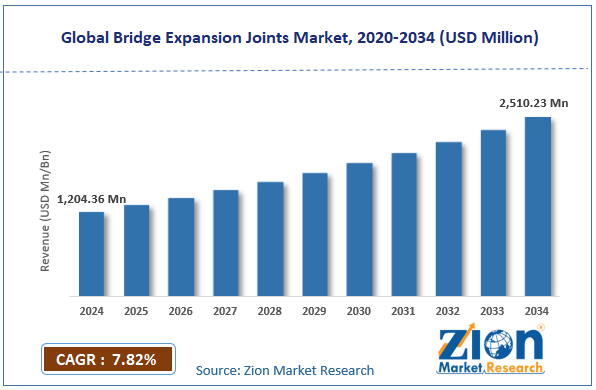
The global bridge expansion joints market size was worth approximately USD 1,204.36 million in 2024 and is projected to grow to around USD 2,510.23 million by 2034, with a compound annual growth rate (CAGR) of roughly 7.82% between 2025 and 2034.
Key Insights
- As per the analysis shared by our research analyst, the global bridge expansion joints market is estimated to grow annually at a CAGR of around 7.82% over the forecast period (2025-2034).
- In terms of revenue, the global bridge expansion joints market size was valued at approximately USD 1,204.36 million in 2024 and is projected to reach USD 2,510.23 million by 2034.
- The bridge expansion joints market is projected to grow significantly due to increasing infrastructure investment, aging bridges requiring replacement, expanding urbanization, expanding highway network development, and rising demand for durable bridge components.
- Based on product type, the modular expansion joints segment is expected to lead the bridge expansion joints market, while the strip seal expansion joints segment is anticipated to grow significantly.
- Based on material, the steel segment is expected to lead the bridge expansion joints market, while the elastomer segment is anticipated to grow at a notable pace.
- Based on bridge type, the highway bridges segment is the dominating segment, while the railway bridges segment is projected to witness sizeable revenue over the forecast period.
- Based on the application, the new construction segment is expected to lead the market compared to the bridge rehabilitation segment.
- Based on region, Asia Pacific is projected to dominate the global bridge expansion joints market during the estimated period, followed by North America.
Bridge Expansion Joints Market: Overview
A bridge expansion joint is a structural component installed between sections of a bridge to allow safe movement caused by temperature changes, traffic loads, and structural vibration. Bridge expansion joints protect bridges by absorbing the thermal expansion and contraction of concrete and steel, reducing cracking, surface damage, and long-term structural stress. These joints maintain smooth vehicle movement across bridge decks while preventing impact damage at deck gaps. Bridge expansion joints play a critical role in extending bridge service life and improving driving comfort. Common types include modular expansion joints for large movements on long-span bridges, strip-seal expansion joints for waterproof protection, and compression-seal joints for smaller movement ranges. Sliding plate and finger-type expansion joints support heavy traffic loads and frequent movement cycles in highway and railway bridges. Elastomeric expansion joints use flexible rubber materials to create continuous deck surfaces with noise reduction benefits.
Expansion joints are widely used in highway bridges, railway bridges, flyovers, viaducts, and pedestrian bridges. Proper selection depends on bridge length, movement range, climate conditions, and traffic volume. Regular inspection and maintenance of bridge expansion joints help prevent water leakage, corrosion, and premature failure. Government infrastructure agencies specify expansion joint standards, while contractors install and service these systems during construction and rehabilitation projects. Growing infrastructure investment, aging bridge replacement, and climate adaptation needs are driving worldwide demand for durable, high-performance bridge expansion joint solutions.
The aging transportation infrastructure across developed nations and expanding bridge construction activity in developing regions are expected to drive sustained growth in the bridge expansion joints market over the forecast period.
Bridge Expansion Joints Market: Technology Roadmap 2025–2034
The bridge expansion joints market is entering a phase of progressive development driven by advances in materials science and structural engineering. The following is the technology roadmap divided into development phases expected to unfold through 2034.
2025–2027: Durability Enhancement and Performance Optimization Phase
- Advanced corrosion-resistant steel alloys extend joint service life, lower maintenance frequency, and improve lifecycle cost value in harsh environmental conditions.
- Improved elastomeric seal formulations increase weather resistance, maintain flexibility across a wider temperature range, and reduce early material wear.
- Optimized modular joint designs reduce noise levels, limit impact forces, and improve ride comfort for highway traffic.
2028–2031: Smart Infrastructure and Sustainable Solutions Phase
- Integrated sensor systems enable real-time monitoring of joint movement, load conditions, and wear indicators for predictive maintenance planning.
- Modular installation systems speed construction timelines, reduce traffic disruption, and lower labor needs through prefabricated components.
2032–2034: Advanced Materials and Digital Integration Phase
- Self-healing polymer technologies automatically repair minor damage, extend maintenance intervals, and improve long-term system reliability.
- Digital twin platforms combine monitoring data with structural models to improve maintenance scheduling and support lifecycle asset management.
- Advanced composite materials deliver higher performance, reduce overall weight, and allow innovative joint designs for specialized applications.
Bridge Expansion Joints Market: Dynamics
Growth Drivers
How is infrastructure modernization increasing demand for bridge expansion joints market?
The bridge expansion joints market is experiencing strong growth as global infrastructure modernization programs increase bridge construction, rehabilitation, and replacement, driven by the adoption of advanced expansion joint systems. Government transportation initiatives across developed regions focus on replacing aging bridges, upgrading structural components, and improving reliability across national transportation networks. Federal highway funding programs allocate large budgets to bridge rehabilitation, addressing structural weaknesses, replacing worn components, and extending service life. Interstate and national highway maintenance activities create a steady demand for expansion joint replacement due to traffic stress, weather exposure, and repeated movement. Urban bridge expansion projects in growing cities require new expansion joint installations to support corridor development, higher capacity, and congestion-reduction goals.
Regional connector bridges linking transport networks depend on expansion joints handling complex movement patterns while preserving structural performance across multi-span designs. Rural infrastructure programs supporting agriculture and resource sectors increase demand for durable bridge expansion joints on remote transportation routes. Coastal, port, military, and emergency bridge projects require specialized expansion joints that resist corrosion, withstand heavy loads, and accommodate urgent reconstruction timelines.
Climate adaptation and resilience planning drive market expansion.
The global bridge expansion joints market is growing as climate adaptation strategies push agencies to prepare infrastructure for harsher, changing environmental conditions. Wider temperature ranges across regions increase demand for bridge expansion joints that safely manage larger thermal movements. More frequent extreme weather events raise demand for durable expansion joint systems that perform reliably during heat waves and cold snaps. Flood resilience goals encourage waterproof expansion joints that protect bridge decks, support drainage performance, and reduce long-term structural damage.
Frequent freeze-thaw cycles accelerate expansion joint wear, increasing replacement needs and driving interest in higher-durability materials. Coastal bridge projects require corrosion-resistant expansion joints that handle salt exposure, storm impact, and heavy commercial traffic loads. Seismic and wind adaptation programs adopt advanced expansion joints that accommodate movement, limit vibration transfer, and support bridge stability. Climate-focused design standards prioritize durable expansion joints that reduce maintenance frequency, lower lifecycle costs, and support sustainable growth of bridge infrastructure.
Restraints
High installation costs and maintenance complexity limit market accessibility.
A significant challenge for the bridge expansion joints industry is the high system costs, which create financial pressure on budget-limited infrastructure agencies and on smaller projects. Premium modular expansion joints for long-span bridges require large capital spending, especially when many joints span long bridge sections. Complex installations require specialized contractors, precise alignment, and strict quality checks, thereby increasing labor costs and significantly extending construction schedules. Traffic control during expansion joint replacement adds indirect costs through lane closures, detours, limited work hours, and reduced productivity.
Ongoing maintenance costs increase over the service life due to inspections, seal replacements, debris removal, and bearing lubrication. Early failure risks from poor installation, drainage issues, or weak design lead to unexpected replacement liability and budget overruns. Limited regional expertise reduces competition, raises procurement prices, slows schedules, and complicates access to reliable expansion joint suppliers. Together, these cost and execution challenges limit project feasibility, delay upgrades, shorten replacement cycles, and slow the growth of the bridge expansion joints market.
Opportunities
How is smart infrastructure development creating growth potential for the bridge expansion joints market?
The bridge expansion joints industry shows strong growth potential as agencies adopt smart infrastructure using sensors, monitoring systems, and data analytics for bridge management. Structural health monitoring adoption increases demand for expansion joints with embedded sensors that measure movement, temperature, vibration, and load conditions in real time. Predictive maintenance programs using artificial intelligence and machine learning rely on continuous data from critical bridge components, including expansion joints. Internet of Things connectivity enables remote monitoring, automated alerts, and constant performance assessment, supporting proactive maintenance planning and faster response actions. Public-private partnerships and performance-based contracts encourage expansion joint suppliers to offer advanced monitoring features, extended warranties, and proven long-term value.
Climate resilience funding and research collaboration accelerate smart expansion joint innovation, thereby improving durability prediction accuracy and global adoption across bridge infrastructure projects. Transportation agencies increasingly integrate monitoring data into asset management platforms to optimize lifecycle performance and budget planning. Digital compliance requirements further drive demand for data-enabled expansion joints supporting inspection, reporting, and regulatory transparency. The growing emphasis on outcome-based infrastructure funding is strengthening demand for verifiable performance data from smart bridge expansion joint systems.
Challenges
How are material durability limitations and performance variability creating obstacles for the bridge expansion joints industry?
The bridge expansion joints market faces challenges from material degradation, environmental exposure, and inconsistent performance, which increase reliability risks and total lifecycle ownership costs. Elastomeric seals degrade under ultraviolet radiation, ozone exposure, and thermal cycling, reducing waterproofing and thereby facilitating saltwater infiltration and accelerating corrosion. Steel components corrode in coastal regions, weakening the structure, increasing maintenance needs, and shortening the service life of expansion joints. Repeated traffic loading and impact forces cause fatigue damage, leading to cracking, loose fasteners, structural failure, and emergency repair situations.
Debris buildup and clogged drainage restrict movement, trap water, raise impact stress, accelerate wear, and create safety hazards. Manufacturing variability and differences in installation workmanship affect tolerances, alignment accuracy of material quality, and long-term expansion joint performance. Design standards and performance specifications struggle to address extreme climates, complex geometries, heavier traffic volumes, and future climate pressures. Limited long-term performance data for newer expansion joint technologies increases uncertainty about maintenance needs, service-life costs, and market confidence.
Bridge Expansion Joints Market: Report Scope
| Report Attributes | Report Details |
|---|---|
| Report Name | Bridge Expansion Joints Market |
| Market Size in 2024 | USD 1,204.36 Million |
| Market Forecast in 2034 | USD 2,510.23 Million |
| Growth Rate | CAGR of 7.82% |
| Number of Pages | 215 |
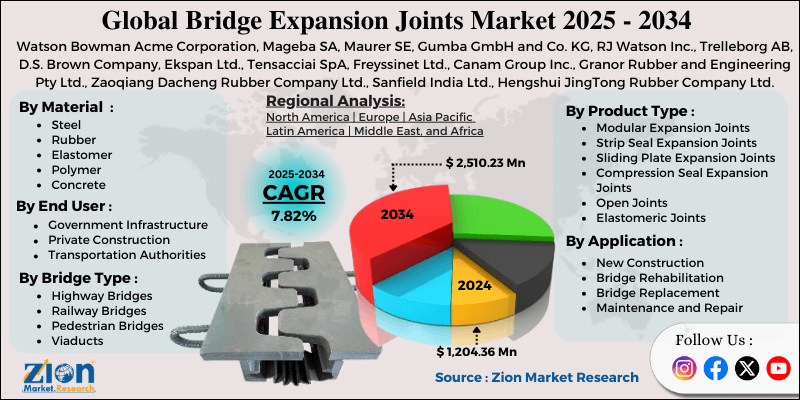
| Key Companies Covered | Watson Bowman Acme Corporation, Mageba SA, Maurer SE, Gumba GmbH and Co. KG, RJ Watson Inc., Trelleborg AB, D.S. Brown Company, Ekspan Ltd., Tensacciai SpA, Freyssinet Ltd., Canam Group Inc., Granor Rubber and Engineering Pty Ltd., Zaoqiang Dacheng Rubber Company Ltd., Sanfield India Ltd., Hengshui JingTong Rubber Company Ltd., and others. |
| Segments Covered | By Product Type, By Material, By Bridge Type, By Application, By End User, and By Region |
| Regions Covered | North America, Europe, Asia Pacific (APAC), Latin America, Middle East, and Africa (MEA) |
| Base Year | 2024 |
| Historical Year | 2019 to 2023 |
| Forecast Year | 2025 - 2034 |
| Customization Scope | Avail customized purchase options to meet your exact research needs. Request For Customization |
Bridge Expansion Joints Market: Segmentation
The global bridge expansion joints market is segmented based on product type, material, bridge type, application, end-user, and region.
Based on product type, the global bridge expansion joints industry is classified into modular expansion joints, strip seal expansion joints, sliding plate expansion joints, compression seal expansion joints, open joints, and elastomeric joints. Modular expansion joints lead the market due to superior performance, large movement ranges, proven reliability in demanding applications, and extensive engineering support from major manufacturers.
Based on the material, the industry is divided into steel, rubber, elastomers, polymers, and concrete. Steel leads the market due to its excellent structural strength supporting heavy traffic loads, compatibility with diverse expansion-joint configurations, and strong corrosion resistance enabled by modern coating technologies and protective treatments.
Based on bridge type, the global bridge expansion joints market is segregated into highway bridges, railway bridges, pedestrian bridges, and viaducts. Highway bridges are expected to lead the market during the forecast period due to the extensive global highway network, prioritized government funding for highway system maintenance, and ongoing capacity-expansion projects requiring new expansion joint installations.
Based on application, the global market is divided into new construction, bridge rehabilitation, bridge replacement, and maintenance and repair. New construction holds the largest market share due to capacity expansion requirements in developed nations and to urbanization trends that drive bridge projects in metropolitan areas.
Based on end-user, the market is classified into government infrastructure, private construction, and transportation authorities. Government infrastructure holds a dominant position due to public ownership of the majority of highway and railway bridge assets, substantial annual infrastructure budgets allocated by federal and regional agencies, and responsibility for maintaining strategic transportation networks.
Bridge Expansion Joints Market: Regional Analysis
What factors are contributing to Asia Pacific dominance in the global bridge expansion joints market?
Asia Pacific accounts for the largest share of the global bridge expansion joints market, holding approximately 45% of total market revenue during the forecast period. Strong regional leadership comes from large infrastructure programs, rapid urbanization, heavy government spending, and expanding highway and railway networks. China drives primary demand through Belt and Road projects, high-speed rail expansion, urban expressway construction, and replacement of aging bridges. India supports growth through the National Infrastructure Pipeline, highway upgrades, metro rail expansion, and rural bridge connectivity programs nationwide. Southeast Asia, including Indonesia, Vietnam, Thailand, and the Philippines, is driven by urban growth, foreign investment, logistics corridors, and regional connectivity. Japan maintains its presence through earthquake retrofitting, replacement of aging bridges, advanced standards, high-performance expansion joints, and typhoon-resistant designs nationwide.
South Korea contributes via highway optimization, high-speed rail links, urban renewal projects, and the adoption of advanced construction technologies. Bangladesh, Pakistan, and Sri Lanka offer emerging opportunities via development bank funding, trade corridors, urban growth, and disaster recovery. Regional manufacturing capacity provides cost advantages, faster customization to local specifications, and reliable supply for projects across the region. Technical skills grow through partnerships in engineering education, workforce training, and industry modernization, improving project execution quality across countries and regions. Population growth, economic expansion, and infrastructure priorities keep the Asia Pacific at the forefront of the bridge expansion joints market.
Overall demand remains strong as governments nationwide prioritize safe bridges, long service life, and reliable performance of expansion joints. Increased investments in climate resilience accelerate the replacement of older joint systems with advanced designs across coastal and flood-prone regions. Smart monitoring adoption in new bridges creates additional demand for technologically enhanced expansion joint solutions. Government-backed public-private partnerships increase long-term project visibility and support sustained procurement of high-quality bridge expansion joint systems. Continued adoption of stricter safety standards and inspection norms further strengthens replacement demand across national and regional bridge networks.
North America maintains a significant market share.
North America accounts for approximately 28% of the global bridge expansion joints market, remaining the second-largest regional market worldwide. A strong regional position stems from extensive aging bridge networks, ongoing maintenance needs, reliable funding programs, strict engineering standards, and experienced construction specialists. The United States drives regional demand through the Interstate Highway System, which contains thousands of bridges that require continuous inspection, maintenance, rehabilitation, and systematic expansion-joint replacement. Federal Highway Administration programs provide consistent funding for bridge repair, replacement, safety upgrades, and long-term infrastructure performance improvements.
Aging bridge assets with design lives exceeding 50 years generate replacement demand, emergency repair activity, and preventive maintenance investment across states. Harsh climate exposure, including freeze-thaw cycles, deicing salts, and temperature extremes, accelerates expansion joint wear, raising replacement frequency. Heavy truck traffic along freight corridors increases impact loads, accelerates fatigue, and requires durable expansion joint systems with higher performance ratings. Seismic retrofitting programs in earthquake-prone regions increase demand for specialized expansion joints that accommodate movement and maintain structural stability. Canada contributes to demand through provincial transport programs, northern infrastructure supporting resources, urban bridge rehabilitation, and trade corridor improvements. Mexico supports growth through highway expansion, port access upgrades, urban congestion projects, and the development of international border infrastructure.
Regional leadership in materials science, engineering design, and monitoring technology supports the adoption and innovation of premium expansion joints. Strong regulations ensure quality inspections, compliance with certification requirements, and consistent standards, thereby sustaining the growth of the North American bridge expansion joints market. The increasing emphasis on asset management planning drives the systematic expansion of joint replacement cycles rather than reactive repairs. Lifecycle cost-optimization strategies favor higher-performing joints with longer service intervals.
Recent Market Developments
- In September 2025, Trelleborg AB introduced advanced rubber-sealed closed expansion joints certified for enhanced waterproofing and corrosion resistance, targeting urban bridge retrofit projects and professional contractor channels to support long-term deck protection.
Bridge Expansion Joints Market: Competitive Analysis
The leading players in the global bridge expansion joints market are:
- Watson Bowman Acme Corporation
- Mageba SA
- Maurer SE
- Gumba GmbH and Co. KG
- RJ Watson Inc.
- Trelleborg AB
- D.S. Brown Company
- Ekspan Ltd.
- Tensacciai SpA
- Freyssinet Ltd.
- Canam Group Inc.
- Granor Rubber and Engineering Pty Ltd.
- Zaoqiang Dacheng Rubber Company Ltd.
- Sanfield India Ltd.
- Hengshui JingTong Rubber Company Ltd.
The global bridge expansion joints market is segmented as follows:
By Product Type
- Modular Expansion Joints
- Strip Seal Expansion Joints
- Sliding Plate Expansion Joints
- Compression Seal Expansion Joints
- Open Joints
- Elastomeric Joints
By Material
- Steel
- Rubber
- Elastomer
- Polymer
- Concrete
By Bridge Type
- Highway Bridges
- Railway Bridges
- Pedestrian Bridges
- Viaducts
By Application
- New Construction
- Bridge Rehabilitation
- Bridge Replacement
- Maintenance and Repair
By End User
- Government Infrastructure
- Private Construction
- Transportation Authorities
By Region
- North America
- The U.S.
- Canada
- Europe
- France
- The UK
- Spain
- Germany
- Italy
- Rest of Europe
- Asia Pacific
- China
- Japan
- India
- South Korea
- Southeast Asia
- Rest of Asia Pacific
- Latin America
- Brazil
- Mexico
- Rest of Latin America
- Middle East & Africa
- GCC
- South Africa
- Rest of Middle East & Africa
Table Of Content
Methodology
FrequentlyAsked Questions

HappyClients

