
Biologic Response Modifiers Market Size, Share and Forecast, 2032

Biologic Response Modifiers Market By Product type (interferon, tyrosine kinase inhibitors, angiogenic inhibitors, tumor vaccines, interleukins, colony stimulating factors, TNF-a, and monoclonal antibodies), By Treatment type (autoimmune diseases, cancer, and others), By Distribution channels (hospital pharmacies, mail order pharmacies, and retail pharmacies) And By Region: - Global and Regional Industry Overview, Market Intelligence, Comprehensive Analysis, Historical Data, and Forecasts, 2024-2032
| Market Size in 2023 | Market Forecast in 2032 | Growth Rate (in %) | Base Year |
|---|---|---|---|
| USD 7.45 Billion | USD 13.72 Billion | CAGR at 7.02% | 2023 |
Description
How big is the Biologic Response Modifiers Market?
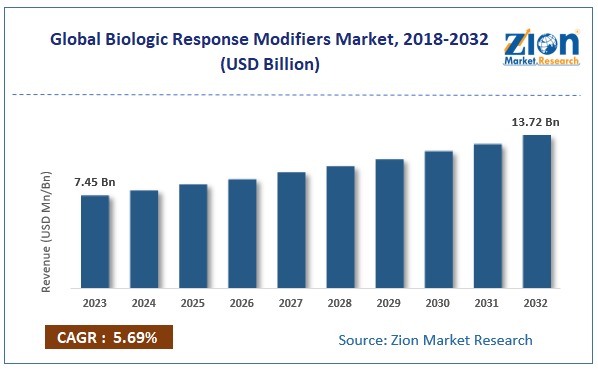
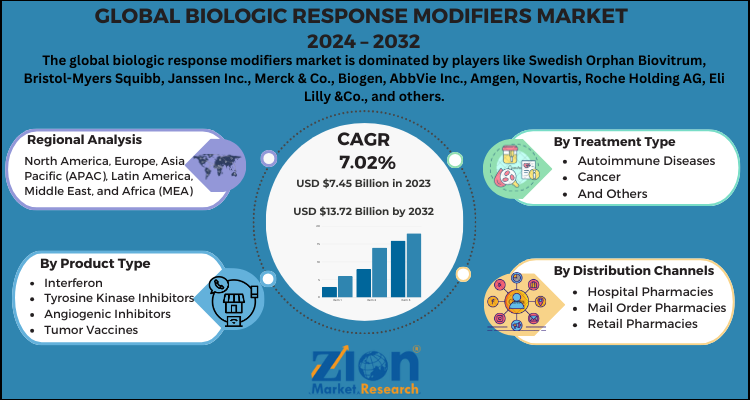
According to the report published by Zion Market Research, the global Biologic Response Modifiers Market size was valued at USD 7.45 Billion in 2023 and is predicted to reach USD 13.72 Billion by the end of 2032. The market is expected to grow with a CAGR of 7.02% during the forecast period. The report analyzes the global Biologic Response Modifiers Market’s growth drivers, restraints, and impact on demand during the forecast period. It will also help navigate and explore the arising opportunities in the Biologic Response Modifiers Market industry.
Global Biologic Response Modifiers Market: Overview
The substances that help in modulating the immune response by making an increase or decrease in the immunogenic effect is known as biologic response modifiers. They are used in biological therapy or immunotherapy to enhance the immune system activity in order to fight against the disease or infection. The pharmaceutical industries are nowadays manufacturing monoclonal antibodies, colony stimulating factors, interleukins, and interferon. Different research studies have increased their awareness about identifying the effective targets and biological agents.
Global Biologic Response Modifiers Market: Segmentation
The global biologic response modifiers market is segmented into its product type, treatment type, and distribution channels.
On the basis of product type, the market is segregated into interferon, tyrosine kinase inhibitors, angiogenic inhibitors, tumor vaccines, interleukins, colony stimulating factors, TNF-α, and monoclonal antibodies.
Based on the treatment type, the market is categorized into autoimmune diseases, cancer, and others.
Depending on the distribution channel, the market is divided into hospital pharmacies, mail order pharmacies, and retail pharmacies.
Global Biologic Response Modifiers Market: Growth Factors
The key factor that is driving the biologic response modifiers market is the increasing cases of the patients developing autoimmune disorder and cancer worldwide. An effective treatment for the patients that are suffering from different types of cancer and are resistant to the radiation treatment and chemotherapy is immunotherapy. There are factors that are restraining the market growth which includes the patients that are receiving the biologic response modifiers can have some side effects such as opportunistic infections and increased risk of certain serious conditions such as viral infections or TB. Some regulatory issues that are related to the export and manufacturing will limit the growth of the market. The biologics are available in high costs thus restricting limiting its availability to all the people.
Biologic Response Modifiers Market : Report Scope
| Report Attributes | Report Details |
|---|---|
| Report Name | Biologic Response Modifiers Market Research Report |
| Market Size in 2023 | USD 7.45 Billion |
| Market Forecast in 2032 | USD 13.72 Billion |
| Growth Rate | CAGR of 7.02% |
| Number of Pages | 185 |
| Key Companies Covered | Swedish Orphan Biovitrum, Bristol-Myers Squibb, Janssen Inc., Merck & Co., Biogen, AbbVie Inc., Amgen, Novartis, Roche Holding AG, Eli Lilly &Co., and others. |
| Segments Covered | By Product type, By Treatment type, By Distribution channels and By Region |
| Regions Covered | North America, Europe, Asia Pacific (APAC), Latin America, Middle East, and Africa (MEA) |
| Base Year | 2023 |
| Historical Year | 2018 - 2022 |
| Forecast Year | 2024 - 2032 |
| Customization Scope | Avail customized purchase options to meet your exact research needs. Request For Customization |
Global Biologic Response Modifiers Market: Regional Analysis
The geographical segmentation of the global biologic response modifiers market is diversified into North America, Latin America, Eastern Europe, Western Europe, Asia-Pacific, and the Middle East and Africa. The region that dominates the biologic response modifiers market is the North America which is followed by Western Europe and Asia-Pacific regions. The factors that are contributing to the market growth in the North America and European region are the presence of a huge number of manufacturers of biological drugs and vaccines, affordable treatment facility, high per capita income, and good reimbursements for the diseases that are life threatening. Western Europe holds the second position both in terms of supply and demand. The market in the Asia-Pacific region will grow at a good rate due to development in the facilities of healthcare, increasing incidences of people developing cancer, the establishment of new pharmaceutical organizations, and increasing insurance coverage.
Global Biologic Response Modifiers Market: Competitive Players
The key market players that are involved in the biologic response modifiers include:
- Swedish Orphan Biovitrum
- Bristol-Myers Squibb
- Janssen Inc.
- Merck & Co.
- Biogen
- AbbVie Inc.
- Amgen
- Novartis
- Roche Holding AG
- Eli Lilly &Co.
- and others.
The Global Biologic Response Modifiers Market is segmented as follows:
By Product type
- interferon
- tyrosine kinase inhibitors
- angiogenic inhibitors
- tumor vaccines
- interleukins
- colony stimulating factors
- TNF-α
- monoclonal antibodies
By Treatment type
- autoimmune diseases
- cancer
- and others
By Distribution channels
- hospital pharmacies
- mail order pharmacies
- retail pharmacies
By Region
What Reports Provides
- Full in-depth analysis of the parent market
- Important changes in market dynamics
- Segmentation details of the market
- Former, on-going, and projected market analysis in terms of volume and value
- Assessment of niche industry developments
- Market share analysis
- Key strategies of major players
- Emerging segments and regional markets
- Testimonials to companies in order to fortify their foothold in the market.
Table Of Content

FrequentlyAsked Questions
Biologic response modifiers are substances that enhance or restore the body’s immune system to fight diseases such as cancer, infections, and autoimmune disorders.
The global biologic response modifiers market is expected to be driven by the Rising prevalence of chronic diseases and cancers; advancements in biologic therapies; increasing healthcare expenditure globally.
According to study, the global biologic response modifiers market size was worth around USD 7.45 Billion in 2023 and is predicted to grow to around USD 13.72 Billion By 2032.
The global biologic response modifiers market is expected to grow at a Compound Annual Growth Rate (CAGR) of around CAGR 7.02% during the forecast period from 2024-2032.
The global biologic response modifiers industry is projected to be challenged by Key challenges include high R&D and manufacturing costs, stringent regulatory approval processes, and complex clinical trial requirements. Limited patient access and reimbursement pressures further restrain market growth.
The Opportunities lie in rising adoption of immunotherapies, expansion of biologics in oncology and autoimmune disorders, and increased R&D investments supported by favorable regulatory pathways will offer significant growth opportunities in the biologic response modifiers market.
Growth in targeted therapies (monoclonals & ADCs), expansion of biosimilar launches improving affordability, and integration of personalized medicine platforms are the emerging trends and innovations impacting the biologic response modifiers market.
The global biologic response modifiers market is expected to be led by North America during the forecast period.
Some of the prominent players operating in the global biologic response modifiers market are; Swedish Orphan Biovitrum, Bristol-Myers Squibb, Janssen Inc., Merck & Co., Biogen, AbbVie Inc., Amgen, Novartis, Roche Holding AG, Eli Lilly &Co., and others. and others.
The report explores crucial aspects of the biologic response modifiers market, including a detailed discussion of existing growth factors and restraints, while also browsing future growth opportunities and challenges that impact the market.
HappyClients

