
Bean To Bar Chocolate Market Size, Share, Value and Forecast 2034

Bean To Bar Chocolate Market By Product Type (Dark Chocolate, White Chocolate, Milk Chocolate, Couverture Chocolate and Compound Chocolate), By End User (Confectionery and Bakery, Household, Pharmaceuticals and Nutraceuticals, Food Service and Cosmetics and Personal Care), By Distribution Channel (Offline Stores, Hypermarkets and Supermarkets, Online Stores, Wholesalers and Distributors and Convenience Stores) and By Region - Global and Regional Industry Overview, Market Intelligence, Comprehensive Analysis, Historical Data, and Forecasts 2025 - 2034
| Market Size in 2024 | Market Forecast in 2034 | CAGR (in %) | Base Year |
|---|---|---|---|
| USD 2.1 Billion | USD 4.1 Billion | 6.9% | 2024 |
Bean To Bar Chocolate Industry Perspective:
What will be the size of the global bean to bar chocolate market during the forecast period?
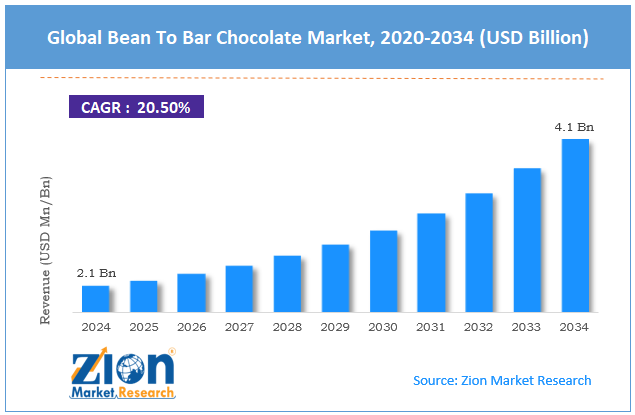
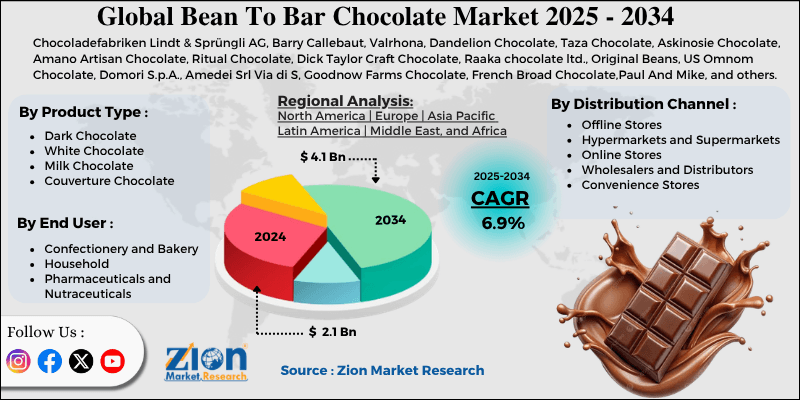
The global bean to bar chocolate market size was worth around USD 2.1 billion in 2024 and is predicted to grow to around USD 4.1 billion by 2034 with a compound annual growth rate (CAGR) of roughly 6.9% between 2025 and 2034.
Bean To Bar Chocolate Market: Overview
Bean-to-bar chocolate denotes a high-quality chocolate manufacturing method in which chocolate producers start with raw cocoa beans and produce the final chocolate through processes such as roasting, grinding, refining, conching, tempering, and molding. This type of chocolate manufacturing differs significantly from that of chocolate manufacturers who acquire processed forms of cocoa, such as cocoa liquor or couverture. The key aspect of bean-to-bar chocolate is that the chocolate manufacturer can highlight its unique taste, as in specialty coffee or wine, based on factors like the geographic origin of the cocoa, the variety of bean used, and fermentation processes.
Key Insights
- As per the analysis shared by our research analyst, the global bean to bar chocolate market is estimated to grow annually at a CAGR of around 6.9% over the forecast period (2025-2034).
- In terms of revenue, the global bean to bar chocolate market size was valued at around USD 2.1 billion in 2024 and is projected to reach USD 4.1 billion by 2034.
- Innovation in flavors and ingredients is expected to propel the bean to bar chocolate market over the projected period.
- Based on the product type, the dark chocolate segment captures the largest market share in 2024.
- Based on the end user, the confectionery and bakery dominated the market with a revenue share of 38%.
- Based on the distribution channel, the offline stores hold the majority of market share in the bean to bar chocolate market.
- Based on region, Europe captures the largest market share in 2024 of over 30%.
Impact of the USA-Israel War on Iran on the Bean To Bar Chocolate Market
The war between the USA and Israel over Iran is another factor that has adversely affected the bean-to-bar chocolate business due to higher global energy costs, rising shipping rates, and disruptions to the logistics chain stemming from volatility in the Strait of Hormuz. In addition, the rising cost of transporting goods and packaging materials has increased production costs for artisans producing bean-to-bar chocolates, who mainly use imported cocoa beans and other rare ingredients. Additionally, the volatility of commodity markets, such as those for cocoa and sugar, has increased alongside inflation, limiting consumer purchases of chocolates.
Bean To Bar Chocolate Market: Dynamics
Growth Drivers
Why does the growing demand for premium and craft chocolate drive the bean to bar chocolate market?
The rising consumer demand for quality craft and premium chocolates is one of the most important factors driving the growth of the bean to bar chocolate industry. Increased disposable incomes, changing consumer preferences, and gourmet food experience trends are prompting customers to move away from commercial and manufactured confectionery toward craft chocolates made with select cocoa beans. In the bean-to-bar category of chocolate, manufacturers place much emphasis on producing chocolates in small batches and on superior taste. Such a factor appeals to consumers seeking luxurious chocolates and other food products.
Restraints
High production cost hinders the growth of the bean to bar chocolate industry
Expensive production is a major constraint on the expansion of the bean to bar chocolate market, as producing bean to bar chocolates requires high-quality cocoa beans, specialized machinery, skilled personnel, and batch processing, all of which drive up production costs. Unlike traditional mass-produced chocolate companies, bean-to-bar chocolate manufacturers usually spend a lot of money sourcing ingredients and establishing partnerships with farmers who practice sustainability, quality assurance, and artisan production practices to ensure the authenticity of their products. Besides, rising cocoa prices, energy costs, packaging, and temperature-controlled shipping also make production expensive.
Opportunities
How does the increasing product launch offer a lucrative opportunity for the bean to bar chocolate market?
The growing product launch is expected to offer a potential opportunity to the bean to bar chocolate market growth during the projected period. For instance, in May 2026, Bühler launched a new version of two of its best-selling products for chocolate mass production: the Finer S Edition 26, a five-roll refiner, and the ELK S Edition 26 single-shaft conche. The two crucial processes in premium-quality chocolate mass production, refining, and conching, remain the same; however, Edition 26 machines are more hygienic, intelligent, efficient, and transparent. Bühler’s next-generation machines with the Edition 26 name show that the company is preparing to meet future challenges and continues its leading position in the chocolate market.
Having the technology proven by time, Bühler has received much respect and recognition from its clients around the world. In recent years, the company’s DoMiReCo procedure – Dosing, Mixing, Refining, and Conching – has become the standard for customers in the chocolate market. The main factors of the DoMiReCo procedure are Refinement and Conching. They establish the quality of the finished product. Fineness, flavor, aroma, fluidity, and efficiency of raw materials are defined at this stage.
Challenges
Why does the limited consumer awareness in emerging markets pose a significant challenge to the bean to bar chocolate market?
Consumer ignorance within new markets is another major obstacle that the bean to bar chocolate industry faces. Consumers in many of these new markets are unaware of artisanal chocolate-making practices, single-origin cocoa sourcing, and ethically produced premium chocolate products. Many developing nations still operate under the notion of buying products based on cost rather than quality, traceability, or manufacturing skills, making it hard for bean-to-bar companies to compete with their higher prices. In addition, a lack of cultural knowledge about specialty chocolates and low market penetration make it even harder for the bean-to-bar chocolate industry to expand in these markets.
Bean To Bar Chocolate Market: Report Scope
| Report Attributes | Report Details |
|---|---|
| Report Name | Bean To Bar Chocolate Market |
| Market Size in 2024 | USD 2.1 Billion |
| Market Forecast in 2034 | USD 4.1 Billion |
| Growth Rate | CAGR of 6.9% |
| Number of Pages | 229 |
| Key Companies Covered | Chocoladefabriken Lindt & Sprüngli AG, Barry Callebaut, Valrhona, Dandelion Chocolate, Taza Chocolate, Askinosie Chocolate, Amano Artisan Chocolate, Ritual Chocolate, Dick Taylor Craft Chocolate, Raaka chocolate ltd., Original Beans, US Omnom Chocolate, Domori S.p.A., Amedei Srl Via di S, Goodnow Farms Chocolate, French Broad Chocolate,Paul And Mike, and others. |
| Segments Covered | By Product Type, By End User, By Distribution Channel, and By Region |
| Regions Covered | North America, Europe, Asia Pacific (APAC), Latin America, Middle East, and Africa (MEA) |
| Base Year | 2024 |
| Historical Year | 2019 - 2023 |
| Forecast Year | 2025 - 2034 |
| Customization Scope | Avail customized purchase options to meet your exact research needs. Request For Customization |
Bean To Bar Chocolate Market: Segmentation
Product Type Insights
Why does the dark chocolate dominate the bean to bar chocolate market?
The dark chocolate segment captures the largest market share in 2024. The increasing popularity of bean-to-bar companies stems from changing consumer preferences for premium-quality, healthy dark chocolate. Awareness of the antioxidants in dark chocolate, its lower sugar content, and other wellness benefits has led consumers to move from conventional milk chocolate varieties toward dark chocolate products. Some bean-to-bar producers have started producing dark chocolate varieties with distinct flavors, and they are organic and health-conscious.
End User Insights
How does the confectionery and bakery capture the largest market share in the bean to bar chocolate market?
The confectionery and bakery dominated the market with a revenue share of 38%. This growth has been spurred by an increasing trend towards the usage of premium artisanal chocolates in cakes, pastries, biscuits, desserts, pralines, and gourmet confections. The growing consumer demand for high-quality ingredients, cocoa-rich taste, and clean-label bakery products has led to a shift towards incorporating bean-to-bar chocolate into bakery products.
Distribution Channel Insights
Does the offline stores segment dominate the bean to bar chocolate market?
The offline stores hold the majority of market share in the bean to bar chocolate market. The segment's growth stems from consumers' desire to discover the product in a physical store, an indulgent shopping experience, and the ability to taste artisanal chocolates directly. Specialty chocolate shops, gourmet specialty stores, grocery stores, department stores, and luxury retail stores provide consumers the opportunity to handle the product, taste its flavors, and get a deeper understanding of their origins.
Regional Insights
Why does Europe lead the bean to bar chocolate market?
Europe captures the largest market share in 2024 of over 30%. Growth can be attributed to sophisticated buyers on the continent and stringent sustainability regulations. The history of chocolate use on the continent, combined with the realization of the need for sustainable chocolate, is creating a conducive market for bean-to-bar. The region's highest consumers of chocolate are people from the United Kingdom. This has been made possible by rising imports of specialty cocoa and the emergence of many craft chocolate producers who appeal to sophisticated customers. The emergence of many bean-to-bar chocolate producers in the UK is indicative of a trend across Europe toward a preference for high-quality, crafted products. There seems to be a trend towards the adoption of organic and single-source products in the region.
Bean To Bar Chocolate Market: Competitive Analysis
The global bean to bar chocolate market is dominated by players like:
- Chocoladefabriken Lindt & Sprüngli AG
- Barry Callebaut
- Valrhona
- Dandelion Chocolate
- Taza Chocolate
- Askinosie Chocolate
- Amano Artisan Chocolate
- Ritual Chocolate
- Dick Taylor Craft Chocolate
- Raaka chocolate ltd.
- Original Beans
- US Omnom Chocolate
- Domori S.p.A.
- Amedei Srl Via di S
- Goodnow Farms Chocolate
- French Broad Chocolate
- Paul And Mike
The global bean to bar chocolate market is segmented as follows:
By Product Type
- Dark Chocolate
- White Chocolate
- Milk Chocolate
- Couverture Chocolate
- Compound Chocolate
By End User
- Confectionery and Bakery
- Household
- Pharmaceuticals and Nutraceuticals
- Food Service
- Cosmetics and Personal Care
By Distribution Channel
- Offline Stores
- Hypermarkets and Supermarkets
- Online Stores
- Wholesalers and Distributors
- Convenience Stores
By Region
- North America
- The U.S.
- Canada
- Mexico
- Europe
- France
- The UK
- Spain
- Germany
- Italy
- Rest of Europe
- Asia Pacific
- China
- Japan
- India
- Australia
- South Korea
- Rest of Asia Pacific
- The Middle East & Africa
- Saudi Arabia
- UAE
- Egypt
- Kuwait
- South Africa
- Rest of the Middle East & Africa
- Latin America
- Brazil
- Argentina
- Rest of Latin America
Table Of Content
Methodology
FrequentlyAsked Questions
Bean-to-bar chocolate denotes a high-quality chocolate manufacturing method in which chocolate producers start with raw cocoa beans and produce the final chocolate through processes such as roasting, grinding, refining, conching, tempering, and molding.
Key growth drivers for the bean-to-bar chocolate market include rising demand for premium artisanal chocolates, increasing consumer preference for ethically sourced and clean-label products, growing health consciousness toward dark chocolate, and expanding interest in single-origin and sustainable cocoa products.
Major challenges restraining the growth of the bean-to-bar chocolate market include high production costs, volatile cocoa prices, limited consumer awareness in emerging markets, supply-chain complexities, and strong competition from mass-market premium chocolate brands.
Based on the distribution channel, the offline stores segment is expected to dominate the bean to bar chocolate market growth during the projected period.
Emerging trends and innovations impacting the bean-to-bar chocolate market include rising demand for single-origin and ethically sourced cocoa, plant-based and low-sugar chocolates, experimental flavors and inclusions, sustainable packaging, functional ingredients, and advanced fermentation and lab-grown cocoa technologies.
According to the report, the global bean to bar chocolate market size was worth around USD 2.1 billion in 2024 and is predicted to grow to around USD 4.1 billion by 2034.
The global bean to bar chocolate market is expected to grow at a CAGR of 6.9% during the forecast period.
The global bean to bar chocolate industry growth is expected to be led by Europe over the forecast period.
The global bean to bar chocolate market is dominated by players like Chocoladefabriken Lindt & Sprüngli AG, Barry Callebaut, Valrhona, Dandelion Chocolate, Taza Chocolate, Askinosie Chocolate, Amano Artisan Chocolate, Ritual Chocolate, Dick Taylor Craft Chocolate, Raaka chocolate ltd., Original Beans, US Omnom Chocolate, Domori S.p.A., Amedei Srl Via di S, Goodnow Farms Chocolate, French Broad Chocolate and Paul And Mike among others.
The market report covers the geographical market along with a comprehensive competitive landscape analysis. It also includes cash flow analysis, profit ratio analysis, market basket analysis, market attractiveness analysis, sentiment analysis, PESTLE analysis, trend analysis, SWOT analysis, trade area analysis, demand & supply analysis, Porter’s five forces analysis, and value chain analysis.

HappyClients

