
Global Aviation And Airport Asset Tracking Market Size, Share, Forecast, 2034

Aviation And Airport Asset Tracking Market By Type of Asset (Aircraft Companies, Ground Support Equipment (GSE), Fuel Management Systems, Passenger Baggage, and Navigation & Communication Equipment), By Technology (Global Positioning System (GPS), Radio-Frequency Identification (RFID), Barcode Systems, Internet-of-Things (IoT), Ultra-Wideband (UWB) Technology, and Others), By Application (Fleet Management, Airport Management, Security & Safety Monitoring, Passenger Management & Tracking, Maintenance, Repair, and Operations (MRO), and Others), By Deployment Model (Hybrid Solutions, On-Premise Solutions, and Cloud-Based Solutions), By End-User (Ground Handling Companies, Regulatory Bodies, Airports, Logistics & Cargo Companies, Airlines, and Others), and By Region - Global and Regional Industry Overview, Market Intelligence, Comprehensive Analysis, Historical Data, and Forecasts 2025 - 2034
| Market Size in 2024 | Market Forecast in 2034 | CAGR (in %) | Base Year |
|---|---|---|---|
| USD 356.25 Million | USD 912.46 Million | 14.83% | 2024 |
Aviation and Airport Asset Tracking Market: Industry Perspective:
What will be the global aviation and airport asset tracking market size during the forecast period?
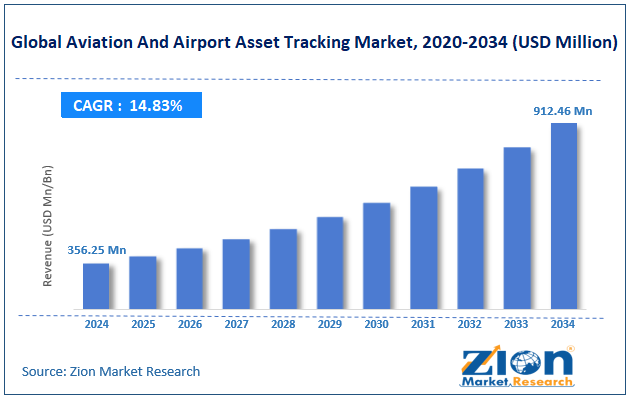
The global aviation and airport asset tracking market size was worth around USD 356.25 million in 2024 and is predicted to grow to around USD 912.46 million by 2034 with a compound annual growth rate (CAGR) of roughly 14.83% between 2025 and 2034.
Key Insights:
- As per the analysis shared by our research analyst, the global aviation and airport asset tracking market is estimated to grow annually at a CAGR of around 14.83% over the forecast period (2025-2034)
- In terms of revenue, the global aviation and airport asset tracking market size was valued at around USD 356.25 million in 2024 and is projected to reach USD 912.46 million by 2034.
- The aviation and airport asset tracking market is projected to grow at a significant rate due to the rising investments in airport infrastructure across the globe.
- Based on the type of asset, the ground support equipment segment is growing at a high rate and will continue to dominate the global market, as per industry projections
- Based on the end-user, the airports segment is anticipated to command the largest market share
- Based on region, North America is projected to dominate the global market during the forecast period
Aviation and Airport Asset Tracking Market: Overview
Aviation and airport asset tracking refers to the wide range of processes and technologies deployed to track and monitor assets and equipment used across airport operations. It includes tracking ground support equipment, luggage, carts, vehicles, and other elements that allow the smooth functioning of an airport. As airport operations and the aviation sector have become increasingly complex, demand for real-time asset-tracking tools has increased significantly. The prominent advantages of aviation and airport asset tracking tools include smooth & error-free operations, enhanced passenger experience, improved security, and compliance. Global demand for aviation and airport asset tracking solutions is projected to continue to grow, driven by the construction of new airports and the upgrading of existing facilities.
Rising focus on enhancing passenger experience and safety, along with increased need to optimize business operations, will aid market expansion. The industry, however, is expected to face growth limitations due to the high upfront cost involved with technology deployment and maintenance.
Aviation and Airport Asset Tracking Market: Dynamics
Growth Drivers
How will rising investments in airport infrastructure fuel aviation and airport asset tracking market growth?
The global aviation and airport asset tracking market is expected to be driven by the rising investments in airport infrastructure across the globe. According to official estimates, the global aviation investment is expected to cross more than USD 2.39 trillion by 2040. The investments in the aviation industry are fueled by rising air passenger traffic, globalization, and increased demand for achieving operational efficiency at airports. The construction of new, technologically advanced airports, along with surging investments in the renovation of existing facilities, will create growth opportunities for asset-tracking solution providers.
For instance, in 2025, the Dubai government announced an investment of USD 35 billion to be used for the expansion of Al-Maktoum International Airport (DWC) and turn it into the world’s largest airport. The refurbished facility is expected to have five runways and will be equipped with integrated logistics for improved operations. Aviation and airport asset-tracking tools are essential technologies for tracking and managing critical equipment and infrastructure across aviation facilities.
Growing focus on improving operational efficiency to generate improved revenue for the industry leaders
Aviation and airport asset tracking solutions are designed to improve operational efficiency within facilities. Airport authorities can significantly reduce operational costs and losses by effectively tracking every asset of the unit in real-time. Furthermore, the tracking devices eliminate the risk of loss or misplacement, especially when managing expensive assets.
In June 2025, a global provider of indoor positioning and real-time location solutions announced that the company had successfully deployed a passenger luggage cart management system at Paris Charles de Gaulle (CDG) Airport. The technology will ensure that carts are available at all times across passenger departure and arrival points. Such strategic innovations are likely to work in favor of the global aviation and airport asset tracking market.
Restraints
How will the high cost of investment limit the expansion of the aviation and airport asset tracking market?
The global aviation and airport asset-tracking industry is projected to be constrained by the high investment costs associated with the market. Deployment of large-scale asset tracking technologies such as radio-frequency identification (RFID) tags requires extensive upfront investment. For instance, fully integrated RFID tags at aviation facilities can range between USD 6 million and over USD 16 million, depending on the overall features. The growing economic uncertainty reported worldwide may impact business market decisions in the long run.
Opportunities
Will strict government regulations offer growth opportunities to the aviation and airport asset tracking industry players?
The global aviation and airport asset tracking market is expected to present growth opportunities, driven by stringent government regulations that encourage the adoption of advanced technologies to enhance operational efficiency and passenger safety. International Civil Aviation Organization (ICAO) Safety Management Systems (SMS) – Annex 19, a global aviation safety framework, requires all aviation operators and airports to be equipped with Safety Management Systems. This creates widespread opportunities for asset tracking solutions providers, as these technologies can be used to prevent incidents and monitor in real-time.
Which growth opportunities will technological advancements create for the aviation and airport asset tracking market?
Technological innovations such as Bluetooth Low Energy (BLE), Internet-of-Things (IoT)-enabled sensors, cloud computing, and data analytics are expected to offer renewed growth opportunities for industry players in the coming years. Innovations reported in asset tracking technologies will facilitate enhanced safety compliance, predictive maintenance, and automated alerts to improve the overall performance of the facility.
Challenges
Concerns over data privacy and cybersecurity threats could challenge industry revenue in the future
The global aviation and airport asset tracking industry is anticipated to be challenged by the rising concerns over data privacy. Most asset tracking systems generate high volumes of confidential data. In case of an information leak, the safety of the airport and the passengers can be compromised. Concerns about privacy protection and cyberattacks will continue to affect industry growth trends in the future.
Aviation And Airport Asset Tracking Market: Report Scope
| Report Attributes | Report Details |
|---|---|
| Report Name | Aviation And Airport Asset Tracking Market |
| Market Size in 2024 | USD 356.25 Million |
| Market Forecast in 2034 | USD 912.46 Million |
| Growth Rate | CAGR of 14.83% |
| Number of Pages | 213 |
| Key Companies Covered | Honeywell Aerospace, Zebra Technologies, Targa Telematics, Unilode Aviation Solutions, Inmar Intelligence, Collins Aerospace, RFID Global Solution, SITA, Ubisense, Siemens Mobility, TrackIT Solutions, HID Global, Sensolus, Smartrac, Litum, and others. |
| Segments Covered | By Type of Asset, By Technology, By Application, By Deployment Model, By End-User, and By Region |
| Regions Covered | North America, Europe, Asia Pacific (APAC), Latin America, Middle East, and Africa (MEA) |
| Base Year | 2024 |
| Historical Year | 2019 to 2023 |
| Forecast Year | 2025 - 2034 |
| Customization Scope | Avail customized purchase options to meet your exact research needs. Request For Customization |
Aviation and Airport Asset Tracking Market: Segmentation
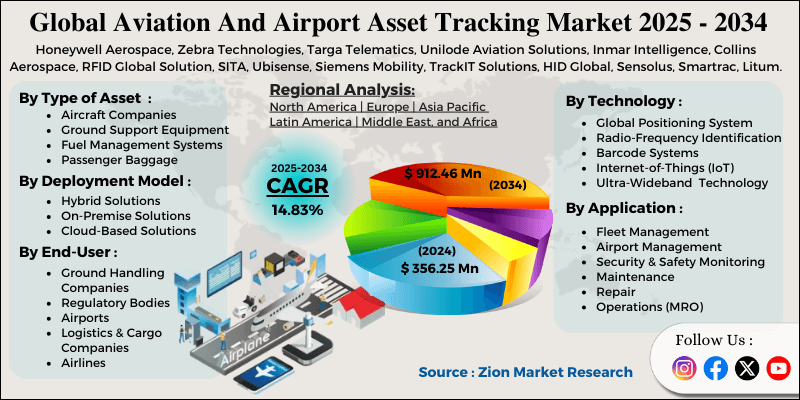
The global aviation and airport asset tracking market is segmented based on type of asset, technology, application, deployment model, end-user, and region.
Why will the ground support equipment segment dominate the aviation and airport asset tracking market?
Based on type of asset, the global market segments are aircraft companies, ground support equipment, fuel management systems, passenger baggage, and navigation & communication equipment. In 2024, the highest growth was listed in the ground support equipment segment due to the use of the technology to manage critical assets such as aircraft tugs & tow tractors, baggage carts & dollies, and ground power units (GPUs). The rising expansion of ground support will fuel segmental demand in the future.
Based on technology, the global market divisions are global positioning systems (GPS), radio-frequency identification (RFID), barcode systems, Internet-of-Things (IoT), ultra-wideband (UWB) technology, and others.
What will help the fleet management segment lead the aviation and airport asset tracking industry?
Based on application, the global aviation and airport asset tracking industry is divided into fleet management, airport management, security & safety monitoring, passenger management & tracking, maintenance, repair, and operations (MRO), and others.
In 2024, the fleet management segment was the leading revenue generator due to surging investments in expanding airport fleets, including airside transport and ground support vehicles. The segment will continue to lead the market during the projection period.
Based on the deployment model, the global market divisions are hybrid solutions, on-premise solutions, and cloud-based solutions.
Why will the airports segment generate the highest revenue in the aviation and airport asset tracking market?
Based on end-user, the global market is divided into ground handling companies, regulatory bodies, airports, logistics & cargo companies, airlines, and others. In 2024, the airports segment generated the highest revenue, driven by the rapid expansion of airport infrastructure worldwide. The airports segment will continue to generate the highest CAGR in the coming years compared with other segments.
Aviation and Airport Asset Tracking Market: Regional Analysis
Which factors will contribute to Asia-Pacific emerging as the fastest-growing region in the aviation and airport asset tracking market?
The global aviation and airport asset tracking market is expected to be led by North America during the forecast period. The region dominated nearly 38.05% of the global revenue and will continue to deliver a CAGR of more than 10.06% in the coming years. The presence of a growing number of large-scale airports across the US and Canada will help fuel regional demand.
For instance, in December 2025, the US Federal Aviation Administration (FAA) announced the release of the fifth and last installment of USD 2.89 billion for building and renovating US airports. Additionally, strict regional legal frameworks focusing on airport and aircraft safety will aid regional expansion in the future.
What position will Asia Pacific hold in the aviation and airport asset tracking industry?
Asia-Pacific is anticipated to emerge as the fastest-growing market. It is anticipated to deliver a CAGR exceeding 16%, driven by increasing air passenger traffic in countries such as China, India, and Japan. The surge in the number of business & leisure travelers across prominent Asian countries will encourage the integration of asset tracking systems.
Additionally, investments in the construction of large-scale airports, along with the addition of new players in the region, may further help the region thrive in the coming years.
Aviation and Airport Asset Tracking Market: Competitive Analysis
The global aviation and airport asset tracking market is led by players like:
- Honeywell Aerospace
- Zebra Technologies
- Targa Telematics
- Unilode Aviation Solutions
- Inmar Intelligence
- Collins Aerospace
- RFID Global Solution
- SITA
- Ubisense
- Siemens Mobility
- TrackIT Solutions
- HID Global
- Sensolus
- Smartrac
- Litum
What are the trends in the Aviation and Airport Asset Tracking Market?
Smart airports
The rising trend of constructing smart airports may influence demand for aviation and airport asset tracking. Smart airports rely heavily on interconnected digital systems that enable automation and real-time analysis of collected data, allowing airport authorities to make informed, timely decisions.
Integration in smaller airports
Aviation and airport asset-tracking technologies are undergoing rapid integration at smaller airports and regional aviation facilities. The asset tracking technologies can help smaller airports improve operational efficiency and reduce costs.
The global aviation and airport asset tracking market is segmented as follows:
By Type of Asset
- Aircraft Companies
- Ground Support Equipment (GSE)
- Fuel Management Systems
- Passenger Baggage
- Navigation & Communication Equipment
By Technology
- Global Positioning System (GPS)
- Radio-Frequency Identification (RFID)
- Barcode Systems
- Internet-of-Things (IoT)
- Ultra-Wideband (UWB) Technology
- Others
By Application
- Fleet Management
- Airport Management
- Security & Safety Monitoring
- Passenger Management & Tracking
- Maintenance
- Repair
- Operations (MRO)
- Others
By Deployment Model
- Hybrid Solutions
- On-Premise Solutions
- Cloud-Based Solutions
By End-User
- Ground Handling Companies
- Regulatory Bodies
- Airports
- Logistics & Cargo Companies
- Airlines
- Others
By Region
- North America
- The U.S.
- Canada
- Mexico
- Europe
- France
- The UK
- Spain
- Germany
- Italy
- Rest of Europe
- Asia Pacific
- China
- Japan
- India
- Australia
- South Korea
- Rest of Asia Pacific
- The Middle East & Africa
- Saudi Arabia
- UAE
- Egypt
- Kuwait
- South Africa
- Rest of the Middle East & Africa
- Latin America
- Brazil
- Argentina
- Rest of Latin America
Table Of Content
Methodology
FrequentlyAsked Questions
Aviation and airport asset tracking refers to the wide range of processes and technologies deployed to track and monitor assets and equipment used across airport operations.
The global aviation and airport asset tracking market is expected to be driven by the rising investments in airport infrastructure across the globe.
According to study, the global aviation and airport asset tracking market size was worth around USD 912.46 million in 2024 and is predicted to grow to around USD 356.25 million by 2034.
The CAGR value of the aviation and airport asset tracking market is expected to be around 14.83% during 2025-2034.
The global aviation and airport asset tracking industry is anticipated to be challenged by the rising concerns over data privacy.
Smart airports and integration of technology in smaller airports are the emerging trends and innovations impacting the aviation and airport asset tracking market.
The global aviation and airport asset tracking market has performed well so far and will offer similar trends in the coming years.
The global aviation and airport asset tracking market is expected to be led by North America during the forecast period.
The global aviation and airport asset tracking market is led by players like Honeywell Aerospace, Zebra Technologies, Targa Telematics, Unilode Aviation Solutions, Inmar Intelligence, Collins Aerospace, RFID Global Solution, SITA, Ubisense, Siemens Mobility, TrackIT Solutions, HID Global, Sensolus, Smartrac, and Litum.
The report explores crucial aspects of the aviation and airport asset tracking market, including a detailed discussion of existing growth factors and restraints, while also browsing future growth opportunities and challenges that impact the market.

List of Contents
Aviation and Airport Asset Tracking Industry Perspective:Key Insights:Aviation and Airport Asset Tracking OverviewAviation and Airport Asset Tracking DynamicsReport ScopeAviation and Airport Asset Tracking SegmentationAviation and Airport Asset Tracking Regional AnalysisAviation and Airport Asset Tracking Competitive AnalysisWhat are the trends in the Aviation and Airport Asset Tracking Market?The global aviation and airport asset tracking market is segmented as follows:HappyClients

