
Automotive Plastics Market Size, Share, Industry Analysis, Trends, Growth, Forecasts, 2032

Automotive Plastics Market By Application (under bonnet, interior, and exterior), By Product type (polyamide, polyvinyl chloride, polypropylene, polycarbonates, HDPE, PET, polyurethanes, PMMA, and ABS) And By Region: - Global and Regional Industry Overview, Market Intelligence, Comprehensive Analysis, Historical Data, and Forecasts, 2024-2032
| Market Size in 2023 | Market Forecast in 2032 | Growth Rate (in %) | Base Year |
|---|---|---|---|
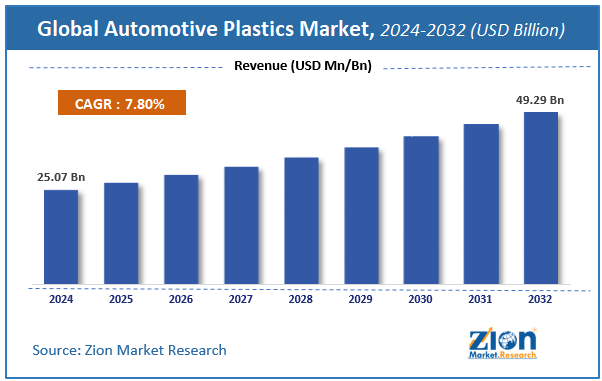
| USD 25.07 Billion | USD 49.29 Billion | CAGR at 7.80% | 2023 |
Description
What is the Market size of the Automotive Plastics Industry?
ccording to the report published by Zion Market Research, the global Automotive Plastics Market size was valued at USD 25.07 Billion in 2023 and is predicted to reach USD 49.29 Billion by the end of 2032. The market is expected to grow with a CAGR of 7.80% during the forecast period. The report analyzes the global Automotive Plastics Market’s growth drivers, restraints, and impact on demand during the forecast period. It will also help navigate and explore the arising opportunities in the Automotive Plastics Market industry.
Global Automotive Plastics Market for Passenger Cars: Overview
Automotive plastics are used in passenger cars for manufacturing automotive components such as upholstery, bumpers, internal & external trims, dashboards, and seating. R&D on the composite materials, polymers, and reinforced plastics come up with the advanced material qualities, which make them suitable for under bonnet components, interior, and exterior of automobiles. These materials are selected very carefully to facilitate designers achieve a reduction in vehicle weight, meet load-bearing requirements, and improve durability. Automotive plastics are extensively preferred for passenger cars owing to the properties such as easy moldability, reduced weight, impact strength, and improved aesthetics as compared to other conventional automotive components.
Global Automotive Plastics Market for Passenger Cars: Growth Factors
Demand for automotive plastics for passenger cars is growing across the world and automobile manufacturers are largely focus on the lightweight cars; all these factors are expected to propel the global automotive plastics market for passenger cars growth. Automotive plastics are heavily used in automotive designs and for various purposes such as improve aesthetics and carbon emissions. It also offers advantages such as fuel economy, reduced vehicle noise and vibration, and facilitating uni-body design; this is anticipated to fuel the global automotive plastics market for passenger cars growth. Automotive plastics passenger cars act as an insulator for cabin air conditioner. Automotive plastics passenger cars reduce the weight of the vehicle; these properties are anticipated to propel the growth of the global market. However, process-reengineering causes high capital and infrastructure cost, further restraining the global market to some extent.
Global Automotive Plastics Market for Passenger Cars: Segmentation
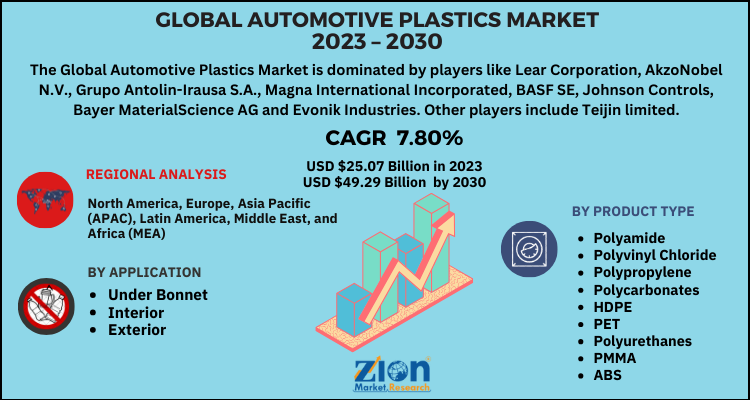
The global automotive plastics market for passenger cars is classified into application and product type.
Based on the application, the global market is categorized as under bonnet, interior, and exterior.
On the basis of product type, the global market is categorized as polyamide, polyvinyl chloride, polypropylene, polycarbonates, HDPE, PET, polyurethanes, PMMA, and ABS.
Automotive Plastics Market : Report Scope
| Report Attributes | Report Details |
|---|---|
| Report Name | Automotive Plastics Market Research Report |
| Market Size in 2023 | USD 25.07 Billion |
| Market Forecast in 2032 | USD 49.29 Billion |
| Growth Rate | CAGR of 7.80% |
| Number of Pages | 196 |
| Key Companies Covered | Lear Corporation, AkzoNobel N.V., Grupo Antolin-Irausa S.A., Magna International Incorporated, BASF SE, Johnson Controls, Bayer MaterialScience AG and Evonik Industries. Other players include Teijin limited, The Dow Chemical Company, Momentive Performance Materials Inc., SABIC, and Royal DSM N.V |
| Segments Covered | By Application, By Product type and By Region |
| Regions Covered | North America, Europe, Asia Pacific (APAC), Latin America, Middle East, and Africa (MEA) |
| Base Year | 2023 |
| Historical Year | 2018 - 2022 |
| Forecast Year | 2024 - 2032 |
| Customization Scope | Avail customized purchase options to meet your exact research needs. Request For Customization |
Global Automotive Plastics Market for Passenger Cars: Regional Analysis
The geographical representation of the global automotive plastics market for passenger cars is given by North America, Europe, Asia-Pacific, Latin America, and the Middle East & Africa. Asia-Pacific is considered as the major market for automotive plastics passenger cars owing to higher demand for these cars in this region. It is further expected to hold this position in the next few years. In addition, Asia Pacific is the largest producer and consumer of polypropylene globally. Europe is another region growing at a faster rate owing to enhancing socio-economic conditions. Other developing countries such as Indonesia, Thailand, China, and India are anticipated to continue their influence in the near future, positively impacting global automotive plastics market for passenger cars.
Global Automotive Plastics Market for Passenger Cars: Competitive Players
Major players in the global automotive plastics market for passenger cars are:
- Lear Corporation
- AkzoNobel N.V.
- Grupo Antolin-Irausa S.A.
- Magna International Incorporated
- BASF SE
- Johnson Controls
- Bayer MaterialScience AG
- Evonik Industries
Other players include
- Teijin limited
- The Dow Chemical Company
- Momentive Performance Materials Inc.
- SABIC
- Royal DSM N.V.
The Global Automotive Plastics Market is segmented as follows:
By Application
- under bonnet
- interior
- exterior
By Product type
- polyamide
- polyvinyl chloride
- polypropylene
- polycarbonates
- HDPE
- PET
- polyurethanes
- PMMA
- ABS
By Region
- North America
- The U.S.
- Canada
- Mexico
- Europe
- France
- The UK
- Spain
- Germany
- Italy
- Rest of Europe
- Asia Pacific
- China
- Japan
- India
- Australia
- South Korea
- Rest of Asia Pacific
- The Middle East & Africa
- Saudi Arabia
- UAE
- Egypt
- Kuwait
- South Africa
- Rest of the Middle East & Africa
- Latin America
- Brazil
- Argentina
- Rest of Latin America
What Report Provides
- Full in-depth analysis of the parent market
- Important changes in market dynamics
- Segmentation details of the market
- Former, on-going, and projected market analysis in terms of volume and value
- Assessment of niche industry developments
- Market share analysis
- Key strategies of major players
- Emerging segments and regional markets
- Testimonials to companies in order to fortify their foothold in the market.
Table Of Content

List of Contents
What is the Market size of the Industry?Global Market for Passenger Cars: OverviewGlobal Market for Passenger Cars: Growth FactorsGlobal Market for Passenger Cars: SegmentationReport ScopeGlobal Market for Passenger Cars: Regional AnalysisGlobal Market for Passenger Cars: Competitive PlayersThe Global Market is segmented as follows:What Report ProvidesFrequentlyAsked Questions
Automotive plastics are lightweight polymer materials used in vehicle interiors, exteriors, and structural components.
The global automotive plastics market is expected to be driven by the Market growth is driven by rising demand for lightweight vehicles, stricter fuel efficiency and emission regulations, and increasing use of plastics in electric and autonomous vehicles for cost reduction and design flexibility.
According to study, the global automotive plastics market size was worth around USD 25.07 Billion in 2023 and is predicted to grow to around USD 49.29 Billion By 2032.
The global automotive plastics market is expected to grow at a Compound Annual Growth Rate (CAGR) of around CAGR 7.80% during the forecast period from 2024-2032.
The global automotive plastics industry is projected to be challenged by Key challenges involve recycling and sustainability requirements, performance limitations under high heat, and regulatory pressure to reduce plastic usage.
The Opportunities stem from lightweighting trends, EV range optimization, and increased use of high-performance polymers and recycled plastics for sustainability targets will offer significant growth opportunities in the automotive plastics market.
Lightweight high-performance polymers, recyclability innovation, and increased EV component usage are the emerging trends and innovations impacting the automotive plastics market.
The global automotive plastics market is expected to be led by APAC during the forecast period.
Some of the prominent players operating in the global automotive plastics market are; Lear Corporation, AkzoNobel N.V., Grupo Antolin-Irausa S.A., Magna International Incorporated, BASF SE, Johnson Controls, Bayer MaterialScience AG and Evonik Industries. Other players include Teijin limited, The Dow Chemical Company, Momentive Performance Materials Inc., SABIC, and Royal DSM N.V and others.
The report explores crucial aspects of the automotive plastics market, including a detailed discussion of existing growth factors and restraints, while also browsing future growth opportunities and challenges that impact the market.
HappyClients

