
Global Automotive Fuse Market Size, Share, Growth & Forecast 2032

Automotive Fuse Market By Fuse Type (Glass Tube, Blade, Semiconductor, and Others), By Voltage (12 & 24V, 24-48V, 49-150V, 151-300V, and >300V), By Applications in BEV (Auxiliary, Onboard, Charge Inlet, Traction Motor, PCU, and Battery), By Motor Output (<80kW, 80-200kW, and >200kW), By Ampere (<40A, 40-100A, and >100A), By Market Type (OEM and Aftermarket), By ICE Vehicle Type (HCV, PC, Mild Hybrid (48V), and LCV), By Electric Vehicle Type (BEV, HEV, and PHEV), By Battery Capacity (<30kWh, 30-75kWh, 75-150kWh, and >150kWh), and By Region - Global and Regional Industry Overview, Market Intelligence, Comprehensive Analysis, Historical Data, and Forecasts 2024 - 2032
| Market Size in 2023 | Market Forecast in 2032 | CAGR (in %) | Base Year |
|---|---|---|---|
| USD 26.20 Billion | USD 39.79 Billion | 4.3% | 2023 |
Automotive Fuse Industry Perspective
What will be the global Automotive Fuse market size during the forecast period?
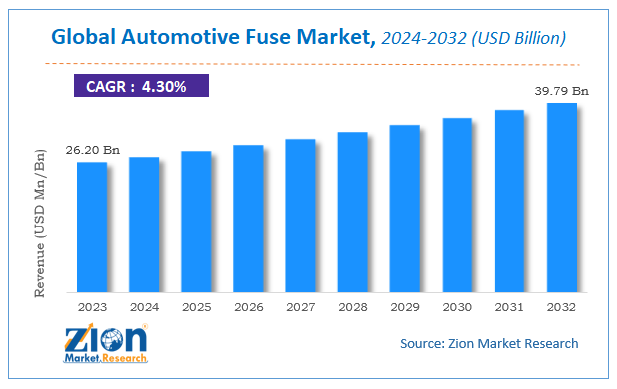
The global automotive fuse market size was around USD 26.20 billion in 2023 and is predicted to reach around USD 39.79 billion by 2032, with a compound annual growth rate (CAGR) of roughly 4.3% between 2024 and 2032. This report provides a comprehensive analysis of the growth drivers, restraints, and challenges shaping demand across the global automotive fuse market throughout the forecast period, while highlighting high-potential emerging opportunities within the industry.
Key Insights
- According to our research analyst, the global Automotive Fuse market is estimated to grow at a CAGR of around 4.3% over the forecast period (2024-2032).
- In terms of revenue, the global Automotive Fuse market size was valued at around USD 26.20 billion in 2023 and is projected to reach USD 39.79 billion by 2032.
- The market is driven by the surge in popularity of electric vehicles, technological breakthroughs, rising electronic content in vehicles, vehicle electrification trends, and increasing demand for safety and comfort features.
- Based on the Fuse Type segment, Blade fuses serve distinct roles, with blade and semiconductor types supporting evolving electrical architectures.
- Based on the Voltage segment, lower voltage ranges such as 12 & 24V remain widely used in conventional systems, while higher voltage categories support electrified powertrains.
- Based on region, Asia Pacific is expected to make notable contributions, driven by rising vehicle sales, electrification needs in China and Japan, and demand for vehicle comfort and safety.
Automotive Fuse Market: Overview
An automotive fuse is utilized for protecting electrical wiring, circuits, switches, and components of automobiles from electrical surges. The product is utilized for circuits with a direct current of nearly twenty-four volts. However, these electrical systems are rated for 42 volts and are sometimes used in non-automotive electrical items. The growing popularity of 3D printing in the automotive sector will create new horizons of growth for the automotive fuse market in the near future.
Automotive Fuse Market: Growth Drivers
The surge in the popularity of electric vehicles, along with technological breakthroughs, has translated into huge market growth over the assessment timeline. With vehicle manufacturers increasing the production of electric vehicles, the automotive fuse industry is anticipated to gain traction over the years ahead. Fuses have myriad applications in electric vehicles and automobiles with integrated electronic properties. With the inception of sensor technology and IoT as well as AI, product penetration is likely to reach far-flung areas, thereby paving the way for the growth of the automotive fuse industry over the projected timeline.
Furthermore, escalating demand for premium automobiles coupled with the growing popularity of self-driving & semi-autonomous vehicles will produce new growth avenues for the automotive fuse industry over the forecast timeframe. Apart from this, massive vehicle electrification trends and the need for vehicle safety & comfort will prompt product demand in the coming years. The thriving automotive powertrain market will further contribute to the automotive fuse industry size over the years ahead.
Apart from this, breakthroughs in additive manufacturing methods and innovations in advanced materials are anticipated to revolutionize the automotive sector. This, in turn, will scale up the growth of the automotive fuse market and will take it to greater heights in the coming decade.

Automotive Fuse Market: Report Scope
| Report Attributes | Report Details |
|---|---|
| Report Name | Automotive Fuse Market |
| Market Size in 2023 | USD 26.20 Billion |
| Market Forecast in 2032 | USD 39.79 Billion |
| Growth Rate | CAGR of 4.3% |
| Number of Pages | 220 |
| Key Companies Covered | ON Semiconductor, MERSEN S.A., Eaton, Littelfuse Inc, Sensata Technologies Inc, and SCHURTER Holding AG. |
| Segments Covered | By Fuse Type, By Voltage, By Applications in BEV, By Motor Output, By Ampere, By Market Type, By ICE Vehicle Type, By Electric Vehicle Type, By Battery Capacity, and By Region |
| Regions Covered | North America, Europe, Asia Pacific (APAC), Latin America, Middle East, and Africa (MEA) |
| Base Year | 2023 |
| Historical Year | 2018 - 2022 |
| Forecast Year | 2024 - 2032 |
| Customization Scope | Avail customized purchase options to meet your exact research needs. Request For Customization |
Automotive Fuse Market: Segmentation
The Automotive Fuse market is segmented by fuse type, voltage, applications in BEV, motor output, ampere, market type, ICE vehicle type, electric vehicle type, battery capacity, and region.
Based on Fuse Type, the Automotive Fuse market is divided into Glass Tube, Blade, Semiconductor, and Others. Blade fuses are widely used due to their reliability and suitability for a broad range of automotive circuits. Semiconductor fuses are increasingly relevant for protecting sensitive electronic components in modern and electrified vehicles. Glass tube fuses continue to serve specific applications, while the overall mix supports both conventional and advanced electrical architectures and drives market volume through diverse vehicle platforms.
Based on Voltage, the Automotive Fuse market is divided into 12 & 24V, 24-48V, 49-150V, 151-300V, and >300V. The 12 & 24V category remains foundational for traditional vehicle electrical systems. Higher voltage ranges support the growing population of mild hybrids, plug-in hybrids, and battery electric vehicles, enabling protection of high-voltage circuits and contributing to market expansion as electrification advances.
Based on Applications in the BEV, The Automotive Fuse market is divided into Auxiliary, Onboard, Charge Inlet, Traction Motor, PCU, and battery. Battery application is critical for high-voltage protection in electric vehicles. Auxiliary and onboard systems also require reliable circuit protection, supporting overall demand as BEV production increases.
Automotive Fuse Market: Regional Analysis
Why will Asia Pacific continue to make notable contributions during the projection period?
The expansion of the automotive fuse industry in the Asia Pacific over the assessment timeframe is owing to the escalating need for the comfort & safety of vehicles. Apart from this, stringent norms pertaining to vehicle security, along with massive vehicle sales, will contribute notably towards the automotive fuse industry size in the years ahead. Additionally, the growing necessity for the electrification of automobiles in Japan and China will accentuate the growth of the automotive fuse industry in the years ahead.
North America maintains solid demand supported by vehicle production, electrification initiatives, and the presence of advanced automotive electronics and safety requirements. Europe continues to contribute through established automotive manufacturing, regulatory emphasis on vehicle safety, and progressive adoption of electrified powertrains that require specialized fuse solutions.
Automotive Fuse Market: Competitive Analysis
The global automotive fuse market is dominated by players:
- ON Semiconductor
- MERSEN S.A
- Eaton
- Littelfuse, Inc.
- Sensata Technologies, Inc.
- SCHURTER Holding AG.
The global automotive fuse market is segmented as follows:
By Fuse Type
- Glass Tube
- Blade
- Semiconductor
- Others
By Voltage
- 12 & 24V
- 24-48V
- 49-150V
- 151-300V
- >300V
By Applications in BEV
- Auxiliary
- Onboard
- Charge Inlet
- Traction Motor
- PCU
- Battery
By Motor Output
- <80kW
- 80-200kW
- >200kW
By Ampere
- <40A
- 40-100A
- >100A
By Market Type
- OEM
- Aftermarket
By ICE Vehicle Type
- HCV
- PC
- Mild Hybrid (48V)
- LCV
By Electric Vehicle Type
- BEV
- HEV
- PHEV
By Battery Capacity
- <30kWh
- 30-75kWh
- 75-150kWh
- >150kWh
By Region
- North America
- The U.S.
- Canada
- Mexico
- Europe
- France
- The UK
- Spain
- Germany
- Italy
- Rest of Europe
- Asia Pacific
- China
- Japan
- India
- Australia
- South Korea
- Rest of Asia Pacific
- The Middle East & Africa
- Saudi Arabia
- UAE
- Egypt
- Kuwait
- South Africa
- Rest of the Middle East & Africa
- Latin America
- Brazil
- Argentina
- Rest of Latin America
Table Of Content
Methodology
FrequentlyAsked Questions
An automotive fuse protects vehicle electrical circuits. It prevents damage from overcurrent conditions
The global Automotive Fuse market is expected to be driven by the increasing vehicle electrification, rising electronic content in vehicles, and safety requirements. Growth in electric and hybrid vehicles boosts market demand.
According to study, the global Automotive Fuse market size was worth around USD 26.20 Billion in 2023 and is predicted to grow to around USD 39.79 Billion By 2032.
The global Automotive Fuse market is expected to grow at a Compound Annual Growth Rate (CAGR) of around CAGR 4.3% during the forecast period from 2024-2032.
The global Automotive Fuse industry is projected to be challenged by Challenges include low margins, material cost volatility, and competition from low-cost suppliers.
The Opportunities include rising electronic content in vehicles, EV and hybrid growth, safety regulation compliance, and demand for advanced fuse technologies will offer significant growth opportunities in the Automotive Fuse market.
Compact and high-current fuses for EVs; advanced materials for heat resistance; integration into intelligent power distribution units are the emerging trends and innovations impacting the Automotive Fuse market.
The global Automotive Fuse market is expected to be led by APAC during the forecast period.
Some of the prominent players operating in the global Automotive Fuse market are; ON Semiconductor, MERSEN S.A, Eaton, Littelfuse Inc, Sensata Technologies Inc, and SCHURTER Holding AG. and others.
The report explores crucial aspects of the Automotive Fuse market, including a detailed discussion of existing growth factors and restraints, while also browsing future growth opportunities and challenges that impact the market.

HappyClients

