
Automated Material Handling Equipment Market Size Report 2034

Automated Material Handling Equipment Market By Product (Robots Automated Storage and Retrieval System [AS/RS], Conveyors Systems, Sortation Systems, Cranes, Warehouse Management System [WMS], Collaborative Robots, Autonomous Mobile Robots [AMR], Automated Guided Vehicle [AGV]), By System Type (Unit Load Material Handling, Bulk Load Material Handling), By Vertical (Automotive, Semiconductor & Electronics, E-Commerce, Healthcare, Metals & Heavy Machinery, Food & Beverages, Chemicals, 3PL, Aviation, and Others), and By Region - Global and Regional Industry Overview, Market Intelligence, Comprehensive Analysis, Historical Data, and Forecasts 2025 - 2034
| Market Size in 2024 | Market Forecast in 2034 | CAGR (in %) | Base Year |
|---|---|---|---|
| USD 64.74 Billion | USD 138.77 Billion | 10.0% | 2024 |
Automated Material Handling Equipment Industry Perspective:
What will be the size of the global automated material handling equipment market during the forecast period?
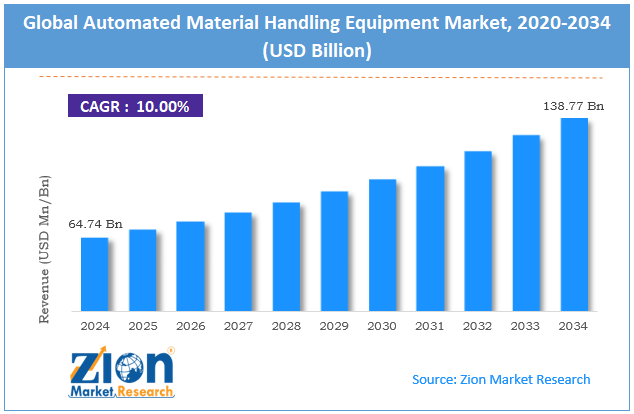
The global automated material handling equipment market size was around USD 64.74 billion in 2024 and is projected to reach USD 138.77 billion by 2034, with a compound annual growth rate (CAGR) of roughly 10% between 2025 and 2034.
Key Insights:
- As per the analysis shared by our research analyst, the global automated material handling equipment market is estimated to grow annually at a CAGR of around 10% over the forecast period (2025-2034)
- In terms of revenue, the global automated material handling equipment market size was valued at around USD 64.74 billion in 2024 and is projected to reach USD 138.77 billion by 2034.
- The automated material handling equipment market is projected to grow significantly owing to the rising warehouse automation adoption, increasing labor costs and workforce shortages, and demand for faster order fulfillment and last-mile delivery.
- Based on product, the Automated Storage and Retrieval System (AS/RS) segment is expected to lead the market, while the robots segment is expected to grow considerably.
- Based on system type, the unit load material handling segment is the dominating segment. In contrast, the bulk load material handling segment is projected to witness sizeable revenue over the forecast period.
- Based on vertical, the e-commerce segment is expected to lead the market, followed by the 3PL segment.
- By region, Asia Pacific is projected to dominate the global market during the forecast period, followed by North America.
Automated Material Handling Equipment Market: Overview
Automated material handling equipment is a system that automatically stores, moves, protects, and controls materials throughout warehousing, manufacturing, and distribution processes. It comprises technologies like AGVs, conveyors, robotic arms, smart sorting systems, and automated storage and retrieval systems (AS/RS) that reduce manual labor and enhance efficiency. The global automated material handling equipment market is projected to witness substantial growth driven by labor shortages and cost, the need for operational efficiency, and the integration of Industry 4.0 technologies. Growing labor costs and difficulties in recruiting qualified workers force businesses to automate heavy, repetitive tasks. Automated material handling equipment reduces reliance on human labor while enhancing safety and accuracy. Hence, industries such as manufacturing and logistics are increasingly adopting automated solutions.
Moreover, companies aim to reduce errors, cut waste, and maximize throughput amid competitive pressure. AMHE systems offer consistent performance and optimized material flow. This efficiency translates to low operational costs and comparatively faster turnaround times. Furthermore, IoT connectivity, smart sensors, and AI analytics are allowing totally integrated AMHE systems. Real-time data enhances decision-making for movement and inventory control. Operations become more adaptive and flexible to demand variations.
Although drivers exist, the global market faces challenges, including integration complexity and workforce skill gaps. A majority of facilities operate complex legacy systems that need to be retrofitted with advanced automation. Complex integration increases project timelines and deployment risks. Technical complications may delay or derail implementation plans. Likewise, maintaining, operating, and troubleshooting AMHE systems demands specialized technical proficiency. Lack of trained personnel raises reliance on high-priced external support. Workforce tactics may slow industry growth in emerging markets.
Even so, the global automated material handling equipment industry is well-positioned due to the growth of automated mobile robots and AI-driven predictive maintenance. The demand for navigation-capable, flexible AMRs is driving new applications in factories and warehouses. AMRs offer plug-and-play scalability without needing fixed infrastructure. Their deployment boosts the modernization of material handling. Additionally, leveraging ML and AI for predictive maintenance reduces breakdowns and increases uptime. Data-driven insights optimize maintenance schedules and asset life. This augments the attraction of AMHE systems with built-in analytics.
Automated Material Handling Equipment Market: Dynamics
Growth Drivers
How is the automated material handling equipment market driven by Industry 4.0, IoT, and the integration of smart technologies?
Industry 4.0 is transforming material handling through connectivity, AI, IoT sensors, and advanced software. These solutions allow predictive maintenance, system optimization, and dynamic scheduling. Autonomous mobile robots and AI-based routing increase flexibility while reducing reliance on fixed conveyors. Cloud-based warehouse control systems simplify challenging material flows and improve operational visibility. This convergence of automation and smart technology fuels broader adoption of AMHE in advanced facilities, thereby driving the automated material handling equipment market.
How are flexible commercial models and lower adoption barriers driving the automated material handling equipment market growth?
Novel models such as Robotics-as-a-Service (RaaS), subscription-based automation, and leasing are changing AMHE investment approaches. They reduce upfront costs, helping SMEs access advanced automation. Pay-per-use and scalable deployments support investment with demand cycles. Modular systems integrate into existing facilities without needing major redesigns, while software platforms streamline implementation. Higher affordability and flexibility are increasing AMHE adoption in industries.
Restraints
Data security and system vulnerabilities adversely impact the market progress
Connected automation platforms increase exposure to cyber risks and data breaches. As IoT and cloud-based systems expand, securing sensitive operational data becomes crucial. SMBs usually lack strong cybersecurity standards to protect automated assets. Cyber threats can disturb operations, affecting brand trust and productivity. Compliance with progressing data protection norms adds another administrative pressure. These vulnerabilities are a limitation on total digital adoption.
Opportunities
How is integration with smart supply chain platforms advantageous for the growth of the automated material handling equipment market?
Connecting AMHE with digital supply chain orchestration tools improves end-to-end visibility. Real-time tracking, optimization, and predictive analytics enhance operational efficiency. Customers are now valuing data-driven decision-making, thus creating demand for connected automation ecosystems. The growth of digital twins further augments planning and simulation capabilities. AMHE providers can expand into analytics and software services. This incorporation opportunity fuels recurring revenue models, thereby impacting the growth of the automated material handling equipment industry.
Challenges
Upfront risk perception limits the market growth
A majority of companies perceive automation deployment as high-risk due to the uncertainty of its outcomes. Fear of operational disturbance during implementation creates hesitation. Smaller enterprises, especially lack an internal change management architecture to manage transition. Breaking current workflows to integrate automation needs great cultural change and leadership. Risk aversion slows down automation projects in industries. Addressing these intricacies needs proof-of-concept success stories and education.
Automated Material Handling Equipment Market: Report Scope
| Report Attributes | Report Details |
|---|---|
| Report Name | Automated Material Handling Equipment Market |
| Market Size in 2024 | USD 64.74 Billion |
| Market Forecast in 2034 | USD 138.77 Bllion |
| Growth Rate | CAGR of 10% |
| Number of Pages | 223 |
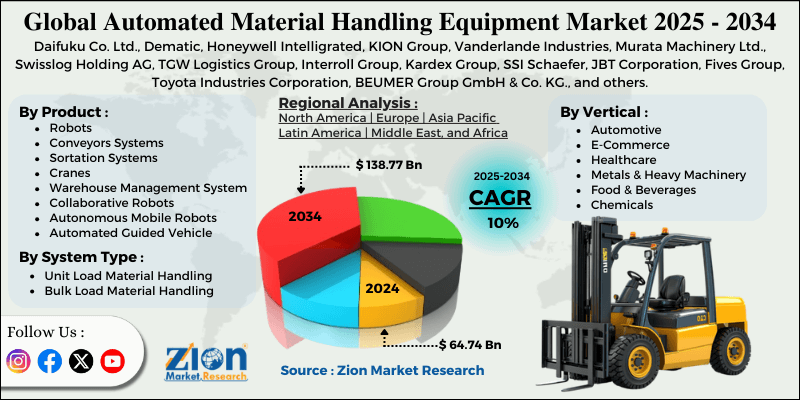
| Key Companies Covered | Daifuku Co. Ltd., Dematic, Honeywell Intelligrated, KION Group, Vanderlande Industries, Murata Machinery Ltd., Swisslog Holding AG, TGW Logistics Group, Interroll Group, Kardex Group, SSI Schaefer, JBT Corporation, Fives Group, Toyota Industries Corporation, BEUMER Group GmbH & Co. KG., and others. |
| Segments Covered | By Product, By System Type, By Vertical, and By Region |
| Regions Covered | North America, Europe, Asia Pacific (APAC), Latin America, Middle East, and Africa (MEA) |
| Base Year | 2024 |
| Historical Year | 2019 to 2023 |
| Forecast Year | 2025 - 2034 |
| Customization Scope | Avail customized purchase options to meet your exact research needs. Request For Customization |
Automated Material Handling Equipment Market: Segmentation
The global automated material handling equipment market is segmented based on product, system type, vertical, and region.
Why is the Automated Storage and Retrieval System (AS/RS) segment projected to dominate the automated material handling equipment market?
Based on product, the global automated material handling equipment industry is divided into robots, Automated Storage and Retrieval System (AS/RS), conveyor systems, sortation systems, cranes, Warehouse Management System (WMS), collaborative robots, Autonomous Mobile Robots (AMR), and Automated Guided Vehicle (AGV). The Automated Storage and Retrieval System (AS/RS) segment leads with 35% of the total market share. This share is backed by their maximized space utilization and automated, highly precise storage/retrieval. Their adoption is strong in large warehouses and manufacturing facilities where dense accuracy and storage are priorities.
Conversely, the robots segment ranks second with approximate 24% of the overall market. This is fueled by their versatility in packing, picking, palletizing, and other high-value jobs. Integration with machine vision and AI continues to drive their demand in production and logistics environments.
What factors help the Unit Load Material Handling segment lead the automated material handling equipment market?
Based on system type, the global automated material handling equipment market is segmented into unit-load and bulk-load material handling. The unit load material handling segment dominates with 61% of the total market. This is because it stores and moves standardized loads, such as containers and pallets. These systems are broadly used in distribution centers and warehouses to drive throughput and minimize handling time. Their leadership is linked to strong demand from the manufacturing and e-commerce industries.
However, the bulk load material handling segment holds the second-largest share, accounting for nearly 39-47% of the total market. It serves industries that handle granular, loose, or heavy materials, such as construction, chemicals, and mining. While smaller than unit-load systems, the segment remains crucial for continuous processing and movement of heavy materials.
What are the key reasons for the leadership of the E-Commerce segment in the automated material handling equipment market?
Based on vertical, the global market is segmented into automotive, semiconductor & electronics, e-commerce, healthcare, metals & heavy machinery, food & beverages, chemicals, 3PL, aviation, and others. The e-commerce segment captures 33% of the overall market, as online retailers automate sorting, storage, and fulfillment to handle large volumes quickly and efficiently. Its prominence signifies the heavy use of robotics, conveyors, and storage systems in high-volume distribution centers. This trend is driven by scalable logistics operations and consumer demand for faster delivery.
Nonetheless, the 3PL segment holds second position, with nearly 20% of the total market, as logistics providers adopt automation to serve a wider range of clients and enhance complex warehousing workflows. Automated material handling equipment helps 3PL companies improve inventory management, fulfillment accuracy, and cost efficiency across industries. The rise in outsourced logistics and contract warehousing further boosts the segment's dominance.
Automated Material Handling Equipment Market: Regional Analysis
What enables Asia Pacific's strong foothold in the Global Automated Material Handling Equipment Market?
Asia Pacific is likely to sustain its leadership in the automated material handling equipment market, with a 12-13% CAGR, driven by the rapid growth of retail and e-commerce, an expanding manufacturing and industrial base, and government initiatives and support for industrial automation. The Asia Pacific region dominates due to significant growth in modern retail and e-commerce, requiring efficient, fast distribution and warehousing systems. High-order volumes fuel demand for sorters, conveyors, automated storage solutions, and robotics. This adoption amplifies the deployment of AMHE in major urban centers.
Moreover, economies like India, Japan, and China have remarkably expanding manufacturing industries, producing automotive, electronics, and consumer goods. Automated material handling enhances production efficiency, reduces reliance on labor, and delivers consistent throughput in these high-volume sectors. Furthermore, regional governments support Industry 4.0 and the adoption of smart factories through policy support, grants, and incentives. These initiatives motivate companies to invest in automation technologies, including AMHE, driving regional market growth.
Why does North America rank second in the global Automated Material Handling Equipment Market?
North America continues to hold the second-highest share, with an 8-8.5% CAGR in the automated material handling equipment industry, owing to advanced technological adoption, a strong retail and e-commerce industry, and an established industrial and manufacturing base. North America leads APAC in the adoption of AMRs, AGVs, and AI-enabled warehouse systems. These technologies reduce errors, improve material flow, and enable real-time monitoring, thereby increasing operational efficiency.
Also, high-volume retail and e-commerce markets drive demand for automated fulfillment centers, conveyor systems, and sortation systems. AMHE helps meet fast delivery expectations while handling large order volumes proficiently. Additionally, diverse sectors such as aerospace, automotive, and electronics rely on AMHE to streamline internal logistics, maintain consistent throughput, and reduce manual handling in complex production environments.
Automated Material Handling Equipment Market: Competitive Analysis
The leading players in the global automated material handling equipment market are:
- Daifuku Co. Ltd.
- Dematic
- Honeywell Intelligrated
- KION Group
- Vanderlande Industries
- Murata Machinery Ltd.
- Swisslog Holding AG
- TGW Logistics Group
- Interroll Group
- Kardex Group
- SSI Schaefer
- JBT Corporation
- Fives Group
- Toyota Industries Corporation
- BEUMER Group GmbH & Co. KG.
What are the key trends in the global Automated Material Handling Equipment Market?
Integration of artificial intelligence & data analytics:
ML, AI, and advanced analytics are being embedded into AMHE systems to facilitate real-time decision-making, workflow optimization, and predictive maintenance. This enhances accuracy in storage allocation, picking, and demand forecasting. Data-driven automation surges throughput while dropping operational costs.
Cloud‑based & IoT‑enabled systems:
IoT sensors and cloud connectivity enable scalable system control, remote monitoring, and improved asset visibility in facilities. This trend backs centralized data dashboards and cross-site coordination in multi-warehouse operations. Cloud-native automated material handling equipment platforms reduce on-site IT pressure and fuel digital transformation.
The global automated material handling equipment market is segmented as follows:
By Product
- Robots
- Automated Storage and Retrieval System (AS/RS)
- Conveyors Systems
- Sortation Systems
- Cranes
- Warehouse Management System (WMS)
- Collaborative Robots
- Autonomous Mobile Robots (AMR)
- Automated Guided Vehicle (AGV)
By System Type
- Unit Load Material Handling
- Bulk Load Material Handling
By Vertical
- Automotive
- Semiconductor & Electronics
- E-Commerce
- Healthcare
- Metals & Heavy Machinery
- Food & Beverages
- Chemicals
- 3PL
- Aviation
- Others
By Region
- North America
- The U.S.
- Canada
- Europe
- France
- The UK
- Spain
- Germany
- Italy
- Rest of Europe
- Asia Pacific
- China
- Japan
- India
- South Korea
- Southeast Asia
- Rest of Asia Pacific
- Latin America
- Brazil
- Mexico
- Rest of Latin America
- Middle East & Africa
- GCC
- South Africa
- Rest of Middle East & Africa
Table Of Content
Methodology
FrequentlyAsked Questions
Which region will contribute notably towards the automated material handling equipment market value?

HappyClients

