
Arc Detector Market Size, Share, Value, Industry Trends 2034

Arc Detector Market By Product Type (Fixed Arc Detectors, Portable Arc Detectors), By Detection Technology (Optical, Acoustic, Thermal, Electromagnetic), By Application (Residential, Commercial, Industrial), By End-User (Utilities, Manufacturing, Construction, and Others), and By Region - Global and Regional Industry Overview, Market Intelligence, Comprehensive Analysis, Historical Data, and Forecasts 2024 - 2032
| Market Size in 2024 | Market Forecast in 2034 | CAGR (in %) | Base Year |
|---|---|---|---|
| USD 2.66 Billion | USD 4.69 Billion | 6.5% | 2024 |
Arc Detector Industry Prospective
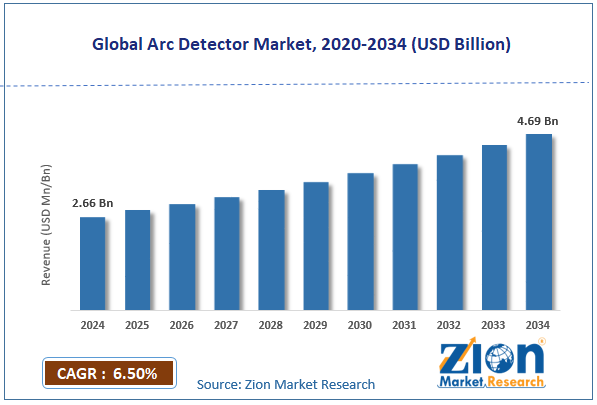
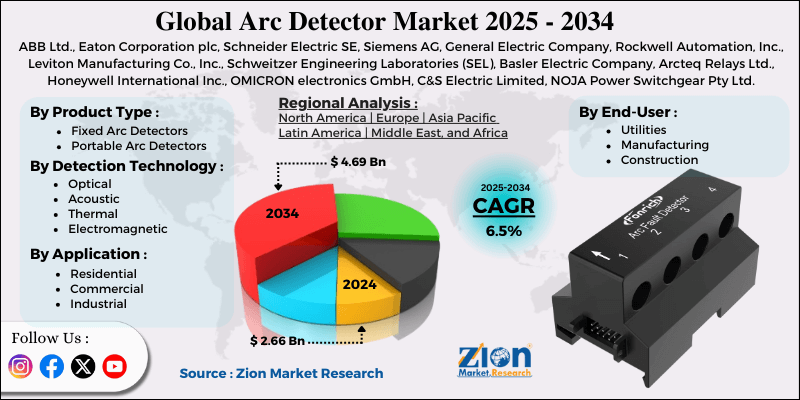
The global arc detector market size was worth around USD 2.66 billion in 2024 and is predicted to grow to around USD 4.69 billion by 2034, with a compound annual growth rate (CAGR) of roughly 6.5% between 2025 and 2034.
Key Insights
- As per the analysis shared by our research analyst, the global arc detector market is estimated to grow annually at a CAGR of around 6.5% over the forecast period (2025-2034)
- In terms of revenue, the global arc detector market size was valued at around USD 2.66 billion in 2024 and is projected to reach USD 4.69 billion by 2034.
- The arc detector market is projected to grow significantly owing to the rising industrial automation adoption, expansion of data centers, and aging electrical infrastructure upgrades.
- Based on product type, the fixed arc detectors segment is expected to lead the market, while the portable arc detectors segment is expected to grow considerably.
- Based on detection technology, the optical segment is the dominating segment, while the acoustic segment is projected to witness sizeable revenue over the forecast period.
- Based on application, the industrial segment leads the market, while the commercial segment is expected to grow considerably in the near future.
- Based on end-user, the utilities segment is expected to lead the market, followed by the manufacturing segment.
- By region, North America is projected to dominate the global market during the forecast period, followed by Europe.
Arc Detector Market: Overview
An ARC detector is a safety device used in electrical systems to detect dangerous electrical arcs, which are unintended high-current discharges that can damage equipment, cause fires, or result in power outages. It continuously monitors the electrical network for unique current and light signatures of an arc and swiftly sends a signal to protective devices, such as circuit breakers, to interrupt power, thereby preventing catastrophic failures. The global arc detector market is poised to expand rapidly, driven by rising electrical safety standards, the growth of industrial automation, and the expansion of power infrastructure. Strict safety regulations worldwide are driving industries to adopt arc detector systems. These devices efficiently protect equipment and personnel from harmful electrical arcs.
Compliance needs are fueling broader adoption in commercial and industrial markets. Moreover, automated manufacturing depends on continuous electrical systems to maintain productivity. Arc detectors monitor these systems to avoid equipment damage and downtime. Growing adoption of automation drives demand for reliable detection solutions. Furthermore, new power transmission and generation projects need modern protective solutions. Arc detectors swiftly identify glitches and avoid electrical mishaps in complex networks. Investment in power infrastructure augments the demand for detection systems.
Despite growth, the global market is impeded by factors such as technical complexity, false trigger concerns, and low awareness in developing markets. Designing and maintaining arc detectors requires specialized expertise. The lack of skilled personnel can slow deployment. Technical challenges limit broader adoption in some regions. Detectors may at times misinterpret non-fault events as arcs. False alarms disturb operations and decrease confidence in the system. These reliability issues hamper adoption by cautious buyers. Likewise, several developing regions underestimate the risk of arc flash events. Low awareness slows the adoption of protective technologies.
Educational gaps hamper industry expansion. Nonetheless, the global arc detector industry stands to gain from several key opportunities, including retrofit solutions for legacy systems, integration with predictive analytics, and expansion in the renewable energy sector. Affordable retrofit kits help traditional electrical systems to upgrade safely. Facilities can improve safety without a complete system replacement. Targeting legacy infrastructure offers notable industry potential. Blending detectors with AI allows predictive fault detection. Analytics help optimize maintenance and decrease unplanned outages. This integration offers a distinguished value proposition. Additionally, renewable plants require dedicated protection for distributed generation. Arc detectors protect wind, solar, and hybrid energy assets. Rise in renewable energy fuels industry opportunities.
Arc Detector Market Dynamics
Growth Drivers
How is escalating focus on electrical safety driving the arc detector market growth?
The growing number of electrical fires worldwide has underscored the importance of arc detection as a major safety solution. Reports predict electrical fire accidents growing in both industrial and residential settings, driving buyers toward arc detectors. Safety awareness campaigns and insurance incentives encourage the adoption of early fault-detection solutions. This elevated focus is driving the demand in offices, homes, and factories. Adoption is majorly strong where fire-prevention standards are tightening.
How are construction and infrastructure expansion significantly fueling the growth of the arc detector market?
Growing construction activity worldwide, particularly in North America and the Asia Pacific, is boosting demand for electrical safety systems. With millions of new commercial projects and residential units underway, arc detection features are increasingly being specified. This is notable in urban retrofit projects and infrastructure upgrades. Developers are steadily viewing advanced safety systems as value-adds. The result is steady growth in the arc detector market volume, driven by construction cycles.
Restraints
Dependence on power supply negatively impacts the industry’s progress
Arc detectors require stable, continuous electrical power to operate efficiently. Power variations, unstable grids, or outages can compromise performance, thereby negatively affecting reliability in some regions. Backup systems may mitigate this issue, but add complexity and cost. In regions with frequent voltage instability, users may be deterred from investing in such devices. Reliance on a stable power supply constrains industrial growth in regions with underdeveloped electrical infrastructure. Reliability concerns are still a key restraint in these markets.
Opportunities
How are strengthening safety regulations creating promising avenues for the arc detector industry’s growth?
Regulatory bodies and governments are constantly updating electrical safety codes to include arc detection needs. Compliance-driven adoption is highly prevalent in residential, industrial, and commercial projects. New mandates in both developing and developed markets are driving demand for certified arc detectors. Enforcement in critical sectors such as healthcare and public infrastructure is particularly effective. Regulatory expansion assures a steady base of mandated installations. This creates long-term stability and predictable growth in the arc detector industry.
Challenges
Rapid technological change restricts the market growth
Technological advancements in software, sensors, and smart integration make devices outmoded quickly. Buyers may delay purchases, fearing frequent upgrades or speedy depreciation. Legacy systems may struggle to support new device features. Manufacturers should continuously invest in R&D to stay ahead in the competition. Speedy evolution can create uncertainty for distributors and users. Staying at the forefront of technological trends is vital to sustaining industry relevance.
Arc Detector Market : Report Scope
| Report Attributes | Report Details |
|---|---|
| Report Name | Arc Detector Market Research Report |
| Market Size in 2024 | USD 2.66 Billion |
| Market Forecast in 2034 | USD 4.69 Billion |
| Growth Rate | CAGR of 6.5% |
| Number of Pages | 220 |
| Key Companies Covered | ABB Ltd., Eaton Corporation plc, Schneider Electric SE, Siemens AG, General Electric Company, Rockwell Automation, Inc., Leviton Manufacturing Co., Inc., Schweitzer Engineering Laboratories (SEL), Basler Electric Company, Arcteq Relays Ltd., Honeywell International Inc., OMICRON electronics GmbH, C&S Electric Limited, NOJA Power Switchgear Pty Ltd., and ZIV Automation |
| Segments Covered | By Product Type, By Detection Technology, By Application, By End-User And By Region |
| Regions Covered | North America, Europe, Asia Pacific (APAC), Latin America, The Middle East and Africa (MEA) |
| Base Year | 2024 |
| Historical Year | 2019 to 2023 |
| Forecast Year | 2025 - 2034 |
| Customization Scope | Avail customized purchase options to meet your exact research needs. Request For Customization |
Arc Detector Market: Segmentation
The global arc detector market is segmented based on product type, detection technology, application, end-user, and region.
Based on product type, the global arc detector industry is divided into fixed arc detectors and portable arc detectors. The fixed arc detector segment holds a 60-70% share of the worldwide market. They offer continuous and permanent monitoring in utility and industrial environments. Their integration ensures rapid fault detection and enhances safety. This makes them the ideal choice for long-term electrical protection.
Conversely, the portable arc detector segment registers a second-leading market share of 30-40%. This share is attributed to their ease of use and flexibility. They are suitable for temporary maintenance checks and monitoring. Their mobility makes them prominent in field-based or smaller applications.
Based on detection technology, the global market is segmented into optical, acoustic, thermal, and electromagnetic. The optical detectors segment registers a dominant share of 40-50%. They offer fast, accurate detection by sensing the light emitted during an arc. Their high sensitivity makes them broadly used in utility and industrial applications.
On the other hand, the acoustic detector segment ranks second in the market, with a 20-30% share. These detectors detect arcs through their distinct sound signatures. They are useful in areas with limited visual monitoring and complement optical systems effectively.
Based on application, the global arc detector market is segmented into residential, commercial, and industrial. The industrial segment is the leading segment, accounting for 55-65% of the market. This growth is driven by ongoing demand from power plants, factories, and manufacturing facilities. High-voltage equipment and complex electrical networks make these detectors important for safety and compliance.
Nonetheless, the commercial segment holds a second position with approximately 25-35% market share. The segment encompasses data centers, offices, and retail spaces. Arc detectors prevent equipment downtime and damage, supporting safe operations in medium-voltage environments.
Based on end-user, the global market is segmented into utilities, manufacturing, construction, and others. The utilities segment holds a leading position with a market share of 50-60%. This growth is attributed to the continuous demand from power generation and distribution companies to protect high-voltage networks. These systems are crucial for assuring safety and reliability in large-scale electrical infrastructure.
However, the manufacturing segment is the fastest-growing, holding a 25-35% market share. This is because industrial plants and factories use arc detectors to protect personnel and equipment. They avoid downtime and equipment damage, making them crucial in industrial operations.
Arc Detector Market: Regional Analysis
Why is North America outperforming other regions in the global Arc Detector Market?
North America is expected to remain a leading region in the global arc detector market due to strict regulatory compliance, advanced power and industrial infrastructure, and rapid technological adoption. North America holds a leading share because of strict electrical safety standards that require advanced arc detection. Companies adopt these systems to protect personnel and ensure regulatory compliance. This robust enforcement drives greater market adoption across industries. The region’s wide power networks and industrial facilities require reliable protection against arc faults. Manufacturing plants, utilities, and commercial buildings invest heavily in these detectors. This infrastructure complexity sustains North America’s industry leadership. The region quickly adopts novel technologies, including smart, IoT-enabled arc-detection systems. Early adoption by integrators and manufacturers amplifies innovation and deployment. This technological dominance strengthens the region’s rank in the worldwide market.
Europe ranks as the second-largest region in the global arc detector industry, driven by a strong regulatory framework, a well-developed utility and industrial sectors, and a focus on technological innovation. Europe maintains stringent workplace regulations and electrical safety standards, driving broader adoption of arc detection systems. Compliance with standards such as EN and IEC standards ensures worker safety and reduces electrical risks. This regulatory environment fuels constant demand in industries.
Moreover, Europe holds a sophisticated industrial base and well-established power infrastructure that needs reliable arc protection. The energy, manufacturing, and commercial sectors invest heavily in detectors to avoid downtime and damage. These investments sustain Europe’s remarkable industry share. Additionally, European nations focus on advanced electrical safety solutions and smart grid technologies. Manufacturers adopt modern arc detection systems incorporated with automation and IoT platforms. Early adoption and innovation strengthen the region’s rank as a fast-growing regional market.
Arc Detector Market: Competitive Analysis
The leading players in the global arc detector market are
- ABB Ltd
- Eaton Corporation plc
- Schneider Electric SE
- Siemens AG
- General Electric Company
- Rockwell Automation Inc
- Leviton Manufacturing Co Inc
- Schweitzer Engineering Laboratories (SEL)
- Basler Electric Company
- Arcteq Relays Ltd
- Honeywell International Inc
- OMICRON electronics GmbH
- C&S Electric Limited
- NOJA Power Switchgear Pty Ltd
- ZIV Automation
Arc Detector Market: Key Market Trends
Integration with smart grid and IoT
Arc detectors are steadily integrated with smart grid systems and IoT platforms for real-time monitoring. This allows predictive maintenance, faster fault detection, and remote diagnostics. This trend supports the development of safer and more efficient electrical infrastructure.
Growth in retrofit solutions for legacy systems
There is a growing demand for retrofit arc-detection kits to upgrade older electrical installations. These solutions allow facilities to improve safety without replacing existing infrastructure. Retrofits are popular in commercial and industrial applications.
The global arc detector market is segmented as follows:
By Product Type
- Fixed Arc Detectors
- Portable Arc Detectors
By Detection Technology
- Optical
- Acoustic
- Thermal
- Electromagnetic
By Application
- Residential
- Commercial
- Industrial
By End-User
- Utilities
- Manufacturing
- Construction
- Others
By Region
- North America
- The U.S.
- Canada
- Europe
- France
- The UK
- Spain
- Germany
- Italy
- Rest of Europe
- Asia Pacific
- China
- Japan
- India
- South Korea
- Southeast Asia
- Rest of Asia Pacific
- Latin America
- Brazil
- Mexico
- Rest of Latin America
- Middle East & Africa
- GCC
- South Africa
- Rest of Middle East & Africa
Table Of Content
Methodology
FrequentlyAsked Questions

HappyClients