
Allergy Diagnostics Market Size, Industry Share, Analysis, Growth Trends, 2032

Allergy Diagnostics Market Analysis by Product Type (Luminometers, Assay Kits, Immunoassay & ELISA Analyzers, and Services), by Allergen Type (Inhaled, Food, and Others), by End-User (Hospitals, Diagnostic Laboratories, Academic Research Institutes, and Others), and By Region: Global Industry Perspective, Comprehensive Analysis, and Forecast, 2024-2032
| Market Size in 2023 | Market Forecast in 2032 | CAGR (in %) | Base Year |
|---|---|---|---|
| USD 5.03 Billion | USD 13.24 Billion | 11.36% | 2023 |
What is the projected value for the Allergy Diagnostics Market during 2024 to 2032?
The global Allergy Diagnostics market size accrued earnings worth approximately USD 5.03 Billion in 2023 and is predicted to gain revenue of about USD 13.24 Billion by 2032, is set to record a CAGR of nearly 11.36% over the period from 2024 to 2032. The study includes drivers and restraints of the allergy diagnostics market along with the impact they have on the demand over the forecast period. Additionally, the report includes the study of opportunities available in the allergy diagnostics market on a global level.
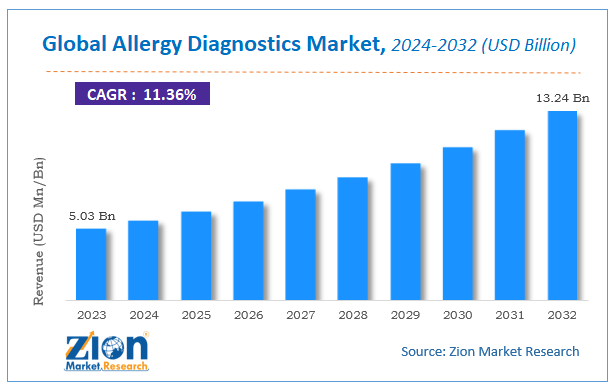
Global Allergy Diagnostics Market: Overview
In order to give the users of this report a comprehensive view of the allergy diagnostics market, we have included a competitive landscape and an analysis of Porter’s Five Forces Model for the market. The study encompasses a market attractiveness analysis, where all the segments are benchmarked based on their market size, growth rate, and general attractiveness.
An allergy is a hyperimmune response to certain products or substances. Allergies occur when a person’s immune system reacts to mild substances present in the environment. There are various different t
ypes of allergies, such as skin allergy, food allergy, dust allergy, pollen allergy, etc. These allergies can be fatal to a person under certain circumstances if left untreated. Various procedures that are used for allergy testing include blood tests, skin tests, etc., which helps healthcare professionals to provide treatment and instant relief to patients. Food allergy is caused due to the consumption of some proteins that may lead to discomfort and digestive problems. Drug allergy is caused due to the ingredients of some drugs that may reflect in the form of rashes, swelling, etc. These diagnostics help in the determination of allergic reactions and their treatment options. Some of the most commonly used diagnostics tests are intradermal, patch, prick, skin, and blood tests.
The major factor that contributes to the growth of the global allergy diagnostics market is the increased prevalence of allergy among people. As per Allergy UK 2015, around 20% of allergy patients live with a severe devastating form of their condition and fight with the distress of a most likely anaphylactic shock, asthma attack, or even death from an allergic reaction daily. Tremendous population rise is expected to increase allergic cases in the future. Furthermore, changing food habits, increasing geriatric population, favorable reimbursement scenario in developed economies, and rising awareness among people are expected to promote the global allergy diagnostics market. Moreover, increased healthcare expenditure and infrastructure coupled with changing lifestyles of people are also expected to boost the allergy diagnostic market globally over the forecast time period. On the other hand, various technological advancements are expected to create new growth opportunities for the growth of the allergy diagnostics market. However, the high cost and stringent regulatory approval process may inhibit the global allergy diagnostics market over the forecast time period.
The report provides company market share analysis to give a broader overview of the key players in the market. In addition, the report also covers key strategic developments of the market including acquisitions & mergers, new technology launch, agreements, partnerships, collaborations & joint ventures, R&D, technology, and regional expansion of major participants involved in the market on a global and regional basis. Moreover, the study covers price trend analysis and product portfolio of various companies according to regions.
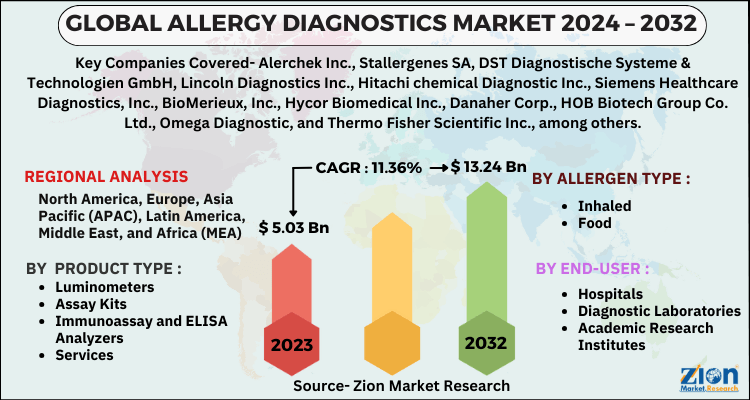
Allergy Diagnostics Market: Segmentation Analysis
The global allergy diagnostics market is categorized into product type, allergen type, and end-user.
By product type, the allergy diagnostics market is segmented into luminometers, assay kits, immunoassay and ELISA analyzers, and services. Assay kits are expected to dominate the market in the future.
By allergen type, the allergy diagnostics market is fragmented into inhaled, food, and others. Inhaled allergens are expected to dominate the allergy diagnostics market.
By end-user, the allergy diagnostics market is segmented into hospitals, diagnostic laboratories, academic research institutes, and others. The hospitals segment is expected to develop rapidly over the estimated timeframe.
Allergy Diagnostics Market: Regional Analysis
By region, North America is projected to lead the global allergy diagnostics market followed by Europe over the estimated timeframe. The Asia Pacific is expected to be the fastest developing region over the forecast period.
Allergy Diagnostics Market: Report Scope
| Report Attributes | Report Details |
|---|---|
| Report Name | Allergy Diagnostics Market |
| Market Size in 2023 | USD 5.03 Billion |
| Market Forecast in 2032 | USD 13.24 Billion |
| Growth Rate | CAGR of 11.36% |
| Number of Pages | 202 |
| Key Companies Covered | Alerchek Inc., Stallergenes SA, DST Diagnostische Systeme & Technologien GmbH, Lincoln Diagnostics Inc., Hitachi chemical Diagnostic Inc., Siemens Healthcare Diagnostics, Inc., BioMerieux, Inc., Hycor Biomedical Inc., Danaher Corp., HOB Biotech Group Co. Ltd., Omega Diagnostic, and Thermo Fisher Scientific Inc., among others |
| Segments Covered | By product type, By Allergen Type, By end-user and By Region |
| Regions Covered | North America, Europe, Asia Pacific (APAC), Latin America, Middle East, and Africa (MEA) |
| Base Year | 2023 |
| Historical Year | 2018 - 2022 |
| Forecast Year | 2024 - 2032 |
| Customization Scope | Avail customized purchase options to meet your exact research needs. Request For Customization |
Allergy Diagnostics Market: Competitive Players
Some major players of the global allergy diagnostics market are -
- Alerchek Inc.
- Stallergenes SA
- DST Diagnostische Systeme & Technologien GmbH
- Lincoln Diagnostics Inc.
- Hitachi chemical Diagnostic Inc.
- Siemens Healthcare Diagnostics
- BioMerieux
- Hycor Biomedical Inc.
- Danaher Corp.
- HOB Biotech Group Co. Ltd.
- Omega Diagnostic
- Thermo Fisher Scientific Inc.
- among others.
This report segments the global allergy diagnostics market into:
By Product Type
- Luminometers
- Assay Kits
- Immunoassay and ELISA Analyzers
- Services
By Allergen Type
- Inhaled
- Food
- Others
By End-User
- Hospitals
- Diagnostic Laboratories
- Academic Research Institutes
- Others
By Region
- North America
- The U.S.
- Canada
- Mexico
- Europe
- France
- The UK
- Spain
- Germany
- Italy
- Rest of Europe
- Asia Pacific
- China
- Japan
- India
- Australia
- South Korea
- Rest of Asia Pacific
- The Middle East & Africa
- Saudi Arabia
- UAE
- Egypt
- Kuwait
- South Africa
- Rest of the Middle East & Africa
- Latin America
- Brazil
- Argentina
- Rest of Latin America
Table Of Content
Methodology
FrequentlyAsked Questions
Allergy diagnostics identify allergic reactions through tests. They help determine allergy causes and guide treatment
The global Allergy Diagnostics market is expected to be driven by the increasing allergy prevalence, awareness of early diagnosis, and demand for accurate testing. Expansion of diagnostic labs and immunoassays supports growth..
According to study, the global Allergy Diagnostics market size was worth around USD 5.03 Billion in 2023 and is predicted to grow to around USD 13.24 Billion By 2032.
The global Allergy Diagnostics market is expected to grow at a Compound Annual Growth Rate (CAGR) of around CAGR 11.36% during the forecast period from 2024-2032.
The global Allergy Diagnostics industry is projected to be challenged by Challenges include test accuracy variability, reimbursement limitations, and need for skilled interpretation.
The Opportunities include rising allergy prevalence, demand for early diagnosis, advances in molecular diagnostics, and expansion of clinical testing labs will offer significant growth opportunities in the Allergy Diagnostics market.
Molecular and component-resolved diagnostics; rapid point-of-care testing; integration with digital allergy management platforms are the emerging trends and innovations impacting the Allergy Diagnostics market.
The global Allergy Diagnostics market is expected to be led by North America during the forecast period.
Some of the prominent players operating in the global Allergy Diagnostics market are; Alerchek Inc., Stallergenes SA, DST Diagnostische Systeme & Technologien GmbH, Lincoln Diagnostics Inc., Hitachi chemical Diagnostic Inc., Siemens Healthcare Diagnostics, Inc., BioMerieux, Inc., Hycor Biomedical Inc., Danaher Corp., HOB Biotech Group Co. Ltd., Omega Diagnostic, and Thermo Fisher Scientific Inc., among others and others.
The report explores crucial aspects of the Allergy Diagnostics market, including a detailed discussion of existing growth factors and restraints, while also browsing future growth opportunities and challenges that impact the market.

HappyClients