
Air Ambulance Services Market SIze, Share, Industry Trends 2034

Air Ambulance Services Market By Service Type (Medical Evacuation, Medical Repatriation, Organ Transport, Neonatal and Pediatric Transport, Disaster Response, and Others), By Aircraft Type (Helicopters, Fixed-Wing Aircraft), By End-User (Hospitals, Insurance Companies, Governments, Private Individuals, Military), By Application (Emergency Medical Services, Patient Transfer, Specialty Care Transport, Disaster Relief), and By Region - Global and Regional Industry Overview, Market Intelligence, Comprehensive Analysis, Historical Data, and Forecasts 2025 - 2034
| Market Size in 2024 | Market Forecast in 2034 | CAGR (in %) | Base Year |
|---|---|---|---|
| USD 17.42 Billion | USD 48.88 Billion | 10.92% | 2024 |
Air Ambulance Services Industry Prospective
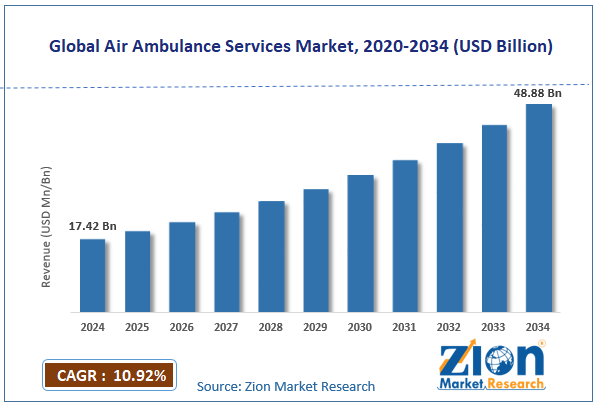
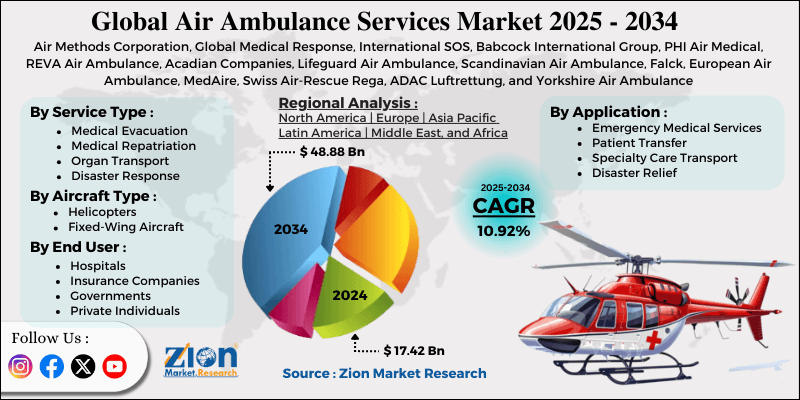
The global air ambulance services market size was worth approximately USD 17.42 billion in 2024 and is projected to grow to around USD 48.88 billion by 2034, with a compound annual growth rate (CAGR) of roughly 10.92% between 2025 and 2034.
Key Insights
- As per the analysis shared by our research analyst, the global air ambulance services market is estimated to grow annually at a CAGR of around 10.92% over the forecast period (2025-2034).
- In terms of revenue, the global air ambulance services market size was valued at approximately USD 17.42 billion in 2024 and is projected to reach USD 48.88 billion by 2034.
- The air ambulance services market is projected to grow significantly due to the rising geriatric population, increasing road accidents and trauma cases, growing demand for emergency medical services, expanding medical tourism, and improving healthcare infrastructure in developing regions.
- Based on service type, the medical evacuation segment is expected to lead the air ambulance services market, while the organ transport segment is anticipated to experience significant growth.
- Based on aircraft type, the helicopters segment is expected to lead the air ambulance services market, while the fixed-wing aircraft segment is anticipated to witness notable growth.
- Based on end-user, the hospitals segment is expected to lead the market compared to the insurance companies segment.
- Based on application, the emergency medical services segment is expected to lead the market during the forecast period.
- Based on region, North America is projected to dominate the global air ambulance services market during the estimated period, followed by Europe.
Air Ambulance Services Market: Overview
Air ambulance services are emergency medical transport systems that use helicopters and airplanes, equipped with lifesaving machines and trained medical teams to move patients with severe illness or injury during flight operations. These aircraft carry patients from accident scenes to trauma centers, transfer patients between hospitals for advanced care, evacuate travelers from remote regions, and transport organs for urgent transplant use. Helicopters operate over short distances and can reach sites without runways, landing on roads, open fields, or nearby areas when road traffic delays ground vehicles. Fixed-wing aircraft transport patients over long distances, providing greater space, equipment, and medical staff, and operate at higher altitudes to achieve smoother travel.
Onboard teams include paramedics, critical care nurses, respiratory therapists, and sometimes doctors. Equipment includes ventilators, heart monitors, infusion pumps, defibrillators, and suction systems. Rising age levels and fewer specialty hospitals increase the need for rapid air medical transport across wide regions. Insurance costs remain high, and coverage varies across policies and regions. The growing elderly population and increasing trauma cases are expected to drive growth in the air ambulance services market throughout the forecast period.
Air Ambulance Services Market Dynamics
Growth Drivers
How are aging populations and chronic disease prevalence driving the air ambulance services market expansion?
The air ambulance services industry is growing as global populations age and older adults face more medical emergencies needing rapid transport. Older adults suffer heart attacks, strokes, and severe falls more often, creating emergencies where quick access to advanced hospitals improves survival. Long-term illnesses like diabetes, heart failure, and lung disease raise risk during emergencies and create a need for close care during flight. Retirement communities and nursing homes in remote areas use air ambulances when residents face sudden illness beyond local clinic limits. Care for older patients during flight requires specialized equipment, stable medications, and trained crew members who support breathing, cardiac rhythm, and safe body movement. Stroke care requires hospital arrival within short time windows; air transport reduces travel time and enables patients to receive clot-removal treatment more quickly. More patients live at home with complex health needs, raising the risk of sudden decline and increasing demand for rapid air evacuation during a crisis.
Rising adventure tourism and remote location accessibility needs
The global air ambulance services market is growing as adventure travel rises and tourists visit remote areas with medical access. Mountain climbing, skiing, and trekking bring visitors to high altitudes where injury risk and altitude sickness create sudden medical emergencies. Diving accidents near remote islands need fast transport to pressure chambers available at a few coastal hospitals for decompression sickness treatment. Safari tourism across Africa, South America, and Asia moves travelers into wild regions where road travel takes hours or days. Cruise ship emergencies at sea exceed onboard care levels and require helicopter evacuation to shore hospitals during long ocean journeys. Oil rigs, mining sites, and remote projects depend on air evacuation after injuries because ground transport is slow or unsafe. International travelers request air medical transport home after illness when access to foreign healthcare feels uncertain due to cost or language barriers.
Restraints
How are high costs and insurance coverage gaps creating key restraints for the air ambulance services market?
The air ambulance services industry faces major problems, as very high prices and weak insurance support create heavy financial stress. Typical air ambulance flights cost between $20,000 and $50,000, depending on the distance and the patient's care needs. Out-of-network billing leads insurers to pay only part of the charges, while patients receive balance bills reaching huge amounts. Rural flights cost more due to longer travel distances and fuel use, raising price gaps for low-income communities in need. Price clarity remains poor, as families learn of charges weeks after emergency flights, with no time for review or choices. Government payment rates remain far below operating cost levels for providers, pushing higher charges toward private insurance users across many regions. Membership plans and travel insurance often exclude air evacuation support, leaving travelers exposed during cross-border medical emergencies in remote areas.
Opportunities
Growing organ transplant procedures and logistics requirements
The air ambulance services market shows a strong opportunity as organ transplants increase and urgent organ movement creates a constant need for rapid air travel. Heart delivery needs under four hours and lung delivery under six hours, so air travel is essential for long-distance hospital routes. Organ networks coordinate donation work across wide regions and depend on air crews to move teams and organs between hospitals fast. Living donor surgery often involves two hospitals at once and requires fast organ movement between sites within narrow safe time limits. Special transport boxes control temperature and fluid levels, while trained medical staff protect organ condition during flight from donor to recipient. Single donors often support several recipients in different cities, so crews must plan many flights under strict pressure. Fewer transplant hospitals increase travel distance between donors and recipients, raising the regular need for air ambulance support across regions.
Challenges
How is addressing pilot shortages and regulatory compliance challenges for the air ambulance services market?
The air ambulance services market faces staff shortages among pilots and medical crews, while strict rules raise costs and limit capacity. Pilot shortages across aviation affect air medical flights since special training needs, night duties, and risky weather reduce job appeal. Medical crews face tough hiring because long shifts, flight stress, and close spaces add heavy physical and mental strain daily. Training costs stay high because crews need medical skills plus flight safety licenses, creating large investments lost during staff changes. Irregular duty hours, including night calls, extended standby periods, and weather delays, make it harder for flight teams to balance personal lives. Safety rules require constant checks, rest periods, paperwork, and aircraft maintenance, which reduce daily flight limits during emergency-demand cycles. Rural bases struggle with crew housing, aircraft service, high insurance fees, and aging equipment repairs during low call volume periods.
Air Ambulance Services Market : Report Scope
| Report Attributes | Report Details |
|---|---|
| Report Name | Air Ambulance Services Market Research Report |
| Market Size in 2024 | USD 17.42 Billion |
| Market Forecast in 2034 | USD 48.88 Billion |
| Growth Rate | CAGR of 10.92% |
| Number of Pages | 220 |
| Key Companies Covered | Air Methods Corporation, Global Medical Response, International SOS, Babcock International Group, PHI Air Medical, REVA Air Ambulance, Acadian Companies, Lifeguard Air Ambulance, Scandinavian Air Ambulance, Falck, European Air Ambulance, MedAire, Swiss Air-Rescue Rega, ADAC Luftrettung, and Yorkshire Air Ambulance |
| Segments Covered | By Service Type, By Aircraft Type, By End User, By Application, And By Region |
| Regions Covered | North America, Europe, Asia Pacific (APAC), Latin America, The Middle East and Africa (MEA) |
| Base Year | 2024 |
| Historical Year | 2019 to 2023 |
| Forecast Year | 2025 - 2034 |
| Customization Scope | Avail customized purchase options to meet your exact research needs. Request For Customization |
Air Ambulance Services Market: Segmentation
The global air ambulance services market is segmented based on service type, aircraft type, service model, end-user, application, and region.
Based on service type, the air ambulance services industry is divided into medical evacuation, medical repatriation, organ transport, neonatal and pediatric transport, disaster response, and others. Medical evacuation leads the market due to the critical nature of emergency situations requiring immediate hospital access and time-sensitive treatment, which justify premium air transport costs.
Based on aircraft type, the industry is segmented into helicopters and fixed-wing aircraft. Helicopters lead the market due to their ability to land at accident scenes and hospital helipads, shorter response times for local emergencies, and their versatility in accessing remote or congested areas where fixed-wing aircraft cannot operate.
Based on end user, the air ambulance services market is categorized into hospitals, insurance companies, governments, private individuals, and the military. Hospitals hold the largest market share due to their frequent need to transfer patients between facilities and their responsibility for arranging emergency transport for critically ill patients.
Based on application, the market is segregated into emergency medical services, patient transfer, specialty care transport, and disaster relief. Emergency medical services hold the largest market share due to the high volume of trauma cases and critical medical emergencies requiring rapid hospital access, the time-sensitive nature of emergency care, and public expectations for immediate response to life-threatening situations.
Air Ambulance Services Market: Regional Analysis
North America leads due to infrastructure and insurance coverage
North America accounted for an estimated 38 percent market share in 2025, supported by high utilization across rural and urban regions. North America leads the air ambulance services market due to strong helicopter fleets, long travel distances, and well-organized emergency medical response systems. The United States runs the largest air ambulance fleet with many helicopters and aircraft placed at bases across wide regions. Rural communities across North America depend on air ambulances for fast access to trauma centers and specialty hospitals located far away. Highway rescue teams use helicopters along major routes to move crash victims quickly to trauma centers during critical early treatment hours. Public and private insurance programs support many air ambulance flights each year, even as billing rules lead to frequent payment disputes. Hospital closures in small towns raise travel distance for emergency care and increase dependence on air transport for time-sensitive cases.
Regional trauma systems guide patient movement based on injury level, using air transport to reach hospitals with proper surgical ability. National parks and mountainous areas frequently require rescue missions in which hikers and skiers are evacuated by helicopter from locations without road access. Oil and gas sites in distant regions rely on air medical contracts for quick worker evacuation after serious industrial accidents. High medical costs encourage air transfers to lower-cost facilities or to advanced specialists unavailable in local centers. Operators in North America invest heavily in modern navigation tools, safety systems, and medical devices, improving flight accuracy and patient care. Large service networks, trained crews, and advanced aircraft allow the region to manage high emergency demand across cities, highways, oceans, and remote lands. Training programs for pilots and medical crews support fast response times and steady service quality.
What is driving Europe's steady growth in the air ambulance services market?
Europe accounted for an estimated 29 percent market share in 2025, supported by a rising cross-border medical transport demand across the region. Europe shows steady growth in the air ambulance services market as emergency systems expand helicopter coverage, and cross-border medical transport rises with tourism. Mountain rescue teams in the Alps, Pyrenees, and Scandinavian ranges run year-round helicopter services for ski injuries, hiking accidents, and avalanche rescues. Island regions and coastal areas rely on helicopters to transport patients from remote islands to mainland hospitals, serving tourists and local residents. Highway rescue units place helicopters along major motorways for fast response to crashes and transfer to trauma centers across borders. Government health systems fund most air ambulance operations, so access stays equal for patients without concern for personal payment. European Union health rules support cross-border emergency flights so patients can reach the nearest suitable hospitals without delay.
Medical tourism adds demand as international patients arrive for treatment and sometimes require emergency air transfer or safe return home. Rural regions in the Nordic areas, Scotland, and Eastern Europe rely on helicopters because nearby hospitals cannot support advanced emergency care. Offshore wind farms and oil platforms depend on helicopter rescue for worker injury support in seas without practical road access. Refugee movements and humanitarian missions at borders create an occasional need for rapid air evacuation from temporary medical camps. Disaster planning across Europe includes helicopter fleets for mass-casualty incidents, major accidents, and rapid patient transport. Strong links between airports, hospitals, and emergency teams support air medical response across cities, mountains, islands, and zones.
Recent Developments
- In June 2025, Norwegian Air Ambulance signed a frame contract with Airbus to acquire up to eight H145 helicopters, including two confirmed deliveries, as part of a fleet modernization program.
- In May 2025, RapidSOS announced a partnership with Global Medical Response (GMR) to integrate emergency call systems so air ambulance requests can launch in under a minute instead of the typical ten minutes.
Air Ambulance Services Market: Competitive Analysis
The leading players in the global air ambulance services market are
- Air Methods Corporation
- Global Medical Response
- International SOS
- Babcock International Group
- PHI Air Medical
- REVA Air Ambulance
- Acadian Companies
- Lifeguard Air Ambulance
- Scandinavian Air Ambulance
- Falck
- European Air Ambulance
- MedAire
- Swiss Air-Rescue Rega
- ADAC Luftrettung
- Yorkshire Air Ambulance.
The air ambulance services market is segmented as follows:
By Service Type
- Medical Evacuation
- Medical Repatriation
- Organ Transport
- Neonatal and Pediatric Transport
- Disaster Response
- Others
By Aircraft Type
- Helicopters
- Fixed-Wing Aircraft
By End User
- Hospitals
- Insurance Companies
- Governments
- Private Individuals
- Military
By Application
- Emergency Medical Services
- Patient Transfer
- Specialty Care Transport
- Disaster Relief
By Region
- North America
- The U.S.
- Canada
- Europe
- France
- The UK
- Spain
- Germany
- Italy
- Rest of Europe
- Asia Pacific
- China
- Japan
- India
- South Korea
- Southeast Asia
- Rest of Asia Pacific
- Latin America
- Brazil
- Mexico
- Rest of Latin America
- Middle East & Africa
- GCC
- South Africa
- Rest of Middle East & Africa
Table Of Content
Methodology
FrequentlyAsked Questions

HappyClients

