
Al Observability Solutions Market Size, Share, Trends, Growth and Forecast 2034

Al Observability Solutions Market By Component (Solutions and Services), By Deployment Mode (Cloud, Hybrid, and On-Premises), By Enterprise Size (Large Enterprises and Small & Medium Enterprises (SMEs)), By Observability Type (Model Observability, Infrastructure Observability, Data Observability, End-to-End AI Pipeline Observability, and Application Observability), By Application (Model Performance Monitoring, AI Security Monitoring, LLM & Agent Monitoring, Prompt Monitoring, Drift Detection, Root Cause Analysis, Compliance & Governance, and Predictive Analytics), By End-use Industry (Banking, Financial Services & Insurance (BFSI), Manufacturing, Retail & E-commerce, Healthcare & Life Sciences, Automotive & Transportation, Government & Public Sector, IT & Telecommunications, Energy & Utilities, Media & Entertainment, and Others), and By Region - Global and Regional Industry Overview, Market Intelligence, Comprehensive Analysis, Historical Data, and Forecasts 2026 - 2034
| Market Size in 2025 | Market Forecast in 2034 | CAGR (in %) | Base Year |
|---|---|---|---|
| USD 1.8 Billion | USD 13.7 Billion | 22.5% | 2025 |
Al Observability Solutions Industry Perspective:
What will be the size of the global Al observability solutions market during the forecast period?
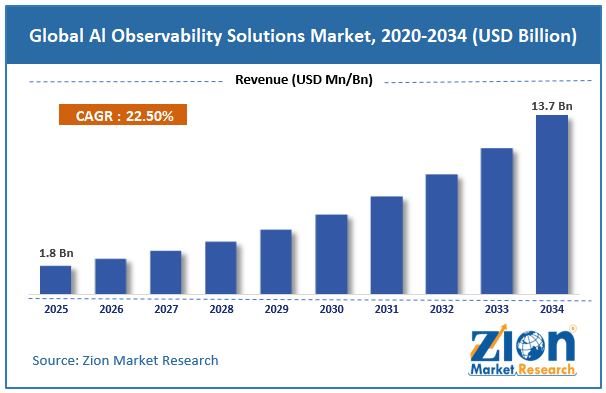
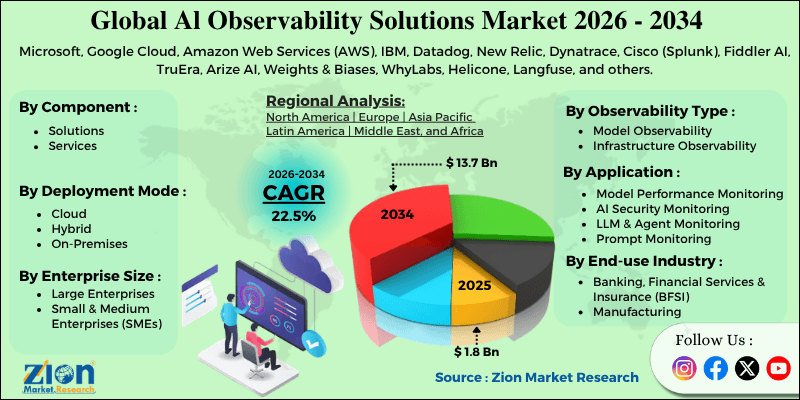
The global Al observability solutions market size was worth around USD 1.8 billion in 2025 and is predicted to grow to around USD 13.7 billion by 2034, with a compound annual growth rate (CAGR) of roughly 22.5% between 2026 and 2034.
Al Observability Solutions Market: Overview
AI observability solutions are tools designed to provide continuous insights into the health, performance, reliability, and activity of artificial intelligence (AI) and machine learning (ML) models throughout their lifecycles. They help track, monitor, analyze, and correlate data related to AI models, data pipelines, infrastructure, applications, and interactions to detect problems such as model drift, data drift, performance degradation, bias, hallucinations, latency, and system failures.
Key Insights
- As per the analysis shared by our research analyst, the global Al observability solutions market is estimated to grow annually at a CAGR of around 22.5% over the forecast period (2026-2034).
- In terms of revenue, the global Al observability solutions market size was valued at around USD 1.8 billion in 2025 and is projected to reach USD 13.7 billion by 2034.
- Increasing focus on AI governance, risk management, and compliance is expected to propel the AI observability solutions market over the projected period.
- Based on the component, the solutions segment held the largest market share in 2025.
- Based on the deployment mode, the on-premises segment held a prominent market share in 2025.
- Based on the enterprise size, the large enterprises dominate the market.
- Based on the observability type, model observability is estimated to be the market leader in terms of revenue in the AI observability solutions market.
- Based on the application, the model performance monitoring segment held the largest revenue share in 2025.
- Based on the end-use industry, the BFSI segment held the largest revenue share in 2025.
- Based on region, North America dominates the market.
Impact of the USA-Israel War on Iran on the Al Observability Solutions Market
The USA-Israel conflict in Iran has had a moderately positive influence on the AI observability solutions market, driven by the growing need for safe, consistent, and stable AI systems across private companies and government institutions. The elevated geopolitical risk led to a rapid increase in cyberattacks targeting government entities, banks, the energy sector, hospitals, and telecommunications operators, thereby driving the adoption of AI-based cybersecurity and threat-prevention systems. As companies use more and more AI algorithms in mission-critical settings, the need for observability solutions has become even more significant, as they must monitor AI model performance, spot deviations, prevent drift, ensure model explainability, and protect against attacks.
At the same time, the rise in AI governance, compliance, and operational resilience measures drives increased investment in observability tools. On the other hand, there are negative impacts of the conflict as well, such as rising infrastructure and energy costs, supply chain disruptions, and enterprise IT conservatism, leading to postponed software deployment projects. Nevertheless, the long-term prospects remain quite favorable for the growth of the AI observability solutions market, despite economic uncertainty caused by geopolitical tensions.
Al Observability Solutions Market: Dynamics
Growth Drivers
Why does the rapid adoption of generative AI and Large Language Models (LLMs) drive the AI observability solutions market?
The rapid adoption of Generative AI and LLMs fuels the AI observability solutions market, driven by the need to continuously monitor the performance, reliability, security, and behavior of ever-evolving AI systems operating in production. Unlike software products, LLMs generate inconsistent results, experience hallucinations, produce biased output, suffer from prompt injection attacks, degrade performance, etc., depending on changes in users' requests and the information they receive. The use of AI observability solutions enables enterprises to monitor prompts, responses, token consumption, latency, model drift, accuracy, and resource consumption, and to identify anomalies and root causes.
In addition, these platforms allow companies to implement AI governance, explainability, compliance management, and automated alerts, thereby ensuring trust in technology, minimizing operational risks, and improving the performance of AI systems. With the increasing integration of generative AI across customer service, software development processes, healthcare, banking, retail, and other sectors, demand for comprehensive AI observability solutions will continue to rise.
Restraints
High implementation and integration costs hamper the growth of the Al observability solutions industry
The high costs of implementing and integrating AI observability solutions pose an obstacle to the development of the AI observability solutions market, as companies, especially SMEs, struggle to adapt to new technology due to these costs. Implementing an AI observability solution is quite costly for organizations, as it requires significant investments in licenses, cloud services, storage, monitoring, and integrating AI, MLOps, DevOps, and IT. In some cases, the company is required to incur costs for customization and training to ensure the smooth operation of solutions within its hybrid or multi-cloud environment. The integration of observability solutions with legacy infrastructure and various AI models increases the complexity, time, and cost of implementation.
Opportunities
Why does the introduction of a new product offer a lucrative opportunity for the Al observability solutions market?
The introduction of a new product is expected to offer a potential opportunity for the AI observability solutions market over the projected period. For instance, in September 2025, Observability firm Honeycomb announced the release of Honeycomb Intelligence, an AI-native observability suite built with developers in mind. New AI-native products help developers debug their code and ship faster by embedding observability in the IDE, investigate problems with a real co-pilot, and automatically spot performance issues. Combining the speed of Honeycomb's proprietary database with the ability to instantly access terabytes of contextual data gives every developer insight into their systems without compromising speed.
Despite the rapid acceleration of software delivery driven by AI and the growing complexity of distributed architecture systems, most observability solutions still face challenges such as latency, siloed data, and increasing costs. Developers work in AI-powered IDEs today and expect collaboration and instant access to their data. Honeycomb Intelligence solves that problem by offering teams a collaborative assistant that can provide sub-second query responses from a billion events – the performance required for real-time AI-powered assistance. Honeycomb's event-based approach ensures that AI improves as the people and systems grow more complex.
Challenges
How does the shortage of skilled AI and MLOps professionals pose a significant challenge to the AI observability solutions market?
One of the main obstacles to the development of the AI observability solutions market is a lack of skilled experts in AI and MLOps, as implementing and maintaining observability platforms requires knowledge of machine learning, data engineering, cloud technologies, MLOps, DevOps, and AI governance. Companies need experienced specialists who can set up monitoring systems, analyze model performance metrics, identify data and model drift, debug AI infrastructure, and optimize model reliability. The limited number of such specialists makes the implementation process more complicated, time-consuming, and costly. Moreover, many companies face difficulties integrating monitoring tools into their existing AI pipelines to generate valuable insights from vast amounts of telemetry and model data.
Al Observability Solutions Market: Report Scope
| Report Attributes | Report Details |
|---|---|
| Report Name | Al Observability Solutions Market |
| Market Size in 2025 | USD 1.8 Billion |
| Market Forecast in 2034 | USD 13.7 Billion |
| Growth Rate | CAGR of 22.5% |
| Number of Pages | 226 |
| Key Companies Covered | Microsoft, Google Cloud, Amazon Web Services (AWS), IBM, Datadog, New Relic, Dynatrace, Cisco (Splunk), Fiddler AI, TruEra, Arize AI, Weights & Biases, WhyLabs, Helicone, Langfuse, and others. |
| Segments Covered | By Component, By Deployment Mode, By Enterprise Size, By Observability Type, By Application, By End-use Industry, and By Region |
| Regions Covered | North America, Europe, Asia Pacific (APAC), Latin America, Middle East, and Africa (MEA) |
| Base Year | 2025 |
| Historical Year | 2020 - 2024 |
| Forecast Year | 2026 - 2034 |
| Customization Scope | Avail customized purchase options to meet your exact research needs. Request For Customization |
Al Observability Solutions Market: Segmentation
Component Insights
Why does the solutions segment hold a prominent position in the Al observability solutions market?
The solutions segment held the largest share of the AI observability solutions market in 2025 and is expected to maintain this trend over the projected period. The solution is to develop software platforms that enable real-time monitoring, tracing, and analysis of AI systems. The platforms will help identify performance bottlenecks, anomalies, and transparency issues in AI and machine learning (ML) across distributed systems. This will help improve decision-making, efficiency, and the reliability of digital systems.
Deployment Mode Insights
How does the on-premises segment capture the largest share in the Al observability solutions market?
The on-premises segment held a prominent share of the AI observability solutions industry in 2025. The reasons for the growth include rising demand for improved data security, compliance, and total control over the infrastructure used to develop AI systems. Companies in heavily regulated industries, including finance and banking, healthcare, government agencies, the defense industry, telecommunications, and critical infrastructure, tend to choose on-premises AI observability solutions to ensure that their data, AI models, and operational logs remain under their own control.
Enterprise Size Insights
Does the large enterprises segment capture the largest market share in the AI observability solutions market?
The large enterprises dominate the AI observability solutions market. This growth can be attributed to the rapid adoption of AI, machine learning, and generative AI in large businesses. These businesses have very complex ecosystems that involve various models, large amounts of data, hybrid or multi-cloud infrastructure, and mission-critical applications, creating a compelling case for adopting AI observability. Large enterprises are spending considerable sums on monitoring model performance, detecting data drift, managing LLM observability and explainability, implementing AI governance, and enabling automated incident management. These enterprises have the financial and technical capabilities to adopt an AI observability platform that integrates well with MLOps, DevOps, and cloud infrastructure.
Observability Type Insights
How does the model observability segment capture the largest market share in the Al observability solutions market?
Model observability is estimated to be the leader, in terms of revenue, in the AI Observability Solutions Market, owing to its crucial role in ensuring the accuracy, reliability, and performance of deployed AI and ML models. Due to the increasing use of predictive AI and generative AI in different sectors like banking, healthcare, retail, manufacturing, telecommunications, and automotive, there is a growing requirement to ensure monitoring of the accuracy of model performance, inference latency, prediction quality, model drift, bias, and overall performance of the model. This is enabled by model observability solutions that help identify problems and conduct root-cause analysis to ensure timely model retraining, which helps achieve consistent business results. The increasing complexity of AI models, the growing use of Large Language Models (LLMs), the need for transparent and reliable AI, and the rise of MLOps are other factors further fueling the adoption of model observability solutions.
Application Insights
Why does the model performance monitoring segment capture the largest share in the Al Observability Solutions market?
The model performance monitoring segment held the largest revenue share in 2025. This growth can be attributed to the growing usage of artificial intelligence, machine learning, and generative AI models in live production settings. In sectors ranging from financial institutions to health care, retail stores, manufacturing, telecommunications, and automobiles, companies depend on AI technology for mission-critical functions and thus need continuous monitoring of the accuracy, predictions, latency, throughput, and reliability of their models. Monitoring tools help detect model drift, data drift, performance drops, and other anomalies.
End-use Industry Insights
Why does the BFSI segment capture the largest market share in the Al Observability Solutions market?
The BFSI segment held the largest revenue share in 2025. The reason behind this growth lies in the rapid adoption of AI systems to detect fraud, evaluate credit risk, support anti-money laundering (AML) efforts, provide customer service, enable algorithmic trading, underwrite insurance products, process claims, and offer personalized financial products. The finance industry operates in complex, mission-critical environments where AI models must always deliver reliable results. AI observability tools help continuously monitor model performance, data drift, bias, inference times, and regulatory compliance through explainability, auditing, and anomaly detection.
Regional Insights
Why does North America lead the Al observability solutions market?
It is anticipated that North America will be the top revenue generator in the AI observability solutions market, owing to the widespread use of artificial intelligence, machine learning, and generative AI across industries such as banking, healthcare, retail, manufacturing, telecommunications, and government. There is significant use of AI technologies and cloud services, resulting in the fast deployment of large-scale, production-level applications. For this reason, there is a high demand for AI observability solutions, as organizations require model performance monitoring, LLM observability, data drift monitoring, AI governance, explainability, and security monitoring.
Al Observability Solutions Market: Competitive Analysis
The global Al observability solutions market is dominated by players like:
- Microsoft
- Google Cloud
- Amazon Web Services (AWS)
- IBM
- Datadog
- New Relic
- Dynatrace
- Cisco (Splunk)
- Fiddler AI
- TruEra
- Arize AI
- Weights & Biases
- WhyLabs
- Helicone
- Langfuse
The global Al observability solutions market is segmented as follows:
By Component
- Solutions
- Services
By Deployment Mode
- Cloud
- Hybrid
- On-Premises
By Enterprise Size
- Large Enterprises
- Small & Medium Enterprises (SMEs)
By Observability Type
- Model Observability
- Infrastructure Observability
- Data Observability
- End-to-End AI Pipeline Observability
- Application Observability
By Application
- Model Performance Monitoring
- AI Security Monitoring
- LLM & Agent Monitoring
- Prompt Monitoring
- Drift Detection
- Root Cause Analysis
- Compliance & Governance
- Predictive Analytics
By End-use Industry
- Banking, Financial Services & Insurance (BFSI)
- Manufacturing
- Retail & E-commerce
- Healthcare & Life Sciences
- Automotive & Transportation
- Government & Public Sector
- IT & Telecommunications
- Energy & Utilities
- Media & Entertainment
- Others
By Region
- North America
- The U.S.
- Canada
- Mexico
- Europe
- France
- The UK
- Spain
- Germany
- Italy
- Rest of Europe
- Asia Pacific
- China
- Japan
- India
- Australia
- South Korea
- Rest of Asia Pacific
- The Middle East & Africa
- Saudi Arabia
- UAE
- Egypt
- Kuwait
- South Africa
- Rest of the Middle East & Africa
- Latin America
- Brazil
- Argentina
- Rest of Latin America
Table Of Content
Methodology
FrequentlyAsked Questions
AI observability solutions are tools designed to provide continuous insight into the health, performance, reliability, and activity of artificial intelligence (AI) and machine learning (ML) models throughout their lifecycles. They help track, monitor, analyze, and correlate data related to AI models, data pipelines, infrastructure, applications, and interactions to detect problems such as model drift, data drift, performance degradation, bias, hallucinations, latency, and system failures.
The AI Observability Solutions Market is primarily driven by the rapid adoption of generative AI and Large Language Models (LLMs) across enterprises, which has increased the need to continuously monitor AI model performance, accuracy, latency, hallucinations, and overall reliability in production environments. As organizations expand AI deployments for mission-critical applications, demand is growing for solutions that detect model drift, data drift, anomalies, and performance degradation in real time. Rising emphasis on AI governance, explainability, regulatory compliance, and responsible AI is further accelerating the adoption of observability platforms that provide audit trails, bias detection, and root-cause analysis.
The major challenges restraining the AI observability solutions market include high implementation and integration costs, which can make adoption difficult, particularly for small and medium-sized enterprises (SMEs). Organizations often face significant expenses related to software licensing, cloud infrastructure, system integration, customization, and ongoing maintenance.
Based on the application, the model performance monitoring segment is expected to dominate the Al observability solutions market growth during the projected period.
One of the most significant trends is the rapid rise of generative AI and Large Language Model (LLM) observability, with enterprises adopting specialized tools to monitor prompts, responses, token usage, hallucinations, latency, and model quality in real time.
According to the report, the global Al observability solutions market size was worth around USD 1.8 billion in 2025 and is predicted to grow to around USD 13.7 billion by 2034.
The global Al observability solutions market is expected to grow at a CAGR of 22.5% during the forecast period.
The global Al observability solutions industry growth is expected to be led by North America over the forecast period.
The global Al observability solutions market is dominated by players like Microsoft, Google Cloud, Amazon Web Services (AWS), IBM, Datadog, New Relic, Dynatrace, Cisco (Splunk), Fiddler AI, TruEra, Arize AI, Weights & Biases, WhyLabs, Helicone, and Langfuse, among others.
The AI observability solutions market report covers the geographical market along with a comprehensive competitive landscape analysis. It also includes cash flow analysis, profit ratio analysis, market basket analysis, market attractiveness analysis, sentiment analysis, PESTLE analysis, trend analysis, SWOT analysis, trade area analysis, demand & supply analysis, Porter’s five forces analysis, and value chain analysis.

HappyClients

