
AI-Enabled Biometric Market Size, Share, Growth, Opportunities 2034

AI-Enabled Biometric Market By Type (Facial Recognition Systems, Fingerprint Recognition Systems, Iris and Retina Recognition Systems, Voice Recognition Systems), By Application (Banking and Financial Services, Government and Public Security, Healthcare Patient Identification, Consumer Electronics and Smartphones), By Deployment Mode (Cloud-based Biometric Systems, On Premise Biometric Systems, Hybrid Biometric Systems, Edge-based Biometric Systems), By End-User (Government Agencies, Banking and Financial Institutions, Healthcare Providers, Corporate Enterprises), and By Region - Global and Regional Industry Overview, Market Intelligence, Comprehensive Analysis, Historical Data, and Forecasts 2026 - 2034
| Market Size in 2025 | Market Forecast in 2034 | CAGR (in %) | Base Year |
|---|---|---|---|
| USD 43.7 Billion | USD 112.70 Billion | 11.10% | 2025 |
AI-enabled Biometric Industry Perspective:
What will be the size of the AI-enabled biometric market during the forecast period?
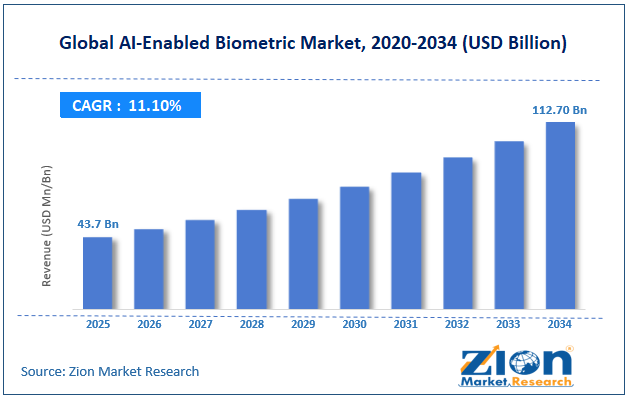
The global AI-enabled biometric market size was valued at approximately USD 43.7 billion in 2025 and is projected to reach around USD 112.70 billion by 2034, growing at a compound annual growth rate of approximately 11.10% between 2026 and 2034.
Key Insights
- As per the analysis shared by our research team, the global AI-enabled biometric market is estimated to grow at a compound annual growth rate of approximately 11.10% during the forecast period from 2026 to 2034.
- In terms of revenue, the global AI-enabled biometric market was valued at approximately USD 43.7 billion in 2025 and is projected to reach USD 112.70 billion by 2034.
- The AI-enabled biometric market is expected to grow strongly due to rising security concerns, increasing digital payment adoption, growing demand for contactless verification, and expanding use of artificial intelligence in identity management.
- Based on type, facial recognition systems lead the market because of their widespread use in smartphones and public security applications, while iris and retina recognition systems are gaining strong momentum as one of the fastest-growing types for high-security environments.
- Based on application, banking and financial services lead the market due to rising demand for secure, convenient customer authentication. At the same time, healthcare patient identification is the fastest-growing segment as hospitals adopt biometric systems to reduce medical record errors.
- Based on deployment mode, cloud-based biometric systems lead the market due to lower upfront costs and easier scalability, while edge-based biometric systems are steadily growing as organizations seek faster processing with reduced data privacy concerns.
- Based on end-user, government agencies lead the market due to large-scale national identification and border security programs, while corporate enterprises are growing rapidly as more companies adopt biometric access control for offices and devices.
- Based on region, North America leads the global AI-enabled biometric market, while Asia Pacific is the fastest-growing region due to rapid digital transformation and expanding government identification programs.
AI-enabled Biometric Market: Overview
AI-enabled biometrics are identity verification systems that use artificial intelligence to recognize a person through unique features such as fingerprints, facial features, voice, iris patterns, or palm prints. AI technology allows these systems to learn from data and improve identification even when factors such as lighting, age, or appearance change. This makes them useful in airports, banks, hospitals, government offices, workplaces, and other locations where secure identity checks are important. The AI-enabled biometric market is expanding as organizations seek faster, more reliable alternatives to passwords, PINs, and physical ID cards. Smartphones, banking applications, access control systems, and border security platforms are increasingly using biometric identification. Growing concerns about identity theft, online fraud, and unauthorized access are also increasing demand for stronger security.
Cloud-based biometric platforms are also helping organizations manage identity verification across multiple locations and digital services. The growing use of multimodal biometrics, which combines features such as face and fingerprint recognition, is improving identification reliability. The growing adoption of contactless authentication is making biometric technology more convenient for everyday users.
The AI-enabled biometric industry continues to expand as technology developers, security agencies, and enterprises work together to build faster, safer, and more accurate identity verification systems worldwide.
AI-enabled Biometric Market: Strategic Perspective
Where is the AI-enabled biometric market heading?
The AI-enabled biometric market is expected to evolve toward smarter, faster, and more adaptable identity systems that can work across smartphones, payment platforms, airports, healthcare facilities, and workplaces. Greater use of behavioral signals, continuous authentication, edge computing, and privacy-focused technology could make biometric verification more seamless while reducing reliance on passwords and physical identification.
Where should businesses invest in the AI-enabled biometric market?
The AI-enabled biometric market offers promising investment opportunities in liveness detection, biometric payment systems, cloud-based authentication, digital identity platforms, and privacy-enhancing technologies. Companies that can develop solutions for remote onboarding, secure digital transactions, and large-scale government identity programs may benefit as organizations move more services online.
What will reshape competition in the AI-enabled biometric market?
Competition in the AI-enabled biometric market is likely to be shaped by system reliability, deployment speed, privacy protection, and the ability to integrate with existing digital platforms. Providers that deliver easy-to-use solutions, meet different regional data requirements, and maintain strong cybersecurity are likely to gain an advantage.
AI-enabled Biometric Market: Technology Roadmap 2026–2034
What is the projected development roadmap of the AI-enabled biometric market over the forecast period?
The AI-enabled biometric market is advancing through improved machine learning models, more precise anti-spoofing detection, expanded cloud infrastructure, and growing use of multimodal verification, making identity systems more secure and reliable for organizations and individuals. The market is expected to grow at a compound annual growth rate of approximately 11.10% over the forecast period, driven by accelerating digital adoption, developing data protection standards, and continuous refinement of biometric recognition technology.
The following roadmap outlines key development phases expected through 2034.
2026–2028: Accuracy, Privacy and Infrastructure Advancement Phase
- Improved recognition capabilities: Developers are expected to strengthen facial, fingerprint, iris, and voice recognition so systems can work more reliably across different environments and user conditions.
- Privacy-first development: Companies are likely to introduce stronger consent controls, encrypted biometric storage, and privacy-focused system designs as governments tighten rules around personal identity data.
- Greater cloud adoption: Cloud-based biometric platforms are expected to become more common, allowing banks, healthcare providers, retailers, and government agencies to deploy identity verification without maintaining extensive on-site infrastructure.
2029–2031: Multimodal Security and Commercial Expansion Phase
- Multimodal authentication growth: Organizations are expected to combine facial, fingerprint, voice, and iris recognition to provide stronger identity checks when a single biometric method is insufficient.
- Edge processing adoption: More biometric processing is expected to move directly onto smartphones, access devices, and security terminals, reducing response times and limiting the need to transfer sensitive information.
- Expansion into everyday services: Biometric verification is expected to spread further into digital banking, healthcare access, travel, workplace systems, and online customer onboarding as users become more comfortable with password-free authentication.
2032–2034: Intelligent and Continuous Identity Phase
- Continuous authentication: Systems are expected to verify users throughout a session by analyzing behavioral signals, reducing the need for repeated login checks.
- Advanced fraud prevention: AI models are likely to identify unusual identity patterns and suspicious behavior earlier, helping financial institutions and digital platforms prevent fraudulent activity.
- Decentralized identity integration: Biometric technology may increasingly connect with digital wallets and decentralized identity systems, giving users greater control over how they share and verify their identity information.
AI-enabled Biometric Market: Dynamics
Growth Drivers
What is driving the expansion of the AI-enabled biometric market across digital identity applications?
The AI-enabled biometric market is expanding as digital services require faster, more reliable identity checks. Financial institutions use facial and fingerprint recognition to strengthen account security, while airports and border agencies adopt automated identification to speed passenger processing. Smartphone manufacturers are also making biometric unlocking a standard feature, increasing everyday exposure to the technology. Advances in liveness detection are helping systems identify fake faces, recordings, and other attempts to bypass security. Growing use of remote banking, digital government services, and online account verification is creating additional demand. At the same time, improvements in AI models are helping biometric systems work more accurately across different environments and user conditions. The rise of password-free authentication is encouraging businesses to integrate biometrics into digital platforms and customer services. The growing adoption of cloud-based identity solutions is also enabling organizations to deploy biometric verification across multiple locations more efficiently. These developments are moving biometrics beyond traditional security applications and supporting wider adoption in banking, travel, healthcare, consumer electronics, and public services. These developments are moving biometrics beyond traditional security applications and supporting wider adoption in banking, travel, healthcare, consumer electronics, and public services.
Cloud-based authentication is creating fresh opportunities in the AI-enabled biometric market.
The AI-enabled biometric market is gaining opportunities as more people shift to digital identity platforms that let them verify themselves remotely. Banks can use biometric checks during account opening, healthcare providers can confirm patient identities, and businesses can use biometric access for employees and visitors. Mobile applications are also combining facial recognition, fingerprints, and voice verification with digital wallets and payment services. Developers are focusing on multimodal systems that combine several biometric features to improve reliability when one method is difficult to use. Cloud-based biometric services are further helping organizations deploy identity verification without building large technology systems themselves. National digital identity programs and expanding e-government services are creating large-scale applications for biometric technology. These developments are broadening biometrics' role from physical access control to remote identity management and supporting long-term growth across the public and private sectors.
Restraints
How are privacy and compliance concerns affecting the AI-enabled biometric market?
The AI-enabled biometric industry faces challenges related to privacy, public acceptance, and the difficulty of managing sensitive identity information. Biometric data such as faces, fingerprints, and iris patterns cannot be easily replaced if compromised, making data protection especially important. Different countries also have different privacy and consent rules, creating additional compliance work for companies operating internationally. Some users remain concerned about facial recognition, surveillance, and how their personal information is collected or stored. AI systems may also produce inaccurate results when training data does not properly represent different age groups, skin tones, or other user characteristics. Organizations need skilled professionals to manage algorithms, cybersecurity, and regulatory requirements, which can increase operating costs. In some developing markets, limited digital infrastructure may also restrict deployment. Improving privacy controls, using diverse training data, increasing transparency, and developing stronger industry standards can help address these concerns and support responsible growth in the AI-enabled biometric market.
Opportunities
Will broader adoption create new opportunities for the AI-enabled biometric market?
The AI-enabled biometric market is growing as digital identity use expands across banking, healthcare, travel, government services, and online platforms. Banks use biometric verification for secure account access and digital payments, while hospitals use it to identify patients and improve medical record accuracy. Airports and border agencies are adopting facial recognition to speed passenger processing and strengthen security. Smartphone manufacturers are also expanding fingerprint and facial recognition features, making biometrics part of everyday digital life. Multimodal systems combining facial, fingerprint, iris, and voice recognition are creating more reliable identification solutions. Growing use of digital wallets, remote customer verification, and government identity programs is opening additional applications. Companies developing stronger anti-spoofing technology, privacy-focused solutions, and easy-to-integrate biometric software can benefit from these trends. The expansion of biometric authentication in connected devices is creating opportunities for wearable technology and smart access systems. Growing investment in digital identity infrastructure is also supporting wider deployment. Rising demand for secure, password-free authentication is expected to support growth across financial services, healthcare, travel, government, retail, and consumer technology.
Challenges
Data privacy concerns are creating challenges for the AI-enabled biometric market.
The AI-enabled biometric market faces challenges related to public trust, data protection, and recognition accuracy. Biometric information such as facial images, fingerprints, and iris patterns is highly sensitive and cannot be replaced easily if compromised. Public concerns about surveillance and the use of facial recognition in public areas may also affect acceptance. Biometric systems can sometimes produce inaccurate results because of poor image quality, changing environments, or limited training data, which can reduce user confidence. Companies operating across different countries must also manage varying privacy, consent, and data storage requirements. Protecting large biometric databases from cyberattacks requires strong security systems and continuous monitoring.
A shortage of professionals with expertise in AI, cybersecurity, and biometric technology can further increase development and operating costs. Improving recognition accuracy, strengthening privacy controls, using diverse training data, and following transparent data practices can help address these barriers and support responsible growth in the global AI-enabled biometric market.
AI-Enabled Biometric Market: Report Scope
| Report Attributes | Report Details |
|---|---|
| Report Name | AI-Enabled Biometric Market |
| Market Size in 2025 | USD 43.7 Billion |
| Market Forecast in 2034 | USD 112.70 Billion |
| Growth Rate | CAGR of 11.10% |
| Number of Pages | 228 |
| Key Companies Covered | NEC Corporation, Idemia, Thales Group, Fujitsu Limited, Aware Inc., Suprema Inc., Precise Biometrics, Cognitec Systems, BIO-key International, Innovatrics, and others. |
| Segments Covered | By Type, By Application, By Deployment Mode, By End User, and By Region |
| Regions Covered | North America, Europe, Asia Pacific (APAC), Latin America, Middle East, and Africa (MEA) |
| Base Year | 2025 |
| Historical Year | 2020 - 2024 |
| Forecast Year | 2026 - 2034 |
| Customization Scope | Avail customized purchase options to meet your exact research needs. Request For Customization |
AI-enabled Biometric Market: Segmentation
The global AI-enabled biometric market is segmented by type, application, deployment mode, end-user, and region.
What makes facial recognition systems the dominant type in the AI-enabled biometric market?
Based on type, the global AI-enabled biometric market is segregated into facial, fingerprint, iris and retina, and voice recognition systems. Facial recognition systems hold about 38% of the market share, leading due to their widespread integration into smartphones, security cameras, and public identification systems. Iris and retina recognition systems hold around 23% market share. They are the fastest-growing segment because of their exceptional accuracy in high-security government and defense applications.
How does the banking and financial services application maintain its leading position in the AI-enabled biometric market?
Based on application, the AI-enabled biometric industry is divided into banking and financial services, government and public security, healthcare patient identification, and consumer electronics and smartphones. Banking and financial services account for approximately 34% of the global market share, driven by rising demand for secure customer authentication in digital banking and mobile payment platforms. Healthcare patient identification holds around 20% market share. It is the fastest-growing segment due to expanding use of biometric verification to reduce medical errors and prevent insurance fraud.
What makes cloud-based biometric systems the dominant deployment mode in the AI-enabled biometric market?
Based on deployment mode, the market is classified into cloud-based, on-premises, hybrid, and edge-based biometric systems. Cloud-based biometric systems lead with about a 43% share because of lower upfront infrastructure costs and the ability to scale easily across multiple locations. Edge-based biometric systems hold around 21% market share. They are growing steadily as organizations prioritize faster local processing and reduced dependence on internet connectivity.
How does the government agency end-user shape the demand landscape of the AI-enabled biometric market?
Based on end-user, the AI-enabled biometric market is categorized into government agencies, banking and financial institutions, healthcare providers, and corporate enterprises. Government agencies account for about 36% of the market, leading because of large-scale national identification, border control, and law enforcement programs. Corporate enterprises hold around 24% market share. This segment is expanding quickly as more companies adopt biometric access control for office security and device authentication.
AI-enabled Biometric Market: Regional Analysis
Why is North America leading the global AI-enabled biometric market?
North America holds a 35.92% global share in the AI-enabled biometric market and is expected to maintain its leading position during the forecast period. The region benefits from strong adoption of advanced identity technologies across banking, airports, healthcare, retail, and public services. The United States is a major contributor because technology companies, financial institutions, and government agencies are actively using facial recognition, fingerprint scanning, and digital identity systems. Large investments in artificial intelligence research are helping improve biometric accuracy and fraud detection. Banks use biometric authentication to secure mobile transactions, while airports are introducing automated identity checks to speed up passenger processing. Healthcare organizations are also exploring biometric patient identification to reduce duplicate records and improve access to medical information. Growing use of smartphones and digital wallets is making biometric authentication familiar to consumers. The region’s mature technology ecosystem also gives companies easier access to software developers, cloud infrastructure, and specialized security solutions.
Growing demand for secure remote identity verification is encouraging businesses to adopt biometric tools for online customer onboarding and digital account access. Strong cybersecurity spending and continued investment in digital identity infrastructure are further supporting regional adoption. Increasing demand for password-free access and stronger identity protection is expected to keep North America at the forefront of the AI-enabled biometric market during the forecast period.
What makes Asia Pacific the fastest-growing region in the AI-enabled biometric market?
The Asia Pacific AI-enabled biometric market is the fastest-growing regional market and is expected to grow at a CAGR of 9.24% during the forecast period. Rapid digitalization, expanding mobile services, and the development of cashless economies are driving regional growth. China and India are major contributors, with large populations creating demand for scalable digital identity and authentication systems. Biometric technology is increasingly used for mobile payments, SIM registration, banking access, government services, and workplace security. Airports and transportation systems are also adopting automated identity checks to manage growing passenger volumes. In countries such as Japan and South Korea, advanced consumer electronics are helping introduce facial and fingerprint authentication into everyday products. Government digital identity programs are creating another major use case by linking biometric verification to public services.
Local technology companies are also offering lower-cost solutions, making the technology more accessible to smaller businesses. Growing e-commerce activity and wider smartphone connectivity are further encouraging secure biometric verification for online transactions and account access. Rising investment in smart cities, digital banking, and cybersecurity infrastructure is also creating new opportunities for biometric technology providers across the region. As smartphone ownership, digital payments, online services, and smart-city projects continue to expand, Asia Pacific is expected to record strong growth in the AI-enabled biometric market.
Recent Market Developments
- In March 2026, NEC Corporation announced that its facial recognition technology ranked first in the latest NIST Face Recognition Technology Evaluation, highlighting improved accuracy for large-scale biometric identification applications.
AI-enabled Biometric Market: Competitive Analysis
The leading players in the global AI-enabled biometric market are:
- NEC Corporation
- Idemia
- Thales Group
- Fujitsu Limited
- Aware Inc.
- Suprema Inc.
- Precise Biometrics
- Cognitec Systems
- BIO-key International
- Innovatrics
The global AI-enabled biometric market is segmented as follows:
By Type
- Facial Recognition Systems
- Fingerprint Recognition Systems
- Iris and Retina Recognition Systems
- Voice Recognition Systems
By Application
- Banking and Financial Services
- Government and Public Security
- Healthcare Patient Identification
- Consumer Electronics and Smartphones
By Deployment Mode
- Cloud-Based Biometric Systems
- On-Premise Biometric Systems
- Hybrid Biometric Systems
- Edge-Based Biometric Systems
By End User
- Government Agencies
- Banking and Financial Institutions
- Healthcare Providers
- Corporate Enterprises
By Region
- North America
- The U.S.
- Canada
- Mexico
- Europe
- France
- The UK
- Spain
- Germany
- Italy
- Rest of Europe
- Asia Pacific
- China
- Japan
- India
- Australia
- South Korea
- Rest of Asia Pacific
- The Middle East & Africa
- Saudi Arabia
- UAE
- Egypt
- Kuwait
- South Africa
- Rest of the Middle East & Africa
- Latin America
- Brazil
- Argentina
- Rest of Latin America
Table Of Content
Methodology
FrequentlyAsked Questions
AI-enabled biometrics are identity verification systems that use artificial intelligence to recognize a person through unique features such as fingerprints, facial features, voice, iris patterns, or palm prints.
The global AI-enabled biometric market is expected to grow due to rising security concerns, increasing digital payment adoption, growing demand for contactless verification, and expanding use of artificial intelligence in identity management worldwide.
According to research, the global AI-enabled biometric market was valued at approximately USD 43.7 billion in 2025 and is projected to reach approximately USD 112.70 billion by 2034.
The compound annual growth rate of the AI-enabled biometric market is expected to be approximately 11.10% from 2026 to 2034.
North America is expected to lead the global AI-enabled biometric market throughout the forecast period, driven by advanced technology infrastructure, strong research investment, and widespread adoption of digital security solutions.
The major players in the global AI-enabled biometric market include NEC Corporation, Idemia, Thales Group, Fujitsu Limited, Aware Inc, Suprema Inc, Precise Biometrics, Cognitec Systems, BIO-key International, and Innovatrics.
The report examines key aspects of the AI-enabled biometric market, including research and development drivers, adoption barriers, application opportunities, competitive landscape dynamics, detailed regional market performance analysis, and a comprehensive forward-looking outlook across all major types, applications, deployment modes, end-user segments, and geographic regions through 2034.
Stricter data privacy laws, consent requirements, and cybersecurity rules are shaping the AI-enabled biometric market. Governments are also demanding stronger protection of sensitive biometric information, encouraging companies to improve data security and transparency.
Banking, digital payments, airports, border security, healthcare, smartphones, and workplace access will offer strong opportunities in the AI-enabled biometric market. Growing demand for quick, secure, and contactless identity verification is driving adoption across these sectors.
AI-powered facial recognition, multimodal biometrics, anti-spoofing technology, and real-time identity verification are key trends shaping the AI-enabled biometric market. Integration with smartphones, digital identity platforms, and contactless payment systems is also expanding its everyday use.

List of Contents
AI-enabled BiometricIndustry Perspective:Key InsightsAI-enabled Biometric OverviewAI-enabled Biometric Strategic PerspectiveAI-enabled Biometric Technology Roadmap 20262034AI-enabled Biometric DynamicsReport ScopeAI-enabled Biometric SegmentationAI-enabled Biometric Regional AnalysisRecent Market DevelopmentsAI-enabled Biometric Competitive AnalysisThe global AI-enabled biometric market is segmented as follows:HappyClients