
Value Based Healthcare Market Size, Growth, Global Trends, Forecast 2034

Value Based Healthcare Market By Payment Model (Shared Savings/Risk Models, Bundled Payments, and Pay-for-Performance (P4P)), By Care Delivery Model (Integrated Care Systems, Patient-Centered Medical Homes (PCMH), and Accountable Care Organizations (ACOs), By Outcome (Cost-Efficiency Metrics, Patient Reported Outcomes, and Clinical Outcomes-Based), and By Region - Global and Regional Industry Overview, Market Intelligence, Comprehensive Analysis, Historical Data, and Forecasts 2025 - 2034
| Market Size in 2024 | Market Forecast in 2034 | CAGR (in %) | Base Year |
|---|---|---|---|
| USD 4.52 Billion | USD 12.48 Billion | 11.75% | 2024 |
Value Based Healthcare Industry Perspective:
What is the anticipated size of the value based healthcare market during the projection period?
The global value based healthcare market size was worth around USD 4.52 billion in 2024 and is predicted to grow to around USD 12.48 billion by 2034 with a compound annual growth rate (CAGR) of roughly 11.75% between 2025 and 2034.
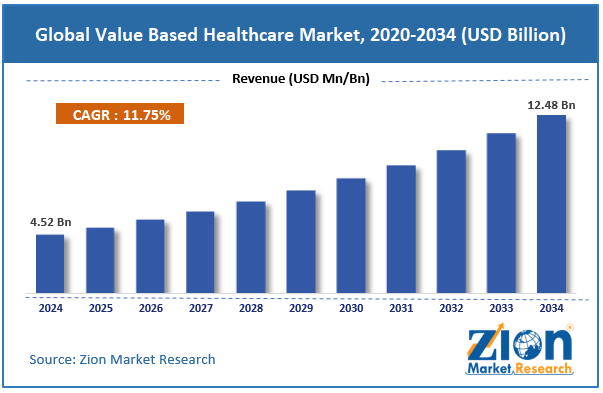
Value Based Healthcare Market: Overview
Value based healthcare refers to the process in Medicare where healthcare professionals focus on delivering high-quality care. It focuses on the patient experience and provider performance. Value-based healthcare is designed around the care parameter that a patient values the most. A common example of value-based healthcare includes coordinating blood work to ensure that the patient only has to visit the clinic once. During the forecast period, demand for value-based healthcare is projected to grow due to government policies and a favorable regulatory environment.
In addition, rising healthcare costs and higher demand for preventive medicine will further drive industry revenue. However, lack of awareness, limited infrastructure, and high initial cost will impact business revenue in the long run.
Key Insights:
- As per the analysis shared by our research analyst, the global value based healthcare market is estimated to grow annually at a CAGR of around 11.75% over the forecast period (2025-2034)
- In terms of revenue, the global value based healthcare market size was valued at around USD 4.52 billion in 2024 and is projected to reach USD 12.48 billion by 2034.
- The market is projected to grow at a significant rate to benefit from the introduction of favorable government policies.
- Based on the payment model, the bundled payments segment will dominate the global market, as per industry projections.
- Based on the care delivery model, the integrated care systems segment is anticipated to command the largest market share.
- Based on the outcome, the patient-reported outcomes segment is expected to lead the market growth trends.
- Based on region, North America is projected to dominate the global market during the forecast period.
Impact of the USA-Israel and Iran war on the Value Based Healthcare Market:
The USA-Israel and Iran war is projected to affect value based healthcare industry due to growing economic volatility worldwide. Global markets have become uncertain and unpredictable. This can lead to diminished healthcare funding and higher operational costs at medical care facilities. In the long run, the war is anticipated to influence resource optimization and cost-efficient models to ensure sustained growth.
Value Based Healthcare Market: Dynamics
Growth Drivers
How will favorable government policies support the expansion of the value based healthcare market?
The global value based healthcare market is projected to benefit from the introduction of favorable government policies. Several countries have launched new schemes and policies that offer incentives to healthcare agencies depending on the quality of care. For instance, in 2023, the Indian government launched novel schemes such as Ayushman Bharat, which focuses on the expansion of access to healthcare. It also promotes increased investments for healthcare infrastructure and digital medical care architecture. The core principle of these schemes is incentivizing health outcomes.
In December 2025, the European Commission proposed an ambitious package aimed at improving the health of European citizens while also promoting competitiveness and long-term resilience of the regional healthcare sector.
Rising demand for preventive care and prevalence of chronic conditions to support market growth trends
There is a rising focus on preventive care and a surge in the number of patients suffering from chronic conditions. The solutions in the global value-based healthcare market focus on early detection, which is an integral part of preventive care. Furthermore, long-term chronic conditions such as diabetes and hypertension have proven to be well-managed by value-oriented healthcare solutions, as these tools help reduce hospitalization risk. During the forecast period, the preventive care industry is projected to reach over USD 800 billion, resulting in growth opportunities for value-based healthcare providers.
Restraints
Why will the lack of supportive infrastructure limit the expansion of the value based healthcare market?
The global value based healthcare industry is anticipated to be restricted due to a lack of ancillary infrastructure. Value-based Medicare can be delivered only through integrated channels, which include digitization of the existing healthcare architecture. Furthermore, it encourages the use of care coordination systems between clinics, hospitals, and specialists. However, the absence of sufficient robust IT systems and a skilled workforce will create growth limitations.
Opportunities
Introduction of novel technologies enhancing value-based care will generate new growth opportunities
The global value-based healthcare market is powered by recent technologies such as big data analytics, Artificial Intelligence (AI) & Machine Learning (ML), electronic health records (EHR), and telemedicine, among others. Introduction of new-age technologies and supportive value-based healthcare will further accelerate market growth trends. In April 2026, Evergreen Nephrology, a leading provider of value-based models for kidney care, announced a partnership with Phamily. The latter is an AI-powered proactive care management platform. The collaboration will promote Evergreen's extensive experience working with nephrologists and Phamily's advanced AI capabilities to deliver enhanced care.
In February 2026, Optum, a healthcare services and technology company, launched Value Connect. This AI-powered platform is designed to help providers and payers operationalize value-based care models by combining financial, operational, and clinical data into a single system.
Challenges
How will cost barriers challenge growth in the value based healthcare industry?
The global value based healthcare industry is projected to be challenged by cost barriers. The development and implementation of value-based healthcare technologies requires extensive initial investment. Operational expenses further contribute to the higher cost of technology ownership, thus preventing wider global adoption.
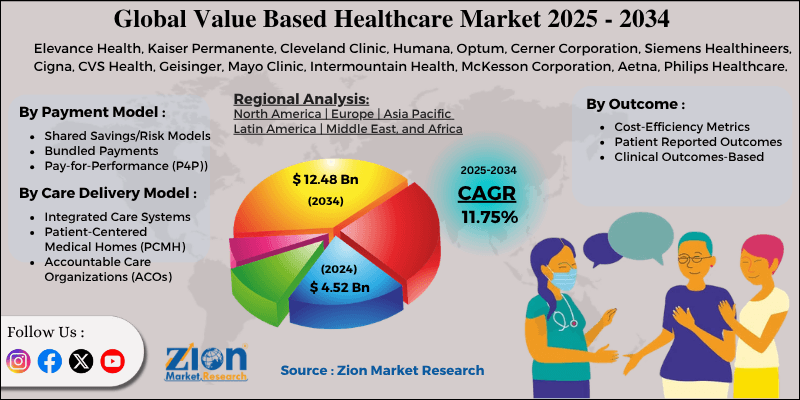
Value Based Healthcare Market: Report Scope
| Report Attributes | Report Details |
|---|---|
| Report Name | Value Based Healthcare Market |
| Market Size in 2024 | USD 4.52 Billion |
| Market Forecast in 2034 | USD 12.48 Billion |
| Growth Rate | CAGR of 11.75% |
| Number of Pages | 227 |
| Key Companies Covered | Elevance Health, Kaiser Permanente, Cleveland Clinic, Humana, Optum, Cerner Corporation, Siemens Healthineers, Cigna, CVS Health, Geisinger, Mayo Clinic, Intermountain Health, McKesson Corporation, Aetna, Philips Healthcare, and others. |
| Segments Covered | By Payment Model, By Care Delivery Model, By Outcome, and By Region |
| Regions Covered | North America, Europe, Asia Pacific (APAC), Latin America, Middle East, and Africa (MEA) |
| Base Year | 2024 |
| Historical Year | 2019 - 2023 |
| Forecast Year | 2025 - 2034 |
| Customization Scope | Avail customized purchase options to meet your exact research needs. Request For Customization |
Value Based Healthcare Market: Segmentation
The global value based healthcare market is segmented based on payment model, care delivery model, outcome, and region.
Why will the bundled payments segment lead the value based healthcare industry revenue during the forecast period?
Based on payment models, the global market segments are shared savings/risk models, bundled payments, and pay-for-performance (P4P). In 2024, the highest growth was listed in the shared savings/risk models segment. It accounted for 70% of the global revenue. During the forecast period, bundled payments are projected to emerge as the fastest-growing segment with a CAGR of 11% due to demand for simple, cost-effective, and quality-focused processes in value-based healthcare.
Which will be the fastest-growing delivery model during the forecast period in the value based healthcare market?
Based on the care delivery model, the global value based healthcare industry is divided into integrated care systems, patient-centered medical homes (PCMH), and accountable care organizations (ACOs). In 2024, the market was dominated by the accountable care organization (ACOs) segment, contributing up to 51% of the global revenue. In the coming years, integrated care systems are projected to grow at a faster CAGR of 14.1% since these technologies facilitate effective end-to-end medical treatment.
How is the patient-reported outcomes segment expected to shape the value based healthcare industry during the projection period?
Based on outcome, the global market divisions are cost-efficiency metrics, patient-reported outcomes, and clinical outcomes-based. During the forecast period, the patient-reported outcomes segment is projected to deliver a higher CAGR of 13.9% as modern healthcare shifts toward patient-centered policies. In 2024, the segment dominated 25% of the global revenue but will emerge as the leading revenue generator in the coming years.
Value Based Healthcare Market: Regional Analysis
Why will North America lead the value based healthcare market?
The global value based healthcare market is projected to be led by North America during the forecast period. In 2024, the region accounted for 45% of the global revenue and is expected to grow at a CAGR of 9.5% during the forecast period. Growth in North America will be led by advanced healthcare infrastructure, rapid adoption of digital technologies, and expansion of telemedicine. In addition, strong government policies favoring patient-centered care and higher awareness among patients will further facilitate improved revenue across North America.
Which factors will ensure faster CAGR in Asia-Pacific in the value based healthcare market?
Asia-Pacific is anticipated to emerge as the fastest-growing region in the value based healthcare market during the projection period. In 2024, it accounted for 26% of the global revenue and will grow at 12.7% CAGR during the forecast period. Rising prevalence of chronic conditions, increased government support, surging healthcare investments, and an aging population are some of the leading regional market growth drivers. In addition, the rapid proliferation of telehealth systems will work in favor of the regional players.
Value Based Healthcare Market: Competitive Analysis
The global value based healthcare market is led by players like:
- Elevance Health
- Kaiser Permanente
- Cleveland Clinic
- Humana
- Optum
- Cerner Corporation
- Siemens Healthineers
- Cigna
- CVS Health
- Geisinger
- Mayo Clinic
- Intermountain Health
- McKesson Corporation
- Aetna
- Philips Healthcare
What are the latest key trends in the value based healthcare market?
Shift toward large-scale implementation
The several advantages associated with value-based healthcare have pushed momentum toward large-scale implementation of the policies instead of relying on pilot programs. More patients will have access to value-based Medicare under full-scale projects.
Efforts toward reducing healthcare costs
Healthcare expenses worldwide have reached unprecedented levels in the last few years. More efforts are being directed toward reducing healthcare costs, and value-based Medicare has emerged as a popular choice among medical professionals. Outcome-based reimbursement models may open new doors for sustained growth in the coming years.
The global value based healthcare market is segmented as follows:
By Payment Model
- Shared Savings/Risk Models
- Bundled Payments
- Pay-for-Performance (P4P))
By Care Delivery Model
- Integrated Care Systems
- Patient-Centered Medical Homes (PCMH)
- Accountable Care Organizations (ACOs)
By Outcome
- Cost-Efficiency Metrics
- Patient Reported Outcomes
- Clinical Outcomes-Based
By Region
- North America
- The U.S.
- Canada
- Mexico
- Europe
- France
- The UK
- Spain
- Germany
- Italy
- Rest of Europe
- Asia Pacific
- China
- Japan
- India
- Australia
- South Korea
- Rest of Asia Pacific
- The Middle East & Africa
- Saudi Arabia
- UAE
- Egypt
- Kuwait
- South Africa
- Rest of the Middle East & Africa
- Latin America
- Brazil
- Argentina
- Rest of Latin America
Table Of Content
Methodology
FrequentlyAsked Questions
Value based healthcare refers to the process in Medicare where healthcare professionals focus on delivering high-quality care.
The global value based healthcare market is projected to benefit from the introduction of favorable government policies.
According to study, the global value based healthcare market size was worth around USD 4.52 billion in 2024 and is predicted to grow to around USD 12.48 billion by 2034.
The CAGR value of the value based healthcare market is expected to be around 11.75% during 2025-2034.
The global value based healthcare industry is projected to be challenged by cost barrier
Shift toward large scale implementation and efforts toward reducing healthcare cost are the emerging trends and innovations impacting the value based healthcare market.
The global value based healthcare market has performed well so far and will offer similar trends in the coming years.
North America will contribute notably towards the value based healthcare market value.
The global value based healthcare market is led by players like Elevance Health, Kaiser Permanente, Cleveland Clinic, Humana, Optum, Cerner Corporation, Siemens Healthineers, Cigna, CVS Health, Geisinger, Mayo Clinic, Intermountain Health, McKesson Corporation, Aetna, and Philips Healthcare.
The report explores crucial aspects of the value based healthcare market including detailed discussion of existing growth factors and restraints while also browsing future growth opportunities and challenges that impact the market.

HappyClients

