
U.S. Bubble Tea Market Size, Trend, Growth, Industry Analysis 2034

U.S. Bubble Tea Market By Type (Black Tea, Oolong Tea, White Tea, and Green Tea), By Flavor (Fruit, Classic, Strawberry, Taro, Coffee, and Others)- Country Specific Industry Overview, Market Intelligence, Comprehensive Analysis, Historical Data, and Forecasts 2025 - 2034
Market Size in 2024
USD 4.23 Bn
Market Forecast in 2034
USD 7.12 Bn
CAGR (in %)
5.95%
Base Year
2024
U.S. Bubble Tea Industry Perspective:
What will be the size of the U.S. bubble tea market during the forecast period?
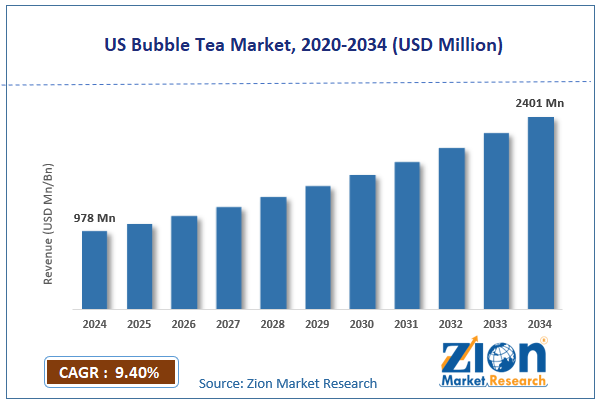
The U.S. bubble tea market size was worth around USD 978 million in 2024 and is predicted to grow to around USD 2401 million by 2034, with a compound annual growth rate (CAGR) of roughly 9.4% between 2025 and 2034.
Key Insights
- As per the analysis shared by our research analyst, the U.S. bubble tea market is estimated to grow annually at a CAGR of around 9.4% over the forecast period (2025-2034).
- In terms of revenue, the U.S. bubble tea market size was valued at around USD 978 million in 2024 and is projected to reach USD 2401 million by 2034.
- Café culture & premiumization are expected to drive the U.S. bubble tea market over the forecast period.
- Based on the type, the black tea segment holds the largest market share in 2024 of 44%.
- Based on the flavor, the fruit-flavored bubble tea segment held the largest revenue share of over 39% in 2024.
U.S. Bubble Tea Market: Overview
Bubble tea, also called boba tea or pearl milk tea, is a sweet, flavored beverage that originated in Taiwan during the 1980s, comprising brewed tea—generally black, green, or flavored tea like jasmine—with added flavorings, sweeteners, ice, and milk, served with chewy boba (tapioca) pearls and other toppings such as fruit jellies or popping boba; the tea is shaken to produce a foaming mouthfeel and served in a transparent cup with a wide straw so that the customer can consume the pearls with the tea.
Over time, bubble tea has developed into a flavored, complex, or even singular drink category, with customer choice over the level of sweetness and ice, the use of milk as a substitute, the availability of fruit syrup flavors, and the type of boba. The intriguing mouthfeel and visual appearance, as well as product flexibility and variety, have aided its widespread popularity and its emergence in coffee shops, QSRs, and ready-to-drink markets.
U.S. Bubble Tea Market: Dynamics
Growth Drivers
How do product innovation & formats drive the growth of the U.S. bubble tea market?
Innovation in products and new formats are key growth factor in the bubble tea market. Regular experimentation with the menu could involve innovation in formats (e.g., brown sugar boba milks, cheese foam toppings, plant-based milks and no-sugar formats, and collagen or probiotic functional add-ins). Limited-edition or seasonal flavor innovations, combined with social media awareness, will keep the category exciting for Millennials and Gen Z and encourage repeat purchases. To meet their changing needs, new product ideas that go beyond drinks in stores have led to ready-to-eat (RTE) bottled or canned bubble teas, DIY kits from supermarkets, instant tapioca pearls, and syrup concentrates sold in stores, making it easier to find these products outside of specialty cafes, keeping them fresh longer, and allowing them to be sold in supermarkets, convenience stores, and online. For instance, RTE bubble tea enables brands to leverage impulse purchase opportunities when consumers are at home.
On the other hand, digital customizations through professional apps or self-serve kiosks will enable consumers to enjoy the flexibility and personalized experience while waiting in line at cafes, while improving operators’ efficiency. Overall, consistent product innovation through flavor expansion, health-based reformulation, and multi-format offerings will continue to grow the demand pool.
Restraints
Health & food-safety concerns (heavy metals, plastics, contaminants) hamper the industry expansion
Health and food-safety issues—including concerns around ingredient contamination, microplastics, and heavy metals—potentially limit the bubble tea market’s immediate growth. Incidents of trace heavy metals, such as lead in tapioca pearls, and of contaminants in imported ingredients shine a spotlight on the bubble tea industry, raising consumer awareness and caution. While internal limits and legislated regulations define safe levels, negative news articles or information may discourage the use of particular ingredients and deter customers, resulting in decreased foot traffic or slowing new customer engagement.
Further, the use of popular sealed plastic cups, straws, and lids—while cost-effective—has attracted the attention of green consumers and legislators. Articles discussing microplastics and potential leaching from cups and straws—causing a consumer shift toward more sustainable, eco-friendly packaging and sourcing options—also serve as restraints on growth. Requirements for more rigorous. safety, import, and quality standards and transparency increase costs for bare-minimum supplies—such as pearl suppliers, flavorings, and syrups—primarily impacting small operators. Increased testing and audits decrease margins but contribute to longer-term sustainability, and with increased safety and validation also come increased costs and potentially longer startup times, hampering overall current growth.
Opportunities
Why does the increasing company expansion in the area present a potential opportunity for the U.S. bubble tea industry?
Growing company expansions, particularly in emerging markets, are a major growth factor for the U.S. bubble tea industry. As disposable incomes rise and developing economies urbanize across continents, both international and regional bubble tea brands are pursuing market expansion through franchising, joint ventures, and other partnership strategies that involve aggressive growth tactics. Chinese brands are scouting high-growth urban centers, establishing in-demand, great-tasting beverages that cater to mass audiences. Countries with robust middle-class populations, expanding cafe culture, and a growing number of young consumers present immense opportunities for brands with broad reach; their cultures thrive within a quick-service paradigm supported by a strong social media presence.
Although emerging markets can offer comparatively cost-effective operations that are yet to be saturated by a number of established brands, some trends are centered around local tastes and flavors, such as not-too-sweet functional beverages, flavor-innovative bubble compositions, and local product sourcing.
For instance, in December 2023, Chinese bubble tea company Heytea entered the United States market by opening its first store. In this newly opened store, they have 16 beverages available, including fruit tea and milk tea.
Challenges
Do the packaging & environmental concerns create an important obstacle to the U.S. bubble tea market development?
Packaging and pollution are key barriers to the development of the U.S. bubble tea market, especially in a maturing, highly regulated market. Bubble tea is highly reliant on single-use plastics, sealed cup lids, and wide-bore plastic straws, which are critical to its unique experience. However, the increased awareness of ocean plastics, plastic waste, and microplastics is bringing more attention to the pollution caused by disposable beverage packaging. Environmental concern is becoming paramount for consumers (especially Gen Z and Millennials), which may create reputational risks and threaten brand loyalty for bubble tea brands that require plastic packaging.
Moreover, increasingly strict regulations are being implemented in a number of cities and states, such as restrictions on single-use plastics, plastic straws, and Extended Producer Responsibility (EPR). Meeting these requirements can be costly, as bubble tea sellers would have to invest in compostable cups and degradable straws or recyclable sealing films. These eco-friendly options tend to be significantly more expensive and can pose operational problems, such as inferior strength properties and incompatibility with heat-sealing equipment. Within the context of growing investor awareness regarding ESG measures, Environmental and social issues could shape the franchise development plans of a bubble tea enterprise in certain markets. Smaller independent operators have less purchasing power, less space to stock, and less access to alternative eco-packages compared to large portfolio companies.
Nonetheless, despite these packaging challenges acting as a restraint, there is a clear opportunity for the industry to embrace more sustainable packaging solutions, such as reusable cup initiatives and prominent green marketing messages, to boost brand reputation and appeal to plant-based customers.
U.S. Bubble Tea Market: Report Scope
| Report Attributes | Report Details |
|---|---|
| Report Name | U.S. Bubble Tea Market |
| Market Size in 2024 | 978 Million |
| Market Forecast in 2034 | 2401 Million |
| Growth Rate | CAGR of 9.4% |
| Number of Pages | 224 |
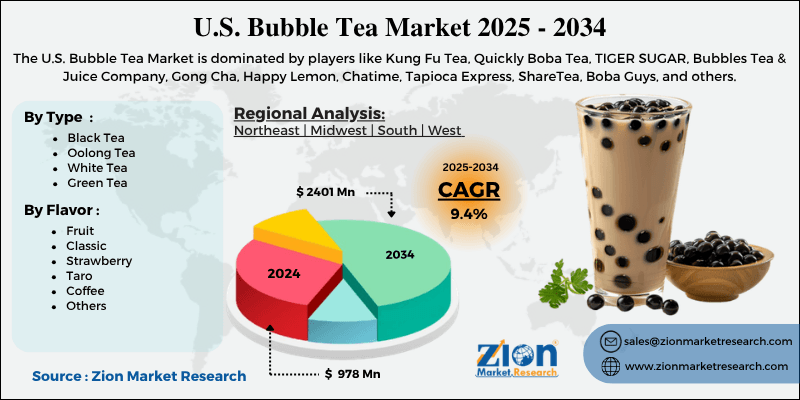
| Key Companies Covered | Kung Fu Tea, Quickly Boba Tea, TIGER SUGAR, Bubbles Tea & Juice Company, Gong Cha, Happy Lemon, Chatime, Tapioca Express, ShareTea, Boba Guys, and others. |
| Segments Covered | By Type, By Flavor, and By Region |
| Regions Covered in U.S. | Northeast, Midwest, South, and West |
| Base Year | 2024 |
| Historical Year | 2019 to 2023 |
| Forecast Year | 2025 - 2034 |
| Customization Scope | Avail customized purchase options to meet your exact research needs. Request For Customization |
U.S. Bubble Tea Market: Segmentation
By Type Insights
Why does black tea hold the dominant position in the U.S. bubble tea market?
The black tea segment holds the largest market share in 2024 of 44%. The black tea type of bubble tea has remained popular among people because of its real and natural taste. Moreover, this drink is considered effective in lowering blood sugar and bad cholesterol and in maintaining gut health. It is also one of the best sources of antioxidants. These facts have been a major reason for the growing demand for the product in the U.S. The classic Taiwanese bubble tea is a combination of black tea, milk, syrups, and tapioca pearls. This characteristic is one of the primary factors that lead most bubble tea shops to serve black tea with milk and sweetener. The strong taste and authentic sensation of black tea enable the taste factor of the drink to be sustained even after adding other flavoring agents and ingredients.
By Flavor Insights
How is the fruit-flavored bubble tea segment growing significantly?
The fruit-flavored bubble tea segment held the largest revenue share of over 39% in 2024. The increasing demand for fruit flavor in bubble tea is mainly because of its wide range of variety. It attracts consumers because it offers both nutrition and novelty. Health-conscious consumers buy these drinks at regular intervals because they provide a considerable amount of vitamins and minerals.
In general, healthy bubble tea is considered better than other varieties, as it contains less or a lower level of caffeine. The frequently used fruit flavors in the different flavored bubble tea variants are lemon, coconut, grape, lychee, natural fruit, green apple, passion fruit, pineapple, honeydew, and kiwi.
U.S. Bubble Tea Market: Competitive Analysis
The U.S. bubble tea market is dominated by players like:
- Kung Fu Tea
- Quickly Boba Tea
- TIGER SUGAR
- Bubbles Tea & Juice Company
- Gong Cha
- Happy Lemon
- Chatime
- Tapioca Express
- ShareTea
- Boba Guys
The U.S. bubble tea market is segmented as follows:
By Type
- Black Tea
- Oolong Tea
- White Tea
- Green Tea
By Flavor
- Fruit
- Classic
- Strawberry
- Taro
- Coffee
- Others
By Region
The U.S.
- Northeast
- Midwest
- South
- West
Table Of Content
Methodology
FrequentlyAsked Questions

HappyClients

