
Global Talc Filler Masterbatch Market Size, Share, Trends, Growth and Forecast 2034

Talc Filler Masterbatch Market By Type (Untreated Talc and Surface-Treated Talc), By Application (Automotive, Packaging, Construction, and Consumer Goods & Electronics), By End-User (Polymer Compounders, Construction Material Manufacturers, Automotive OEMs, and Consumer Goods & Electronics Manufacturers), and By Region - Global and Regional Industry Overview, Market Intelligence, Comprehensive Analysis, Historical Data, and Forecasts 2026 - 2034
| Market Size in 2025 | Market Forecast in 2034 | CAGR (in %) | Base Year |
|---|---|---|---|
| USD 2.1 Billion | USD 3.7 Billion | 6.6% | 2025 |
Talc Filler Masterbatch Market: Industry Perspective
What will be the size of the global talc filler masterbatch market during the forecast period?
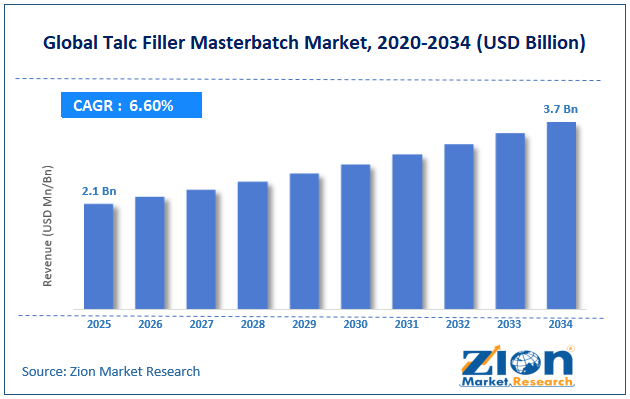
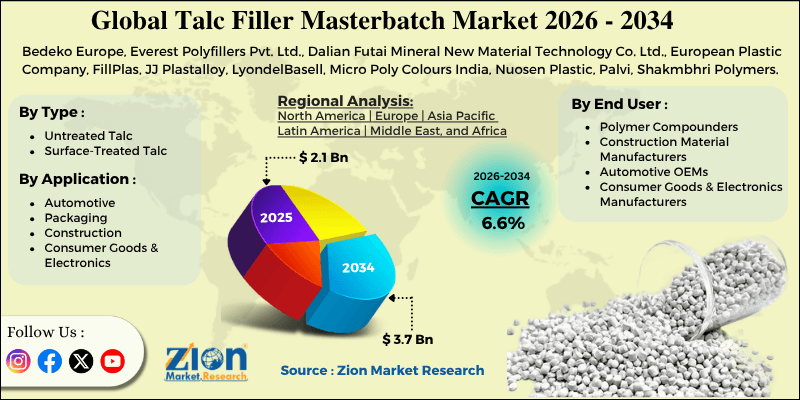
The global talc filler masterbatch market size was worth around USD 2.1 billion in 2025 and is predicted to grow to around USD 3.7 billion by 2034, with a compound annual growth rate (CAGR) of roughly 6.6% between 2026 and 2034.
Key Insights
- As per the analysis shared by our research analyst, the global talc filler masterbatch market is estimated to grow annually at a CAGR of around 6.6% over the forecast period (2026-2034).
- In terms of revenue, the global talc filler masterbatch market size was valued at around USD 2.1 billion in 2025 and is projected to reach USD 3.7 billion by 2034.
- Rising adoption in the packaging industry is expected to propel the talc filler masterbatch market over the projected period.
- Based on the type, the untreated talc segment held the largest revenue share in 2025 of 56%.
- Based on the application, the automotive segment held a prominent market share of 35% in 2025.
- Based on the end-user, the polymer compounders segment captures a prominent revenue share.
- Based on region, the Asia Pacific dominates the talc filler masterbatch market with a revenue share of 42% in 2025.
Talc Filler Masterbatch Market: Overview
Talc filler masterbatch is a concentrate formed by thoroughly mixing a fine mineral powder with a polymer carrier resin and processing additives, then cutting it into granules of uniform size. The granules are compounded into virgin plastic to produce products. This filler is commonly used in polymers such as polypropylene (PP) and polyethylene (PE), among others, to produce dimensionally stable plastics, improve their heat resistance, and give them a good surface finish. It is also used to reduce the overall cost of the polymer. Talc filler masterbatch is widely used in thermoforming and extrusion processes in the production of such products as packages and household appliances. The filler reduces shrinkage and improves the overall rigidity and strength of the plastic products.
In addition, it is used in the automotive, construction, consumer goods, and packaging industries to enhance plastics’ properties and reduce costs at the same time.
Impact of the USA-Israel War on Iran on the Talc Filler Masterbatch Market
The USA-Iran war has short-term implications for the talc filler masterbatch market. The conflict not only raises petrochemical prices but also increases freight and insurance costs in vital routes like the Strait of Hormuz. As a result, masterbatch production costs increase as carrier resins such as polypropylene and polyethylene become expensive. Nevertheless, manufacturers and converters are using the cost advantage of the masterbatch to offset the increased cost of virgin polymers, which will benefit the market under review.
In addition, masterbatch production volumes are rising due to high adoption by manufacturers, especially in the packaging industry. In this regard, major players in the market are considering product launches and collaborations as a means of strengthening their presence in the region. This move by key companies will contribute to future market growth; however, market growth is expected to depend on demand from developing nations.
Talc Filler Masterbatch Market: Dynamics
Growth Drivers
Does the growing demand for cost-effective plastic production drive the talc filler masterbatch market?
Talc filler masterbatch is one of the key growth drivers behind the talc filler masterbatch market due to its role in reducing the production costs of plastic products. The filler is used by manufacturers to replace a portion of costly virgin polymers, including polypropylene (PP) and polyethylene (PE), with low-cost mineral filler. Apart from helping reduce production expenditures, talc also serves as a process aid, improving various plastic properties and enhancing production efficiency by minimizing shrinkage and shortening cycle time, among others.
As a result, the filler is widely adopted in the production process of a diverse range of end-use products, including packaging, automotive components, construction materials, consumer goods, and home appliances, among others, which has significantly spurred its demand over the past years.
Restraints
How do fluctuating talc and polymer carrier resin prices act as a major restraint to the talc filler masterbatch industry's growth?
Talc and polymer carrier resin prices are expected to restrain the talc filler masterbatch market growth over the forecast period. Talc prices are volatile due to regulatory norms, mining activities, and freight rates. In contrast, polymer carrier resins like polypropylene (PP) and polyethylene (PE), which depend on crude oil prices, have become unpredictable. Production costs increase, and profit margins become unstable for manufacturers. Thus, the price variations of these raw materials discourage manufacturers and end-users, resulting in a negative impact on the market.
Opportunities
How does the focus on material optimization and sustainability offer a lucrative opportunity for the talc filler masterbatch market?
The emphasis on material optimization and sustainability presents a great opportunity for the talc filler masterbatch market as manufacturers look to reduce costs and use fewer materials while still providing the necessary performance. By substituting a certain amount of PP and PE resins with talc filler masterbatch, manufacturers can reduce the amount of plastic needed per product and optimize the mechanical properties of the plastics they do use. This reduces manufacturers' carbon footprint, improving efficiency and reducing waste throughout the supply chain. With various industries such as packaging, automotive, construction, and consumer goods adopting circular economy strategies, the demand for talc filler masterbatch is likely to benefit from their need to develop high-performance materials while using less virgin plastic.
Challenges
Stringent environmental regulations pose a significant challenge to the growth of the talc filler masterbatch industry
Stringent environmental regulations are a primary factor that may hinder the growth of the talc filler masterbatch market. Governments worldwide are imposing strict norms and guidelines to limit and control plastic waste and encourage recycling and the use of eco-friendly materials. Regulations such as extended producer responsibility, prohibitions on certain plastic products, and mandatory recycled content requirements are forcing manufacturers to reduce their reliance on conventional plastics.
Even though talc is a natural mineral, filler masterbatches are blended with polymers such as polypropylene and polyethylene, which are subject to the mentioned regulations. Moreover, meeting environmental compliance requirements requires investment in research and development of modified masterbatches and sustainable manufacturing processes, thus challenging market growth in countries with stringent environmental policies.
Talc Filler Masterbatch Market: Report Scope
| Report Attributes | Report Details |
|---|---|
| Report Name | Talc Filler Masterbatch Market |
| Market Size in 2025 | USD 2.1 Billion |
| Market Forecast in 2034 | USD 3.7 Billion |
| Growth Rate | CAGR of 6.6% |
| Number of Pages | 228 |
| Key Companies Covered | Bedeko Europe, Everest Polyfillers Pvt. Ltd., Dalian Futai Mineral New Material Technology Co. Ltd., European Plastic Company, FillPlas, JJ Plastalloy, LyondelBasell, Micro Poly Colours India, Nuosen Plastic, Palvi, Shakmbhri Polymers, Shivam Polychem, Shreeji Industries, Surya Masterbatches, ZBHOLY, and others. |
| Segments Covered | By Type, By Application, By End User, and By Region |
| Regions Covered | North America, Europe, Asia Pacific (APAC), Latin America, Middle East, and Africa (MEA) |
| Base Year | 2025 |
| Historical Year | 2020 to 2024 |
| Forecast Year | 2026 - 2034 |
| Customization Scope | Avail customized purchase options to meet your exact research needs. Request For Customization |
Talc Filler Masterbatch Market: Segmentation
Type Insights
Why does the untreated talc segment hold a prominent position in the talc filler masterbatch market?
The untreated talc segment held the largest revenue share of the talc filler masterbatch industry in 2025, at 56%. The growth is explained by its low cost, extensive availability, and ability to suit high-volume plastic uses. The untreated mineral is widely applied in polypropylene (PP), polyethylene (PE), and other plastics that require improved stiffness, dimensional stability, and lower shrinkage, but for which the expense of modified powders is not worth the effect. It is cheaper than the modified one, which allows some fields, like packaging, construction, household appliances, and consumer goods, to use it for cost-saving purposes.
Application
How does the automotive segment capture the largest share in the talc filler masterbatch market?
The automotive segment held a prominent share of the talc filler masterbatch market of 35% in 2025. The growth is attributed to rising demand for light, high-end plastic parts to improve fuel economy and facilitate vehicle electrification. Talc filler masterbatch is extensively used in the polypropylene (PP) based automotive industry for manufacturing dashboards, door trims, pillar trims, bumper parts, battery housing, and interior parts. This is because it offers improved stiffness, dimensional stability, heat resistance, and scratch resistance and also reduces material cost, allowing substitution of metal parts with light plastic parts.
End User Insights
Does the polymer compounders segment capture the largest share in the talc filler masterbatch market?
The polymer compounders segment captures a prominent revenue share of the talc filler masterbatch industry. Growth is attributed to rising demand for customized plastic compounds with improved mechanical properties and cost-effectiveness. Polymer compounders use Talc filler masterbatch to produce specialized formulations for the automotive, packaging, construction, electrical & electronics, and consumer goods sectors.
Moreover, it provides high stiffness, dimensional stability, heat resistance, and processability, thereby reducing the use of costly virgin polymer resins and making it cost-effective for large-scale plastic compounding.
Regional Insights
What factors drive the Asia Pacific region in the talc filler masterbatch market?
The Asia Pacific dominates the talc filler masterbatch market with a revenue share of 42% in 2025. The region’s significant development depends on extensive plastics manufacturing markets, increasing industrialization, and the growth of the automobile sector in China, India, Japan, South Korea, Southeast Asia, and the rest of the region. The demand for plastics in automotive applications has increased due to their light weight, durability, and cost-effectiveness.
Thus, the usage of talc filler masterbatch to enhance the stiffness, dimensional stability, and heat resistance of polymers is gaining traction across automakers. Moreover, rising investment in electric vehicle (EV) manufacturing and automotive components is projected to drive demand for talc-filled polypropylene (PP) and other plastics in making dashboards, door trims, bumpers, and battery housing.
The regional growth of the Asia Pacific talc filler masterbatch market is primarily driven by the automotive industry’s demand for plastics. In 2025, according to the Organization of Motor Vehicle Manufacturers (OICA), automobile production in Asia Pacific increased by 7.6% to 59.2 million units, contributing to over 61% of the global vehicle production. Of these, China alone produced 34.53 million units, while India produced 6.49 million units. Thus, the automobile industry is at the forefront of this region’s economic growth and development, impacting the demand for talc filler masterbatch.
Talc Filler Masterbatch Market: Competitive Analysis
The global talc filler masterbatch market is dominated by players like:
- Bedeko Europe
- Everest Polyfillers Pvt. Ltd.
- Dalian Futai Mineral New Material Technology Co. Ltd.
- European Plastic Company
- FillPlas
- JJ Plastalloy
- LyondelBasell
- Micro Poly Colours India
- Nuosen Plastic
- Palvi
- Shakmbhri Polymers
- Shivam Polychem
- Shreeji Industries
- Surya Masterbatches
- ZBHOLY
The global talc filler masterbatch market is segmented as follows:
By Type
- Untreated Talc
- Surface-Treated Talc
By Application
- Automotive
- Packaging
- Construction
- Consumer Goods & Electronics
By End User
- Polymer Compounders
- Construction Material Manufacturers
- Automotive OEMs
- Consumer Goods & Electronics Manufacturers
By Region
- North America
- The U.S.
- Canada
- Mexico
- Europe
- France
- The UK
- Spain
- Germany
- Italy
- Rest of Europe
- Asia Pacific
- China
- Japan
- India
- Australia
- South Korea
- Rest of Asia Pacific
- The Middle East & Africa
- Saudi Arabia
- UAE
- Egypt
- Kuwait
- South Africa
- Rest of the Middle East & Africa
- Latin America
- Brazil
- Argentina
- Rest of Latin America
Table Of Content
Methodology
FrequentlyAsked Questions
Talc filler masterbatch is a concentrate formed by thoroughly mixing a fine mineral powder with a polymer carrier resin and processing additives, then cutting it into granules of uniform size.
The development is driven by the growing demand for cost-effective plastic production, increasing use of lightweight materials in the automotive industry, and rising consumption of polypropylene (PP) and polyethylene (PE) in packaging, construction, and consumer goods. Demand is further supported by the need for improved stiffness, dimensional stability, and processing efficiency in plastic products, along with expanding infrastructure development and industrialization in emerging economies.
The talc filler masterbatch market faces several challenges, including fluctuating prices of talc and polymer carrier resins, which increase production costs and create pricing uncertainty. Stringent environmental regulations on plastic usage, growing competition from alternative fillers such as calcium carbonate and glass fibers, and the reduced impact strength and flexibility associated with high talc loading also restrain market growth.
Based on the application, the automotive segment is expected to dominate the talc filler masterbatch market growth during the projected period.
The talc filler masterbatch market is being shaped by innovations in high-dispersion and ultra-fine talc masterbatch formulations that improve mechanical performance, surface finish, and processing efficiency. Manufacturers are increasingly developing lightweight compounds for electric vehicles (EVs), recyclable and circular-economy-compatible masterbatches, and low-dust, high-loading formulations that reduce virgin polymer consumption while maintaining product quality.
According to the report, the global talc filler masterbatch market size was worth around USD 2.1 billion in 2025 and is predicted to grow to around USD 3.7 billion by 2034.
The global talc filler masterbatch market is expected to grow at a CAGR of 6.6% during the forecast period.
The global talc filler masterbatch industry growth is expected to be led by the Asia Pacific over the forecast period.
The global talc filler masterbatch market is dominated by players like Bedeko Europe, Everest Polyfillers Pvt. Ltd., Dalian Futai Mineral New Material Technology Co. Ltd., European Plastic Company, FillPlas, JJ Plastalloy, LyondelBasell, Micro Poly Colours India, Nuosen Plastic, Palvi, Shakmbhri Polymers, Shivam Polychem, Shreeji Industries, Surya Masterbatches, and ZBHOLY, among others.
The talc filler masterbatch market report covers the geographical market along with a comprehensive competitive landscape analysis. It also includes cash flow analysis, profit ratio analysis, market basket analysis, market attractiveness analysis, sentiment analysis, PESTLE analysis, trend analysis, SWOT analysis, trade area analysis, demand & supply analysis, Porter’s five forces analysis, and value chain analysis.

HappyClients