
Swimming Pool Heaters Market Size, Growth, Global Trends, Forecast 2034

Swimming Pool Heaters Market By Product Type (Heat Pumps, Solar Pool Heaters, Gas Pool Heaters, and Electric Pool Heaters), By Pool Type (Above-Ground and In-Ground), By Fuel Type (Propane, Electric, Solar, and Natural Gas), By Application (Commercial and Residential), and By Region - Global and Regional Industry Overview, Market Intelligence, Comprehensive Analysis, Historical Data, and Forecasts 2026 - 2034
| Market Size in 2025 | Market Forecast in 2034 | CAGR (in %) | Base Year |
|---|---|---|---|
| USD 4.2 Billion | USD 6.15 Billion | 4.20% | 2025 |
Swimming Pool Heaters Industry Perspective:
What is the anticipated size of the swimming pool heaters market during the projection period?
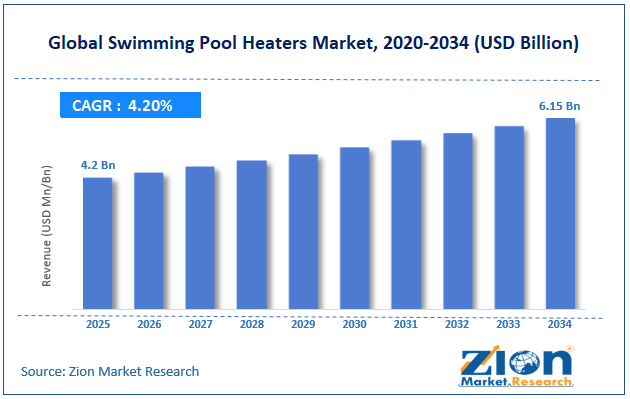
The global swimming pool heaters market size was worth around USD 4.2 billion in 2025 and is predicted to grow to around USD 6.15 billion by 2034, with a compound annual growth rate (CAGR) of roughly 4.20% between 2026 and 2034.
 Request Free SampleRequest Free SampleRequest Free Sample
Key Insights:
- As per the analysis shared by our research analyst, the global swimming pool heaters market is estimated to grow annually at a CAGR of around 4.20% over the forecast period (2026-2034)
- In terms of revenue, the global swimming pool heaters market size was valued at around USD 4.2 billion in 2025 and is projected to reach USD 6.15 billion, by 2034.
- The swimming pool heaters market is projected to grow at a significant rate due to the increasing expansion of commercial accommodation and entertainment establishments.
- Based on the product type, the heat pumps segment is growing at a high rate and will continue to dominate the global market as per industry projections.
- Based on the pool type, the above-ground segment is anticipated to grow at a higher CAGR of 6.56% during the projection period.
- Based on the fuel type, in 2025, solar-powered swimming pool heaters were the leading revenue generators. They accounted for 49.12% of global revenue and will continue leading the market.
- Based on the application, the residential segment is projected to influence revenue in the market.
- Based on region, Asia-Pacific is projected to dominate the global market during the forecast period.
Swimming Pool Heaters Market: Overview
Swimming pool heaters are heating devices that use different technologies to heat residential or commercial-grade swimming pools. The market includes different types of pool heaters, including solar, electric, and gas variants. Each type uses specific technology and delivers certain advantages over the others. Demand for swimming pool heaters is highest in colder seasons, since low temperatures can keep pools unusable for long periods. Pool heaters are especially useful in regions that witness low temperatures for most of the year. Nonetheless, pool heaters have applications across the globe, even in tropical countries. The global swimming pool heaters market is expected to be driven by growing pool construction across commercial facilities such as high-end restaurants, hotels, and resorts.
In addition, expansion of swimming academies, higher residential demand, and heater-based innovation will further aid market growth in the coming years. However, high cost of initial investment, seasonal dependency, and safety risks will limit market growth over the forecast duration.
Impact of the USA-Israel and Iran war on the Swimming Pool Heaters Market:
The USA-Israel and Iran war has primarily affected the logistics cost of swimming pool heaters. It has also increased supply chain uncertainty and heater manufacturing costs. During the forecast period, the war will influence demand for more energy-efficient pool heaters, domestic production, and development of a more robust supply chain across geographical markets.
Swimming Pool Heaters Market: Dynamics
Growth Drivers
How will expansion of commercial facilities encourage growth in the swimming pool heaters market?
The global swimming pool heaters market is expected to benefit from the increasing expansion of commercial accommodation and entertainment establishments. Most hotels, resorts, and some high-end restaurants have swimming pools to elevate user experience. Market analysis suggests growing investment in luxury pool trends such as unique designs, infinity views, and structures that are coherently integrated with the surroundings.
In August 2026, Austria’s Hotel Lürzerhof reopened after undergoing a transformation worth EUR 10 million. Apart from other facilities, the hotel now offers cantilevered infinity pools to its customers. The growing tourism industry and proliferation of leisure culture will drive demand for modern swimming pools, ultimately fueling the use of pool heaters.
Expansion of swimming academies to generate high revenue in the market
Growing participation in swimming as a sport has created growth opportunities for swimming academies. According to healthcare experts, swimming is considered an excellent form of workout. This is the primary reason why a large number of people choose to include swimming in their daily or weekly health routine. In addition, competitive swimming participation has risen considerably in recent years, further driving demand for training facilities. The global swimming pool heaters market is expected to benefit as more Olympic-grade pools are constructed worldwide.
Restraints
High cost of investment and operational expenses to limit industry growth
The global swimming pool heaters industry is expected to be restricted due to high cost of initial investment and recurring operational expenses. The average cost of a swimming pool heater can range between USD 4000 to USD 10,000 depending on the type and capacity. In addition, pool heaters use a lot of energy, increasing fuel and battery consumption and ultimately driving up operational costs. Growing economic uncertainty and a lack of sufficient repair and maintenance facilities are additional industry limitations.
Opportunities
How are technological advancements expected to shape the swimming pool heaters market?
The global swimming pool heaters market is expected to be significantly influenced by ongoing technological advancements offering sustainable, high-performance, and cost-effective solutions. In November 2025, PHNIX, a leading market player, showcased its latest Artificial Intelligence (AI)-powered Full Inverter R290 pool heat pump range along with other offerings. As per official records, the new pool heater range offers 30% more energy savings and automatic optimization based on energy requirements, electricity price cycles, and grid load.
In May 2024, Hayward Holdings, Inc., a global leader in pool and outdoor living technology, launched the HeatPro Series of Heat+Chill Heat Pumps. They feature industry-first microchannel heat exchanger technology. Owners can set different temperatures based on the water channel. Solar pool heaters are eco-friendly as they utilize natural air. They have seen higher investment recently, opening additional growth channels.
Challenges
Which safety risks will challenge swimming pool heaters market growth?
The global swimming pool heaters industry is anticipated to be challenged by safety risks and seasonal demand. Gas-filled swimming pool heaters pose a risk of carbon monoxide poisoning if they lack an effective ventilation system. In addition, swimming pool heaters are often associated with electrical shocks, gas leaks, and explosion hazards. These systems are generally used more during colder weather and therefore see reduced demand in other seasons.
Swimming Pool Heaters Market: Report Scope
| Report Attributes | Report Details |
|---|---|
| Report Name | Swimming Pool Heaters Market |
| Market Size in 2025 | USD 4.2 Billion |
| Market Forecast in 2034 | USD 6.15 Billion |
| Growth Rate | CAGR of 4.20% |
| Number of Pages | 227 |
| Key Companies Covered | Rheem Manufacturing, Hayward Industries, Raypak, Waterco, Certikin International, Pentair, Sta-Rite, Coates Heater Company, AquaCal AutoPilot, EvoHeat, Zodiac Pool Systems (Jandy), AstralPool, Lochinvar, and others. |
| Segments Covered | By Product Type, By Pool Type, By Fuel Type, By Application, and By Region |
| Regions Covered | North America, Europe, Asia Pacific (APAC), Latin America, Middle East, and Africa (MEA) |
| Base Year | 2025 |
| Historical Year | 2020 - 2024 |
| Forecast Year | 2026 - 2034 |
| Customization Scope | Avail customized purchase options to meet your exact research needs. Request For Customization |
Swimming Pool Heaters Market: Segmentation
The global swimming pool heaters market is segmented based on product type, pool type, fuel type, application, and region.
Why will the heat pumps segment lead the swimming pool heaters industry revenue during the forecast period?
Based on product type, the global market segments are heat pumps, solar pool heaters, gas pool heaters, and electric pool heaters. In 2025, the highest growth was listed in the heat pumps segment. It accounted for 33% of the global revenue and will grow at a CAGR of 7.81% during the projection period. Advanced heat pumps offer high performance and cost-efficiency. Improvements in inverter technology will benefit the market players in the coming years.
Which will be the fastest-growing pool type during the forecast period in the swimming pool heaters market?
Based on pool type, the global swimming pool heaters industry is fragmented into above-ground and in-ground. In 2025, the largest market share was held by the in-ground segment. It contributed up to 61.5% of the global revenue. The above-ground segment is anticipated to grow at a higher CAGR of 6.56% during the projection period. Excellent portability, higher applications in residential areas, and lower initial cost will encourage segmental growth in the future.
What factors drive demand in the solar segment of the swimming pool heater industry?
Based on fuel type, the global market divisions are propane, electric, solar, and natural gas. In 2025, solar-powered swimming pool heaters were the leading revenue generators. They accounted for 49.12% of global revenue and will continue leading the market with strong CAGR during the forecast period. AI-powered solar pool heaters with advanced features are gaining popularity among commercial and residential end-users.
What will be the influence of the residential segment on the swimming pool heaters market?
Based on application, the global market is fragmented into commercial and residential. In 2025, over 65% of global revenue was listed in the residential segment. It will continue delivering a CAGR of 6.51% during the forecast period. Growing construction of backyard pools and shifting consumer preference toward energy-efficient heaters will drive segmental growth trends in the coming years.
Swimming Pool Heaters Market: Regional Analysis
Why will Asia-Pacific lead the swimming pool heaters market during the forecast period?
The global swimming pool heaters market is expected to be dominated by Asia-Pacific during the forecast period. In 2025, it accounted for 38.76% of the global revenue and is projected to grow at a CAGR of 7.49% during the forecast period. Asia-Pacific is one of the world’s largest providers of high-tech pool heaters. Regional players are experimenting with AI and renewable energy-powered pool heaters with applications across varying climatic conditions worldwide and energy availability.
How is North America expected to perform in the swimming pool heaters market during the projection period?
North America is anticipated to deliver a strong CAGR of 5.61% in the global swimming pool heaters market during the forecast period. It dominated around 27% of the total market share. North America has high demand for residential pools across the US and Canada. In addition, luxury pools in commercial and residential facilities for high-net-worth individuals are key drivers of regional market growth. Higher demand for energy-efficient heaters will prove beneficial for the regional players.
Swimming Pool Heaters Market: Competitive Analysis
The global swimming pool heaters market is led by players like:
- Rheem Manufacturing
- Hayward Industries
- Raypak
- Waterco
- Certikin International
- Pentair
- Sta-Rite
- Coates Heater Company
- AquaCal AutoPilot
- EvoHeat
- Zodiac Pool Systems (Jandy)
- AstralPool
- Lochinvar
What are the latest key trends in the swimming pool heaters market
Variable speed compressors
The introduction of inverter and variable-speed compressors is gaining momentum. These pool heaters are designed to deliver performance as per natural outdoor temperature, pool-water temperature, and desired temperature.
Smart pool heaters
Smart pool heaters equipped with remote control and predictive maintenance solutions are expected to become more popular. These heaters can be controlled using applications and also offer higher energy efficiency.
The global swimming pool heaters market is segmented as follows:
By Product Type
- Heat Pumps
- Solar Pool Heaters
- Gas Pool Heaters
- Electric Pool Heaters
By Pool Type
- Above-Ground
- In-Ground
By Fuel Type
- Propane
- Electric
- Solar
- Natural Gas
By Application
- Commercial
- Residential
By Region
- North America
- The U.S.
- Canada
- Mexico
- Europe
- France
- The UK
- Spain
- Germany
- Italy
- Rest of Europe
- Asia Pacific
- China
- Japan
- India
- Australia
- South Korea
- Rest of Asia Pacific
- The Middle East & Africa
- Saudi Arabia
- UAE
- Egypt
- Kuwait
- South Africa
- Rest of the Middle East & Africa
- Latin America
- Brazil
- Argentina
- Rest of Latin America
Table Of Content
Methodology
FrequentlyAsked Questions
Swimming pool heaters are heating devices that use different technologies to heat residential or commercial-grade swimming pools.
The global swimming pool heaters market is expected to benefit from the increasing expansion of commercial accommodation and entertainment establishments.
According to study, the global swimming pool heaters market size was worth around USD 4.2 billion in 2025 and is predicted to grow to around USD 6.15 billion by 2034.
The CAGR value of the swimming pool heaters market is expected to be around 4.20% during 2026-2034.
The global swimming pool heaters industry is anticipated to be challenged by safety risks and seasonal demand.
Variable speed compressors and smart pool heaters are the emerging trends and innovations impacting the swimming pool heaters market.
The global swimming pool heaters market has performed well so far and will offer similar trends in the coming years.
The global swimming pool heaters market is expected to be dominated by Asia-Pacific during the forecast period.
The global swimming pool heaters market is led by players like Rheem Manufacturing, Hayward Industries, Raypak, Waterco, Certikin International, Pentair, Sta-Rite, Coates Heater Company, AquaCal AutoPilot, EvoHeat, Zodiac Pool Systems (Jandy), AstralPool, and Lochinvar.
The report explores crucial aspects of the swimming pool heaters market, including a detailed discussion of existing growth factors and restraints, while also browsing future growth opportunities and challenges that impact the market.

HappyClients

