
Global Specimen Retrieval Market Size, Share, & Growth Report 2032

Specimen Retrieval Market By Type (Detachable and Non-Detachable), By Introducer Size (5 mm, 10 mm, 15 mm, and 25 mm), By Application (Cardiovascular Surgeries, Gynecological Surgeries, Urological Surgeries, Gastrointestinal Surgeries, and Others), By End-Use (Ambulatory Surgical Centers, Hospitals, and Others), And By Region - Global And Regional Industry Overview, Market Intelligence, Comprehensive Analysis, Historical Data, And Forecasts 2024-2032
| Market Size in 2023 | Market Forecast in 2032 | CAGR (in %) | Base Year |
|---|---|---|---|
| USD 277.69 Million | USD 511.11 Million | 7.30% | 2023 |
Specimen Retrieval Industry Perspective
What will be the global specimen retrieval market size during the forecast period?
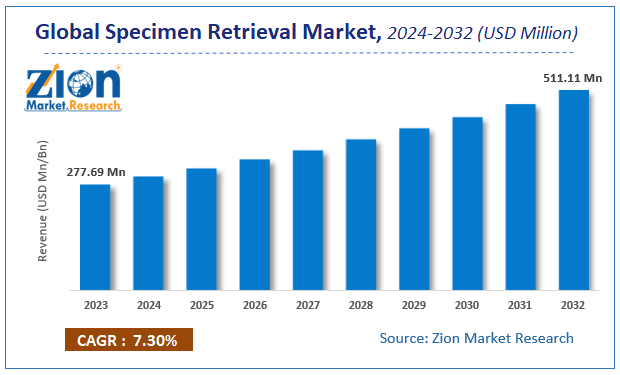
The global specimen retrieval market size was worth around USD 277.69 million in 2023 and is predicted to grow to around USD 511.11 million by 2032 with a compound annual growth rate (CAGR) of roughly 7.30% between 2024 and 2032.
This report provides a comprehensive analysis of the growth drivers, restraints, and challenges shaping demand across the global specimen retrieval market throughout the forecast period, while highlighting high-potential emerging opportunities within the industry.
Key Insights
- As per the analysis shared by our research analyst, the global specimen retrieval market is estimated to grow annually at a CAGR of around 7.30% over the forecast period (2024-2032).
- In terms of revenue, the global specimen retrieval market size was valued at around USD 277.69 million in 2023 and is projected to reach USD 511.11 million by 2032.
- The market is driven by the rising incidence of chronic diseases requiring surgical intervention, growing volume of laparoscopic and minimally invasive procedures, increasing awareness among physicians and patients regarding specimen retrieval systems, and lifestyle factors such as sedentary habits, tobacco use, and poor dietary patterns that elevate surgical needs.
- Based on the type, the detachable segment dominated the market with a significant share due to its greater flexibility during procedures
- Based on the introducer size, the 10 mm segment held the largest share owing to its broad compatibility with standard laparoscopic instruments, optimal balance between specimen accessibility and minimal incision size
- Based on the application, the gastrointestinal surgeries segment dominated because of the high volume of laparoscopic procedures involving tissue or organ removal
- Based on the end-use, the hospitals segment dominated with a major share due to higher surgical volumes, availability of advanced laparoscopic infrastructure, and presence of specialized surgical teams
- Based on the region, Asia Pacific dominated the global specimen retrieval market and is expected to maintain leadership due to the expanding geriatric population susceptible to chronic disorders, rising cases of hypertension and obesity
Specimen Retrieval Market: Overview
Specimen retrieval systems are widely utilized in laparoscopic surgeries for temporarily containing specimens and removing the specimens from the body system of patients. These systems are devised for minimizing pollution of the abdominal cavity through isolation & specimen containment. Apparently, the special retrieval tools find a slew of applications in minimally invasive surgeries.
Specimen Retrieval Market: Growth Drivers
How is the rising volume of laparoscopic surgeries and chronic disease burden accelerating market expansion
Surge in the incidence of chronic ailments and huge requirement of surgeries will prompt market proliferation in the coming years. In addition to this, a rise in surgical operations for the removal of specimens from the human body will spur industry growth over the forecast time span. Apparently, high consciousness about specimen retrieval systems among both the patient population base and physicians or surgeons will create lucrative growth avenues for the market over the forecast timespan. Additionally, inactive lifestyles, a surge in tobacco consumption, and wrong food habits will further contribute to the overall market size in the forecast years.
Furthermore, a rise in the incidence of heart ailments will result in a high need for surgeries, and this will enhance the acceptance of specimen retrieval tools while performing these surgical procedures. This, in turn, will prompt business growth.
Specimen Retrieval Market: Restraints
What factors limit broader adoption of specimen retrieval systems?
The relatively high cost of advanced specimen retrieval products remains a key restraint, especially in developing and emerging economies where healthcare budgets are constrained. Premium pricing can place these systems beyond the reach of many smaller facilities or limit their use to higher-volume centers, slowing overall market penetration.
In certain regions, limited awareness of the clinical benefits of dedicated retrieval systems among some healthcare providers and patients also restricts uptake. Budgetary pressures and competing priorities within hospital procurement processes can further delay investment in newer or more specialized devices.

Specimen Retrieval Market: Report Scope:
| Report Attributes | Report Details |
|---|---|
| Report Name | Specimen Retrieval Market |
| Market Size in 2023 | USD 277.69 Million |
| Market Forecast in 2032 | USD 511.11 Million |
| Compound Annual Growth Rate | CAGR of 7.30% |
| Number of Pages | 250 |
| Forecast Units | Value (USD Million) and Volume (Units) |
| Key Companies Covered | Braun Melsungen AG, Johnson & Johnson Services, Inc., Medtronic PLC, Applied Medical Resources Corp., GENICON, Inc., CONMED Corp., and Teleflex Inc. |
| Segments Covered | By Type, By Introducer Size, By Application, By End-Use, and By Region |
| Regions Covered | North America, Europe, Asia Pacific (APAC), Latin America, Middle East and Africa (MEA) |
| Countries Covered | North America: U.S. and Canada Europe: Germany, Italy, Russia, U.K., Spain, France, Rest of Europe APAC: China, Australia, Japan, India, South Korea, Southeast Asia, Rest of Asia Pacific Latin America: Brazil, Argentina, Chile The Middle East And Africa: South Africa, GCC, Rest of MEA |
| Base Year | 2023 |
| Historical Year | 2018 - 2022 |
| Forecast Year | 2024 - 2032 |
| Customization Scope | Avail customized purchase options to meet your exact research needs. Request For Customization |
Specimen Retrieval Market: Segmentation
The specimen retrieval market is segmented by type, introducer size, application, end-use, and region. All the segments of the specimen retrieval market have been analyzed based on present and future trends and the market is estimated from 2024 to 2032.
Based on the Type, the market is divided into detachable and non-detachable. The detachable segment is the most dominant because these systems offer greater intraoperative flexibility, allow surgeons to separate the bag from the introducer for controlled manipulation and closure, and facilitate extraction through smaller ports when appropriate. This design reduces the need for larger incisions in many procedures and supports safer containment of specimens during complex laparoscopic cases. The non-detachable segment ranks as the second most dominant and continues to drive market volume through its simplicity, reliability in routine procedures, and cost-effectiveness for facilities that prioritize straightforward, proven designs for standard specimen removal.
Based on Introducer Size Segment, the market is divided into 5 mm, 10 mm, 15 mm, and 25 mm. The 10 mm segment holds the leading position due to its excellent compatibility with widely used laparoscopic instrument sets, balanced capacity for a broad range of specimen sizes, and frequent application in general surgery, gynecology, and gastrointestinal procedures. Surgeons value the ability to introduce and retrieve specimens efficiently without unnecessarily enlarging access sites. The 15 mm segment is the second most prominent, supporting larger specimens and more complex extractions while still aligning with common port configurations, thereby contributing to overall procedural efficiency and market growth.
Based on the Application, the market is divided into cardiovascular surgeries, gynecological surgeries, urological surgeries, gastrointestinal surgeries, and others. Gastrointestinal surgeries represent the dominant application because of the high frequency of laparoscopic procedures involving tissue or organ resection, the critical need for secure containment to avoid contamination of the abdominal cavity, and the direct contribution of reliable retrieval systems to patient safety and surgical outcomes. Gynecological surgeries form the second major application area, driven by the substantial volume of minimally invasive procedures in this specialty and the consistent requirement for controlled specimen extraction that minimizes trauma and supports faster recovery.
Based on the end-user, the market is divided into ambulatory surgical centers, hospitals, and others. Hospitals dominate the end-use landscape owing to their higher overall surgical volumes, access to advanced laparoscopic equipment and trained specialists, and established protocols for specimen handling across multiple specialties. These institutions perform a wide spectrum of procedures that rely on secure retrieval systems and benefit from centralized procurement and training. Ambulatory surgical centers constitute the second key end-use segment and help expand the market by supporting the shift toward outpatient minimally invasive procedures, where efficient, reliable retrieval tools contribute to shorter stays and cost-effective care delivery.
Specimen Retrieval Market: Regional Analysis
Why will Asia Pacific continue to dominate the global market during the projection period?
Asia Pacific is positioned to maintain a leading role in the global specimen retrieval market over the forecast horizon. The growth of the market in the region over the estimated timeline is due to a rise in the geriatric population in countries like India and China that is susceptible to chronic disorders. Apart from this, the introduction of favorable healthcare policies and growing cases of high blood pressure and obesity will elevate the business landscape in the region.
North America remains an important market supported by advanced healthcare infrastructure, high volumes of laparoscopic procedures, and strong presence of leading manufacturers. The region continues to influence global trends through early adoption of refined techniques and product innovations. Europe contributes steadily through well-established surgical standards, regulatory emphasis on patient safety, and sustained demand for reliable retrieval solutions across specialized centers. Latin America and the Middle East and Africa are expected to register progressive growth as healthcare access improves, surgical volumes rise, and awareness of minimally invasive approaches expands in these developing markets.
Specimen Retrieval Market: Competitive Landscape
- Braun Melsungen AG
- Johnson & Johnson Services Inc.
- Medtronic PLC
- Applied Medical Resources Corp.
- GENICON Inc.
- CONMED Corp.
- Teleflex Inc.
Segment Covered
By Type
- Detachable
- Non-detachable
By Introducer Size
- 5 mm
- 10 mm
- 15 mm
- 25 mm
By Application
- Cardiovascular Surgeries
- Gynecological Surgeries
- Urological Surgeries
- Gastrointestinal Surgeries
- Others
By End-Use
- Ambulatory Surgical Centers
- Hospitals
- Others
By Region
- North America
- The U.S.
- Canada
- Mexico
- Europe
- France
- The UK
- Spain
- Germany
- Italy
- Rest of Europe
- Asia Pacific
- China
- Japan
- India
- Australia
- South Korea
- Rest of Asia Pacific
- The Middle East & Africa
- Saudi Arabia
- UAE
- Egypt
- Kuwait
- South Africa
- Rest of the Middle East & Africa
- Latin America
- Brazil
- Argentina
- Rest of Latin America
Table Of Content
Methodology
FrequentlyAsked Questions
Specimen retrieval systems are massively utilized in laparoscopic surgeries for temporarily containing specimens and removing the specimens from the body system of patients.
According to study, the global specimen retrieval market size was worth around USD 277.69 million in 2023 and is predicted to grow to around USD 511.11 million by 2032.
The CAGR value of specimen retrieval market is expected to be around 7.30% during 2024-2032.
Asia Pacific has been leading the global specimen retrieval market and is anticipated to continue on the dominant position in the years to come.
The global specimen retrieval market is led by players like B. Braun Melsungen AG, Applied Medical Resources Corp., GENICON, Inc., CONMED Corp., Medtronic PLC, Johnson & Johnson Services, Inc., and Teleflex Inc.
Emerging trends include the growing preference for detachable and redeployable retrieval systems that enhance procedural flexibility, continuous improvements in material strength and ease of use, and the expansion of minimally invasive and outpatient surgical volumes that increase demand for efficient containment solutions.
The report provides a comprehensive geographical analysis, competitive landscape assessment, and detailed insights covering historical data, current market dynamics, segmentation analysis, and forecasts for 2024-2032, enabling stakeholders to understand growth opportunities and industry trends.

HappyClients

