
Global Surgical Instrument Tracking Systems Market Size, Share Report, Analysis, Trends, Growth 2032

Surgical Instrument Tracking Systems Market Analysis By Component (Software, Hardware, and Services), By Technology (Radio-Frequency Identification and Bar Codes), and By End-User (Hospitals (Private Hospitals and Public Hospitals), and Others), and By Region: Global Industry Perspective, Comprehensive Analysis and Forecast, 2024-2032
| Market Size in 2023 | Market Forecast in 2032 | CAGR (in %) | Base Year |
|---|---|---|---|
| USD 228.3 million | USD 649.9 million | 12.45% | 2023 |
How big is the Surgical Instrument Tracking Systems market?
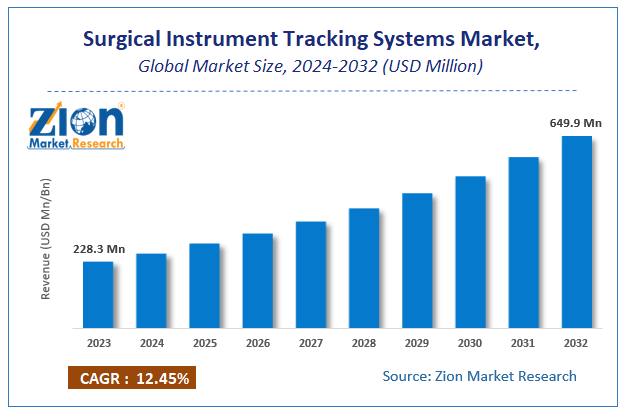
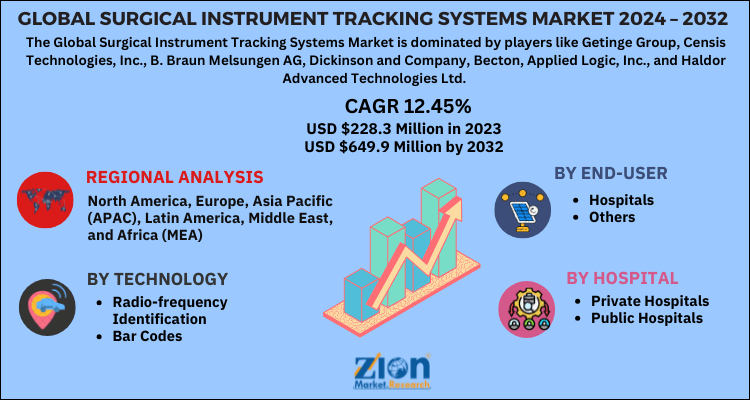
The global Surgical Instrument Tracking Systems market size accrued earnings worth approximately USD 228.3 Million in 2023 and is predicted to gain revenue of about USD 649.9 Million by 2032, is set to record a CAGR of nearly 12.45% over the period from 2024 to 2032.
Surgical Instrument Tracking Systems Market: Overview
In Global Surgical Instrument Tracking Systems Market Report, Surgical instrument tracking systems are effective systems that aid healthcare providers. The system basically includes service, hardware, and software. The surgical instrument tracking system can decrease case delays, enhance patient safety, and enhance staff productivity.
Surgical Instrument Tracking Systems Market: Growth Factors
The key factors propelling the growth of the global surgical instrument tracking market include Unique Device Identification regulations by Food and Drug Administration, high patient well-being concerns, increasing demand for inventory management, and the necessity to increase revenues through operational effectiveness. However, factors such as huge system costs, budgetary limitations, and lengthy investment cycles can be attributed to the restraining factors of the global surgical instrument tracking market growth.
Surgical Instrument Tracking Systems Market: Report Scope
| Report Attributes | Report Details |
|---|---|
| Report Name | Surgical Instrument Tracking Systems Market |
| Market Size in 2023 | USD 228.3 Million |
| Market Forecast in 2032 | USD 649.9 Million |
| Growth Rate | CAGR of 12.45% |
| Number of Pages | 196 |
| Key Companies Covered |
Getinge Group, Censis Technologies, Inc., B. Braun Melsungen AG, Dickinson and Company, Becton, Applied Logic, Inc., and Haldor Advanced Technologies Ltd. The other key players in the global market are TGX Medical Systems, Materials Management Microsystems, Inc., Synergy Health, Vizbee RFID Solutions, Intelligent InSites, Inc., Infor, Xerafy, Mobile Aspects, Inc., and Key Surgical, Inc., among others. |
| Segments Covered | By Component, By Technology, By End-Use, and By Region |
| Regions Covered | North America, Europe, Asia Pacific (APAC), Latin America, Middle East, and Africa (MEA) |
| Base Year | 2023 |
| Historical Year | 2018 - 2022 |
| Forecast Year | 2024 - 2032 |
| Customization Scope | Avail customized purchase options to meet your exact research needs. Request For Customization |
Global Surgical Instrument Tracking Systems Market: Segmentation
The global surgical instrument tracking market may be segmented based on component, technology, end-user, and region.
The component segment of the global market is divided into software, hardware, and services. The hardware segment is assumed to grow in the coming period due to the frequent requirement to change labels or tags, which ultimately leads to repeat purchases.
The technology segment of the global surgical instrument tracking market is classified into radio-frequency identification and bar codes. The barcode segment is expected to dominate the technology market owing to its feasible use and low cost for installation.
The end-user segment is diversified into hospitals and others. The hospital segment is sub-segmented into private hospitals and public hospitals. The hospital segment of the global surgical instrument tracking systems market is expected to grow at a fast pace due to the increasing need for inventory management to supervise a huge quantity of surgical instruments and to secure better patient well-being.
Region-wise, the global market is segregated into North America, Europe, Asia Pacific, Latin America, and Middle East & Africa.
Surgical Instrument Tracking Systems Market: Regional Analysis
North America is expected to dominate the global surgical instrument tracking systems market due to the regulation by Food and Drug Administration for Unique Device Identification. However, the Asia-Pacific region is also anticipated to grow in the global market in the near future.
Surgical Instrument Tracking Systems Market: Competitive Players
Some main participants of the Surgical Instrument Tracking Systems market are
- Getinge Group
- Censis Technologies Inc.
- B. Braun Melsungen AG
- Dickinson and Company
- Becton
- Applied Logic Inc.
- and Haldor Advanced Technologies Ltd
- TGX Medical Systems
- Materials Management Microsystems Inc.
- Synergy Health
- Vizbee RFID Solutions
- Intelligent InSites Inc.
- Infor
- Xerafy
- Mobile Aspects Inc.
- and Key Surgical Inc.
- among others.
The global Surgical Instrument Tracking Systems Market is segmented as follows:
By Component
- Software
- Hardware,
- Services
By Technology
- Radio-Frequency Identification and Bar Codes
By End-User
- Hospitals
- Private Hospitals
- Public Hospitals
- Others
By Region
- North America
- The U.S.
- Canada
- Mexico
- Europe
- France
- The UK
- Spain
- Germany
- Italy
- Rest of Europe
- Asia Pacific
- China
- Japan
- India
- Australia
- South Korea
- Rest of Asia Pacific
- The Middle East & Africa
- Saudi Arabia
- UAE
- Egypt
- Kuwait
- South Africa
- Rest of the Middle East & Africa
- Latin America
- Brazil
- Argentina
- Rest of Latin America
Table Of Content
Methodology
FrequentlyAsked Questions
Surgical instrument tracking systems monitor and manage surgical tools. They improve efficiency, safety, and sterilization control.
The global Surgical Instrument Tracking Systems market is expected to be driven by the increasing surgical volumes, need to reduce errors, and regulatory compliance. Adoption of RFID and digital tracking improves operational efficiency.
According to study, the global Surgical Instrument Tracking Systems market size was worth around USD 228.3 Million in 2023 and is predicted to grow to around USD 649.9 Million By 2032.
The global Surgical Instrument Tracking Systems market is expected to grow at a Compound Annual Growth Rate (CAGR) of around CAGR 12.45% during the forecast period from 2024-2032.
The global Surgical Instrument Tracking Systems industry is projected to be challenged by Challenges include integration with hospital IT systems, high deployment costs, and workflow resistance.
The Opportunities include patient safety initiatives, operating room efficiency demand, RFID adoption, and regulatory compliance in sterile processing will offer significant growth opportunities in the Surgical Instrument Tracking Systems market.
RFID and barcode-based real-time tracking; integration with hospital IT systems; compliance-driven sterilization and inventory management are the emerging trends and innovations impacting the Surgical Instrument Tracking Systems market.
The global Surgical Instrument Tracking Systems market is expected to be led by North America during the forecast period.
Some of the prominent players operating in the global Surgical Instrument Tracking Systems market are; Getinge Group, Censis Technologies, Inc., B. Braun Melsungen AG, Dickinson and Company, Becton, Applied Logic, Inc., and Haldor Advanced Technologies Ltd. The other key players in the global market are TGX Medical Systems, Materials Management Microsystems, Inc., Synergy Health, Vizbee RFID Solutions, Intelligent InSites, Inc., Infor, Xerafy, Mobile Aspects, Inc., and Key Surgical, Inc., among others. and others.
The report explores crucial aspects of the Surgical Instrument Tracking Systems market, including a detailed discussion of existing growth factors and restraints, while also browsing future growth opportunities and challenges that impact the market.

HappyClients

