
Space Sensors and Actuators Market Size, Share, Trends, Growth 2032

Space Sensors and Actuators Market By Product (Activators and Sensors), By Application (Solar Array Drive Mechanism, Energy Valve Control System, Thrust Vector Control System, Robotic Arm System, Berthing & Docking System, Surface Mobility & Navigation System, Rocket Motors, Propellent Feed System, Thermal System, Telemetric, Tracking & Command, Command & Data Handling System Attitude, Orbital Control System and Others), By End-Users (Government & Defense and Commercial), And By Region- Global Industry Perspective, Comprehensive Analysis, And Forecast, 2024 - 2032
| Market Size in 2023 | Market Forecast in 2032 | CAGR (in %) | Base Year |
|---|---|---|---|
| USD 3.12 Billion | USD 11.41 Billion | 15.5% | 2023 |
Description
What is the Market size of the Space Sensors and Actuators Industry?
According to the report published by Zion Market Research, the global Space Sensors and Actuators Market size was valued at USD 3.12 Billion in 2023 and is predicted to reach USD 11.41 Billion by the end of 2032. The market is expected to grow with a CAGR of 15.5% during the forecast period.
The report analyzes the global Space Sensors and Actuators Market's growth drivers, restraints, and impact on demand during the forecast period. It will also help navigate and explore the arising opportunities in the Space Sensors and Actuators industry.
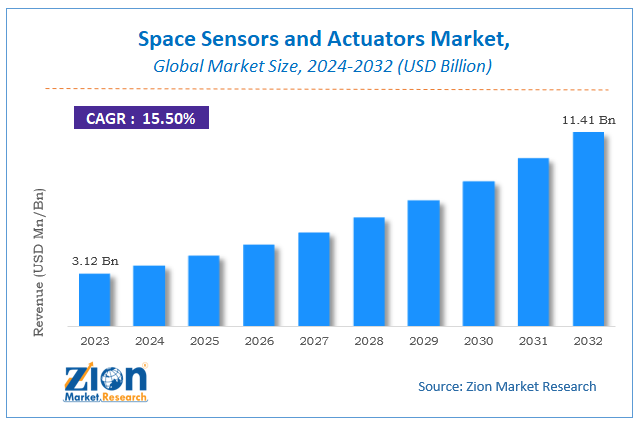
Global Space Sensors and Actuators Market: Overview
The sensor is equipment that indicates, measures, and detects specific physical quantities like pressure, light, heat, moisture, motion, and other similar entities. On other hand, the actuator is a device that assists in achieving physical movements by transforming energy into mechanical force.
Global Space Sensors and Actuators Market: Growth Factors
The global space sensors and actuators market is expected to grow with a high CAGR due to its growing trend during the forecast period. The ongoing technological advancements in the field of space science and technology along with the surging number of satellites being launched frequently will further complement the growth of the market. The growing investment in various missions for space exploration like the Moon and Mars is further likely to fuel the demand for space sensors and actuators globally. The post Covid-19 market landscape is likely to skyrocket the growth due to its speedy recovery after worldwide lockdown owing to the spread of coronavirus. The innovation of radiation-hardened electro-optical space sensors will significantly escalate the growth of the market.
Radiation deeply affects space systems and creates critical issues in different fields like space electronics, high energy physics experiments, medical instruments, and nuclear applications that require precise sensing and effective control of environmental parameters. The silicone-based integrated devices are affected by both instantaneous and accumulated radiation effects, including single event effect or total ionizing dose which further modifies the device parameters. Therefore, to lower the effect of radiation on the system, circuit, and sensors different radiation hardening devices are innovated, namely, radiation-hardened by device, radiation hardening by shielding, and radiation-hardened by the process.
These techniques play a vital role in guaranteeing the safety and reliability of the sensor system that is required to tolerate extreme radiation in the environment with effective operational activities. The development of advanced actuators for launch vehicles and small satellites is likely to create many lucrative growth opportunities in the forthcoming years. The growth in the complex instruments in robotic machines will also escalate the need for activation functions.
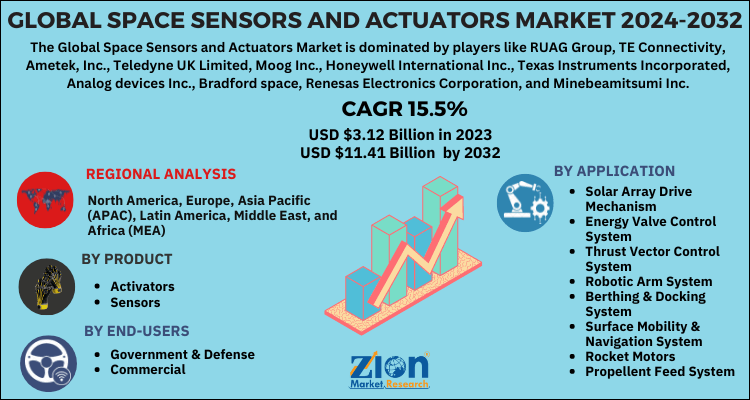
Global Space Sensors and Actuators Market: Segmentation
The global space sensors and actuators market can be segmented into end-user, application, product, and region.
By end-users, the market can be segmented into government & defense and commercial. The commercial segment accounts for the largest share in the global space sensors and actuators market due to the increasing number of satellite constellation providers like SpaceX, OneWeb, and others.
By application, the market can be segmented into solar array drive mechanism, energy valve control system, thrust vector control system, robotic arm system, berthing & docking system, surface mobility & navigation system, rocket motors, propellent feed system, thermal system, telemetric, tracking & command, command & data handling system attitude, orbital control system and others.
By product, the market can be segmented into activators and sensors. The sensors segment accounts for the largest share in the global space sensors and actuators market. The sensors segment can further be bifurcated into flow sensors, gravity sensors, proximity sensors, vibration sensors, spectrometers, vacuum ultraviolet photodetectors, GPS sensors, position & velocity sensors, image sensors, humidity sensors, attitude measurements, pressure sensors, and others.
Space Sensors and Actuators Market: Report Scope
| Report Attributes | Report Details |
|---|---|
| Report Name | Space Sensors and Actuators Market |
| Market Size in 2023 | USD 3.12 Billion |
| Market Forecast in 2032 | USD 11.41 Billion |
| Growth Rate | CAGR of 15.5% |
| Number of Pages | 194 |
| Key Companies Covered | RUAG Group, TE Connectivity, Ametek, Inc., Teledyne UK Limited, Moog Inc., Honeywell International Inc., Texas Instruments Incorporated, Analog devices Inc., Bradford space, Renesas Electronics Corporation, and Minebeamitsumi Inc |
| Segments Covered | By end-user, By application, By product and By Region |
| Regions Covered | North America, Europe, Asia Pacific (APAC), Latin America, Middle East, and Africa (MEA) |
| Base Year | 2023 |
| Historical Year | 2018 to 2022 |
| Forecast Year | 2024 - 2032 |
| Customization Scope | Avail customized purchase options to meet your exact research needs. Request For Customization |
Global Space Sensors and Actuators Market: Regional analysis
North America accounts for the largest share in the global space sensors and actuators market due to the surging demand for commercial Mars and lunar moon missions. The growing deployment of orbital satellites in Moon exploration is likely to further propel the growth of the regional market in the forthcoming years.
Asia Pacific is expected to witness a significant growth rate in forthcoming years due to the growing initiatives and funding from the government to encourage space missions in the region.
Global Space Sensors and Actuators Market: Competitive Players
Some of the significant players in the global space sensors and actuators market are
- RUAG Group
- TE Connectivity
- Ametek, Inc
- Teledyne UK Limited
- Moog Inc
- Honeywell International Inc
- Texas Instruments Incorporated
- Analog devices Inc
- Bradford space
- Renesas Electronics Corporation
- Minebeamitsumi Inc
The global Space Sensors and Actuators Market is segmented as follows:
By Product
- Activators
- Sensors
By Application
- Solar Array Drive Mechanism
- Energy Valve Control System
- Thrust Vector Control System
- Robotic Arm System
- Berthing & Docking System
- Surface Mobility & Navigation System
- Rocket Motors
- Propellent Feed System
- Thermal System
- Telemetric
- Tracking & Command
- Command & Data Handling System Attitude
- Orbital Control System
- Others
By End-Users
- Government & Defense
- Commercial
By Region
- North America
- The U.S.
- Canada
- Mexico
- Europe
- France
- The UK
- Spain
- Germany
- Italy
- Rest of Europe
- Asia Pacific
- China
- Japan
- India
- Australia
- South Korea
- Rest of Asia Pacific
- The Middle East & Africa
- Saudi Arabia
- UAE
- Egypt
- Kuwait
- South Africa
- Rest of the Middle East & Africa
- Latin America
- Brazil
- Argentina
- Rest of Latin America
What Reports Provides
- Full in-depth analysis of the parent market
- Important changes in market dynamics
- Segmentation details of the market
- Former, on-going, and projected market analysis in terms of volume and value
- Assessment of niche industry developments
- Market share analysis
- Key strategies of major players
- Emerging segments and regional markets
- Testimonials to companies in order to fortify their foothold in the market.
Table Of Content

FrequentlyAsked Questions
Space sensors and actuators are components used in spacecraft systems. They detect conditions and control movement or operations.
The global Space Sensors and Actuators market is expected to be driven by the Fueled by increasing satellite launches, miniaturization of spacecraft, and demand for precise attitude/orbit control. Growth in Earth observation and communications constellations drives component demand.
According to study, the global Space Sensors and Actuators market size was worth around USD 3.12 Billion in 2023 and is predicted to grow to around USD 11.41 Billion By 2032.
The global Space Sensors and Actuators market is expected to grow at a Compound Annual Growth Rate (CAGR) of around CAGR 15.5% during the forecast period from 2024-2032.
The global Space Sensors and Actuators industry is projected to be challenged by Challenges include long qualification cycles, strict reliability requirements, and high costs due to low-volume specialized manufacturing.
The Opportunities include growth in LEO constellations, increased defense space spending, miniaturization trends, and expanding commercial satellite applications will offer significant growth opportunities in the Space Sensors and Actuators market.
Radiation-hardened miniaturized components for small satellites; MEMS-based sensors and precision actuators; on-orbit autonomy with health monitoring and self-calibration are the emerging trends and innovations impacting the Space Sensors and Actuators market.
The global Space Sensors and Actuators market is expected to be led by North America during the forecast period.
Some of the prominent players operating in the global Space Sensors and Actuators market are; RUAG Group, TE Connectivity, Ametek, Inc., Teledyne UK Limited, Moog Inc., Honeywell International Inc., Texas Instruments Incorporated, Analog devices Inc., Bradford space, Renesas Electronics Corporation, and Minebeamitsumi Inc and others.
The report explores crucial aspects of the Space Sensors and Actuators market, including a detailed discussion of existing growth factors and restraints, while also browsing future growth opportunities and challenges that impact the market.
HappyClients

