
Solo Travel Market Size, Trend, Growth, Industry Analysis 2034

Solo Travel Market By Travel Type (Business Travel, Cultural & Heritage Travel, Adventure & Extreme Travel, Leisure & Vacation Travel, Eco Travel, Safari & Wildlife Travel, and Others), By Type (Domestic and International), By Gender (Female and Male), By Booking Mode (Marketplace Booking, Direct Booking, and Online Travel Agents & Agencies (OTAs), By Age Group (18-24 Years, 25-40 Years, 41-56 Years, and Above 56 Years), and By Region - Global and Regional Industry Overview, Market Intelligence, Comprehensive Analysis, Historical Data, and Forecasts 2025 - 2034
| Market Size in 2024 | Market Forecast in 2034 | CAGR (in %) | Base Year |
|---|---|---|---|
| USD 1,148.73 Billion | USD 2,698.45 Billion | 9.79% | 2024 |
Solo Travel Industry Perspective:
What is the anticipated size of the solo travel market during the projection period?
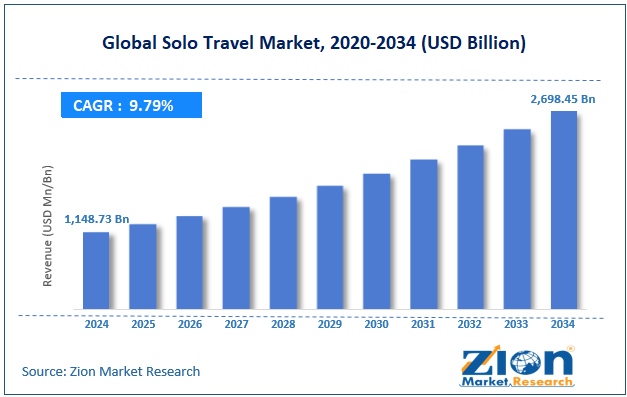
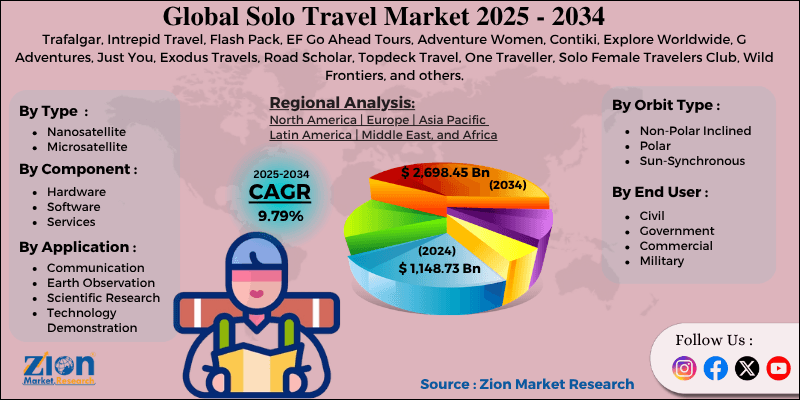
The global solo travel market size was worth around USD 1,148.73 billion in 2024 and is predicted to grow to around USD 2,698.45 billion by 2034 with a compound annual growth rate (CAGR) of roughly 9.79% between 2025 and 2034.
Solo Travel Market: Overview
Solo travel refers to the process of visiting new locations for personal or business purposes alone. It involves traveling without companions and is generally preferred by travelers seeking total freedom during travel. Solo traveling allows for more flexibility, as the traveler can choose to accompany other travelers across various locations. It is considered an excellent way of self-discovery and heightened awareness. However, solo traveling can be more expensive, especially when visiting offbeat or remote locations. It also poses safety risks. During the forecast period, the solo travel market is expected to benefit from evolving consumer lifestyles, increased spending on travel & tourism, infrastructure development, and the emergence of a remote work culture. The market may remain restricted due to cost barriers, growing geopolitical tension, and safety concerns.
Key Insights:
- As per the analysis shared by our research analyst, the global solo travel market is estimated to grow annually at a CAGR of around 9.79% over the forecast period (2025-2034)
- In terms of revenue, the global solo travel market size was valued at around USD 1,148.73 billion in 2024 and is projected to reach USD 2,698.45billion by 2034.
- The market is projected to grow at a significant rate due to the evolving lifestyle of the general population.
- Based on the travel type, the leisure & vacation travel segment is growing at a high rate and will continue to dominate the global market, as per industry projections
- Based on the type, the domestic segment is anticipated to command the largest market share.
- Based on gender, the male segment is expected to lead the market growth trends.
- Based on the booking mode, the online travel agents & agencies (OTAs) segment is projected to influence revenue in the market.
- Based on the group, the 25-40-year-olds will emerge as the fastest-growing segment.
- Based on region, Europe is projected to dominate the global market during the forecast period.
Impact of the USA-Israel and Iran war on the Solo Travel Market:
The USA-Israel and Iran war has affected travel plans for millions of enthusiasts around the globe. According to official reports, Middle Eastern countries are losing more than USD 590 million every day in the tourism industry since the war began. Until the geopolitical situation eases, more countries are expected to register reduced revenue in the tourism and travel sector. During the forecast period, the war is anticipated to encourage domestic travel and a heightened number of travelers seeking unexplored regions.
Solo Travel Market: Dynamics
Growth Drivers
What will be the influence of evolving consumer lifestyles on the solo travel market?
The global solo travel market is expected to be driven by the evolving lifestyle of the general population. Since the COVID-19 pandemic, people have shown a greater inclination toward spending significantly on unique travel experiences. As per market research, more than 20% of travel enthusiasts prefer solo traveling, especially in the age group of 25 to 44 years. Traveling freedom by solo travel is cited as the primary reason among 90% of independent travelers. Furthermore, increased disposable income, the emergence of novel forms of employment, and a general shift in consumer preferences have helped the market thrive.
Infrastructure development to promote industry growth in the coming years
Governments across the globe have amplified investments toward upgrading travel and tourism-oriented infrastructure. They are working on ensuring traveler convenience and safety. These developments can be registered in the form of improved connectivity to off-beat locations, expansion of railway networks, modernization of airports, and introduction of smart transport technologies. The global solo travel market will continue benefiting from such investments, as these solutions make travel easy and carefree.
Restraints
How will budget constraints limit the expansion of the solo travel market?
The global solo travel industry is expected to be restricted due to budget constraints. Solo traveling can be more expensive than group travel since it requires the traveler to deal with all expenses alone. In addition, tour organizers generally charge more per person when traveling alone as compared to catering to a group. Global economic uncertainty at present may affect business revenue in the long run.
Opportunities
Emergence of a remote and hybrid work culture to create growth opportunities
The global solo travel market is anticipated to generate growth opportunities due to the emergence of a remote and hybrid work culture. It allows more freedom to employees. They work from different geographical locations and spend their personal time exploring new areas. The digital nomadic lifestyle has become more popular among the younger population who do not wish to invest in long-term permanent assets such as residential homes, but use the money to gain travel experience.
How will the digitalization of the travel industry shape the solo travel market?
The rapid digitalization of the travel industry has worked in favor of solo travel. It includes the use of digital applications and websites to research, book tickets, accommodations, and navigate through unfamiliar destinations with ease. In addition, travel industry digitalization has also helped improve safety features, further encouraging more people to opt for solo traveling.
Challenges
Safety challenges and competition from travel forms challenge market growth
The global solo travel industry is projected to be challenged by safety concerns and competition from conventional travel forms. According to industry analysis, more than 59% of women face safety concerns as major barriers against solo traveling. Furthermore, competition from conventional forms of travel, such as group tours and tourism with families or friends, continues to fragment market revenue.
Solo Travel Market: Report Scope
| Report Attributes | Report Details |
|---|---|
| Report Name | Solo Travel Market |
| Market Size in 2024 | USD 1,148.73 Billion |
| Market Forecast in 2034 | USD 2,698.45 Billion |
| Growth Rate | CAGR of 9.79% |
| Number of Pages | 228 |
| Key Companies Covered | Trafalgar, Intrepid Travel, Flash Pack, EF Go Ahead Tours, Adventure Women, Contiki, Explore Worldwide, G Adventures, Just You, Exodus Travels, Road Scholar, Topdeck Travel, One Traveller, Solo Female Travelers Club, Wild Frontiers, and others. |
| Segments Covered | By Travel Type, By Type, By Gender, By Booking Mode, By Age Group, and By Region |
| Regions Covered | North America, Europe, Asia Pacific (APAC), Latin America, Middle East, and Africa (MEA) |
| Base Year | 2024 |
| Historical Year | 2019 - 2023 |
| Forecast Year | 2025 - 2034 |
| Customization Scope | Avail customized purchase options to meet your exact research needs. Request For Customization |
Solo Travel Market: Segmentation
The global solo travel market is segmented based on travel type, gender, booking mode, age group, and region.
Why will the leisure & vacation travel segment deliver a faster CAGR in the solo travel industry revenue during the forecast period?
Based on travel type, the global market segments are business travel, cultural & heritage travel, adventure & extreme travel, leisure & vacation travel, eco travel, safari & wildlife travel, and others. In 2024, the highest growth was listed in the leisure & vacation travel segment, contributing up to 32.9% of the global revenue. It is expected to deliver a CAGR of 15.5% during the forecast period due to rising disposable income and a shift toward experimental travel.
Which will be the fastest-growing type during the forecast period in the solo travel market?
Based on type, the global solo travel industry is divided into domestic and international. In 2024, the domestic segment led the market growth in revenue, accounting for 63% of the global revenue. During the forecast period, it is projected to emerge as the fastest-growing segment with a CAGR of 14.51%, as domestic travel is relatively more cost-effective and safer.
Why will the male segment continue to lead the solo travel industry in the coming years?
Based on gender, the global market divisions are female and male. In 2024, the highest growth was listed in the male segment, accounting for 75% of the global revenue. It is projected to offer a CAGR of 13.29%, due to safety issues. Female solo travelers are expected to increase in the coming years as safety measures become stricter and more efficient.
What will be the contribution of online travel agents & agencies (OTAs) in the solo travel market during the projection period?
Based on booking mode, the global market is fragmented into marketplace booking, direct booking, and online travel agents & agencies (OTAs). The highest growth rate in 2024 was listed in the online travel agents & agencies (OTAs), leading up to 49% of the global revenue. It is projected to grow at a significant CAGR of 15.67% as online bookings offer convenience and cost benefits.
Which group will emerge as the leading revenue generator in the solo travel market?
Based on the group, the global market divisions are 18-24 years, 25-40 years, 41-56 years, and above 56 years. In 2024, the 25-40 years segment emerged as the prominent group type accounting for 47% of the total market share. It will continue offering a CAGR of 15.67% during the forecast period due to remote work trends and higher travel enthusiasm among the age group.
Solo Travel Market: Regional Analysis
Why will Europe continue to lead the solo travel market during the forecast period?
The global solo travel market is expected to be led by Europe during the forecast period. In 2024, it accounted for 38% of the global revenue and will grow at a CAGR of 14.1% during the forecast period. European citizens are avid travelers. In 2024, more than 250 million European citizens participated in some form of traveling. The presence of a vast natural landscape, a growing number of international tourists from other parts of the world, and a safer environment will aid regional expansion in the coming years.
How is Asia-Pacific expected to perform in the solo travel market during the forecast period?
Asia-Pacific is anticipated to emerge as the fastest-growing region with a CAGR of 17% during the forecast period. It contributed up to 26% of the global revenue. Countries such as Japan, India, China, and South Korea, among other geographically diverse nations, will aid regional growth. Surge in infrastructure development projects, rising disposable income, and efforts toward digitalization of the tourism industry will accelerate growth across the Asia-Pacific.
Solo Travel Market: Competitive Analysis
The global solo travel market is led by players like;'
- Trafalgar
- Intrepid Travel
- Flash Pack
- EF Go Ahead Tours
- Adventure Women
- Contiki
- Explore Worldwide
- G Adventures
- Just You
- Exodus Travels
- Road Scholar
- Topdeck Travel
- One Traveller
- Solo Female Travelers Club
- Wild Frontiers
What are the latest key trends in the solo travel market?
Shift toward eco & cultural travel
A promising trend in the solo travel industry has emerged in the form of higher revenue in eco and cultural tourism. It deals with environmental conservation, sustainable travel practices, and immersive experiences with local traditions, cuisines, and communities.
Community-based travel
Community-based travel deals with solo travelers who eventually engage with other independent travelers. This form of solo traveling is encouraged by the emergence of co-living spaces, activity camps, and group travel itineraries.
The global solo travel market is segmented as follows:
By Travel Type
- Business Travel
- Cultural & Heritage Travel
- Adventure & Extreme Travel
- Leisure & Vacation Travel
- Eco Travel
- Safari & Wildlife Travel
- Others
By Type
- Domestic
- International
By Gender
- Female
- Male
By Booking Mode
- Marketplace Booking
- Direct Booking
- Online Travel Agents & Agencies (OTAs)
By Age Group
- 18-24 Years
- 25-40 Years
- 41-56 Years
- Above 56 Years
By Region
- North America
- The U.S.
- Canada
- Mexico
- Europe
- France
- The UK
- Spain
- Germany
- Italy
- Rest of Europe
- Asia Pacific
- China
- Japan
- India
- Australia
- South Korea
- Rest of Asia Pacific
- The Middle East & Africa
- Saudi Arabia
- UAE
- Egypt
- Kuwait
- South Africa
- Rest of the Middle East & Africa
- Latin America
- Brazil
- Argentina
- Rest of Latin America
Table Of Content
Methodology
FrequentlyAsked Questions
Solo travel refers to the process of visiting new locations for personal or business purposes alone.
The global solo travel market is expected to be driven by the evolving lifestyle of the general population.
According to study, the global solo travel market size was worth around USD 1,148.73 billion in 2024 and is predicted to grow to around USD 2,698.45 billion by 2034.
The CAGR value of the solo travel market is expected to be around 9.79% during 2025-2034.
The global solo travel industry is projected to be challenged by safety concerns and competition from conventional travel forms.
Shift toward eco & cultural travel and community-based travel are the emerging trends and innovations impacting the solo travel market.
The global solo travel market has performed well so far and will offer similar trends in the coming years.
Asia-Pacific is anticipated to emerge as the fastest-growing region with a CAGR of 17% during the forecast period.
The global solo travel market is led by players like Trafalgar, Intrepid Travel, Flash Pack, EF Go Ahead Tours, Adventure Women, Contiki, Explore Worldwide, G Adventures, Just You, Exodus Travels, Road Scholar, Topdeck Travel, One Traveller, Solo Female Travelers Club, and Wild Frontiers.
The report explores crucial aspects of the solo travel market including detailed discussion of existing growth factors and restraints while also browsing future growth opportunities and challenges that impact the market.

HappyClients

