
Global Solar Photovoltaic Material Market Size, Share, Growth Report 2032

Solar Photovoltaic Material Market By Technology (Concentrated Solar Power Systems (CSP) and Photovoltaic Cells), By Application (Cadmium Telluride Silicon Cells, Monocrystalline Silicon Cells, Amorphous Silicon Cells, Polycrystalline Silicon Cells, and Others), By Generation (1st, 2nd, and 3rd), and By Region - Global And Regional Industry Overview, Market Intelligence, Comprehensive Analysis, Historical Data, And Forecasts 2024-2032
| Market Size in 2023 | Market Forecast in 2032 | CAGR (in %) | Base Year |
|---|---|---|---|
| USD 97.43 Billion | USD 229.72 Billion | 10.00% | 2023 |
Solar Photovoltaic Material Industry Perspective
What will be the global solar photovoltaic material market size during the forecast period?
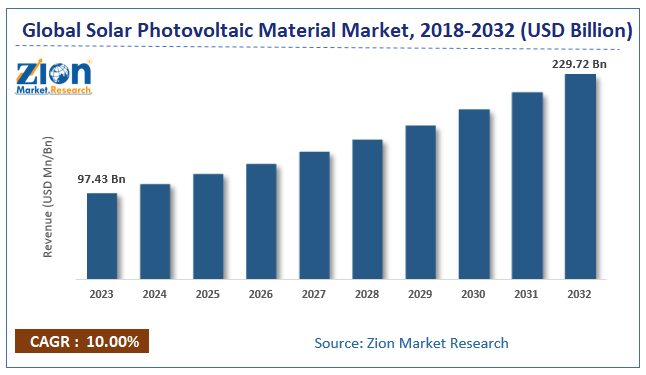
The global solar photovoltaic material market size was worth around USD 97.43 billion in 2023 and is expected to grow to around USD 229.72 billion by 2032, at a compound annual growth rate (CAGR) of roughly 10.00% between 2024 and 2032.
This report provides a comprehensive analysis of the growth drivers, restraints, and challenges shaping demand across the global solar photovoltaic material market throughout the forecast period, while highlighting high-potential emerging opportunities within the industry.
Key Insights
- As per the analysis shared by our research analyst, the solar photovoltaic material market is anticipated to grow at a CAGR of 10.00% during the forecast period.
- The global solar photovoltaic material market was estimated to be worth approximately USD 97.43 billion in 2023 and is projected to reach a value of USD 229.72 billion by 2032.
- The growth of the solar photovoltaic material market is being driven by the increasing global demand for clean and renewable energy sources to reduce greenhouse gas emissions and dependence on fossil fuels.
- Based on the technology, the concentrated solar power systems (CSP) segment is growing at a high rate and is projected to dominate the market.
- On the basis of application, the cadmium telluride silicon cells segment is projected to swipe the largest market share.
- In terms of generation, the 1st segment is expected to dominate the market.
- By region, Asia Pacific is estimated to be the strong contributor with a major revenue share to the global solar photovoltaic material market, with China anticipated as the major dominating market in the region due to increasing demand for solar photovoltaic installations in the power production sector.
Solar Photovoltaic Material Market: Overview
Photovoltaic materials are used for the conversion of solar energy into power generation. Photovoltaic power generation consists of solar panels, which include a number of solar cells containing a photovoltaic material. Solar photovoltaic installations can be rooftop-mounted or wall-mounted, and it can also be ground-mounted. Solar photovoltaic materials are available in two kinds, which include thin film and crystalline. Further, crystalline material is categorized into gallium arsenide and polycrystalline. Moreover, the thin film material is categorized into amorphous silicon, cadmium telluride, and copper indium diselenide.
Rising concerns regarding environmental issues owing to the increase in the use of conventional energy sources lead to the increase in the acceptance of solar energy. Moreover, increasing greenhouse gas emissions lead to the rising demand for clean energy, which in turn is bolstering the solar photovoltaic material market.
Solar Photovoltaic Material Market: Dynamics
Growth Drivers
What factors are accelerating demand for solar photovoltaic material?
Rising concerns regarding environmental issues resulting from increased use of conventional energy sources are leading to greater acceptance of solar energy. Increasing greenhouse gas emissions are driving demand for clean energy, which in turn is bolstering the solar photovoltaic material market.
Increasing research and development activities for the innovation of new materials, combined with lower production prices and improved power conversion effectiveness, will support growth of the global solar photovoltaic materials market during the forecast period. These factors collectively expand installation capacity and material consumption across residential, commercial, and utility-scale projects.
Restraints
What barriers are limiting market expansion?
Materials used in solar photovoltaic systems are found to be difficult to recycle or reuse, which tends to cause a negative impact on the environment and can hamper market growth. End-of-life management challenges and associated environmental concerns may slow adoption in regions with strict sustainability requirements.
Supply chain concentration and price volatility for key raw materials can also affect cost stability and project economics, particularly for large-scale deployments.
Solar Photovoltaic Material Market: Report Scope
| Report Attributes | Report Details |
|---|---|
| Report Name | Solar Photovoltaic Material Market |
| Market Size in 2023 | USD 97.43 Billion |
| Market Forecast in 2032 | USD 229.72 Billion |
| Growth Rate | CAGR of 10.00% |
| Number of Pages | 250 |
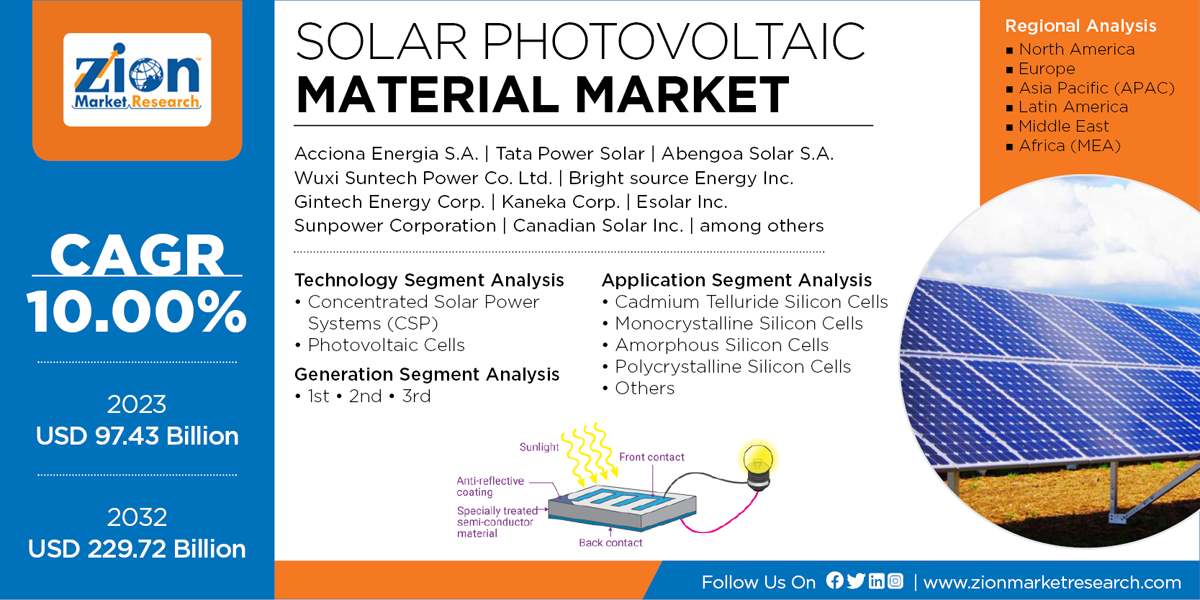
| Key Companies Covered | Acciona Energia S.A., Tata Power Solar, Abengoa Solar S.A., Wuxi Suntech Power Co. Ltd., Bright Source Energy Inc., Gintech Energy Corp., Kaneka Corp., Esolar Inc., Sunpower Corporation, Canadian Solar Inc., among others. |
| Segments Covered | By Technology, By Application, By Generation, And By Region |
| Regions Covered | North America, Europe, Asia Pacific (APAC), Latin America, Middle East, and Africa (MEA) |
| Base Year | 2023 |
| Historical Year | 2018 - 2022 |
| Forecast Year | 2024 - 2032 |
| Customization Scope | Avail customized purchase options to meet your exact research needs. Request For Customization |
Solar Photovoltaic Material Market: Segmentation
The solar photovoltaic material market is segmented by technology, application, generation, and region. All the segments of the solar photovoltaic material market have been analyzed based on present and future trends and the market is estimated from 2024 to 2032.
On the basis of technology, the solar photovoltaic material market is bifurcated into concentrated solar power systems (CSP) and photovoltaic cells. The concentrated solar power systems (CSP) segment is growing at a high rate and is projected to dominate the market due to its ability to generate electricity through concentrated sunlight and thermal storage potential that supports dispatchable renewable power. This dominance drives market growth by enabling large-scale power production applications and stimulating demand for specialized materials. Photovoltaic cells form the complementary and widely deployed category that underpins distributed and utility-scale solar generation through direct conversion of sunlight into electricity.
Based on the application, the solar photovoltaic material market is divided into cadmium telluride silicon cells, monocrystalline silicon cells, amorphous silicon cells, polycrystalline silicon cells, and others. The cadmium telluride silicon cells segment is projected to capture the largest market share owing to cost-effectiveness and performance characteristics suited to thin-film applications that support competitive solar module production. This leadership helps expand overall market volume by enabling affordable large-scale deployments. Monocrystalline silicon cells represent a strong secondary category valued for higher efficiency and widespread use in high-performance modules that drive technology advancement and premium market segments.
Based on the generation, the market is divided into 1st, 2nd, and 3rd. The 1st generation segment is expected to dominate the market as it encompasses established crystalline silicon technologies that continue to account for the majority of global solar installations due to proven performance, manufacturing scale, and cost reductions. This dominance anchors market volume and supports ongoing incremental improvements.
Solar Photovoltaic Material Market: Regional Analysis
Why will Asia Pacific continue to dominate the global market during the projection period?
Regionally, Asia Pacific is estimated to be a strong contributor with a major revenue share to the global solar photovoltaic material market. China is anticipated to be the major dominating market in the region. Growth is attributed to the increasing demand for solar photovoltaic installations in the power production sector. Expanding manufacturing capacity, strong policy support for renewable energy, and large-scale project pipelines further reinforce the region’s leadership. These factors enable Asia Pacific to drive global market growth, influence material innovation, and accelerate deployment of photovoltaic technologies across utility and distributed applications.
Moreover, North America accounted for a considerable share in 2023. The region is anticipated to experience an escalating demand for solar photovoltaic materials. The growth is attributed to growing photovoltaic installations in countries such as the U.S. and Canada. Additionally, an increasing number of companies manufacturing photovoltaic materials are projected to further boost the market growth in upcoming years. The Middle East & Africa, Latin America, and Europe are projected to grow at a steady pace in the market during the forecast timeline.
Solar Photovoltaic Material Market: Competitive Analysis
Some of the strong players operating in the global solar photovoltaic material market are:
- Acciona Energia S.A.
- Tata Power Solar
- Abengoa Solar S.A.
- Wuxi Suntech Power Co. Ltd.
- Bright Source Energy Inc.
- Gintech Energy Corp.
- Kaneka Corp.
- Esolar Inc.
- Sunpower Corporation
- Canadian Solar Inc.
Segments Covered
The global solar photovoltaic material market is segmented as follows:
By Technology
- Concentrated Solar Power Systems (CSP)
- Photovoltaic Cells
By Application
- Cadmium Telluride Silicon Cells
- Monocrystalline Silicon Cells
- Amorphous Silicon Cells
- Polycrystalline Silicon Cells
- Others
By Generation
- 1st
- 2nd
- 3rd
By Region
- North America
- The U.S.
- Canada
- Mexico
- Europe
- France
- The UK
- Spain
- Germany
- Italy
- Rest of Europe
- Asia Pacific
- China
- Japan
- India
- Australia
- South Korea
- Rest of Asia Pacific
- The Middle East & Africa
- Saudi Arabia
- UAE
- Egypt
- Kuwait
- South Africa
- Rest of the Middle East & Africa
- Latin America
- Brazil
- Argentina
- Rest of Latin America
Table Of Content
Methodology
FrequentlyAsked Questions
Solar photovoltaic materials are the key components used to convert sunlight into electricity in photovoltaic systems. They form the active layers in solar cells and modules that enable power generation from solar energy.
According to study, the global solar photovoltaic material market size was worth around USD 97.43 billion in 2023 and is predicted to grow to around USD 229.72 billion by 2032.
The CAGR value of solar photovoltaic material market is expected to be around 10.00% during 2024-2032.
Asia Pacific is expected to contribute notably and lead the global solar photovoltaic material market, with China as the major market supported by strong demand for solar photovoltaic installations in power production.
The global solar photovoltaic material market is led by players like Acciona Energia S.A., Tata Power Solar, Abengoa Solar S.A., Wuxi Suntech Power Co. Ltd., Bright source Energy Inc., Gintech Energy Corp., Kaneka Corp., Esolar Inc., Sunpower Corporation, Canadian Solar Inc., among others.
Key growth drivers include increasing global demand for clean and renewable energy sources to reduce greenhouse gas emissions and dependence on fossil fuels, rising environmental concerns, and research and development supporting new materials with improved efficiency and lower production costs.
The report provides a detailed examination of growth drivers, restraints, opportunities, and challenges, along with comprehensive segmentation analysis, regional insights, competitive landscape, and forward-looking forecasts for the solar photovoltaic material market.

HappyClients

