Smart Travel Sector Market Size, Growth, Global Trends, Forecast 2034

Smart Travel Sector Market By Solution (Smart Ticketing, Smart City Bots, Smart Parking, Smart Security Services, and Others), By Booking Channel (Phone Booking, In-Person Booking, and Online Booking), By Tourism Type (Domestic and International), By Tourist Type (Independent Traveler, Package Traveler, and Tour Group), and By Region - Global and Regional Industry Overview, Market Intelligence, Comprehensive Analysis, Historical Data, and Forecasts 2026 - 2034
| Market Size in 2025 | Market Forecast in 2034 | CAGR (in %) | Base Year |
|---|---|---|---|
| USD 39.5 Billion | USD 145.6 Billion | 15.6% | 2025 |
Smart Travel Sector Industry Perspective:
What will be the size of the global smart travel sector market during the forecast period?
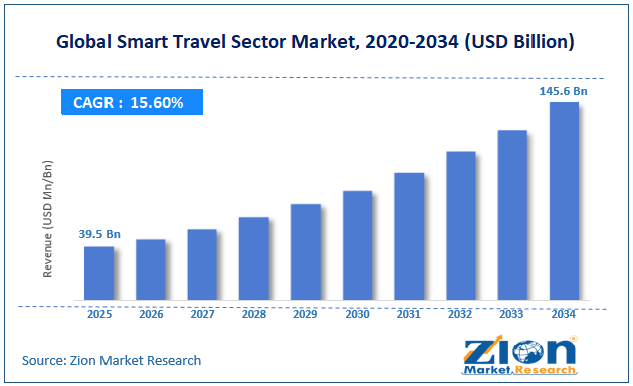
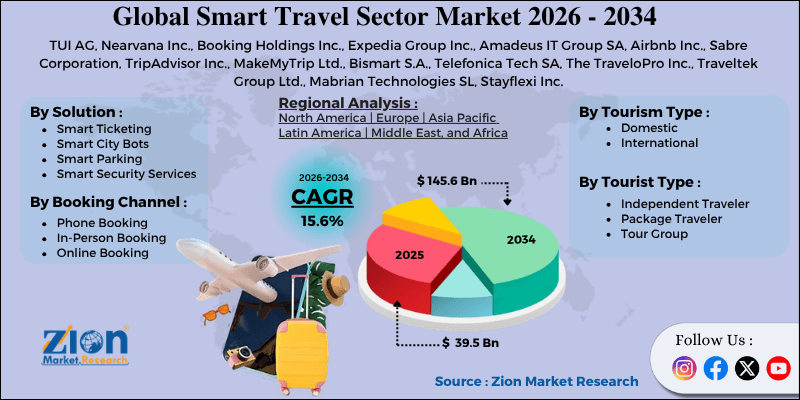
The global smart travel sector market size was worth around USD 39.5 billion in 2025 and is predicted to grow to around USD 145.6 billion by 2034, with a compound annual growth rate (CAGR) of roughly 15.6% between 2026 and 2034.
Smart Travel Sector Market: Overview
Smart travel sector refers to the deployment of modern technological innovations, connected infrastructure, and intelligent, data-driven solutions within the travel and tourism domain to improve travel processes in terms of efficiency, convenience, safety, and customization. It involves the deployment of innovative technologies such as artificial intelligence (AI), the Internet of Things (IoT), cloud computing, big data analytics, blockchain, mobile apps, biometric authentication, and smart transportation by airlines, hotels, airports, online travel agencies, tourism boards, and mobility providers. The application of smart travel solutions enables travel processes to be conducted in real time through contactless solutions, personalized suggestions, automated operations, and improved connectivity among different stakeholders in the travel business.
Key Insights
- As per the analysis shared by our research analyst, the global smart travel sector market is estimated to grow annually at a CAGR of around 15.6% over the forecast period (2026-2034).
- In terms of revenue, the global smart travel sector market size was valued at around USD 39.5 billion in 2025 and is projected to reach USD 145.6 billion by 2034.
- Rising adoption of AI and data analytics is expected to propel the smart travel sector market over the projected period.
- Based on the solution, the smart ticketing segment held the largest market share in 2025.
- Based on the booking channel, the phone booking segment captures a majority of the revenue share in the market.
- Based on the tourism type, the international segment is growing at a substantial rate over the projected period.
- Based on the tourist type, the package traveler segment dominates the market.
- Based on region, North America captures a major market share in 2025.
Impact of the USA-Israel War on Iran on the Smart Travel Sector Market
The USA-Israeli dispute over Iran led to short-term issues in the smart travel sector due to geopolitical tensions, including canceled flights, closed airspace, and altered international travel routes in the Middle East. This caused a temporary decline in demand for tourist services and business travel, leading to additional expenses for travel service providers and airlines. At the same time, the dispute between the countries led to even greater use of smart travel technology such as route optimization via artificial intelligence, travel alerts, digital assistance, contactless solutions, and risk prediction.
Smart Travel Sector Market: Dynamics
Growth Drivers
How does the increasing smartphone and mobile internet penetration drive the smart travel sector market?
The increasing number of smartphone users and mobile Internet connectivity will be one of the key drivers of the smart travel sector market. This is because people are increasingly turning to mobile devices to perform all travel-related activities, including destination searches, booking tickets and accommodation, accessing digital boarding passes, obtaining travel information, directions, translations, and more. Also, mobile connectivity will help travelers use AI travel assistants, make contactless payments, receive location-based recommendations, get instant customer support, and enjoy other benefits. The International Telecommunication Union estimates that by 2025, there will be around 6 billion Internet users, representing 74% of the global population.
Moreover, according to the GSMA, by the end of 2023, there were 4.6 billion mobile Internet users, representing 57% of the global population. At that point, mobile Internet will remain one of the main ways to access travel websites in many countries. In India, according to early 2024 data, there are 751.5 million Internet users, with an Internet penetration rate of 52.4%.
Restraints
High initial investment and infrastructure costs hamper the growth of the smart travel sector industry
The expensive nature of investment and infrastructure development remains one of the significant barriers that hinder the growth of the smart travel sector market because the deployment of new technologies such as AI, IoT, biometric identification, cloud computing, intelligent airport infrastructures, and digital payment systems entails an initial expense of huge sums of money. Airlines, airports, hotels, public transport service providers, and tourism companies will have to incur the costs of investing in high-speed internet services, cybersecurity measures, integration software, employee training in the use of technologies, and technology maintenance. These expenses could prove costly for small firms and SMEs, as well as for tourism organizations operating in developing nations. They could act as a barrier to the pace of digitization.
Opportunities
How does the increasing innovative product launch offer a lucrative opportunity for the smart travel sector market?
Increasing innovative product launch is expected to offer a potential opportunity to the smart travel sector market. For instance, in July 2026, Airwheel officially unveiled its state-of-the-art intelligent suitcase, SE3SXD, marking the start of a new era of rideable cabin bags with electric mobility and AI connectivity that comply with airway regulations for travelers worldwide. As the world of travel evolves, more and more travelers seek a new sense of freedom. Even though traditional luggage is necessary for storing items, it still fails to offer an experience beyond simple transportation.
Challenges
How does the data privacy and cybersecurity concerns pose a significant challenge to the smart travel sector market?
The issues regarding data privacy and security pose a significant challenge for the smart travel sector market, as all services provided via smart travel applications collect large amounts of sensitive data, including passport information, biometrics, bank card details, itineraries, and location data. The increased application of artificial intelligence systems, cloud computing technologies, IoT, and mobile apps increases the possible number of attack vectors that may be used by cyber criminals to cause damage to the company, through the breach of the system or ransomware attacks, as well as identity theft and hacking of the information infrastructure of the travel firm. Compliance with the GDPR and other strict data protection laws adds complexity to processes and increases expenses.
Smart Travel Sector Market: Report Scope
| Report Attributes | Report Details |
|---|---|
| Report Name | Smart Travel Sector Market |
| Market Size in 2025 | USD 39.5 Billion |
| Market Forecast in 2034 | USD 145.6 Billion |
| Growth Rate | CAGR of 15.6% |
| Number of Pages | 228 |
| Key Companies Covered | TUI AG, Nearvana Inc., Booking Holdings Inc., Expedia Group Inc., Amadeus IT Group SA, Airbnb Inc., Sabre Corporation, TripAdvisor Inc., MakeMyTrip Ltd., Bismart S.A., Telefonica Tech SA, The TraveloPro Inc., Traveltek Group Ltd., Mabrian Technologies SL, Stayflexi Inc., Moca Technologies LLC, Cubic Corporation, LamasaTech Ltd., FlippARGo Technologies Pvt. Ltd., Imvizar Limited, Smartvel S.A., and others. |
| Segments Covered | By Solution, By Booking Channel, By Tourism Type, By Tourist Type, and By Region |
| Regions Covered | North America, Europe, Asia Pacific (APAC), Latin America, Middle East, and Africa (MEA) |
| Base Year | 2025 |
| Historical Year | 2020 - 2024 |
| Forecast Year | 2026 - 2034 |
| Customization Scope | Avail customized purchase options to meet your exact research needs. Request For Customization |
Smart Travel Sector Market: Segmentation
Solution Insights
Why does the smart ticketing segment hold a prominent position in the smart travel sector market?
The smart ticketing segment held the largest share in the smart travel sector industry in 2025. The growth is a result of the rising popularity of contactless and mobile ticketing technologies used by airlines, railway services, metros, buses, ferries, and tourist attractions. Public transport companies are intensifying their efforts to develop digital mobility technologies and integrated transport systems that will deliver better services and reduce operational costs. The increasing popularity of mobile devices and contactless ticketing via QR codes, digital wallets, and cloud technology has also contributed to higher demand for contactless payments.
Booking Channel Insights
Why does the phone booking segment capture the largest share in the smart travel sector market?
The phone booking segment captures the majority of revenue in the smart travel sector market. The growth is being driven by smartphone penetration, mobile Internet access, and travel mobile apps. Travelers are opting to book flights, hotels, car rentals, travel packages, and other travel services on their smartphones for the convenience they offer. The advantages of booking platforms include real-time price comparison, immediate booking confirmation, mobile payment services, mobile boarding passes, and personalized travel recommendations.
Tourism Type Insights
Does the international segment capture the largest share in the smart travel sector market?
The international segment is growing at a substantial rate in the smart travel sector industry over the projected period. The growth in numbers is due to the ongoing recovery in cross-border travel, higher volumes of business travel, and the rising demand for hassle-free travel enabled by digital technologies. Travelers today rely more and more on smart travel technologies such as AI-based itinerary planning, mobile booking apps, biometric identification, digital visas, contactless airport operations, and real-time travel updates to make international travel easier. The widespread use of e-passports, automatic border control systems, and smart airports has made the process of travelers' clearance more efficient.
Tourist Type Insights
Why does the package traveler segment capture the largest share in the smart travel sector market?
The package traveler segment dominates the smart travel sector market. The above growth is attributed to increased customer preference for convenient, cost-effective, and online travel packages. Customers are increasingly opting for travel packages that include air tickets, hotels, local transportation at the destination, visits to tourist attractions, travel insurance, and entertainment tickets. Smart travel websites leverage AI, analytics, and learning algorithms to create customized travel packages for travelers.
Regional Insights
Why does North America lead the smart travel sector market?
The North American region is expected to account for a significant share of revenue growth in the smart travel sector market. This will be facilitated by the region's high level of digitization, widespread adoption of AI and cloud technologies, high smartphone penetration, and presence of major travel technology firms, airlines, and travel portals. The region is also continuing to invest heavily in smart airports, biometric passenger processing, contactless payment systems, digital identity verification systems, intelligent transportation, and AI-driven travel management. The growing trend of mobile booking and personalized travel services, along with the availability of real-time travel information, is driving the adoption of smart travel technologies in the United States and Canada.
Government statistics also support this growth prediction. The National Travel and Tourism Office reports that the country received 72.39 million international visitors in 2024, up 9.1% from 2023, while American citizens recorded a record 107.71 million departures, up 9.2%.
Smart Travel Sector Market: Competitive Analysis
The global smart travel sector market is dominated by players like:
- TUI AG
- Nearvana Inc.
- Booking Holdings Inc.
- Expedia Group Inc.
- Amadeus IT Group SA
- Airbnb Inc.
- Sabre Corporation
- TripAdvisor Inc.
- MakeMyTrip Ltd.
- Bismart S.A.
- Telefonica Tech SA
- The TraveloPro Inc.
- Traveltek Group Ltd.
- Mabrian Technologies SL
- Stayflexi Inc.
- Moca Technologies LLC
- Cubic Corporation
- LamasaTech Ltd.
- FlippARGo Technologies Pvt. Ltd.
- Imvizar Limited
- Smartvel S.A.
The global smart travel sector market is segmented as follows:
By Solution
- Smart Ticketing
- Smart City Bots
- Smart Parking
- Smart Security Services
- Others
By Booking Channel
- Phone Booking
- In-Person Booking
- Online Booking
By Tourism Type
- Domestic
- International
By Tourist Type
- Independent Traveler
- Package Traveler
- Tour Group
By Region
- North America
- The U.S.
- Canada
- Mexico
- Europe
- France
- The UK
- Spain
- Germany
- Italy
- Rest of Europe
- Asia Pacific
- China
- Japan
- India
- Australia
- South Korea
- Rest of Asia Pacific
- The Middle East & Africa
- Saudi Arabia
- UAE
- Egypt
- Kuwait
- South Africa
- Rest of the Middle East & Africa
- Latin America
- Brazil
- Argentina
- Rest of Latin America
Table Of Content
Methodology
FrequentlyAsked Questions
Smart travel sector refers to the deployment of modern technological innovations, connected infrastructure, and intelligent, data-driven solutions within the travel and tourism domain to improve travel processes in terms of efficiency, convenience, safety, and customization.
The smart travel sector market is primarily driven by the increasing adoption of smartphones and mobile internet, growing demand for seamless and personalized travel experiences, and rapid advancements in artificial intelligence (AI), Internet of Things (IoT), cloud computing, and big data analytics.
The major challenges restraining the growth of the smart travel sector market include high initial investment and infrastructure costs, increasing data privacy and cybersecurity risks, and the complexity of integrating advanced technologies with legacy travel systems.
Based on the tourism type, the international segment is expected to dominate the smart travel sector market growth during the projected period.
Emerging trends and innovations shaping the smart travel sector market include the increasing use of artificial intelligence (AI) for personalized trip planning and virtual travel assistants, the adoption of biometric authentication and contactless travel services at airports and hotels, and the integration of Internet of Things (IoT) devices for real-time tracking and smart mobility.
According to the report, the global smart travel sector market size was worth around USD 39.5 billion in 2025 and is predicted to grow to around USD 145.6 billion by 2034.
The global smart travel sector market is expected to grow at a CAGR of 15.6% during the forecast period.
The global smart travel sector industry growth is expected to be led by North America over the forecast period.
The global smart travel sector market is dominated by players like TUI AG, Nearvana Inc., Booking Holdings Inc., Expedia Group Inc., Amadeus IT Group SA, Airbnb Inc., Sabre Corporation, TripAdvisor Inc., MakeMyTrip Ltd., Bismart S.A., Telefonica Tech SA, The TraveloPro Inc., Traveltek Group Ltd., Mabrian Technologies SL, Stayflexi Inc., Moca Technologies LLC, Cubic Corporation, LamasaTech Ltd., FlippARGo Technologies Pvt. Ltd., Imvizar Limited, and Smartvel S.A., among others.
The smart travel sector market report covers the geographical market along with a comprehensive competitive landscape analysis. It also includes cash flow analysis, profit ratio analysis, market basket analysis, market attractiveness analysis, sentiment analysis, PESTLE analysis, trend analysis, SWOT analysis, trade area analysis, demand & supply analysis, Porter’s five forces analysis, and value chain analysis.

HappyClients