
Smart Shelves Market Size, Share, Growth, Opportunities 2034

Smart Shelves Market By Component (Hardware, Services, and Software), By Application (Planogram Management, Content Management, Pricing Management, Inventory Management, and Others), By End-use (Hypermarkets, Department Stores, Warehouses, Supermarkets, and Others), and By Region - Global and Regional Industry Overview, Market Intelligence, Comprehensive Analysis, Historical Data, and Forecasts 2026 - 2034
| Market Size in 2025 | Market Forecast in 2034 | CAGR (in %) | Base Year |
|---|---|---|---|
| USD 4.6 Billion | USD 35.8 Billion | 25.6% | 2025 |
Smart Shelves Industry Perspective:
What will be the size of the global smart shelves market during the forecast period?
The global smart shelves market size was worth around USD 4.6 billion in 2025 and is predicted to grow to around USD 35.8 billion by 2034, with a compound annual growth rate (CAGR) of roughly 25.6% between 2026 and 2034.
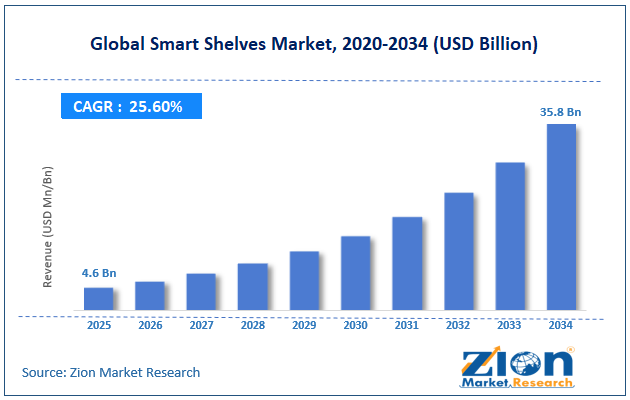
Smart Shelves Market: Overview
Smart shelves market is the term used to describe the global market involved in the manufacture and deployment of highly sophisticated smart shelves technology using the Internet of Things (IoT) sensors, Radio Frequency Identification (RFID), electronic shelf labels (ESL), weighing sensors, computer vision, artificial intelligence (AI), cameras, and cloud analytics for monitoring the products at all times. The smart shelves monitor product availability, check for out-of-stock and missing goods, support dynamic pricing, track products, and analyze customers' purchasing behavior. The smart shelves have been adopted by many retailers as part of their digital transformation and omnichannel retail strategy because the system helps optimize inventory management, reduce shrinkage losses, enable efficient product replenishment, support dynamic pricing, and provide a better consumer experience.
Key Insights
- As per the analysis shared by our research analyst, the global smart shelves market is estimated to grow annually at a CAGR of around 25.6% over the forecast period (2026-2034).
- In terms of revenue, the global smart shelves market size was valued at around USD 4.6 billion in 2025 and is projected to reach USD 35.8 billion by 2034.
- Increasing adoption of retail automation is expected to propel the smart shelves market over the projected period.
- Based on the component, the hardware segment held the largest market share of 48% in 2025.
- Based on the application, the inventory management segment held the largest revenue share in 2025 of over 35%.
- Based on the end-use, the hypermarkets segment captures a significant revenue share of 30% in 2025.
- Based on region, North America leads the smart shelves market with a revenue share of 34.5% in 2025.
Impact of the USA-Israel War on Iran on the Smart Shelves Market
The conflict between the USA and Israel against Iran negatively affected the smart shelves market to some extent during its initial period due to the disruption in the supply chain of electronic components, including semiconductors, radio frequency identification (RFID) components, internet of things (IoT) sensors, electronic shelf labels (ESLs), and others used in the development of smart shelves. Due to rising tensions in the region, the costs of oil, transportation, and transportation insurance increased following the blockage of vital sea routes like the Strait of Hormuz, thereby increasing the cost of implementing smart shelves. But the market recovered from this setback as tensions in the region eased.
Smart Shelves Market: Dynamics
Growth Drivers
Why does the rising demand for real-time inventory management drive the smart shelves market?
The need for real-time inventory management is another key factor driving the growth in the smart shelves market, as retailers strive to improve inventory accuracy, avoid stockouts, and streamline operations. The technology of smart shelves, which includes RFID tags, IoT sensors, weight sensors, computer vision, and AI-powered analytics, provides continuous tracking of product inventory and triggers an alert whenever inventory falls below predetermined thresholds. This way, retailers can reduce their losses from out-of-stock products, reduce excess inventory, and gain better insights into demand forecasts. Moreover, smart shelves enable inventory synchronization not only across different retail outlets but also between physical and online stores. As retailers increasingly focus on efficiency, labor costs, and the customer experience, the global smart shelves market continues to grow.
Restraints
High initial implementation costs hamper the growth of the smart shelves industry
Higher implementation costs are a key factor limiting the development of the smart shelves market, especially for small and medium-sized retail companies with limited budgets. The deployment of smart shelf technology will be very expensive, including the costs of purchasing electronic shelf label (ESL) systems, RFID technology, IoT sensors, cameras, edge computing devices, networking systems, software, and the integration of the entire system.
Apart from the purchase of the mentioned equipment, costs for installation, personnel training, software license fees, maintenance, and technology upgrades should also be considered. Another cost of integrating the technology into POS, ERP, and inventory management systems should also be mentioned. Although smart shelves offer many benefits, including improved inventory control accuracy, reduced labor costs, and other benefits, their high deployment costs have limited their adoption.
Opportunities
How do the increasing investments in smart retail infrastructure offer a lucrative opportunity for the smart shelves market?
There is a significant opportunity for increased investment in smart retail infrastructure, as retailers worldwide seek to digitize to improve efficiency. The best supermarket chains, hypermarkets, convenience stores, and specialized retailers are leveraging the Internet of Things (IoT), electronic shelf labels, RFID, artificial intelligence, computer vision, edge computing, and cloud-based retail management systems to transform their in-store operations. That will assist retailers in achieving real-time inventory visibility, automatic replenishment, dynamic pricing, and merchandising, ultimately enhancing productivity and reducing costs.
Additionally, omnichannel retailing and cashless stores, along with smart shops resulting from government initiatives to promote digitization and advanced retailing, create a favorable environment for smart shelf solutions. As retail infrastructure continues to move towards connectivity and intelligence, demand for smart shelves is expected to increase significantly.
Challenges
Does the complex integration with legacy retail systems pose a significant challenge for the smart shelves market?
The complex integration of smart shelves with traditional retail systems is a barrier to the growth of the smart shelves market, as many retailers use outdated point-of-sale (POS), ERP, WMS, and inventory management systems that cannot support new IoT technologies. The integration of smart shelves with traditional systems often requires software customization, middleware, data migration, and system testing, resulting in more time and costs during implementation. Compatibility problems between traditional retail infrastructure and new technologies, including RFID, ESLs, AI-driven analysis, and cloud platforms, can disrupt business processes during implementation and delay the achievement of expected outcomes. In addition, large retailers with multi-format chains can have difficulty providing standardized integration solutions.
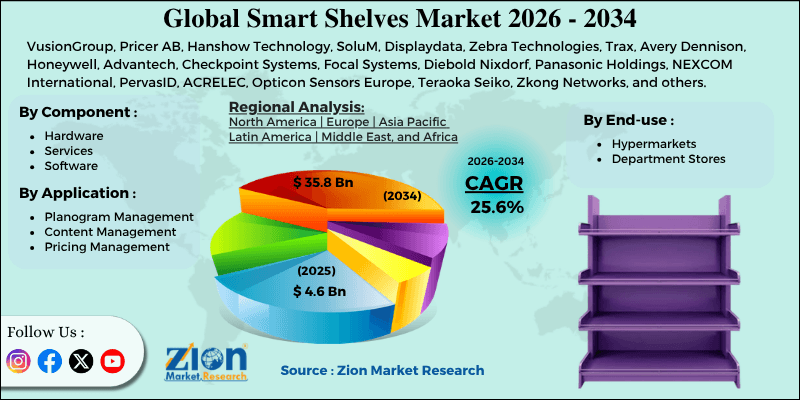
Smart Shelves Market: Report Scope
| Report Attributes | Report Details |
|---|---|
| Report Name | Smart Shelves Market |
| Market Size in 2025 | USD 4.6 Billion |
| Market Forecast in 2034 | USD 35.8 Billion |
| Growth Rate | CAGR of 25.6% |
| Number of Pages | 228 |
| Key Companies Covered | VusionGroup, Pricer AB, Hanshow Technology, SoluM, Displaydata, Zebra Technologies, Trax, Avery Dennison, Honeywell, Advantech, Checkpoint Systems, Focal Systems, Diebold Nixdorf, Panasonic Holdings, NEXCOM International, PervasID, ACRELEC, Opticon Sensors Europe, Teraoka Seiko, Zkong Networks, and others. |
| Segments Covered | By Component, By Application, By End-use, and By Region |
| Regions Covered | North America, Europe, Asia Pacific (APAC), Latin America, Middle East, and Africa (MEA) |
| Base Year | 2025 |
| Historical Year | 2020 - 2024 |
| Forecast Year | 2026 - 2034 |
| Customization Scope | Avail customized purchase options to meet your exact research needs. Request For Customization |
Smart Shelves Market: Segmentation
Component Insights
Why does the hardware segment hold a prominent position in the smart shelves market?
The hardware segment held the largest share in the smart shelves industry, at 48%, in 2025. Hardware solutions are being adopted by retailers and warehouse owners to reduce shrinkage and improve inventory management and product availability. One significant trend is the use of smaller, integrated sensors and RFID technologies, which make them easier to install without appearing intrusive. Additionally, there is increased adoption of battery-free RFID tags that leverage ambient energy.
Application Insights
Why does the Inventory Management segment capture the largest share in the smart shelves market?
The inventory management segment held the largest revenue share in the smart shelves market in 2025, of over 35%. Real-time visibility into stock status is one of the key factors driving organizations to adopt smart shelves for inventory management. As consumer demand for product availability has grown, retailers must keep their shelves stocked with appropriate items at all times. On top of that, the development of just-in-time inventory management techniques has made the need more pertinent.
End-use Insights
Does the hypermarkets segment capture the largest share in the Smart Shelves market?
The hypermarkets segment captured a significant 30% revenue share in the smart shelves industry in 2025. It is crucial to have efficient inventory management in such massive retail systems. Smart shelves help prevent out-of-stocks and overstocks, thereby optimizing inventory. Also, one of the main concerns of hypermarkets today is improving their customers' experience to distinguish themselves in the market.
Regional Insights
Why does North America lead the global smart shelves market?
North America leads the smart shelves market with a revenue share of 34.5% in 2025. This is attributed to the region's superior retail infrastructure, rapid adoption of digital technologies, and robust investment in AI, IoT, RFID, ESLs, and retail automation. The big retailers in the U.S. and Canada have begun implementing smart shelf solutions to optimize real-time inventory visibility, minimize out-of-stock situations, streamline inventory replenishment, and improve omnichannel retailing operations. The fast expansion of e-commerce and BOPIS services is another catalyst for the increasing demand for smart inventory management solutions.
According to the U.S. Census Bureau, U.S. retail e-commerce sales in Q1 2026 totaled US$326.7 billion, up 9.8% year over year and accounting for 16.9% of total retail sales. Moreover, the National Retail Federation (NRF) forecasted U.S. retail sales to hit between US$5.42 and 5.48 trillion in 2025, while non-store and online sales were predicted to rise by 7–9%. This would compel retailers to adopt smart retail technologies, enabling them to become more efficient and improve the customer experience. Positive developments in the retail sector, along with continuous technological advancements and the high rate of digitalization, are likely to fuel revenue growth in the smart shelves market in North America.
Smart Shelves Market: Competitive Analysis
The global smart shelves market is dominated by players like:
- VusionGroup
- Pricer AB
- Hanshow Technology
- SoluM
- Displaydata
- Zebra Technologies
- Trax
- Avery Dennison
- Honeywell
- Advantech
- Checkpoint Systems
- Focal Systems
- Diebold Nixdorf
- Panasonic Holdings
- NEXCOM International
- PervasID
- ACRELEC
- Opticon Sensors Europe
- Teraoka Seiko
- Zkong Networks
The global smart shelves market is segmented as follows:
By Component
- Hardware
- Services
- Software
By Application
- Planogram Management
- Content Management
- Pricing Management
- Inventory Management
- Others
By End-use
- Hypermarkets
- Department Stores
- Warehouses
- Supermarkets
- Others
By Region
- North America
- The U.S.
- Canada
- Mexico
- Europe
- France
- The UK
- Spain
- Germany
- Italy
- Rest of Europe
- Asia Pacific
- China
- Japan
- India
- Australia
- South Korea
- Rest of Asia Pacific
- The Middle East & Africa
- Saudi Arabia
- UAE
- Egypt
- Kuwait
- South Africa
- Rest of the Middle East & Africa
- Latin America
- Brazil
- Argentina
- Rest of Latin America
Table Of Content
Methodology
FrequentlyAsked Questions
Smart shelves market is the term used to describe the global market involved in the manufacture and deployment of highly sophisticated smart shelves technology using the Internet of Things (IoT) sensors, Radio Frequency Identification (RFID), electronic shelf labels (ESL), weighing sensors, computer vision, artificial intelligence (AI), cameras, and cloud analytics for monitoring the products at all times.
The smart shelves market is primarily driven by the rising demand for real-time inventory management, increasing adoption of AI, IoT, RFID, and electronic shelf labels (ESLs), and growing investments in smart retail infrastructure. Retailers are deploying smart shelf solutions to reduce stockouts, automate inventory tracking, enable dynamic pricing, improve operational efficiency, and enhance customer experiences.
The smart shelves market faces several challenges, including high initial implementation costs, the complex integration of smart shelves with legacy retail systems, and ongoing maintenance and infrastructure expenses. Retailers must invest significantly in RFID technology, IoT sensors, electronic shelf labels (ESLs), AI-powered software, and cloud platforms, while also addressing compatibility issues with existing POS and inventory management systems.
Based on the application, the inventory management segment is expected to dominate the smart shelves market growth during the projected period.
The smart shelves market is being shaped by emerging trends such as the integration of artificial intelligence (AI), computer vision, Internet of Things (IoT), RFID technology, and electronic shelf labels (ESLs) to enable real-time inventory tracking, predictive replenishment, and dynamic pricing. Retailers are increasingly adopting cloud-based analytics, edge computing, digital twins, and AI-driven shelf monitoring to improve operational efficiency and customer engagement. The growing popularity of cashier-less stores, omnichannel retailing, personalized in-store experiences, and autonomous retail solutions is further driving innovation, while sustainability initiatives are encouraging the use of energy-efficient digital displays and smart inventory systems to reduce waste and optimize resource utilization.
According to the report, the global smart shelves market size was worth around USD 4.6 billion in 2025 and is predicted to grow to around USD 35.8 billion by 2034.
The global smart shelves market is expected to grow at a CAGR of 25.6% during the forecast period.
The global smart shelves industry growth is expected to be led by North America over the forecast period.
The global smart shelves market is dominated by players like VusionGroup, Pricer AB, Hanshow Technology, SoluM, Displaydata, Zebra Technologies, Trax, Avery Dennison, Honeywell, Advantech, Checkpoint Systems, Focal Systems, Diebold Nixdorf, Panasonic Holdings, NEXCOM International, PervasID, ACRELEC, Opticon Sensors Europe, Teraoka Seiko, and Zkong Networks, among others.
The smart shelves market report covers the geographical market along with a comprehensive competitive landscape analysis. It also includes cash flow analysis, profit ratio analysis, market basket analysis, market attractiveness analysis, sentiment analysis, PESTLE analysis, trend analysis, SWOT analysis, trade area analysis, demand & supply analysis, Porter’s five forces analysis, and value chain analysis.

HappyClients

