
Smart Air Purifier Market Size, Share, Trends, Growth and Forecast 2034

Smart Air Purifier Market By Type (Fume & Smoke Collectors, Dust Collectors, and Others), By Technology (Air Filters, Activated Carbon Filters, High-Efficiency Particulate Air (HEPA), and Others), By Application (Commercial, Residential, and Others), By Sales Channel (Aftermarket and Original Equipment Manufacturer (OEM)), and By Region - Global and Regional Industry Overview, Market Intelligence, Comprehensive Analysis, Historical Data, and Forecasts 2025 - 2034
| Market Size in 2024 | Market Forecast in 2034 | CAGR (in %) | Base Year |
|---|---|---|---|
| USD 3.81 Billion | USD 9.52 Billion | 10.53% | 2024 |
Smart Air Purifier Industry Perspective:
What is the anticipated size of the smart air purifier market during the projection period?
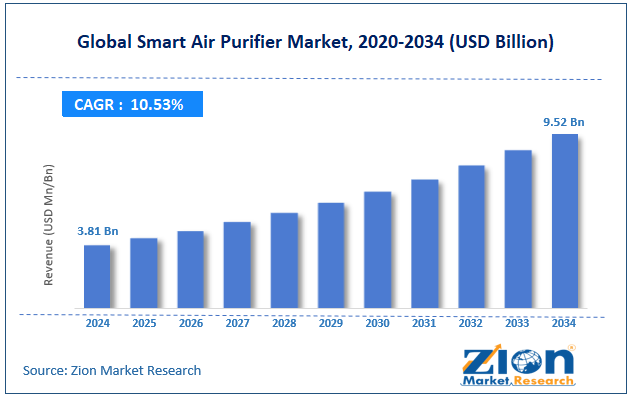
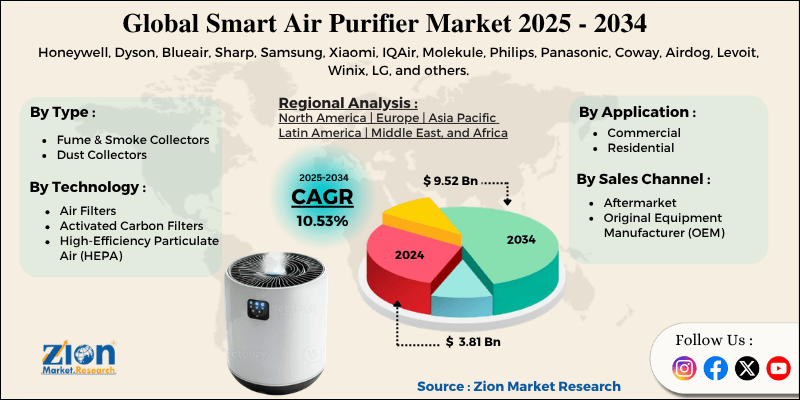
The global smart air purifier market size was worth around USD 3.81 billion in 2024 and is predicted to grow to around USD 9.52 billion by 2034 with a compound annual growth rate (CAGR) of roughly 10.53% between 2025 and 2034.
Smart Air Purifier Market: Overview
Smart air purifiers are intelligent air filtering devices. They are used to enhance the quality of indoor air using automated features. According to market research, smart air purifiers detect pollution levels in indoor spaces in real-time and adjust their performance accordingly. They require minimal to no human intervention to deliver optimal performance. Some of the key features of smart air purifiers include multi-stage filtration, smart sensors & automation, 360° surround air intake, WiFi and app control, and digital display. During the forecast period, demand for smart air purifiers is expected to be driven by growing air pollution levels across the globe. Rising prevalence of respiratory disorders, increased consumer awareness, and technological advancements will facilitate market expansion in the long run. However, the high cost of smart air purifiers, lack of repair & maintenance facilities, and competition from conventional alternatives will affect business revenue during the forecast period.
Key Insights:
- As per the analysis shared by our research analyst, the global smart air purifier market is estimated to grow annually at a CAGR of around 10.53% over the forecast period (2025-2034)
- In terms of revenue, the global smart air purifier market size was valued at around USD 3.81 billion in 2024 and is projected to reach USD 9.52 billion by 2034.
- The market is projected to grow at a significant rate due to the rising air pollution worldwide.
- Based on the type, the fume & smoke collectors segment is growing at a high rate and will continue to dominate the global market as per industry projection.
- Based on the technology, the high-efficiency particulate air (HEPA) segment is anticipated to command the largest market share.
- Based on the application, the residential segment is expected to lead the market growth trends.
- Based on the sales channel, the original equipment manufacturer (OEM) segment is projected to influence revenue in the market.
- Based on region, the Asia-Pacific is projected to dominate the global market during the forecast period.
Impact of the USA-Israel and Iran war on the Smart Air Purifier Market:
The smart air purifier industry is expected to be affected by the USA-Israel and Iran war due to disruption in the supply chain of raw materials, manpower, and final goods. Smart air purifier are powered by an advanced chip. However, the semiconductor industry has been significantly hit due to the closure of the Strait of Hormuz, leading to delayed shipments. During the forecast period, the war is anticipated to encourage more reliance on domestic production and supply.
Smart Air Purifier Market: Dynamics
Growth Drivers
What will be the impact of air pollution on the smart air purifier market?
The global smart air purifier market is expected to be driven by the rising air pollution worldwide. Urban areas around the globe have been exposed to several forms of air pollutants, including vehicle emissions and construction dust. Accelerated infrastructure development across emerging nations has further intensified the air pollution rate in most parts of the world. Indoor air can feel heavy and can lead to throat or eye irritation when exposed to air pollutants.
According to the World Health Organization (WHO), indoor air can be 2 to 5 times more polluted than outdoor air, especially in cases of a lack of effective ventilation. Consumer awareness around the importance of maintaining indoor air quality has resulted in higher demand for intelligent air purifiers.
Rising prevalence of respiratory disorders is expected to encourage market adoption trends in the coming years
Diminishing air quality can be more harmful for people with weak immunity, allergies, or asthma. Over the years, cases related to respiratory disorders have increased worldwide. More than 260 million people across the globe live with asthma, as per the WHO. The solutions available in the global smart air purifier market help reduce pollutants, ensure that the indoor air is clean, and neutralize microbes. By improving the health of indoor air, patients with respiratory concerns can ensure optimal health.
Restraints
Which cost constraints limit the expansion of the smart air purifier market?
The global smart air purifier industry is projected to be restricted due to cost barriers, such as high initial investment. Premium smart air purifiers can range between USD 300 to USD 1000 or more, depending on the overall features. In addition, repair and maintenance costs of smart air purifiers are significantly higher than those of conventional products. These factors will limit market expansion in the long run, especially among low to middle-income groups.
Opportunities
Technological advancements to create growth opportunities for the industry leaders
The global smart air purifier market is anticipated to generate growth opportunities due to rising technological advancements such as Artificial Intelligence (AI)-driven air quality monitoring, Internet-of-Things (IoT)-enabled connectivity, mobile app control, real-time sensor integration, and voice assistant compatibility among other features.
In April 2026, Portronics, a leading provider of electronic products, announced its entry in the Indian market with the launch of AIR X smart High-Efficiency Particulate Air (HEPA) air purifier. The tool is equipped with a True H13 HEPA filtration system capturing 99.95% of airborne particles as small as 0.3 microns including PM2.5 pollutants, allergens, and dust. In March 2026, Xiaomi launched the new Mijia Smart Air Purifier Max in specific European countries. The novel offering has a dual filter system and is equipped with remote app-based controls along with integrated display.
Challenges
Limited consumer awareness and competition from alternatives challenge market expansion
The global smart air purifier industry is projected to be challenged by limited consumer awareness and tough competition from traditional alternatives. Consumers continue to invest in basic air purifiers that perform the role of cleaning air optimally and without the use of advanced technologies. A large number of consumers continue to remain hesitant toward the adoption of novel home solutions such as smart air purifiers since they are perceived to be difficult to operate and maintain.
Smart Air Purifier Market: Report Scope
| Report Attributes | Report Details |
|---|---|
| Report Name | Smart Air Purifier Market |
| Market Size in 2024 | USD 3.81 Billion |
| Market Forecast in 2034 | USD 9.52 Billion |
| Growth Rate | CAGR of 10.53% |
| Number of Pages | 227 |
| Key Companies Covered | Honeywell, Dyson, Blueair, Sharp, Samsung, Xiaomi, IQAir, Molekule, Philips, Panasonic, Coway, Airdog, Levoit, Winix, LG, and others. |
| Segments Covered | By Type, By Technology, By Application, By Sales Channel, and By Region |
| Regions Covered | North America, Europe, Asia Pacific (APAC), Latin America, Middle East, and Africa (MEA) |
| Base Year | 2024 |
| Historical Year | 2019 - 2023 |
| Forecast Year | 2025 - 2034 |
| Customization Scope | Avail customized purchase options to meet your exact research needs. Request For Customization |
Smart Air Purifier Market: Segmentation
The global smart air purifier market is segmented based on type, technology, application, sales channel, and region.
Why will the fume & smoke collectors segment deliver a faster CAGR in the smart air purifier industry revenue during the forecast period?
Based on type, the global market segments are fume & smoke collectors, dust collectors, and others. In 2024, the highest growth was listed in the fume & smoke collectors segment, dominating nearly 49% of the global revenue. It is expected to grow at a CAGR of 12.01% during the forecast period due to stricter government policies and growing applications across commercial facilities.
Which will be the fastest-growing technology segment during the forecast period in the smart air purifier market?
Based on technology, the global smart air purifier industry is fragmented into air filters, activated carbon filters, high-efficiency particulate air (HEPA), and others. The highest growth was listed in the high-efficiency particulate air (HEPA) segment, accounting for 51% of the total revenue. It is expected to grow at a CAGR of 8.1%, driven by the effectiveness of the technology in capturing dust particles.
Why will the residential segment continue to lead the smart air purifier industry in the coming years?
Based on application, the global market divisions are commercial, residential, and others. In 2024, the highest market share was held by the residential segment. It accounted for 61% of the global revenue and will grow at a CAGR of 10.01% in the coming years. Growing air pollution, increased consumer awareness, and evolving lifestyles will influence segmental revenue.
What will be the contribution of the integrated segment in the smart air purifier market during the projection period?
Based on the sales channel, the global market is fragmented into aftermarket and original equipment manufacturers (OEM). In 2024, the market was dominated by the original equipment manufacturer (OEM) segment, accounting for 72% of the global revenue. It is expected to deliver a CAGR of 9.25% during the forecast period, as OEM channels are more trustworthy and offer excellent post-sale services.
Smart Air Purifier Market: Regional Analysis
How is Asia-Pacific expected to perform in the smart air purifier market during the projection period?
The global smart air purifier market is expected to be dominated by the Asia-Pacific region. It is also expected to emerge as the fastest-growing region with a CAGR of 12.6% during the forecast period. In 2024, it accounted for 42% of the global revenue. Asian countries have recorded a high level of air pollution in the last few years, driving the sale of residential air purifiers. In addition, the presence of key players and easy access to raw materials, along with robust manufacturing capabilities, will help fuel market growth trends in the coming years.
Why will North America emerge as the second-largest region in the smart air purifier market?
North America will emerge as the second-largest region in the smart air purifier market during the forecast period, growing at a CAGR of 11%. In 2024, it accounted for 25% of the global revenue. Increased sales of commercial smart air purifiers are driven by strict government laws and heightened awareness around occupational safety. In addition, growing integration of smart home solutions and higher demand for premium solutions will reshape industry growth trends during the projection period.
Smart Air Purifier Market: Competitive Analysis
The global smart air purifier market is led by players like:
- Honeywell
- Dyson
- Blueair
- Sharp
- Samsung
- Xiaomi
- IQAir
- Molekule
- Philips
- Panasonic
- Coway
- Airdog
- Levoit
- Winix
- LG
What are the latest key trends in the smart air purifier market?
Smart home ecosystem
The growing integration of additional smart home ecosystems, such as voice-controlled features using Alexa and Google Assistant, is a promising market trend. It promotes seamless connectivity and eases the use of smart air purifiers.
Growing demand across commercial facilities
Rising focus toward occupational safety, especially across high-risk industries such as chemical manufacturing plants, has intensified demand for commercial-grade smart air purifiers. Rapid industrialization and stricter government laws will encourage market adoption in the coming years.
The global smart air purifier market is segmented as follows:
By Type
- Fume & Smoke Collectors
- Dust Collectors
- Others
By Technology
- Air Filters
- Activated Carbon Filters
- High-Efficiency Particulate Air (HEPA)
- Others
By Application
- Commercial
- Residential
- Others
By Sales Channel
- Aftermarket
- Original Equipment Manufacturer (OEM)
By Region
- North America
- The U.S.
- Canada
- Mexico
- Europe
- France
- The UK
- Spain
- Germany
- Italy
- Rest of Europe
- Asia Pacific
- China
- Japan
- India
- Australia
- South Korea
- Rest of Asia Pacific
- The Middle East & Africa
- Saudi Arabia
- UAE
- Egypt
- Kuwait
- South Africa
- Rest of the Middle East & Africa
- Latin America
- Brazil
- Argentina
- Rest of Latin America
Table Of Content
Methodology
FrequentlyAsked Questions
Smart air purifiers are intelligent air filtering devices. They are used to enhance the quality of indoor air using automated features.
The global smart air purifier market is expected to be driven by the rising air pollution worldwide.
According to study, the global smart air purifier market size was worth around USD 3.81 billion in 2024 and is predicted to grow to around USD 9.52 billion by 2034.
The CAGR value of smart air purifier market is expected to be around 10.53% during 2025-2034.
The global smart air purifier industry is projected to be challenged by limited consumer awareness and tough competition from traditional alternatives.
Smart home ecosystem and growing demand across commercial facilities are the emerging trends and innovations impacting the smart air purifier market.
The global smart air purifier market has performed well so far and will offer similar trends in the coming years.
Asia-Pacific will contribute notably towards the smart air purifier market value.
The global smart air purifier market is led by players like Honeywell, Dyson, Blueair, Sharp, Samsung, Xiaomi, IQAir, Molekule, Philips, Panasonic, Coway, Airdog, Levoit, Winix, and LG.
The report explores crucial aspects of the smart air purifier market including detailed discussion of existing growth factors and restraints while also browsing future growth opportunities and challenges that impact the market.

HappyClients

