Silicon Cables Market Size, Share, Growth, Opportunities 2034

Silicon Cables Market By Conductor Material (Aluminum, Copper, and Others), By Voltage (High Voltage, Medium Voltage, and Low Voltage), By Insulation Type (Glass Fibers, Silicon Rubber, and Others), By Shielding (Combination Shielding, Braided Shielding, Foil Shielding, and Unshielded), By End-User Industry (Transportation, Aerospace & Defense, Energy & Power, ICT & Telecommunications, Industrial Automation, and Others), By Application (Renewable Energy Systems, Industrial Robotics & Automation, EV Charging Stations, Data Center & Server Connectivity, 5G Network Infrastructure, and Others), and By Region - Global and Regional Industry Overview, Market Intelligence, Comprehensive Analysis, Historical Data, and Forecasts 2025 - 2034
| Market Size in 2024 | Market Forecast in 2034 | CAGR (in %) | Base Year |
|---|---|---|---|
| USD 3.87 Billion | USD 5.97 Billion | 4.95% | 2024 |
Silicon Cables Industry Perspective:
What will be the anticipated size of the silicon cables market during the projection period?
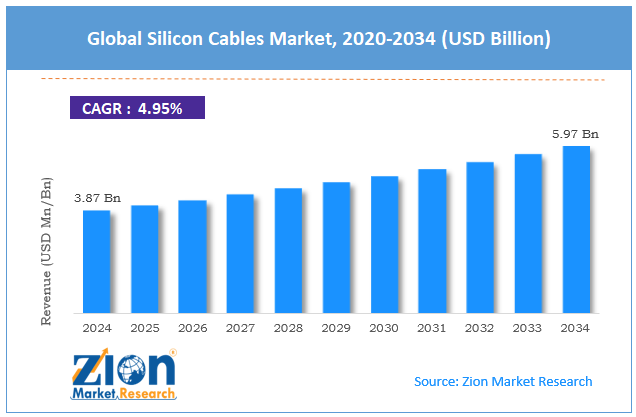
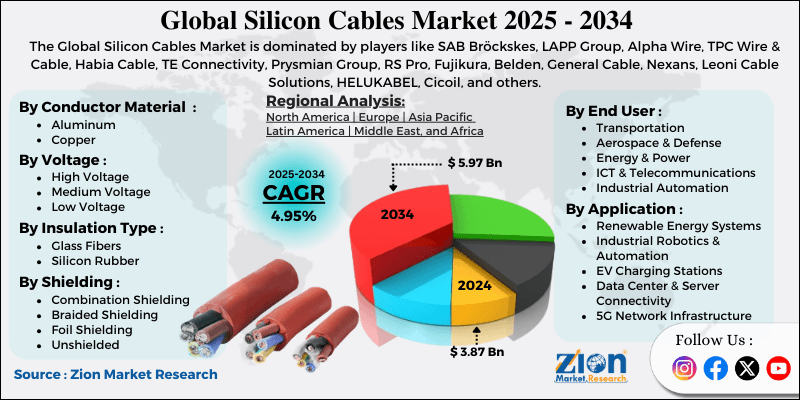
The global silicon cables market size was worth around USD 3.87 billion in 2024 and is predicted to grow to around USD 5.97 billion by 2034, with a compound annual growth rate (CAGR) of roughly 4.95% between 2025 and 2034.
 Request Free SampleRequest Free Sample
Key Insights:
- As per the analysis shared by our research analyst, the global silicon cables market is estimated to grow annually at a CAGR of around 4.95% over the forecast period (2025-2034)
- In terms of revenue, the global silicon cables market size was valued at around USD 3.87 billion in 2024 and is projected to reach USD 5.97 billion by 2034.
- The silicon cables market is projected to grow at a significant rate due to the growing demand for cables in electric vehicle production.
- Based on the conductor material, the copper segment is growing at a high rate and will continue to dominate the global market, as per industry projections
- Based on the voltage, the high voltage segment is anticipated to command the largest market share
- Based on the insulation type, the silicon rubber segment is expected to lead the market growth trends
- Based on the shielding, the unshielded segment is projected to influence revenue in the market
- Based on the end-user industry, the industrial automation segment will emerge as the fastest-growing segment
- Based on the application, the Industrial robotics & automation segment will contribute the largest part of the market share
- Based on region, the Asia-Pacific is projected to dominate the global market during the forecast period
Silicon Cables Market: Overview
Silicon cables are electrical cables with applications across several end-user industries. The outer protective covering or jacket of silicon cables is silicon rubber instead of conventionally used rubber blends or Polyvinyl Chloride (PVC) blends. Silicon cables are popular due to their extreme temperature resistance. They are highly flexible and offer excellent electrical insulation compared to other alternatives. Silicon cables are used in the automotive industry, especially in electric and hybrid vehicles. Furthermore, they are an integral element of modern kitchen appliances and consumer products. The global silicon cables market is expected to be driven by growing electric vehicle (EV) production, surging demand for consumer electronics, and applications in renewable energy systems.
Additionally, advancements in cable manufacturing techniques may further create growth opportunities for industry leaders. However, the high cost of silicon cables and their limited effectiveness in environments requiring high mechanical protection may affect overall market adoption in the coming years.
Silicon Cables Market: Dynamics
Growth Drivers
How will growing EV production influence demand for silicon cables?
The global silicon cables market is expected to be led by the growing demand for cables in electric vehicle production. Silicon cables have high temperature resistance. They can function in harsh environments without melting or deteriorating. EVs are subject to constant vibrations and extreme heat, making silicon cables ideal for electric vehicle components such as battery packs and motors.
Furthermore, the flame-retardant property of silicon cables helps enhance passenger safety. During the forecast period, EV production is expected to witness unprecedented growth trends. According to official reports, the EV sales rate grew by more than 29% in 2025. Favorable government policies toward EV production, including tax subsidies and incentives, growing consumer awareness of sustainability, and fluctuating fuel prices will create more revenue for the EV industry, subsequently influencing demand for silicon cables.
Restraints
High cost and low mechanical strength will limit industry growth trends in the future
The global silicon cables market is expected to be constrained by the high cost of silicon cables compared to alternatives such as rubber and PVC. Growing economic volatility worldwide and increasing cost-cutting efforts by organizations may impact demand for silicon cables in a cost-sensitive environment. In addition, silicon cables have low mechanical strength, further limiting their adoption in harsh conditions.
Opportunities
What will be the impact of novel manufacturing techniques on the silicon cables market?
The global silicon cables industry is expected to experience new growth opportunities due to the rising technological innovation reported in the market. Demand for high-performance has increased globally, resulting in a higher need to develop novel silicon masterbatches and powders, which is driving industry investments. Smart manufacturing is emerging as a prominent silicon cables production technique involving the use of Artificial Intelligence (AI) and robotic solutions. Furthermore, material innovations, such as halogen-free flame-retardant (HFFR) silicon and eco-friendly alternatives, may create added revenue for industry players.
Rising demand for consumer electronics in emerging markets offers expansion possibilities
Consumer electronics in emerging markets have been growing at a steady rate. The demand is driven by changing consumer lifestyles, rising disposable income, and the proliferation of the e-commerce industry, among other factors. Silicon cables deliver improved safety features in modern electronics. They deliver electrical insulation and are more flexible, providing widely useful essential items such as hair dryers and ovens.
Challenges
Why will supply chain disruptions impact the silicon cables market revenue during the forecast period?
The global silicon cables market is projected to be challenged by the growing concerns over supply chain disruptions. Silicon is the primary raw material for the cables. However, it is subject to supply chain disruptions due to changing geopolitical partnerships and trade wars. These complexities will affect business expansion decisions in the long run.
 Request Free SampleRequest Free Sample
Silicon Cables Market: Report Scope
| Report Attributes | Report Details |
|---|---|
| Report Name | Silicon Cables Market |
| Market Size in 2024 | USD 3.87 Billion |
| Market Forecast in 2034 | USD 5.97 Bllion |
| Growth Rate | CAGR of 4.95% |
| Number of Pages | 223 |
| Key Companies Covered | SAB Bröckskes, LAPP Group, Alpha Wire, TPC Wire & Cable, Habia Cable, TE Connectivity, Prysmian Group, RS Pro, Fujikura, Belden, General Cable, Nexans, Leoni Cable Solutions, HELUKABEL, Cicoil, and others. |
| Segments Covered | By Conductor Material, By Voltage, By Insulation Type, By Shielding, By End-User Industry, By Application, and By Region |
| Regions Covered | North America, Europe, Asia Pacific (APAC), Latin America, Middle East, and Africa (MEA) |
| Base Year | 2024 |
| Historical Year | 2019 to 2023 |
| Forecast Year | 2025 - 2034 |
| Customization Scope | Avail customized purchase options to meet your exact research needs. Request For Customization |
Silicon Cables Market: Segmentation
The global silicon cables market is segmented based on conductor material, voltage, insulation type, shielding, end-user industry, application, and region.
Why will copper lead the silicon cables market during the forecast period?
Based on conductor material, the global market is segmented into aluminum, copper, and others. In 2024, the highest growth was listed in the copper segment, accounting for 76% of the global revenue. It is projected to grow at a CAGR of 6.01% during the forecast period, as it has higher durability and thermal performance. The growing copper production globally will impact segmental revenue in the future.
What is the expected CAGR for the low-voltage segment in the silicon cables market during the projection period?
Based on voltage, the global market is segmented into high voltage, medium voltage, and low voltage. The highest revenue in 2024 was listed in the high voltage segment, accounting for around 57% of global revenue. The projected CAGR for low-voltage silicon cables is around 6.5% over the coming years due to higher adoption across commercial and residential applications. Growing demand for consumer electronics will aid segmental dominance during the forecast period.
Which factors aid higher revenue in the silicon rubber segment in the silicon cables market?
Based on insulation type, the global silicon cables industry is divided into glass fibers, silicon rubber, and others. 2024 was dominated by the silicon rubber segment, with control over 60% of the final returns. It will continue to offer a CAGR of 5.59% in the coming years due to the superior performance associated with silicon rubber compared to other counterparts. Moreover, increased applications of the segment across major industries may aid further revenue for silicon rubber-based cables.
What are the reasons for growth in the unshielded segment in the silicon cables market?
Based on shielding, the global market divisions are combination shielding, braided shielding, foil shielding, and unshielded. In 2024, the unshielded segment generated the highest revenue, accounting for up to 40% of global end results. It is expected to grow at a 5.5% CAGR due to increased adoption of unshielded silicon cables across general applications, driven by their cost-effectiveness.
Which is the largest end-user vertical in the silicon cables market?
Based on the end-user industry, the global market fragments are transportation, aerospace & defense, energy & power, ICT & telecommunications, industrial automation, and others. According to industry research, industrial automation is the largest end-user vertical of silicon cables. In 2024, it contributed over 39% of the global revenue and is projected to deliver a CAGR of 6.2% in the coming years. Growing integration of automated solutions across major industries, along with the emergence of smart factories, will aid improved revenue in the segment.
Why will industrial robotics & automation emerge as the highest revenue generator in the silicon cables industry?
Based on application, the global market is segmented into renewable energy systems, industrial robotics & automation, EV charging stations, data center & server connectivity, 5G network infrastructure, and others. Industrial robotics & automation accounted for 38% of the final revenue in 2024 and will emerge as the fastest-growing market during the forecast period with a CAGR of 6.5%. Surging factory automation rate, along with robotic advancements, will aid in accelerated revenue in the industry during the forecast period.
Silicon Cables Market: Regional Analysis
What is the projected CAGR for Asia-Pacific in the silicon cables market during the forecast period?
The global silicon cables market will be led by Asia-Pacific in the coming years. In 2024, the region accounted for 45.01% of global revenue and is expected to offer a CAGR of 6.7% during the forecast period. India, China, and South Korea are the leading regional market revenue generators. The presence of a growing cables and wire manufacturing industry across Asia-Pacific has helped the region maintain its dominance. Additionally, growing end-user demand for silicon cables in the domestic automotive and transportation sector, along with rising production of consumer electronics, will aid regional expansion in the future.
Which factors will drive growth in Europe during the forecast period in the silicon cables industry?
Europe is the second-highest revenue generator in the global silicon cables market, accounting for 32% of total revenue in 2024. It will continue delivering a CAGR of 6.1% in the coming years. Growing EV production, along with the expansion of the region’s telecommunication sector and strict regulatory guidelines, will help accelerate Europe’s growth rate. Moreover, rising demand for energy-efficient and safe consumer electronics, along with industrial automation trends, will work in favor of the regional players.
Silicon Cables Market: Competitive Analysis
The global silicon cables market is led by players like:
- SAB Bröckskes
- LAPP Group
- Alpha Wire
- TPC Wire & Cable
- Habia Cable
- TE Connectivity
- Prysmian Group
- RS Pro
- Fujikura
- Belden
- General Cable
- Nexans
- Leoni Cable Solutions
- HELUKABEL
- Cicoil
What are the latest key trends in the silicon cables market?
Applications in renewable energy systems
Silicon cables are widely preferred in renewable energy infrastructure development projects. They are used in solar and wind systems due to their high temperature resistance. Surging renewable energy investments will create new growth avenues for the industry players.
Eco-friendly silicon cables
The rising demand for sustainability in the cables sector is propelling demand for recycled silicon cables. Additionally, the use of low-energy-intensive silicon cable manufacturing processes is a promising trend reported in the market.
The global silicon cables market is segmented as follows:
By Conductor Material
- Aluminum
- Copper
- Others
By Voltage
- High Voltage
- Medium Voltage
- Low Voltage
By Insulation Type
- Glass Fibers
- Silicon Rubber
- Others
By Shielding
- Combination Shielding
- Braided Shielding
- Foil Shielding
- Unshielded
By End-User Industry
- Transportation
- Aerospace & Defense
- Energy & Power
- ICT & Telecommunications
- Industrial Automation
- Others
By Application
- Renewable Energy Systems
- Industrial Robotics & Automation
- EV Charging Stations
- Data Center & Server Connectivity
- 5G Network Infrastructure
- Others
By Region
- North America
- The U.S.
- Canada
- Mexico
- Europe
- France
- The UK
- Spain
- Germany
- Italy
- Rest of Europe
- Asia Pacific
- China
- Japan
- India
- Australia
- South Korea
- Rest of Asia Pacific
- The Middle East & Africa
- Saudi Arabia
- UAE
- Egypt
- Kuwait
- South Africa
- Rest of the Middle East & Africa
- Latin America
- Brazil
- Argentina
- Rest of Latin America
Table Of Content
Methodology
FrequentlyAsked Questions

HappyClients