
Regenerative Artificial Skin Market Growth, Size, Share, Trends, and Forecast 2032

Regenerative Artificial Skin Market By Material type (temporary skin material, composite skin material, and permanent skin material), By End user (burn care centers, clinics, and hospital) And By Region: - Global And Regional Industry Overview, Market Intelligence, Comprehensive Analysis, Historical Data, And Forecasts, 2024-2032
| Market Size in 2023 | Market Forecast in 2032 | Growth Rate (in %) | Base Year |
|---|---|---|---|
| USD 691.3 Million | USD 2,027.60 Million | CAGR at 12.70% | 2023 |
Description
What is the Regenerative Artificial Skin Market Size?
According to the report published by Zion Market Research, the global Regenerative Artificial Skin Market size was valued at USD 691.3 Million in 2023 and is predicted to reach USD 2,027.60 Million by the end of 2032. The market is expected to grow with a CAGR of 12.70% during the forecast period. The report analyzes the global Regenerative Artificial Skin Market’s growth drivers, restraints, and impact on demand during the forecast period. It will also help navigate and explore the arising opportunities in the Regenerative Artificial Skin Market industry.
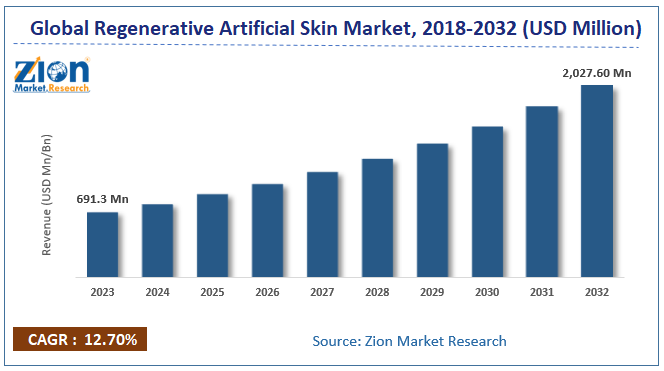
Regenerative Artificial Skin Market: Overview
Artificial skin is normally obtained from the collagen and the body easily absorbs it and it also helps in generating new skin on the part that is affected. Continuous research works are being made by several market players for the development of the new technology in the artificial skin regeneration, which includes the development of the autologous spray on the skin.
Regenerative Artificial Skin Market: Facts
In the British biotech company Intercytex, Paul Kemp and his colleagues developed the “living” skin which is comparatively better than the alternatives that are present as these are biodegraded in situ after a short duration of time. Tests proved that this new membrane gets completely integrated by 28 days which closes and heals the site of the wound.
Regenerative Artificial Skin Market: Segmentation
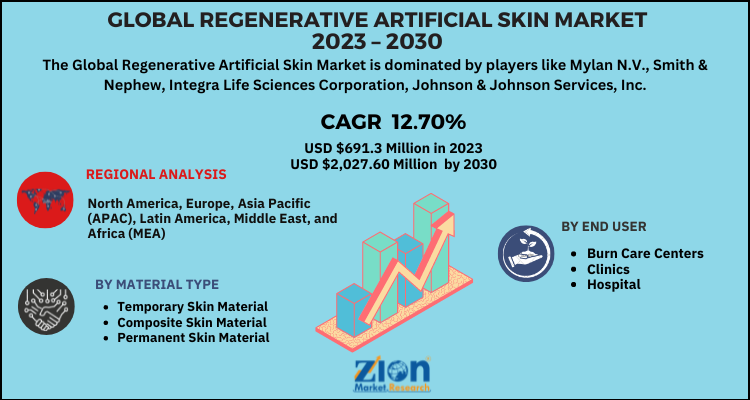
The global market for the regenerative artificial skin is fragmented into its material type and end user.
Depending on the type of the material that is being used, the global market is segregated into temporary skin material, composite skin material, and permanent skin material.
- The temporary skin material segment is sub-segregated into bi-layered material and single layer material.
- The composite skin material segment is sub-categorized into skin graft and engineered skin material.
- The permanent skin material segment is sub-divided into dermal skin material and epidermal skin material.
Based on the end-user, the market is categorized into burn care centers, clinics, and hospitals.
Regenerative Artificial Skin Market: Growth Factors
The increase in the cases of the burn accidents and other road accidents that leads to fire and injuries contributes positively to the growth of the regenerative artificial skin market. Other factors such as an increase in the skin diseases, increased rate of acid attacks, and other body surgeries attribute positively to the growth of the market. There are certain factors that restrain the growth of the regenerative artificial market which include the regulatory approvals for the surgical procedures, the adoption by the body by regaining the natural structure.
Regenerative Artificial Skin Market : Report Scope
| Report Attributes | Report Details |
|---|---|
| Report Name | Regenerative Artificial Skin Market Research Report |
| Market Size in 2023 | USD 691.3 Million |
| Market Forecast in 2032 | USD 2,027.60 Million |
| Growth Rate | CAGR of 12.70% |
| Number of Pages | 196 |
| Key Companies Covered | Mylan N.V., Smith & Nephew, Integra Life Sciences Corporation, Johnson & Johnson Services, Inc., and Mallinckrodt Plc. |
| Segments Covered | By Material type, By End user and By Region |
| Regions Covered | North America, Europe, Asia Pacific (APAC), Latin America, Middle East, and Africa (MEA) |
| Base Year | 2023 |
| Historical Year | 2018 - 2022 |
| Forecast Year | 2024 - 2032 |
| Customization Scope | Avail customized purchase options to meet your exact research needs. Request For Customization |
Regenerative Artificial Skin Market: Regional Analysis
The main regional markets for the regenerative artificial skin market are Europe and North America. The factors that are supporting the growth of the market in these regions are a strong presence of some of the big market players and the increasing adoption of the procedures. In Asia Pacific region, the regenerative artificial skin market will experience a positive growth due to the increasing cases of the accidental burns and the rise in the cosmetic surgeries. In the developed nations such as the U.K., Australia, and the U.S., changes are being made in the burn management reforms thus having a good support for the growth of the regenerative artificial skin market.
Regenerative Artificial Skin Market: Competitive Players
The key market players that are involved in the regenerative artificial skin market include:
- Mylan N.V.
- Smith & Nephew
- Integra Life Sciences Corporation
- Johnson & Johnson Services, Inc.
- Mallinckrodt Plc.
The Global Regenerative Artificial Skin Market is segmented as follows:
By Material type
- temporary skin material
- composite skin material
- permanent skin material
By End user
- burn care centers
- clinics
- hospital
By Region
- North America
- The U.S.
- Canada
- Mexico
- Europe
- France
- The UK
- Spain
- Germany
- Italy
- Rest of Europe
- Asia Pacific
- China
- Japan
- India
- Australia
- South Korea
- Rest of Asia Pacific
- The Middle East & Africa
- Saudi Arabia
- UAE
- Egypt
- Kuwait
- South Africa
- Rest of the Middle East & Africa
- Latin America
- Brazil
- Argentina
- Rest of Latin America
What Reports Provides
- Full in-depth analysis of the parent market
- Important changes in market dynamics
- Segmentation details of the market
- Former, on-going, and projected market analysis in terms of volume and value
- Assessment of niche industry developments
- Market share analysis
- Key strategies of major players
- Emerging segments and regional markets
- Testimonials to companies in order to fortify their foothold in the market.
Table Of Content

FrequentlyAsked Questions
Regenerative artificial skin is a bioengineered material used to repair or replace damaged skin. It supports tissue regeneration and wound healing.
The global regenerative artificial skin market is expected to be driven by the The market is driven by rising burn and chronic wound cases, advancements in tissue engineering, and growing adoption in advanced wound care.
According to study, the global regenerative artificial skin market size was worth around USD 691.3 Million in 2023 and is predicted to grow to around USD 2,027.60 Million By 2032.
The global regenerative artificial skin market is expected to grow at a Compound Annual Growth Rate (CAGR) of around CAGR 12.70% during the forecast period from 2024-2032.
The global regenerative artificial skin industry is projected to be challenged by Challenges involve high R&D costs, complex clinical trials, and regulatory approvals. Scalability and affordability remain issues.
The Opportunities include advanced wound care expansion, burn and diabetic ulcer treatment growth, and rising hospital specialization. Tissue-engineered products and reimbursement improvements can accelerate adoption will offer significant growth opportunities in the regenerative artificial skin market.
3D bioprinting and scaffold innovations; stem-cell derived skin substitutes with enhanced vascularization; bio-responsive wound healing technologies are the emerging trends and innovations impacting the regenerative artificial skin market.
The global regenerative artificial skin market is expected to be led by North America during the forecast period.
Some of the prominent players operating in the global regenerative artificial skin market are; Mylan N.V., Smith & Nephew, Integra Life Sciences Corporation, Johnson & Johnson Services, Inc., and Mallinckrodt Plc. and others.
The report explores crucial aspects of the regenerative artificial skin market, including a detailed discussion of existing growth factors and restraints, while also browsing future growth opportunities and challenges that impact the market.
HappyClients

