
Artificial Disc Replacement Market Size, Share, Trends, Growth and Forecast 2034

Artificial Disc Replacement Market By Material Type (Metal-on-metal and Metal-on-biopolymer), By Product Type (Cervical Artificial Disc and Lumbar Artificial Disc), And By Region: Global Industry Perspective, Comprehensive Analysis, And Forecast, 2025 - 2034
| Market Size in 2024 | Market Forecast in 2034 | CAGR (in %) | Base Year |
|---|---|---|---|
| USD 677.98 Million | USD 2178.24 Million | 12.38% | 2024 |
Artificial Disc Replacement Industry Perspective:
What will be the global Artificial Disc Replacement market size during the forecast period?
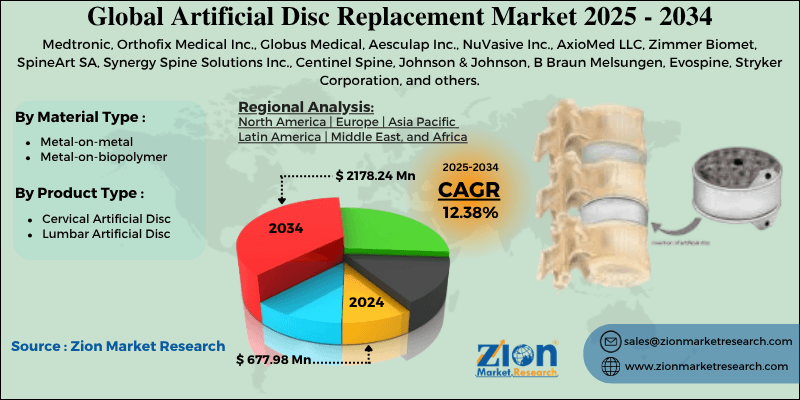
The global Artificial Disc Replacement Market size was worth around USD 677.98 Million in 2024 and is predicted to grow to around USD 2178.24 Million by 2034 with a compound annual growth rate (CAGR) of roughly 12.38% between 2025 and 2034. The Artificial Disc Replacement Market is driven by the increasing prevalence of degenerative disc diseases and spinal disorders, a growing geriatric population, technological advancements in disc materials and designs, and rising demand for minimally invasive procedures as alternatives to spinal fusion.
The report offers an assessment and analysis of the Artificial Disc Replacement Market on a global and regional level. The study offers a comprehensive assessment of the market competition, constraints, revenue estimates, opportunities, evolving trends, and industry-validated data.
Artificial Disc Replacement Market: Overview
An artificial disc is also referred to as disc replacement and is an instrument inserted in the spine to imitate normal disc functions such as load carrying & allowing motion. Moreover, artificial discs are categorized into two kinds, namely, disc nucleus replacement and total disc replacement. Apparently, these products are made from biopolymers or metallic materials, as well as a blend of both biopolymers and metallic materials. Artificial discs are used for treating chronic pain, back pain, and cervical pain. Additionally, the product is utilized for treating pain not adequately reduced due to non-operative care, including medications and injections.
Key Insights
- As per the analysis shared by our research analyst, the global artificial disc replacement market is estimated to grow annually at a CAGR of around 12.38% over the forecast period (2025-2034).
- Regarding revenue, the global artificial disc replacement market size was valued at around USD 677.98 million in 2024 and is projected to reach USD 2178.24 million by 2034.
- The artificial disc replacement market is projected to grow at a significant rate due to increasing prevalence of degenerative disc diseases and spinal disorders, a growing geriatric population susceptible to these conditions, technological advancements in artificial disc materials and designs, and a rising demand for minimally invasive surgical procedures offering benefits over traditional spinal fusion.
- Based on Material Type, the Metal-on-biopolymer sub-segment is expected to lead the global market due to its combination of mechanical strength and improved flexibility that better mimics natural disc motion while reducing wear concerns.
- On the basis of Indication, the Cervical Disc Replacement segment is growing at a high rate and will continue to dominate the global market.
- Based on region, North America is predicted to dominate the global market during the forecast period.
Artificial Disc Replacement Market: Growth Dynamics
The growth of the artificial disc replacement market over the assessment period is subject to a surge in a number of trauma-related disorders, sports injuries, and orthopedic surgeries. In addition to this, an increase in technological breakthroughs and a rise in the aging population will drive the size of the artificial disc replacement industry. Furthermore, artificial disc replacement surgical operations are performed on individuals having chronic back pain as a result of degenerated discs. Massive awareness among individuals pertaining to the advantages of artificial disc replacement methods as compared to spinal fusion surgeries will steer the artificial disc replacement industry's growth.
Moreover, artificial disc replacement is a paradigm shift in spinal surgery. For the record, Charité – the first disc implant utilized as a total disc replacement- was created in Germany in 1982. Reportedly, Fernstrom had produced as well as inserted the first cervical artificial disc type in 1966. All such moves have favorably influenced growth in the volume of production & revenue of the artificial disc replacement market.
The rise in degenerative disc disorders has paved the way for the impeccable growth of the artificial disc replacement market. The need for minimally invasive surgeries and the launch of multi-level disc replacement methods have drawn an immaculate growth trajectory for the artificial disc replacement market. However, high implantation costs and low reimbursement for disc replacement surgical procedures have decimated the utility of artificial disc replacement methods in surgeries, thereby severely affecting the growth of the market.
Artificial Disc Replacement Market: Segmentation
The Artificial Disc Replacement market is segmented by material type, product type, and region.
Based on Material Type, the Artificial Disc Replacement market is divided into metal-on-metal and metal-on-biopolymer. The Metal-on-biopolymer segment is expected to lead the market because it combines the mechanical durability of metal with the flexibility and lower wear characteristics of biopolymer articulating surfaces, more closely approximating natural disc biomechanics. This balance of strength and motion preservation supports strong clinical adoption and drives overall market growth. The Metal-on-metal segment holds a significant secondary position, valued for its robustness in high-load applications, although concerns related to wear debris have moderated its relative growth compared with hybrid designs.
Based on Product Type, the Artificial Disc Replacement market is divided into cervical artificial disc and lumbar artificial disc. The Cervical Artificial Disc segment is growing at a high rate and continues to dominate due to the relatively higher incidence of symptomatic cervical disc degeneration and the greater availability of approved cervical disc devices. Cervical procedures are often associated with favorable clinical outcomes and shorter recovery times, supporting strong procedural volumes and market expansion. The Lumbar Artificial Disc segment ranks as the second major category, driven by the high prevalence of low-back pain and ongoing efforts to expand indications and improve implant designs for the more demanding biomechanical environment of the lumbar spine.
Artificial Disc Replacement Market: Report Scope
| Report Attributes | Report Details |
|---|---|
| Report Name | Artificial Disc Replacement Market |
| Market Size in 2024 | USD 677.98 Million |
| Market Forecast in 2034 | USD 2178.24 Million |
| Growth Rate | CAGR of 12.38% |
| Number of Pages | 169 |
| Key Companies Covered | Centinel Spine, Synergy Spine Solutions, Inc., SpineArt SA, Orthofix Medical Inc., NuVasive Inc., Zimmer Biomet, Aesculap. Inc., AxioMed LLC, Globus Medical Inc., Medtronic plc., and Others |
| Segments Covered | By Material Type, By Product Type, and By Region |
| Regions Covered | North America, Europe, Asia Pacific (APAC), Latin America, The Middle East and Africa (MEA) |
| Base Year | 2024 |
| Historical Year | 2020 to 2023 |
| Forecast Year | 2025 - 2034 |
| Customization Scope | Avail customized purchase options to meet your exact research needs. Request For Customization |
Artificial Disc Replacement Market: Regional Analysis
Why will North America continue to dominate the global market during the projection period?
North America is expected to maintain its leading position due to sedentary lifestyle patterns, high prevalence of degenerative disc disorders, strong presence of major manufacturers, and greater patient and surgeon preference for motion-preserving disc replacement over traditional fusion procedures.
Growth of the artificial disc replacement market in North America over the next six years can be credited to sedentary life patterns in countries such as the U.S. Increase in market size of the region is due to a rise in the occurrence of disc degenerative disorders in the U.S. and the increment in the proportion of individuals opting for disc replacement over other forms of surgeries. With key players already based in the U.S. and Canada, the market in the region is likely to gain traction in the upcoming years.
Artificial Disc Replacement Market: Competitive Insights
Inorganic growth strategies have provided attractive avenues for industry players in terms of both revenue growth and business expansion. Some of them are profiled in our report and include
- Centinel Spine
- Synergy Spine Solutions Inc.
- SpineArt SA
- Orthofix Medical Inc.
- NuVasive. Inc.
- Zimmer Biomet
- Aesculap. Inc.
- AxioMed LLC
- Globus Medical. Inc.
- Medtronic plc.
The global Artificial Disc Replacement Market is segmented as follows:
By Material Type
- Metal-on-metal
- Metal-on-biopolymer
By Product Type
- Cervical Artificial Disc
- Lumbar Artificial Disc
By Region
- North America
- The U.S.
- Canada
- Europe
- France
- The UK
- Spain
- Germany
- Italy
- Rest of Europe
- Asia Pacific
- China
- Japan
- India
- South Korea
- Southeast Asia
- Rest of Asia Pacific
- Latin America
- Brazil
- Mexico
- Rest of Latin America
- Middle East & Africa
- GCC
- South Africa
- Rest of Middle East & Africa
Table Of Content
Methodology
FrequentlyAsked Questions
The global artificial disc replacement market is expected to grow due to rising prevalence of degenerative spinal disorders, advancements in implant technology, growing demand for minimally invasive surgeries, and an aging population.
According to a study, the global artificial disc replacement market size was worth around USD 677.98 Million in 2024 and is expected to reach USD 2178.24 Million by 2034.
The global artificial disc replacement market is expected to grow at a CAGR of 12.38% during the forecast period.
North America is expected to dominate the artificial disc replacement market over the forecast period.
Leading players in the global artificial disc replacement market include Medtronic, Orthofix Medical Inc., Globus Medical, Aesculap Inc., NuVasive Inc., AxioMed LLC, Zimmer Biomet, SpineArt SA, Synergy Spine Solutions Inc., Centinel Spine, Johnson & Johnson, B Braun Melsungen, Evospine, Stryker Corporation, among others.
The report explores crucial aspects of the artificial disc replacement market, including a detailed discussion of existing growth factors and restraints, while also examining future growth opportunities and challenges that impact the market.

HappyClients

