
Global Recombinant Cell Culture Supplements Market Size, Share, Growth Report, 2034

Recombinant Cell Culture Supplements Market By Product (Recombinant Insulin, Recombinant Trypsin, Recombinant Transferrin, Recombinant Lysozyme, Recombinant Albumin, and Others), By Source (Microorganisms, Animals, and Humans), By Application (Vaccine Development, Bioprocess Application, Gene Therapy, Stem Cell Therapy, and Others), By End-User Industry (Contract Research Organization (CROs, Cancer Research Centers, Biopharmaceutical Companies, and Academic & Research Institutions), and By Region - Global and Regional Industry Overview, Market Intelligence, Comprehensive Analysis, Historical Data, and Forecasts 2026 - 2034
| Market Size in 2025 | Market Forecast in 2034 | CAGR (in %) | Base Year |
|---|---|---|---|
| USD 917.2 Million | USD 2,866.96 Million | 13.50% | 2025 |
Recombinant Cell Culture Supplements Market: Industry Perspective
What is the anticipated size of the recombinant cell culture supplements market during the projection period?
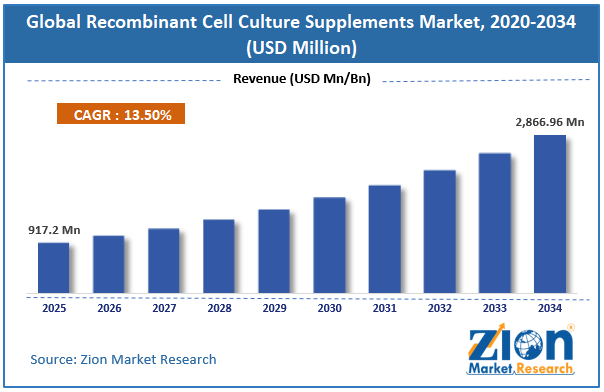
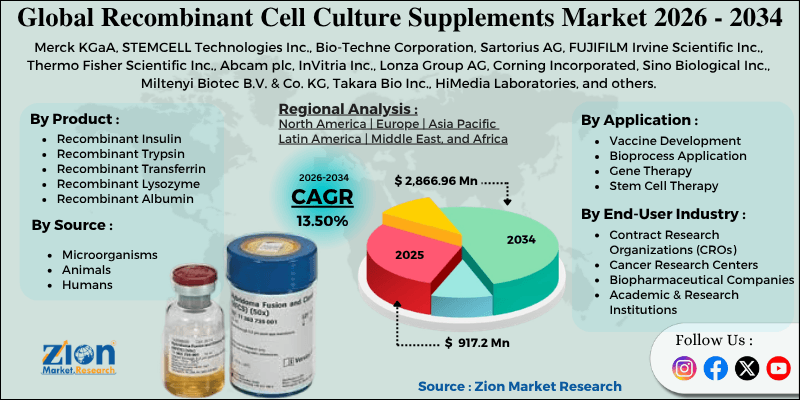
The global recombinant cell culture supplements market size was worth around USD 917.2 million in 2025. It is predicted to grow to around USD 2,866.96 million by 2034, with a compound annual growth rate (CAGR) of roughly 13.50% between 2026 and 2034.
Key Insights:
- As per the analysis shared by our research analyst, the global recombinant cell culture supplements market is estimated to grow annually at a CAGR of around 13.50% over the forecast period (2026-2034)
- In terms of revenue, the global recombinant cell culture supplements market size was valued at around USD 917.2 million in 2025 and is projected to reach USD 2,866.96 million, by 2034.
- The recombinant cell culture supplements market is projected to grow at a significant rate due to the increasing cancer research and investments in cell & gene therapy.
- Based on the product, the recombinant albumin segment is growing at a high rate and will continue to dominate the global market as per industry projections.
- Based on the source, the microorganisms segment is anticipated to command the largest market share.
- Based on the application, the bioprocess application segment will lead the market growth, but the gene & therapy segment will emerge as the fastest-growing segment.
- Based on the end-user industry, the biopharmaceutical companies segment is projected to influence revenue in the market.
- Based on region, North America is projected to dominate the global market during the forecast period.
Recombinant Cell Culture Supplements Market: Overview
Recombinant cell culture supplements are a type of genetically modified protein. They are added to cell cultures to facilitate survival, enhanced productivity, growth, and differentiation. Recombinant cell culture supplements are developed using recombinant deoxyribonucleic acid (DNA) technology and do not require extraction from human and animal tissues. Regenerative medicine, biopharmaceutical, stem cell research, and cell & gene therapy are some of the leading end-user industries of recombinant cell culture supplements. Growing cancer research, increased investments in vaccine development, and higher focus on drug discovery will aid recombinant cell culture supplements market growth during the projection period. However, high development costs, limited storage facilities, and competition from traditional supplements will affect industry expansion trends in the coming years.
Impact of the USA-Israel and Iran war on the Recombinant Cell Culture Supplements Market:
The USA-Israel and Iran war is expected to affect supply chain, product cost, and logistics related to recombinant cell culture supplements. However, the war will create demand for vaccines and novel drugs, subsequently pulling investments toward recombinant cell culture supplements. The war will also drive the need for more resilient supply chain networks.
Recombinant Cell Culture Supplements Market: Dynamics
Growth Drivers
How will investments in cancer research drive recombinant cell culture supplements market growth?
The global recombinant cell culture supplements market is expected to be driven by increasing cancer research worldwide. Industry research confirms an accelerated shift toward the use of biologics and therapeutic drugs in cancer treatments. Recombinant cell culture supplements are essential for the production of monoclonal antibodies. Some of the prominent cancer treatment drugs produced using recombinant supplements are Rituximab, Pembrolizumab, and Trastuzumab. The growing global prevalence of cancer will drive higher demand for effective, affordable treatments, propelling market revenue.
Investments in cell & gene therapy to influence market expansion in the coming years
Cell & gene therapies have emerged as efficient advanced medical treatments that prevent, cure, or manage diseases by modifying a patient’s cellular structure. Treatment processes for rare genetic disorders such as hemophilia A & B, Wiskott–Aldrich syndrome, and Spinal muscular atrophy (SMA), among others, are increasingly incorporating cell & gene therapies to achieve desired outcomes. The growing number of cell & gene therapy-based clinical trials and discovery will accelerate the expansion of the global recombinant cell culture supplements market.
Restraints
Why will the recombinant cell culture supplements industry be affected by cost constraints?
The global recombinant cell culture supplements industry is anticipated to be restricted due to the high cost of development. Production of recombinant supplements requires advanced manufacturing techniques. These methods must comply with strict regulatory requirements and performance under the guidance of experts. Additionally, next-generation bioreactors required for producing recombinant supplements are expensive to operate and maintain. For instance, the average cost of Recombinant albumin production ranges between USD 60 and USD 300 per gram.
Opportunities
Will the transition toward animal-origin-free supplements create novel growth opportunities for the recombinant cell culture supplements industry?
The global recombinant cell culture supplements market is projected to generate growth opportunities due to the transition away from animal-derived supplements to animal-origin-free counterparts. Traditional supplement production techniques are often associated with batch-to-batch quality inconsistencies. In addition, animal-derived supplements generally lead to animal cruelty. Moreover, traditional supplements have raised concerns over pathogen contamination. These factors, along with greater public awareness and strict government measures preventing animal cruelty, have created higher demand for animal-origin-free supplements. Recombinant alternatives offer improved production yield and superior batch-to-batch consistency.
Challenges
What are the leading challenges in the recombinant cell culture supplements market?
The global recombinant cell culture supplements industry will be challenged by significant complexities for new player entry, lack of supportive infrastructure, and competition from alternative techniques. In addition, recombinant supplements have lower biological half-life as compared to traditional supplements, further affecting the industry growth rate.
Recombinant Cell Culture Supplements Market: Report Scope
| Report Attributes | Report Details |
|---|---|
| Report Name | Recombinant Cell Culture Supplements Market |
| Market Size in 2025 | USD 917.2 Million |
| Market Forecast in 2034 | USD 2,866.96 Million |
| Growth Rate | CAGR of 13.50% |
| Number of Pages | 228 |
| Key Companies Covered | Merck KGaA, STEMCELL Technologies Inc., Bio-Techne Corporation, Sartorius AG, FUJIFILM Irvine Scientific Inc., Thermo Fisher Scientific Inc., Abcam plc, InVitria Inc., Lonza Group AG, Corning Incorporated, Sino Biological Inc., Miltenyi Biotec B.V. & Co. KG, Takara Bio Inc., HiMedia Laboratories, and others. |
| Segments Covered | By Product, By Source, By Application, By End-User Industry, and By Region |
| Regions Covered | North America, Europe, Asia Pacific (APAC), Latin America, Middle East, and Africa (MEA) |
| Base Year | 2025 |
| Historical Year | 2020 - 2024 |
| Forecast Year | 2026 - 2034 |
| Customization Scope | Avail customized purchase options to meet your exact research needs. Request For Customization |
Recombinant Cell Culture Supplements Market: Segmentation
The global recombinant cell culture supplements market is segmented based on product, source, application, end-user industry, and region.
Why will the recombinant albumin segment lead the recombinant cell culture supplements industry revenue during the forecast period?
Based on product, the global market divisions are recombinant insulin, recombinant trypsin, recombinant transferring, recombinant lysozyme, recombinant albumin, and others. In 2025, the highest growth was listed in the recombinant albumin segment. It accounted for 32% of the global revenue and will grow at a CAGR of 7.25% during the forecast period. Rising applications of recombinant albumin in vaccine production and drug discovery will aid segmental growth.
Which will be the fastest-growing source during the forecast period in the recombinant cell culture supplements market?
Based on source, the global recombinant cell culture supplements industry is fragmented into microorganisms, animals, and humans. The highest market share, in 2025, was held by the microorganisms segment. It is projected to deliver a CAGR of 13.2% during the forecast period. Yeast and bacteria expression systems have found widespread adoption across recombinant supplement production, leading to higher growth in the segment.
Which factors drive demand in the gene therapy segment in the recombinant cell culture supplements industry?
Based on application, the global market is divided into vaccine development, bioprocess application, gene therapy, stem cell therapy, and others. Bioprocess application emerged as the highest revenue generator in 2025. It contributed up to 51% of the global revenue. Gene therapy is projected to emerge as the fastest-growing segment with a CAGR of 18.2% due to a surge in clinical trials and rapid commercialization of gene therapies.
What will be the influence of the biopharmaceutical companies segment on the recombinant cell culture supplements market?
Based on the end-user industry, the global market fragments are contract research organizations (CROs), cancer research centers, biopharmaceutical companies, and academic & research institutions. During the forecast period, they will continue to lead market growth trends. In 2025, they accounted for 52% of the total revenue and will grow at a CAGR of 14.57%. Government support, higher demand for biologics, and next-generation production facilities will aid segmental prominence during the projection period.
Recombinant Cell Culture Supplements Market: Regional Analysis
Why will North America lead the recombinant cell culture supplements market in the coming years?
The global recombinant cell culture supplements market is currently led by North America. In 2025, it accounted for 42% of the global revenue and will grow at a CAGR of 12.9% during the forecast period. The presence of a robust biopharmaceutical industry, growing investments in gene & cell therapies, numerous clinical trials, and support from the regulatory authorities will aid regional expansion in the coming years.
Why will Asia-Pacific generate the fastest CAGR in the recombinant cell culture supplements market during the forecast period?
Asia-Pacific is expected to emerge as the fastest-growing region in the recombinant cell culture supplements industry with a CAGR of 7.21% during the forecast period. In 2025, it accounted for 28.9% of the global revenue. Rising pressure on the regional healthcare sector, expansion of drug manufacturing facilities, and rising demand for vaccines will promote growth across Asia-Pacific. Moreover, strategic expansion of regional players across emerging markets will open new growth avenues in the region.
Recombinant Cell Culture Supplements Market: Competitive Analysis
The global recombinant cell culture supplements market is led by players like:
- Merck KGaA
- STEMCELL Technologies Inc.
- Bio-Techne Corporation
- Sartorius AG
- FUJIFILM Irvine Scientific Inc.
- Thermo Fisher Scientific Inc.
- Abcam plc
- InVitria Inc.
- Lonza Group AG
- Corning Incorporated
- Sino Biological Inc.
- Miltenyi Biotec B.V. & Co. KG
- Takara Bio Inc.
- HiMedia Laboratories
What are the latest key trends in the recombinant cell culture supplements market?
Use of Artificial Intelligence (AI)
The ongoing use of AI and Machine Learning (ML) in the production of recombinant supplements is a promising trend. AI and ML are expected to optimize the production process while assisting in discoveries.
Precision fermentation
Synthetic biology and precision fermentation have shown promising results when applied to recombinant supplement production. These systems help reduce production costs and improve overall yield.
The global recombinant cell culture supplements market is segmented as follows:
By Product
- Recombinant Insulin
- Recombinant Trypsin
- Recombinant Transferrin
- Recombinant Lysozyme
- Recombinant Albumin
- Others
By Source
- Microorganisms
- Animals
- Humans
By Application
- Vaccine Development
- Bioprocess Application
- Gene Therapy
- Stem Cell Therapy
- Others
By End-User Industry
- Contract Research Organizations (CROs)
- Cancer Research Centers
- Biopharmaceutical Companies
- Academic & Research Institutions
By Region
- North America
- The U.S.
- Canada
- Mexico
- Europe
- France
- The UK
- Spain
- Germany
- Italy
- Rest of Europe
- Asia Pacific
- China
- Japan
- India
- Australia
- South Korea
- Rest of Asia Pacific
- The Middle East & Africa
- Saudi Arabia
- UAE
- Egypt
- Kuwait
- South Africa
- Rest of the Middle East & Africa
- Latin America
- Brazil
- Argentina
- Rest of Latin America
Table Of Content
Methodology
FrequentlyAsked Questions
Recombinant cell culture supplements are a type of genetically modified protein. They are added to cell cultures to facilitate survival, enhanced productivity, growth, and differentiation.
The global recombinant cell culture supplements market is expected to be driven by increasing cancer research worldwide.
According to study, the global recombinant cell culture supplements market size was worth around USD 917.2 million in 2025 and is predicted to grow to around USD 2,866.96 million by 2034.
The CAGR value of the recombinant cell culture supplements market is expected to be around 13.50% during 2026-2034.
The global recombinant cell culture supplements industry will be challenged by significant complexities for new player entry, lack of supportive infrastructure, and competition from alternative techniques.
Product and material innovation are initiatives undertaken by leading players to expand their market presence.
The offline sales channel segment holds the largest market share in the recombinant cell culture supplements market.
North America will contribute notably towards the recombinant cell culture supplements market value.
The global recombinant cell culture supplements market is led by players like Merck KGaA, STEMCELL Technologies Inc., Bio-Techne Corporation, Sartorius AG, FUJIFILM Irvine Scientific, Inc., Thermo Fisher Scientific Inc., Abcam plc, InVitria, Inc., Lonza Group AG, Corning Incorporated, Sino Biological, Inc., Miltenyi Biotec B.V. & Co. KG, Takara Bio Inc., and HiMedia Laboratories.
The report explores crucial aspects of the recombinant cell culture supplements market, including a detailed discussion of existing growth factors and restraints, while also browsing future growth opportunities and challenges that impact the market.

HappyClients

