
Global Radiation Therapy Software Market Size, Share, Global Trends, and Forecast 2034

Radiation Therapy Software Market By Type (Treatment Planning Software, Image Guided Radiation Therapy Software, Dose Verification Software, Adaptive Radiation Therapy Software), By Application (Breast Cancer Treatment, Lung Cancer Treatment, Prostate Cancer Treatment, Head and Neck Cancer Treatment), By End-User (Hospitals, Radiation Therapy Centers, Cancer Research Institutes, Ambulatory Care Centers), By Deployment (Cloud Based, On Premises), and By Region - Global and Regional Industry Overview, Market Intelligence, Comprehensive Analysis, Historical Data, and Forecasts 2026 - 2034
| Market Size in 2025 | Market Forecast in 2034 | CAGR (in %) | Base Year |
|---|---|---|---|
| USD 739.32 Million | USD 1600 Million | 9.03% | 2025 |
Radiation Therapy Software Industry Perspective:
What will be the size of the radiation therapy software market during the forecast period?
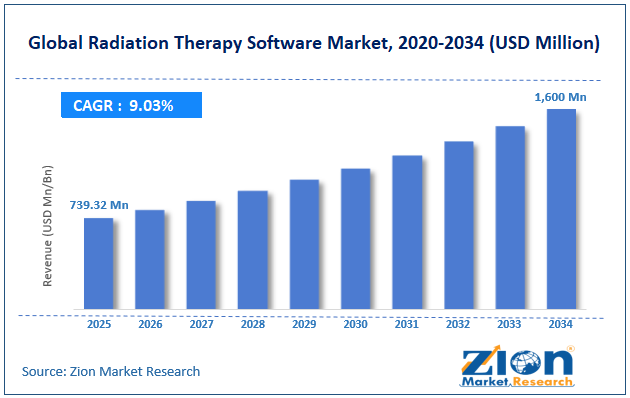
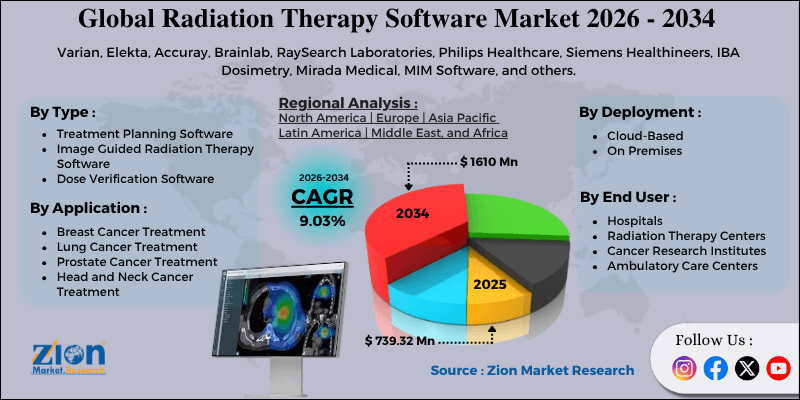
The global radiation therapy software market size was valued at approximately USD 739.32 million in 2026 and is projected to reach around USD 1,610 million by 2034, growing at a compound annual growth rate of approximately 9.03% between 2026 and 2034.
Key Insights
- As per the analysis shared by our research team, the global radiation therapy software market is estimated to grow at a compound annual growth rate of approximately 9.03% during the forecast period from 2026 to 2034.
- In terms of revenue, the global radiation therapy software market was valued at approximately USD 739.32 million in 2026 and is projected to reach USD 1,610 million by 2034.
- The radiation therapy software market is expected to grow strongly due to rising cancer diagnosis rates, increasing adoption of precision radiation treatment, growing preference for automated treatment planning, and expanding use of artificial intelligence in cancer care.
- Based on type, treatment planning software leads the market because of its essential role in every radiation therapy procedure, while adaptive radiation therapy software is gaining strong momentum as one of the fastest-growing segments due to its ability to adjust treatment plans in real time.
- Based on application, breast cancer treatment leads the market due to the high number of patients receiving radiation therapy for this condition. In contrast, lung cancer treatment is the fastest-growing segment as new imaging techniques improve targeting accuracy.
- Based on end-user, hospitals lead the market due to high patient volumes and advanced radiation therapy infrastructure, while radiation therapy centers are steadily growing as more specialized clinics open outside large hospital networks.
- Based on deployment, on-premises solutions lead the market because of strong data security preferences among large hospitals. In contrast, cloud-based deployment is the fastest-growing segment as smaller clinics look for flexible and affordable software options.
- Based on region, North America leads the global radiation therapy software market. At the same time, the Asia Pacific is the fastest-growing region due to rising cancer cases and expanding radiation therapy infrastructure.
Radiation Therapy Software Market: Overview
Radiation therapy software is a medical software solution that helps doctors plan, manage, and monitor radiation treatment for cancer patients. It uses medical images to identify the exact location of a tumor, calculate the correct radiation dose, and guide radiation to the target while reducing damage to healthy tissues. The radiation therapy software market is growing as hospitals and cancer centers adopt advanced digital tools to improve treatment accuracy and patient safety. The software is widely used to treat breast, lung, prostate, head and neck, and other cancers. Rising cancer cases, increasing demand for personalized treatment, growing adoption of image-guided radiation therapy, and continuous advancements in healthcare technology are driving market growth. Increasing investments in oncology care and the integration of artificial intelligence into treatment planning are further supporting market expansion worldwide. Growing awareness about early cancer diagnosis and improved access to advanced cancer treatment are also increasing the demand for radiation therapy software. Continuous software upgrades and cloud-based solutions are helping healthcare providers deliver faster, more accurate, and efficient radiation treatment.
The radiation therapy software industry continues to expand as software developers and healthcare providers work together to bring safer and more precise cancer treatment planning tools to patients around the world.
Impact of the USA-Israel War on Iran on the Radiation Therapy Software Market
The radiation therapy software market may face short-term disruptions because of ongoing geopolitical tensions between the United States, Israel, and Iran, which can affect the availability of certain hardware components and imaging equipment used alongside this software. Technology companies are strengthening their supply chains and expanding regional support centers to reduce these risks. Despite these temporary challenges, rising demand for advanced and precise cancer treatment tools is expected to support the continued growth of the market.
Radiation Therapy Software Market: Technology Roadmap 2026-2034
What is the projected development roadmap of the radiation therapy software market over the forecast period?
The radiation therapy software market is advancing through improved imaging integration, more precise dose calculation methods, expanded use of artificial intelligence, and growing adoption of cloud-based platforms, making cancer treatment planning safer and more efficient for patients. The market is expected to grow at a compound annual growth rate of approximately 9.03% over the forecast period, driven by accelerating technology investment, developing regulatory pathways, and continuous refinement of software design.
The following roadmap outlines key development phases expected through 2034.
2026-2028: Digital Integration and Clinical Validation Phase
- Software developers are expected to improve integration between imaging systems and treatment planning tools, allowing doctors to design more accurate and efficient radiation treatment plans.
- Stricter global regulatory standards are expected to encourage companies to improve testing and validation processes, helping ensure new radiation therapy software is both safe and reliable before clinical use.
- Growing collaboration between software developers, hospitals, and research institutes is expected to speed up the development of new and improved treatment planning tools.
2029-2031: Automation and Broader Access Phase
- Advanced automation features are expected to become more widely used, helping reduce planning time and minimize human error during radiation treatment preparation.
- The growing use of artificial intelligence within treatment planning software is expected to help doctors identify optimal radiation doses more quickly and accurately for each patient.
- Improved cloud-based platforms are expected to help smaller clinics and hospitals in developing regions access advanced radiation therapy software at a lower cost.
2032–2034: Next Generation Precision Radiotherapy Phase
- Radiation therapy software is expected to become more refined, with tools designed to adjust treatment plans automatically based on daily changes in tumor size and patient positioning.
- Smaller and more specialized software modules are expected to support the growing demand for tools that can be tailored closely to specific cancer types and treatment centers.
- New technologies combining radiation therapy software with real-time monitoring tools are expected to help doctors track patient response closely, improving safety and treatment adjustments during care.
Radiation Therapy Software Market: Dynamics
Growth Drivers
What is driving growth in the radiation therapy software market as demand for precise cancer treatment rises?
The radiation therapy software industry is growing steadily as hospitals, research centers, and technology companies focus more on precise and automated cancer treatment planning. The rising number of cancer cases, increasing demand for accurate radiation delivery, and continuous progress in imaging technology are driving market growth worldwide. Radiation therapy software helps doctors map tumors accurately, calculate correct radiation doses, and guide treatment delivery while protecting healthy tissue from unnecessary exposure. These tools are widely used for treating breast cancer, lung cancer, prostate cancer, and head and neck cancer, while their use is expanding to other cancer types through ongoing clinical innovation. Growing adoption of advanced imaging techniques and artificial intelligence integration is further supporting the market. Technology companies are investing heavily in developing safer and more efficient planning tools with improved automation capabilities. Healthcare providers are also adopting advanced radiation therapy software to improve patient outcomes, reduce treatment planning time, and enhance workflow efficiency across cancer centers.
The growing demand for automated and efficient treatment planning is driving the radiation therapy software market.
The radiation therapy software market is creating strong growth opportunities as hospitals and cancer centers increasingly adopt automated treatment planning tools. These software solutions help doctors and medical physicists create faster, more accurate radiation treatment plans while reducing manual work and planning errors. They improve treatment precision, protect healthy tissues, and support better patient outcomes. Hospitals, radiation therapy centers, and research institutes are expanding the use of advanced software to improve workflow efficiency and deliver high-quality cancer care. Developers are also adding artificial intelligence and advanced imaging features to make treatment planning more reliable and personalized. Continuous software upgrades, rising investments in healthcare technology, and stronger digital infrastructure are further driving the market. In addition, growing government support for cancer care, increasing adoption of precision medicine, and rising awareness of advanced radiation treatment solutions are expected to support long-term market growth.
Restraints
Why are high implementation costs and data security concerns challenging the radiation therapy software market?
The radiation therapy software industry faces several challenges that may limit its growth. Advanced radiation therapy software requires high initial investment, powerful computer systems, and skilled professionals, making adoption difficult for many small hospitals and clinics. Limited budgets often prevent healthcare providers from upgrading to modern treatment planning solutions. Strict regulatory approvals, data security requirements, and software validation processes can also delay new product launches and increase development costs. In addition, there is a shortage of trained medical physicists, dosimetrists, and radiation therapy specialists needed to operate these systems effectively. Many developing countries also lack the healthcare infrastructure and digital resources required to implement advanced radiation therapy software. Continuous software maintenance, upgrades, and staff training further add to operational expenses. However, increasing healthcare investments, ongoing technological advancements, growing use of artificial intelligence, and partnerships between software developers and healthcare providers are expected to improve accessibility and support the long-term growth of the market.
Opportunities
Will expanding software capabilities and emerging markets drive growth opportunities in the radiation therapy software market?
The radiation therapy software market offers significant growth opportunities as healthcare providers increasingly adopt advanced digital tools for accurate and efficient cancer treatment planning. Radiation therapy software helps doctors map tumors, calculate precise radiation doses, and deliver treatment while minimizing damage to healthy tissues. It is widely used for treating breast cancer, lung cancer, prostate cancer, head and neck cancer, and several other cancers. The growing use of artificial intelligence, automation, and advanced imaging technologies is making treatment planning faster, more accurate, and more personalized. Rising demand for precision medicine is encouraging hospitals, cancer centers, and research institutes to invest in modern radiation therapy software solutions. Emerging economies such as China, India, Brazil, and countries across Southeast Asia are expanding healthcare infrastructure and increasing investments in oncology services, creating new opportunities for market growth. Software developers are also introducing cloud-based platforms that improve accessibility, lower deployment costs, and simplify system management. Continuous software upgrades, integration with advanced imaging systems, and improvements in clinical workflows are further strengthening the market. Increasing healthcare spending, supportive government initiatives, and rising awareness of advanced cancer treatment are expected to sustain long-term market growth.
Challenges
What challenges does the radiation therapy software market face in sustaining growth and achieving widespread adoption?
The radiation therapy software market faces several challenges that may affect its growth. Developing advanced radiation therapy software requires significant investment in research, software development, clinical validation, and regulatory compliance, making it difficult for smaller companies to compete. Strict approval processes require extensive testing to ensure patient safety, treatment accuracy, and software reliability, often delaying product launches. Different regulatory standards across countries further increase development time and costs. The market also faces a shortage of skilled medical physicists, dosimetrists, and radiation therapy professionals who are needed to operate these systems effectively. In addition, protecting sensitive patient data through strong cybersecurity measures has become increasingly important as healthcare organizations adopt digital platforms. High implementation costs, regular software maintenance, and staff training also create challenges for hospitals with limited budgets. Despite these barriers, continuous technological advancements, greater use of artificial intelligence, and increasing collaboration between software developers, hospitals, and research institutions are expected to support the long-term growth of the market.
Radiation Therapy Software Market: Report Scope
| Report Attributes | Report Details |
|---|---|
| Report Name | Radiation Therapy Software Market |
| Market Size in 2025 | USD 739.32 Million |
| Market Forecast in 2034 | USD 1610 Million |
| Growth Rate | CAGR of 9.03% |
| Number of Pages | 228 |
| Key Companies Covered | Varian, Elekta, Accuray, Brainlab, RaySearch Laboratories, Philips Healthcare, Siemens Healthineers, IBA Dosimetry, Mirada Medical, MIM Software, and others. |
| Segments Covered | By Type, By Application, By End-User, By Deployment, and By Region |
| Regions Covered | North America, Europe, Asia Pacific (APAC), Latin America, Middle East, and Africa (MEA) |
| Base Year | 2025 |
| Historical Year | 2020 - 2024 |
| Forecast Year | 2026 - 2034 |
| Customization Scope | Avail customized purchase options to meet your exact research needs. Request For Customization |
Radiation Therapy Software Market: Segmentation
The global radiation therapy software market is segmented by type, application, end-user, deployment, and region.
What makes treatment planning software the dominant type in the radiation therapy software market?
Based on type, the global radiation therapy software market is classified into treatment planning software, image-guided radiation therapy software, dose verification software, and adaptive radiation therapy software. Treatment planning software holds about 40% of the market share, leading due to its essential role in nearly every radiation therapy procedure and its long history of clinical use. Adaptive radiation therapy software holds around 24% market share. It is the fastest-growing segment because of its ability to adjust treatment plans based on daily changes in the patient's body and tumor position.
How does breast cancer treatment maintain its leading position in the radiation therapy software market?
Based on application, the radiation therapy software industry is segregated into breast cancer treatment, lung cancer treatment, prostate cancer treatment, and head and neck cancer treatment. Breast cancer treatment accounts for approximately 33% of the global market share, driven by the high number of patients who receive radiation therapy as part of their treatment plan. Lung cancer treatment holds around 26% market share. It is the fastest-growing segment due to expanding use of advanced imaging techniques that improve targeting accuracy for moving tumors.
What makes hospitals the dominant end-users in the radiation therapy software market?
Based on end-user, the market is divided into hospitals, radiation therapy centers, cancer research institutes, and ambulatory care centers. Hospitals lead with about a 46% share because of their advanced infrastructure and ability to manage a high volume of radiation therapy patients. Radiation therapy centers hold around 27% market share. They are growing steadily as more specialized and standalone treatment facilities open across various regions.
How does deployment type shape the software adoption landscape of the radiation therapy software market?
Based on deployment, the radiation therapy software market is categorized into cloud-based and on-premises solutions. On-premises solutions account for about 58% of the market, leading because many large hospitals prefer to keep sensitive patient data within their own secure systems. Cloud-based deployment holds around 42% market share. It is growing quickly as smaller clinics look for flexible, lower-cost, and easier-to-maintain software options.
Radiation Therapy Software Market: Regional Analysis
Why is North America leading the global radiation therapy software market?
The North America radiation therapy software market holds the largest share of the global market and is expected to grow at a CAGR of around 8.4% during the forecast period. The region benefits from advanced healthcare infrastructure, early adoption of digital technologies, and strong investment in cancer treatment and research. The United States leads the regional market due to its large number of cancer treatment centers, advanced hospitals, and the presence of leading radiation therapy software developers. Rising cancer cases, increasing demand for precision radiotherapy, and continuous software innovation are driving market growth across the country. Canada is also witnessing steady growth, supported by higher healthcare spending, expanding oncology research, and increasing adoption of advanced treatment planning solutions.
Research institutions and healthcare providers continue to invest in technologies that improve treatment accuracy and patient outcomes. Mexico is emerging as a promising market because of improving healthcare infrastructure, growing access to radiation therapy services, and rising awareness of modern cancer treatment technologies. Increasing government support, digital healthcare initiatives, and investments in oncology care are further strengthening the North America radiation therapy software market. Continuous advancements in artificial intelligence and imaging technologies are also expected to support long-term regional growth.
What makes Asia Pacific the fastest-growing region in the radiation therapy software market?
The Asia Pacific radiation therapy software market is one of the fastest-growing regional markets and is expected to grow at a CAGR of around 11.2% during the forecast period. Rising cancer cases, a large patient population, expanding healthcare infrastructure, and increasing adoption of advanced cancer treatment technologies drive market growth. China leads the regional market due to strong government support, rapid healthcare modernization, growing investments in oncology care, and the presence of domestic medical technology companies. Japan is another key market, supported by its advanced healthcare system, high adoption of precision radiotherapy, and continuous innovation in treatment planning software.
South Korea is witnessing steady growth as hospitals increasingly adopt artificial intelligence and automation to improve radiation therapy planning and clinical efficiency. India offers significant opportunities because of improving healthcare facilities, rising awareness of cancer treatment, expanding access to radiation therapy centers, and increasing public and private healthcare investments. Australia, Singapore, Thailand, and Malaysia are also contributing to regional growth through higher healthcare spending and wider adoption of digital healthcare solutions. Growing demand for precision medicine, continuous software advancements, supportive government initiatives, and increasing investments in healthcare technology are expected to drive the long-term growth of the Asia Pacific radiation therapy software market.
Recent Market Developments
- In July 2026, RaySearch Laboratories released RayCare® v2026 and showcased new automation, workflow, and oncology analytics advancements at the AAPM 2026 Annual Meeting to improve clinical efficiency in radiation therapy.
Radiation Therapy Software Market: Competitive Analysis
The leading players in the global radiation therapy software market are:
- Varian
- Elekta
- Accuray
- Brainlab
- RaySearch Laboratories
- Philips Healthcare
- Siemens Healthineers
- IBA Dosimetry
- Mirada Medical
- MIM Software
The global radiation therapy software market is segmented as follows:
By Type
- Treatment Planning Software
- Image Guided Radiation Therapy Software
- Dose Verification Software
- Adaptive Radiation Therapy Software
By Application
- Breast Cancer Treatment
- Lung Cancer Treatment
- Prostate Cancer Treatment
- Head and Neck Cancer Treatment
By End-User
- Hospitals
- Radiation Therapy Centers
- Cancer Research Institutes
- Ambulatory Care Centers
By Deployment
- Cloud-Based
- On Premises
By Region
- North America
- The U.S.
- Canada
- Mexico
- Europe
- France
- The UK
- Spain
- Germany
- Italy
- Rest of Europe
- Asia Pacific
- China
- Japan
- India
- Australia
- South Korea
- Rest of Asia Pacific
- The Middle East & Africa
- Saudi Arabia
- UAE
- Egypt
- Kuwait
- South Africa
- Rest of the Middle East & Africa
- Latin America
- Brazil
- Argentina
- Rest of Latin America
Table Of Content
Methodology
FrequentlyAsked Questions
Radiation therapy software is a medical software solution that helps doctors plan, manage, and monitor radiation treatment for cancer patients. It uses medical images to identify the exact location of a tumor, calculate the correct radiation dose, and guide radiation to the target while reducing damage to healthy tissues.
The global radiation therapy software market is expected to grow due to rising cancer diagnosis rates, increasing adoption of precision treatment planning tools, growing demand for automation, and expanding use of artificial intelligence in cancer care worldwide.
According to research, the global radiation therapy software market was valued at approximately USD 739.32 million in 2026 and is projected to reach approximately USD 1,610 million by 2034.
The compound annual growth rate of the radiation therapy software market is expected to be approximately 9.03% from 2026 to 2034.
North America is expected to lead the global radiation therapy software market throughout the forecast period, driven by its strong technology research base, advanced healthcare system, and significant investment in precision cancer treatment tools.
The major players in the global radiation therapy software market include Varian, Elekta, Accuray, Brainlab, RaySearch Laboratories, Philips Healthcare, Siemens Healthineers, IBA Dosimetry, Mirada Medical, and MIM Software.
The report examines key aspects of the radiation therapy software market, including research and development drivers, adoption barriers, application opportunities, competitive landscape dynamics, detailed regional market performance analysis, and a comprehensive forward-looking outlook across all major types, applications, end user segments, deployment methods, and geographic regions through 2034.
Leading players in the radiation therapy software market focus on software upgrades, strategic partnerships, acquisitions, product launches, and technology expansion. These strategies help companies strengthen their product portfolios and increase their global market presence.
The United States leads the global radiation therapy software market. The country benefits from advanced healthcare infrastructure, strong technology research, high healthcare spending, and continuous investment in precision radiotherapy tools.
The radiation therapy software market features strong competition among global healthcare technology companies. Leading players compete through innovation, research investments, advanced software platforms, and strategic collaborations.

HappyClients

